Hubbry Logo
TablaTablaMain
Open search
Tabla
Community hub
Tabla
logo
8 pages, 0 posts
0 subscribers
Be the first to start a discussion here.
Tabla
Tabla
from Wikipedia

Tabla
Percussion instrument
Classification Membranophone percussion instrument
Hornbostel–Sachs classification211.12
(Sets of instruments in which the body of the drum is dish- or bowl-shaped)
Developed18th century, India
Playing range
One octave (variable)[1][2]
Related instruments
Pakhavaj, mridangam, khol, dholak, nagara, madal, tbilat, jori, bongos
A demo of tabla playing

A tabla[nb 1] is a pair of hand drums from the Indian subcontinent. Since the 18th century, it has been the principal percussion instrument in Hindustani classical music,[3] where it may be played solo, as an accompaniment with other instruments and vocals, or as a part of larger ensembles. It is frequently played in popular and folk music performances in India, Bangladesh, Afghanistan, Pakistan, Nepal and Sri Lanka.[4][5] The tabla is an essential instrument in the bhakti devotional traditions of Hinduism and Sikhism, such as during bhajan and kirtan singing.[6][7] It is one of the main qawwali instruments used by Sufi musicians.[8] The instrument is also featured in dance performances such as Kathak. Tabla is a rhythmic instrument.[9]

The word tabla likely comes from tabl, the Arabic word for drum.[10] The ultimate origin of the musical instrument is contested by scholars, though earliest evidence trace its evolution from indigenous musical instruments of the Indian subcontinent; drums like structure is mentioned in Vedic-era texts.[11]

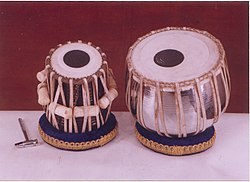
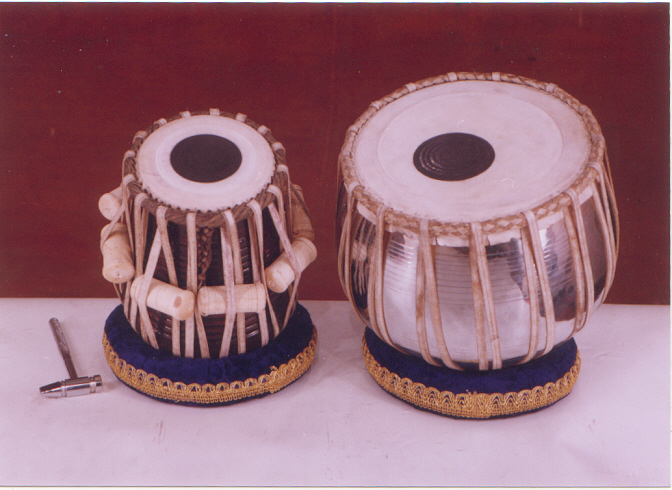
The tabla consists of two small drums of slightly different sizes and shapes.[4][12] Each drum is made of hollowed-out wood, clay, or metal. The smaller drum (dayan/tabla) is used for creating treble and tonal sounds, while the primary function of the larger drum (baya/dagga) is for producing bass. They are laced with hoops, thongs, and wooden dowels on its sides; the dowels and hoops are used to tighten the tension of the membranes for tuning the drums.[13]

The playing technique is complex and involves extensive use of the fingers and palms in various configurations to create a wide variety of different sounds and rhythms, reflected in mnemonic syllables (bol).

Origins

[edit]

Traditions

[edit]

According to legend, it was derived from the ancient barrel drum known as mridana, which the deity Krishna is said to have cut in half to create the tabla.[14] The history of the tabla is unclear, and there are multiple theories regarding its origins.[11][15] There are two groups of theories; the first theorizes the instrument had indigenous origins while the other traces its origins to the Muslim and Mughal invaders of the Indian subcontinent.[11] While the carvings in Bhaja Caves support the theory that the instrument had indigenous origins, clear pictorial evidence of the drum emerges only from about 1745, and the drum continued to develop in shape until the early 1800s.[16]

Indian origins

[edit]

The origin of tabla is traced back to an indigenous ancient civilization. The stone sculpture carvings in Bhaja Caves depict a woman playing a pair of drums, which some have claimed as evidence for the ancient origin of the tabla in India.[17][18][19] A different version of this theory states that the tabla acquired a new Arabic name during the Islamic rule, having evolved from ancient Indian puśkara drums. The evidence of the hand-held puśkara is found in many temple carvings, such as at the 6th and 7th century Muktesvara and Bhuvaneswara temples in India.[15][20][21] These arts show drummers who are sitting, with two or three separate small drums, with their palm and fingers in a position as if they are playing those drums.[20] However, it is not apparent in any of these ancient carvings that those drums were made of the same material and skin, or played the same music, as the modern tabla.[20]

The textual evidence for similar material and methods of construction as tabla comes from Sanskrit texts. The earliest discussion of tabla-like musical instrument building methods is found in the Hindu text Natyashastra. This text also includes descriptions of paste-patches (syahi) such as those found on a tabla.[20] The Natyashastra also discusses how to play these drums. The South Indian text Silappatikaram, likely composed in the early centuries of the 1st millennium CE, describes thirty types of drums along with many stringed and other instruments. These are, however, called pushkara; the name tabla appears in later periods.[22]

Muslim and Mughal origins

[edit]

This theory is based on the etymological links of the word tabla to the Arabic word tabl which means "drum". Beyond the root of the word, this proposal points to the documentary evidence that the Muslim armies had hundreds of soldiers on camels and horses carrying paired drums as they invaded the Indian subcontinent. They would beat these drums to scare the residents, the non-Muslim armies, their elephants and chariots, that they intended to attack. However, the war drums did not look or sound anything like tabla, they were large paired drums and were called naqqara (noise, chaos makers).[11]

Another version states that Amir Khusraw, a musician patronized by Sultan Alauddin Khalji invented the tabla when he cut an Awaj drum, which used to be hourglass-shaped, into two parts. However, no painting or sculpture or document dated to his period supports it with this evidence, nor was it found in the list of musical instruments that were written down by Muslim historians. For example, Abul Fazi included a long list of musical instruments in his Ain-i-akbari written in the time of the 16th-century Mughal Emperor Akbar, the generous patron of music. Abul Fazi's list makes no mention of tabla.[11]

The third version credits the invention of tabla to the 18th-century musician, with a similar-sounding name Amir Khusru, where he is suggested to have cut a Pakhawaj into two to create tabla. Miniature paintings of this era show instruments that sort of look like tabla. This theory implies that tabla emerged from within the Muslim community of Indian subcontinent and were not an Arabian import.[11][23] However, scholars such as Neil Sorrell and Ram Narayan state that this legend of cutting a pakhawaj drum into two to make tabla drums "cannot be given any credence".[13]

History

[edit]
200 BCE carvings at Buddhist Bhaja Caves, Maharashtra, India showing a woman playing a pair of drums and another dancer performing.[24]

Drums and Talas are mentioned in the Vedic era texts.[25][26] A percussion musical instrument with two or three small drums, held with strings, called Pushkara (also spelled Pushkala) were in existence in pre-5th century Indian subcontinent along with other drums such as the Mridang, but these are not called tabla then.[27] The pre-5th century paintings in the Ajanta Caves, for example, show a group of musicians playing small tabla-like upright seated drums, a kettle-shaped mridang drum and cymbals.[28] Similar artwork with seated musicians playing drums, but carved in stone, are found in the Ellora Caves,[29] and others.[30]

Some drums of central India that look like tabla, but do not have Syahi which creates the unique Tabla sound.

A type of small Indian drums, along with many other musical instruments, are also mentioned in Tibetan and Chinese memoirs written by Buddhist monks who visited the Indian subcontinent in the 1st millennium CE. The pushkala are called rdzogs pa (pronounced dzokpa) in Tibetan literature.[31] The pushkara drums are also mentioned in many ancient Jainism and Buddhism texts, such as Samavayasutra, Lalitavistara and Sutralamkara.[32]

Various Hindu and Jain temples, such as the Eklingji in Udaipur, Rajasthan show stone carvings of a person playing tabla-like small pair of drums. Small drums were popular during the Yadava rule (1210 to 1247) in the south, at the time when Sangita Ratnakara was written by Sarangadeva. Madhava Kandali, 14th century Assamese poet and writer of Saptakanda Ramayana, lists several instruments in his version of "Ramayana", such as tabal, jhajhar, dotara, vina, bīn, vipanchi, etc. (meaning that these instruments existed since his time in 14th century or earlier). There is recent iconography of the drum-like structure dating back to 1799.[33] There are Hindu temple carvings of double hand drums resembling the tabla that date back to 500 BCE.[34] The tabla was spread widely across ancient India. A Hoysaleshwara temple in Karnataka shows a carving of a woman playing a tabla in a dance performance.[35]

According to classifications of musical instruments defined in the Natyashastra, Tabla is classified in the Avanadha Vadya category of rhythm instruments which are made by capping an empty vessel with a stretched skin.[25]

Construction and features

[edit]

The tabla consists of two single-headed, barrel-shaped small drums of slightly different sizes and shapes: baya and daya for left and right drums, respectively.[4][12]

Ustad Zakir Hussain performing at Konark, Odisha. This illustrates the common sitting position used by tabla players.

The smaller drum, played with the dominant hand, is called dayan (literally "right" side), dāhina, siddha or chattū, but is correctly called the "tabla." It is made from a conical piece of mostly teak and rosewood hollowed out to approximately half of its total depth. The daya tabla is played by the musician's right hand (dominant hand), and is about 15 centimetres (~6 in) in diameter and 25 centimetres (~10 in) high. The drum is tuned to a specific note, usually either the tonic, dominant or subdominant of the soloist's key and thus complements the melody. This is the ground note of the raga called Sa (the tonic in Indian music).[4] The tuning range is limited, although different dāyāñs are produced in different sizes, each with a different range. Cylindrical wood blocks, termed Gatta, are inserted between the strap and the shell allowing tension to be adjusted by their vertical positioning. Fine-tuning is achieved while striking vertically on the braided portion of the head using a small, heavy hammer. While tabla usually features two drums, a tabla tarang may consist of 10-16 dayas to perform melodies based on several ragas.

The baya tabla is a bit bigger and kettledrum-shaped, about 20 centimetres (~8 in) in diameter and 25 centimetres (~10 in) in height. It played with the non-dominant hand, is called bāyāñ (literally "left") duggī or dhāmā (correctly called "dagga"), has a much deeper bass tone, much like its distant cousin, the kettle drum. The bāyāñs can be found to be made up of many different types of materials. Brass is the most common, copper is more expensive, but generally held to be the best, while aluminum and steel are often found in inexpensive models. Sometimes wood is used, especially in old bāyāñs from the Punjab. Clay is also used, although not favored for durability; these are generally found in the North-East region of Bengal. The baya construction and tuning is about a fifth to an octave below that of the daya drum. The musician uses their hand's heel pressure to change the pitch and tone colour of each drum during a performance.[4][13]

The head of each drum has a central area of "tuning paste" called the syahi (lit. "ink"; a.k.a. shāī or gāb). Syahi is common in many drums of Indian origin. This method allows these drums to produce harmonic overtones and is responsible for their unique sound.[36] Syahi is constructed using multiple layers of a paste made from starch (rice or wheat) mixed with a black powder of various origins. The precise construction and shaping of this area is responsible for the modification of the drum's natural overtones, resulting in the clarity of pitch (see inharmonicity) and variety of tonal possibilities unique to this instrument which has a bell-like sound. The skill required for the proper construction of this area is highly refined and is the main differentiating factor in the quality of a particular instrument. The earliest discussion of these paste-patches is found in the Hindu text Natyashastra.[37]

For stability while playing, each drum is positioned on a toroidal bundle called chutta or guddi, consisting of plant fiber or another malleable material wrapped in cloth. They are commonly played while sitting cross-legged on the floor.

Musical notation

[edit]
Keharwa Taal written in Vishnu Narayan Bhatkhande Notation. The bols are written in both Latin and Devanagari. The Matras (beat measure) are specified using numerals. 'X' indicates Sum (first beat) and 'O' serves as an indicator for Khaali.

Indian music is traditionally practice-oriented and until the 20th century did not employ written notations as the primary media of instruction, understanding, or transmission. The rules of Indian music and compositions themselves are taught from a guru to a shishya, in person. Thus oral notation for playing tabla strokes and compositions is very developed and exact. These are made up of onomatopoetic syllables and are known as bols.

Written notation is regarded as a matter of taste and is not standardized. Thus, there is no universal system of written notation for the rest of the world to study Indian music. The two popular systems for writing notations were created by Vishnu Digambar Paluskar and Vishnu Narayan Bhatkhande.[38][39] These notations are named after their respective creators. Both these systems have bols written down in a script such as Latin or Devanagari. The differences arise in the representation of various concepts of a compositions, such as Taali, Khaali, Sum (the first beat in a rhythmic cycle), and Khand (divisions). Another difference is the use of numerals in the Vishnu Narayan Bhatkande system to represent matras and beat measures, whereas more sophisticated symbols are used in the Vishnu Digambar Paluskar system to denote one matra, its fractions and combinations.[38]

Basic strokes

[edit]

Tabla's repertoire and techniques borrow many elements from Pakhavaj and Mridangam, which are played sideways using one's palms. The physical structure of these drums also share similar components: the smaller pakhavaj head for the dayan, the naqqara kettledrum for the bayan, and the flexible use of the bass of the dholak.[40] Tabla is played from the top and uses "finger tip and hand percussive" techniques allowing more complex movements.[41] The rich language of tabla is made up of permutations of some basic strokes. These basic strokes are divided into five major categories along with a few examples:[39][42]

  1. Bols played on the daya (right / treble drum)
    • Na: striking the edge of the syahi with the last two fingers of the right hand
    • Ta or Ra: striking sharply with the index finger against the rim while simultaneously applying gentle pressure to the edge of the syahi with the ring finger to suppress the fundamental vibration mode
    • Tin: placing the last two fingers of the right hand lightly against the syahi and striking on the border between the syahi and the maidan (resonant)
    • Te: striking the center of the syahi with the middle finger in Delhi gharana, or using middle, ring, and little fingers together in Varanasi style (non resonant)
    • Ti: striking the center of the syahi with the index finger (non resonant)
    • Tun: striking the center of the syahi with the index finger to excite the fundamental vibration mode (resonant)
    • TheRe: striking of syahi with palm
  2. Bols played on baya (left / bass drum)
    • Ghe: holding wrist down and arching the fingers over the syahi; the middle and ring-fingers then strike the maidan (resonant)
    • Ga: striking the index finger
    • Ka, Ke, or Kat: (on bayan) striking with the flat palm and fingers (non resonant)
  3. Bols played on both the drums on unison
    • Dha: combination of Na and (Ga or Ghe)
    • Dhin: combination of Tin and (Ga or Ghe)
  4. Bols played one after another in a successive manner
    • Ti Re Ki Ta
    • TaK = Ta + Ke
  5. Bols played as flam
    • Ghran: Ge immediately followed by Na
    • TriKe: Ti immediately followed by Ke and Te

Tabla Talas

[edit]

Tala defines the musical meter of a composition. It is characterized by groups of matras in a defined time cycle.[25] Talas are composed of basic elements, bols. Matra defines the number of beats within a rhythm. Talas can be of 3 to 108 matras. They are played in repeated cycles. The starting beat of each cycle is known as Sum. This beat is often represented by a special symbol such as 'X'. This is the most emphasized beat of the cycle. Other emphasized parts of the tala which are represented by Taali (clap), while Khali (empty) portions are played in a relaxed manner. They are represented by a 'O' in Vishnu Narayanan Bhatkhande notation. Tali is often marked by a numeral representing its beat measure. Separate sections or stanzas of a tala are called Vibhagas.

Three main types of tempos or layas are used in playing Tabla talas: 1) Slow (vilambit) or half speed, 2) Medium (madhya) or reference speed, and 3) Fast (drut) or double speed. Keeping these three tempos as reference, other variations of these tempos are also defined such as Aadi laya where bols are played at one and a half speed of medium tempo. Others such as Ati Ati drut laya stand for a very fast tempo.[39] Modern tabla players often use beats per minute measures as well.[43]

There are many talas in Hindustani music. Teental or Trital is one of the most popular tala played on Tabla. It has 16 beat measures or matras, and can be written down as 4 sections of 4 matras each. Teental can be played at both slow and fast speeds. Other talas such as Dhamaar, Ek, Jhoomra and Chau talas are better suited for slow and medium tempos. While some flourish at faster speeds, such as Jhap or Rupak talas. Some of the popular Talas in Hindustani Classical music include:

Name Beats Division Vibhag
Teental (or Trital or Tintal) 16 4+4+4+4 X 2 0 3
Jhoomra 14 3+4+3+4 X 2 0 3
Tilwada 16 4+4+4+4 x 2 0 3
Dhamar 14 5+2+3+4 X 2 0 3
Ektal and Chautal 12 2+2+2+2+2+2 X 0 2 0 3 4
Jhaptal (or Japtal) 10 2+3+2+3 X 2 0 3
Keherwa 8 4+4 X 0
Rupak (Mughlai/Roopak) 7 3+2+2 0 X 2
Dadra 6 3+3 X 0

Rare Hindustani talas

[edit]
Name Beats Division Vibhaga
Adachoutal 14 2+2+2+2+2+2+2 X 2 0 3 0 4 0
Brahmtal 28 2+2+2+2+2+2+2+2+2+2+2+2+2+2 X 0 2 3 0 4 5 6 0 7 8 9 10 0
Dipchandi 14 3+4+3+4 X 2 0 3
Shikar 17 6+6+2+3 X 0 3 4
Sultal 10 2+2+2+2+2 x 0 2 3 0
Teevra 7 3+2+2 x 2 3
Ussole e Fakhta 5 1+1+1+1+1 x 3
Farodast 14 3+4+3+4 X 2 0 3
Pancham Savari 15 3+4+4+4 x 2 0 3
Gaj Jhampa 15 5+5+5 x 2 0 3

Tabla Gharanas

[edit]

Tabla gharanas are responsible for the development of a variety of new bols, characteristic playing techniques, composition styles and rhythmic structures. Gharanas acted as a means of preserving these styles between generations of tabla players. The first recorded history of gharanas is in the early 18th century. Delhi gharana is considered to be the first and the oldest traditional tabla tradition. Its students were responsible for the spawn of other gharanas as well. Each of these gharanas includes a handful of prominent players and maestros. They carry the honorific title 'Pandit' and 'Ustad' for Hindu and Muslim tabla players, respectively. Modernization and accessible means of travel have reduced the rigid boundaries between these gharanas in recent times.[39][25]

The different Gharanas in Tabla

[edit]

Kayda

[edit]

A Kayda or Kaida is a type of Tabla composition. There are two major types of tabla compositions, fixed (pre-composed) and improvised (composed and improvised at the time of practicing or performing). A rhythmic seed (theme) is introduced, which is then used as a basis for elaboration through improvisation and/or composition. The word Kayda is an Arabic or Hindi word which means 'rule' or 'a system of rules'.[44][45] The rules for playing a kayda are complex, but in short, one must only use the bols that are in the original theme. This original theme is known as a Mukh. The kayda form originated in the Delhi Gharana of tabla playing and serves three fundamental and very important roles for tabla players.[46] The Dayan (right side tabla - also known as Dagga) and Bayan (Left side tabla - just known as Tabla) of the Tabla are used in synchronization to form a Kayda. Kaydas can be played in any Tala. But in most of the concerts, Teental and their Kaydas are played very often. Note that in talas like Dadra and Keherwa or in thekas like Bhajani, laggis are played, kaydas are not played. The reason for this is that these talas/thekas mentioned in the previous line are specifically played for Semi-Classical and light music (Bhajans, Kirtans, Thumris, etc.) and not for Hindustani classical music. Different Gharanas have their own Kaydas.

Basic structure of a kayda:

  1. Mukh - Basic bol which is called as Mukh that means face of the particular Kayda.[47] The kayda's bols are structured out of the Mukh.
  2. Dohara - Dohara is the repetition of the Mukh 3 times. Dohara means to repeat. In Hindi it is called Doharana that means to repeat.[48]
  3. Adha Dohara - Adha Dohara is the repetition of the first bol of the Mukh.
  4. Vishram - Vishram means taking rest.[49] As the name suggests, a minute of pause is taken from the bol.
  5. Adha Vishram - Adha Vishram is the repetition of taking a pause i.e. repetition of the bol that was repeated in Vishram.
  6. Palta - Palta is a variation of various bols, but these bols are stuck or are only from the bols which are there in the Mukh. This Palta is a section of the whole Kayda.[50][51] Now what it means that Palta is a section. It means that like Mukh, Dohara, Adha Dohara, Vishram, Adha Vishram, these 4 names are not or cannot be repeated. So there is no duplication of all the 4 names taken. So all of the 4 names taken above are played only once. But a Palta, as said it is a section. joining various bols many such Palte (plural form of Palta) can be created.
  7. Tihai - The musical phrase sung or played thrice to arrive at the Sam/Sum is called a Tithai. It is the last part of a Kayda. The Mukh's last part is played thrice i.e. 3 times and then the particular Kayda is ended.[52]

Just like Kaydas, there are Relas and Ravs (or Raus).

Famous players

[edit]

See also

[edit]

Notes

[edit]

References

[edit]

Further reading

[edit]
[edit]
Revisions and contributorsEdit on WikipediaRead on Wikipedia
from Grokipedia
The tabla is a pair of hand-played drums central to of the , consisting of the smaller wooden right-hand drum known as the dayan (or tabla proper) and the larger left-hand drum called the bayan (or duggi), both producing distinct pitched tones through specialized striking techniques. The name 'tabla' derives from the word 'tabl', meaning drum. Constructed from hollow cylindrical shells—typically wood for the dayan (about 5.5 inches in diameter) and metal or wood for the bulbous bayan—each features a goatskin head tensioned by interlaced straps and wooden blocks for tuning, with a central black paste (syahi) of and that enables resonant overtones and effects when struck. The origins of the tabla are unclear, but its modern form is believed to have developed in the in northern , evolving from ancient barrel drums like the pakhawaj and rooted in a rhythmic tradition traceable to Vedic texts around 1500 BCE. Played seated with bare hands using finger, palm, and heel strikes to produce mnemonic syllables (bols) such as ta, tun, or ge, the tabla supports intricate improvisations in tala (rhythmic cycles) and accompanies vocalists, instrumentalists, and dancers in classical, semi-classical, and fusion genres, while also performing solos that highlight virtuosic speed and techniques. Its global prominence has grown since the late 20 century through masters like Ustad Alla Rakha and his son Zakir Hussain, influencing , rock, and , yet it remains a cornerstone of oral transmission in North Indian gharanas (schools) such as , , and Banaras, each emphasizing unique stylistic variations.

Origins and History

Traditional Accounts

One prominent attributes the invention of the tabla to the 13th-century poet and musician , a of the , who is said to have split the larger pakhawaj drum into two separate pieces to create a more portable instrument suitable for accompanying vocal performances. According to this legend, Khusrau, frustrated during a musical duel or seeking innovation, divided the barrel-shaped pakhawaj lengthwise, resulting in the bass-oriented bayan and the higher-pitched dayan that form the modern tabla pair. This narrative emphasizes the tabla's emergence as a practical adaptation for the dynamic needs of medieval Indian music, blending creativity with necessity. In Hindu traditions, the tabla is often connected to ancient percussive roots described in texts like the , an foundational treatise on attributed to Bharata Muni around the 2nd century BCE to 2nd century CE, which details drum-like instruments used in ritualistic and theatrical contexts. These accounts portray the tabla's precursors, such as the or pakhawaj, as integral to temple rituals and devotional music, symbolizing cosmic rhythms (tala) that accompany dances and chants in honor of deities like , the lord of dance. Folklore in these traditions views the tabla not as a new creation but as an evolution of sacred drums invoked in Vedic hymns and epic narratives, fostering spiritual harmony through rhythmic cycles that mirror the universe's pulse. Muslim legends, particularly those tied to the Mughal era, describe the tabla's development as an innovation for lighter, more versatile accompaniment in courtly settings, such as recitals and semi-classical forms like khayal. One such tale recounts an 18th-century dispute between pakhawaj players at the court of Emperor , where the losing musician angrily halved his drum, inadvertently birthing the tabla's dual structure for easier transport and play during elegant soirées. These stories highlight the instrument's role in blending rhythmic precision with poetic expression, adapting heavier ancient drums to the refined aesthetics of Indo-Persian cultural patronage. Debates in medieval underscore the tabla's syncretic origins, weaving Indian indigenous percussion with Persian influences introduced through invasions and cultural exchanges, such as the Arabic-derived term "tabl" for and rhythmic patterns from Central Asian traditions. Oral narratives from this period portray the tabla as a product of harmonious fusion, where Hindu drums encountered Persian war drums and courtly beats, evolving into a symbol of shared heritage in the subcontinent's diverse musical landscape. This interplay reflects broader medieval dynamics of cultural synthesis, without a single definitive inventor but through collective innovation.

Historical Development

The origins of the tabla can be traced to ancient percussion instruments like the and pakhawaj, which have roots in the around 1500 BCE, where drums such as the dundubhi were used in rituals and sacrifices as described in texts like the Atharva Veda. The earliest known reference to a tablalike instrument appears in a 2nd-century BCE carving at the in , depicting two women playing a pair of drums, though scholars debate whether this represents the modern tabla or a precursor. These barrel-shaped drums evolved into formalized forms by the time of the Natyasastra (circa 200 BCE–200 CE), which dedicates a chapter to the as a central courtly instrument symbolizing , kingship, and rhythmic structure in performances. The pakhawaj, a northern variant of the , maintained this continuity through the medieval period, serving as a precursor to the tabla with shared techniques and barrel construction. During the 16th to 18th centuries, Mughal patronage significantly advanced the tabla's development, with the instrument emerging as a distinct pair of drums likely derived from splitting the pakhawaj to suit lighter, more versatile in court music. Earliest pictorial evidence dates to around 1745, and by the reign of Emperor (1719–1748), the tabla gained prominence in courts, where musicians like Sudhar Khan Dharhi established lineages that spread to regional centers such as in the 1760s–1770s amid economic and political shifts. This era marked the tabla's widespread adoption in , transitioning from the heavier pakhawaj in forms to for emerging and instrumental styles. In the 19th and 20th centuries, the tabla underwent standardization through the formalization of gharana systems around 1900 and documentation by colonial-era scholars, solidifying its design with a smaller right drum (dayan) and larger left drum (bayan) by the early 1800s. By the late 19th century, it had become the primary percussion instrument for khyal and solo performances, replacing the pakhawaj and dholak in most contexts. Following India's independence in , the tabla expanded into film music, integrating rhythmic cycles from classical traditions into Bollywood soundtracks and broadening its cultural reach. Globally, artists like Ustad Alla Rakha (1919–2000) played a pivotal role in dissemination through collaborations with , introducing the tabla to Western audiences via concerts and recordings from the onward.

Design and Construction

Components and Materials

The tabla is a paired percussion instrument consisting of two distinct hand drums: the smaller, right-hand drum known as the dayan (also called tabla proper), which produces treble and melodic tones, and the larger, left-hand drum called the bayan (or dugga), responsible for bass sounds. The dayan is crafted from a single block of seasoned hardwood, hollowed out to create a conical or slightly tapered cylindrical body, typically measuring about 10 to 12 inches (25 to 30 cm) in height with a drumhead diameter of approximately 5 to 6 inches (13 to 15 cm). Common woods include sheesham (Dalbergia sissoo, or Indian rosewood), teak (Tectona grandis), or mahogany, selected for their density and resonance, which contribute to the drum's clear, tunable pitch. In contrast, the bayan features a broader, more bulbous body made from metal to enhance its deep, resonant bass, with dimensions similar in height to the dayan but a of roughly 9 to 10 inches (23 to 25 cm). Traditional and modern bayan shells are commonly constructed from , often with a or for corrosion resistance and tonal consistency, though variations include for warmer tones or for affordability. Historically, both drums were wooden, but the shift to metal for the bayan began in the due to material availability and acoustic preferences. Regional differences appear in material choices, such as aluminum alloys in some contemporary sets for reduced weight or clay in rare traditional variants. Both drums share similar head construction, utilizing multi-layered goat skin (Capra hircus) stretched taut over the open top. The head comprises an inner primary layer (puri) for the main playing surface, overlaid by an outer annular ring (keenar) that provides structural support and edge resonance, all secured by a complex system of leather lacing or braided straps encircling the underside. A critical element is the syahi, a permanent black circular patch applied to the center of each head, made from a paste of fine iron filings (or powder) mixed with boiled rice or wheat flour, water, and sometimes natural glue, built up in successive thin layers and dried to alter vibration patterns. This application, unique to each drum's size and role, significantly influences tonal quality. Cow skin is occasionally substituted in some regions for durability, though goat skin remains predominant for its flexibility. Essential accessories for the tabla include a tuning , typically forged from or weighing around 300 to 440 grams, with a hooked end for adjusting tension by striking wooden dowels (gatta) inserted between the lacing straps and the drum body. These hammers allow precise pitch control without damaging the skin. Leather straps, often 30 to 33 feet long and treated for strength, form the tensioning system, while protective or covers shield the heads from dust and moisture, and cushioned mats prevent slippage during performance. Modern sets may incorporate synthetic alternatives for straps or covers to enhance portability, reflecting adaptations in global manufacturing.

Tuning and Acoustics

The tuning of the tabla involves adjusting the tension of the drumheads to achieve desired pitches relative to the tonic (sa) of the accompanying , primarily using a specialized to strike the wooden blocks (gatta) wedged between the cylindrical rim (gajara) and the leather straps (tasma). This process tightens or loosens the unevenly around its perimeter, allowing precise control over the pitch produced by key strokes like "na" on the dayan, which is prioritized for alignment with the raga's scale degrees. The syahi—a central or eccentric paste of , , and gum—is initially applied and shaped during construction to optimize mass distribution, but fine adjustments during tuning ensure its cracks and density contribute to stability without further repositioning. Acoustically, the syahi's mass loading on the lowers the frequencies of specific modes, creating a composite structure that generates a rich series of overtones approximating harmonics, particularly on the dayan where the central syahi enables a definite pitch. On the bayan, the eccentric syahi and enclosed air cavity produce an indefinite pitch characterized by subharmonic content and bassy , enhancing rhythmic depth through non-harmonic low-frequency modes influenced by air loading, which reduces overall mode frequencies while the cavity stiffens axisymmetric s. Typically, the dayan's fundamental pitch is set to the middle octave's Pa ( above sa) or Ma ( above sa), around 300–400 Hz depending on the performer's range, while the bayan resonates at suboctave levels to complement these tones. Maintenance of tuning stability requires periodic head replacement when the membrane wears thin or cracks from repeated striking, a process that entails removing the old skin, relacing a new pre-fitted pudi (head) with tasma over the shell and rim, and re-tensioning with the while moistening the edge for pliability. Environmental factors significantly impact tuning: high causes syahi particles to bind, dulling and requiring polishing with a stone to restore flexibility, while fluctuations can split the head or alter tension, necessitating adjustments before performances to maintain pitch accuracy.

Performance Techniques

Basic Strokes

The basic strokes of the tabla, known as bols, form the foundational vocabulary for producing distinct sounds on the two drums: the right-hand dayan (treble drum) and the left-hand bayan (bass drum). These strokes involve precise finger and palm techniques to generate a range of pitches and timbres, essential for rhythmic expression in . On the dayan, the primary resonant stroke is tun (or too), executed by striking the center of the syahi (black paste spot) with the index finger while keeping the hand relaxed to allow the skin to vibrate freely, producing a clear, ringing tone. The na stroke is a non-resonant sound created by striking the edge of the syahi with the middle and ring fingers, often with the index finger lightly damping the center to mute the resonance. For te, the index finger along with the second, third, and fourth fingers strike flat on the syahi (black spot) to produce a sharp, staccato non-resonant tone, with fingers briefly damping the resonance. A variation, tin, involves a softer index finger strike at the border between the syahi and the surrounding maidan (open skin), with the middle and ring fingers lightly touching the syahi for a resonant, treble-like pitch. The bayan emphasizes bass resonance through pressure and broader hand contact. The ghe (or ge) stroke is produced by a hammer-like motion of the or the base of the palm onto the syahi, with the slightly relaxed to allow deep , creating a low, tone. In contrast, ke (or ka) is a closed slap using the flat palm or fingers against the drumhead on the bayan, damping the sound immediately for a muted, percussive effect. Composite strokes combine actions from both hands for integrated rhythms. The dha bol is formed by simultaneously playing ta or na on the dayan with ga or ghe on the bayan, where the right hand focuses on the syahi for pitch while the left applies pressure to enhance the bass depth. Similarly, dhin pairs tin on the dayan with ghe on the bayan, emphasizing resonance through coordinated rebound of the hands. Hand positions are critical for control and tone quality. For the dayan, the right hand is held with the wrist low and fingers arched over the syahi, allowing the index finger to strike precisely while the other fingers provide damping or support. On the bayan, the left hand uses a cupped position with the palm facing down, applying variable pressure to modulate pitch, as greater force lowers the bass note. Tabla sounds are broadly classified by resonance: open or resonant bols like ta, tin, and na allow vibration for sustained tones; closed bols such as ke and ghe produce damped, abrupt sounds; and resonant composites like na (in certain executions) emphasize depth through undamped vibration. For beginners, practice begins with simple sequences in (a 16-beat cycle), such as the basic theka pattern: Dha (1), Dhin (2), Dhin (3), Dha (4), Dha (5), Dhin (6), Dhin (7), Dha (8), Dha (9), Tin (10), Tin (11), Ta (12), Ta (13), Dhin (14), Dhin (15), Dha (16), recited and played slowly to build finger independence and even . This sequence reinforces coordination without introducing complexity, progressing from vocal recitation to drum execution.
BolDrumTechniqueSound Type
TunDayanIndex finger on syahi centerResonant, ringing
NaDayanMiddle/ring fingers on syahi edgeNon-resonant, muted
TeDayanFingers flat on syahiClosed, sharp
GheBayanFingertips/palm hammer on syahiResonant bass
DhaBothNa/Ta + Ghe/Ga simultaneousComposite resonant

Notation and Pedagogy

Tabla notation primarily relies on onomatopoeic syllables known as bols, which mimic the sounds produced by individual strokes on the drums, such as ta for a resonant right-hand stroke or na for a damped right-hand stroke on the edge of the syahi. These bols are typically transcribed in Roman script for accessibility in Western contexts or in Devanagari script in traditional Indian texts, allowing performers to vocalize rhythms before playing them. To denote rhythmic structure, notation systems incorporate symbols for matras (individual beats), often marked with numbers or vertical lines to indicate divisions within a cycle, while vibhags (sectional divisions) are represented by dashed or specialized barlines that highlight accents without disrupting the overall flow. Hybrid approaches, such as the Universal Indian Drum Notation (UIDN), combine these bols with a simplified two-line staff borrowed from Western systems to specify hand positions and timings, facilitating transcription of complex patterns. Pedagogical approaches to tabla emphasize the guru-shishya parampara, a traditional oral where knowledge is passed directly from to through , repetition, and , fostering a deep intuitive understanding of without reliance on written materials. In this method, students absorb bols and patterns aurally, often in intensive one-on-one sessions that build and emotional connection to the music, reflecting the holistic and ritualistic nature of Hindustani training. This orality, categorized as complete or partial depending on the stage of learning, uses formulaic phrases as mnemonic devices to retain vast repertoires, ensuring cultural continuity while adapting to individual aptitude. Learning progresses hierarchically, beginning with basic thekas—fixed rhythmic cycles recited and played to internalize beat divisions—before advancing to more elaborate forms like kaydas (thematic variations on a core motif) and relas (rapid, flowing improvisations that expand on thekas through sequential elaborations). Mnemonic aids, such as vocalizing bols in sequence or using visual diagrams to map hand positions, reinforce this progression, helping students transition from rote repetition to creative application. Modern supplements include instructional books like Learning the Tabla by David Courtney, which provides structured exercises with audio examples to bridge oral and written learning, and rhythm training apps such as Rhythm with Tabla & Tanpura, which offer adjustable tempos for practicing thekas and variations independently. Notating tabla's improvisation-heavy nature presents significant challenges, as the tradition prioritizes spontaneous variation over fixed scores, making comprehensive documentation difficult without losing the performative nuance of real-time creativity. Forms like relas involve extensive thematic expansions that resist linear transcription, often requiring hybrid notations to capture cadential figures (tihais) or groupings, yet these systems remain limited in conveying the full improvisational freedom emphasized in oral . This aural emphasis excludes learners outside the guru-shishya framework, prompting transitional tools like software notations to democratize access while preserving the tradition's improvisatory essence.

Rhythmic Elements

Tala Cycles

In , tala refers to a repeating rhythmic cycle that structures the timing of a , consisting of a fixed number of beats known as matras, which are grouped into sections called vibhags. These vibhags are emphasized through hand gestures: claps (tali) mark the stressed beats, while waves (khali) indicate the unstressed or open sections, creating a clear framework for rhythmic and among performers. The cycle repeats from the first beat, called sam, ensuring continuity and providing a temporal anchor for the music. Among the common talas used in tabla accompaniment, Teentaal stands out as the most versatile and frequently employed, featuring 16 matras divided into four vibhags of 4 beats each (4+4+4+4), with tali on the 1st, 5th, and 13th beats and khali on the 9th. Its basic theka pattern, formed by fundamental tabla strokes such as Dha, Dhin, Tin, Ta, and Na, is: Dha Dhin Dhin Dha | Dha Dhin Dhin Dha | Dha Tin Tin Ta | Ta Dhin Dhin Dha. , another prevalent tala, comprises 10 matras in four vibhags (2+3+2+3), with tali on the 1st, 6th, and 8th beats and khali on the 3rd. The standard theka for is: Dhin Na | Dhin Dhin Na | Tin Na | Dhin Dhin Na. Ektal, with 12 matras across six vibhags of 2 beats each (2+2+2+2+2+2), includes tali on the 1st, 5th, 9th, and 11th beats and khali on the 3rd and 7th. Its theka pattern reads: Dhin Dhin | Dha Ge Ti Ra Ki Ta | Tu Na | Ka Ti Ta | Dhin Dhin | Dha Ge Ti Ra Ki Ta. In tabla accompaniment, tala cycles serve as the rhythmic foundation, enabling the percussionist to align precisely with melodic instruments like the , maintaining the cycle's integrity while allowing subtle variations to enhance the overall flow. The tabla player renders the theka to delineate the tala's structure, ensuring synchronization and providing a steady that supports without disrupting the melodic line. Less common talas, such as Chautal with its 14 matras divided into seven vibhags of 2 beats each (2+2+2+2+2+2+2), feature four tali (on beats 1, 5, 9, and 13) and two khali (on beats 3 and 7), often used in dhrupad-style performances. A brief theka example for Chautal is: Dha Ge | Na Ti Na | Ke Dha | Ti Na Ke | Dha Ge | Na Ti Na | Ke Ta.

Kayda and Compositions

In tabla music, kayda represents a core compositional form employed primarily in solo performances, where a fixed thematic serves as the foundation for rhythmic exploration and . The kayda typically unfolds within tintal, a 16-beat tala cycle, beginning with the palla or theme, which occupies the first half of the cycle and aligns with the tali (emphasized beats) for rhythmic stability. This theme is then expanded through elaborations known as tans, which introduce variations by manipulating bol patterns while preserving the tala's cyclic integrity, allowing performers to demonstrate fluency and innovation. The purpose of kayda lies in cultivating technical proficiency and creative expression, enabling tabla players to transcend the instrument's accompaniment function—where it supports vocal or melodic lines—toward intricate solo expositions that highlight speed, precision, and musical depth. Unlike simpler theka patterns, kayda encourages performers to weave personal interpretations into the form, fostering a balance between adherence to tradition and spontaneous development during extended improvisations. Kaydas are categorized into simple and complex types based on their scope and elaboration. Simple kaydas, often spanning 2-4 avartans (full tala cycles), consist of straightforward variations on the theme, such as repeating and slightly altering the palla to build familiarity and control. Complex kaydas, by contrast, integrate relas—rapid, continuous bol sequences for —and tihais—tripled phrases culminating on the sam (first beat) for dramatic closure—to heighten emphasis and virtuosity. For instance, a basic kayda theme in tintal might employ bols like "dha ti dhagi na dha tirakita dha ti dhage tin na ki na," with the first portion fitting the tali structure and the second mirroring it in the khali (unclapped) section, allowing subsequent tans to accelerate or fragment these elements.

Gharanas and Styles

Major Gharanas

The major gharanas of tabla represent distinct lineages that emerged in the 18th and 19th centuries, each shaped by their founders' innovations and regional influences, forming the core stylistic frameworks for tabla performance in . These schools, primarily , , Ajrada, , Benares, and , trace their roots to early tabla practitioners who adapted techniques from pakhawaj and regional traditions, emphasizing unique approaches to , composition, and articulation. The , the oldest and foundational school, was established in the early by Ustad Siddhar Khan Dhadi, a from the Dhadi known for singing with percussion. Originating in , it prioritizes clarity in bols (syllabic strokes) and precision in executing complex rhythmic patterns, with a repertoire rich in kaydas and relas that form the basis for . This gharana's style features light, controlled strokes and avoids excessive force, influencing nearly all subsequent schools as the progenitor of tabla's systematic development. The Lucknow gharana, also called the Purab or Khula baj style, developed in Lucknow when Ustad Modu Khan and his brother Ustad Bakshu Khan—nephews of Siddhar Khan—migrated from Delhi in the mid-18th century, adapting tabla to accompany Kathak dance in the nawabi courts. Known for its lighter, more melodic and flowing approach, it emphasizes the peshkar as a central composition, with open-handed (khula) techniques that produce resonant tones and subtle dynamics. This gharana's aesthetic integrates grace and expressiveness, distinguishing it through fluid transitions and a dance-like rhythmicity. Emerging as an offshoot of the tradition in the late , the Ajrada gharana originated in the village of Ajrada near , , founded by brothers Kallu Khan and Miru Khan, who were disciples of the Delhi maestro Sitab Khan. It focuses on intricate rhythmic constructions and the use of firatang patterns—rapid, interlocking strokes that create dense polyrhythms—along with aad laya quidas for layered . The style retains Delhi's precision but amplifies complexity through bold, syncopated variations. The gharana took shape in around the late , founded by Haji Vilayat Ali Khan, a disciple of Modu Khan who relocated from after extensive training. This school blends robust power with nuanced subtlety, featuring gats—energetic, composition-based pieces—and a balanced use of force in strokes to achieve dynamic contrasts. Its repertoire draws from 's openness while incorporating broader tonal depth, making it versatile for both solo and accompaniment roles. In (Benares), the Benares gharana was founded in the early by Pandit Ram Sahai (1780–1826), who studied under Modu Khan before returning to his hometown to refine a powerful, crisp style. It highlights baant (rhythmic divisions) and laggi ladi (fast chases), excelling in rapid teen-tala renditions with clear, forceful articulation that evokes pakhawaj influences. This gharana's emphasis on speed and intensity sets it apart within the eastern (Purbi) baj category. The , rooted in the region, traces its origins to Lala Bhavani Das, a pakhawaj player who adapted those techniques to tabla in the , though some accounts credit Miyan Qadir Baksh as a key early figure. It incorporates jodi-style playing—mimicking pakhawaj's dual-drum resonance—and maintains an independent, vigorous approach with influences from both and eastern traditions. The style is marked by bold, expansive rhythms suited to the region's folk and martial music contexts.

Stylistic Variations

The tabla gharanas exhibit distinct technical approaches in their execution of kayda, with the emphasizing precision through a refined "two-finger" technique that produces clear, melodic articulations, while the favors fluidity via full-hand strokes and crisp relas for a more graceful, sonorous flow. This contrast highlights Delhi's focus on nimble, controlled development of themes, contrasting Lucknow's bolder integration of open sounds influenced by dance elements. Repertoire variations further delineate these schools, as seen in the Ajrada gharana's preference for tisra jati compositions—rhythmic groupings in multiples of three—and extended kaydas often featuring unique aralay divisions like 3:1 or 6:1 ratios, which introduce complexity beyond standard talas. In comparison, the gharana incorporates dance-derived rhythms through its emphasis on gats, tukras, and chalans, blending resonant purbi baj techniques with versatile structures that adapt to both solo and accompaniment contexts. Philosophically, gharanas differ in stroke articulation philosophies, with closed (gupt) styles—prevalent in traditions—prioritizing subtle, finger-based precision to evoke melodic introspection, whereas open (prakaash) approaches in and lineages stress palm-heavy thaap for expansive, resonant expression that enhances rhythmic drama. These orientations reflect broader aesthetic priorities: Delhi's restraint for purity versus the eastern schools' emphasis on sonic breadth and cultural fusion. In modern practice, cross-gharana influences have proliferated, with performers increasingly blending Delhi's clarity with Lucknow's expressiveness or Ajrada's intricate jatis into hybrid repertoires, fostering a more fluid, eclectic tabla tradition that transcends rigid lineages. This evolution is evident in contemporary compositions that draw from multiple baj styles, promoting innovation while preserving core techniques.

Adaptations and Influence

Carnatic Variations

In South Indian , the tabla is integrated into percussion ensembles, particularly within the tala vadya katcheri format, where multiple percussion instruments engage in rhythmic dialogues. This adaptation allows tabla players to participate in Carnatic performances by employing similar bols (syllabic strokes) but adjusting them to align with Carnatic rhythmic cycles, such as the eight-beat adi tala, which differs from the more flexible structures common in Hindustani music. To suit the subtler tonal palette of Carnatic aesthetics, tabla players often modify their technique, producing softer tones on the bayan (left drum) to emulate the mridangam's resonant warmth rather than the tabla's sharper projection. There is also a pronounced emphasis on korvai, intricate concluding rhythmic phrases that build tension and resolve in sync with the ensemble, highlighting the tabla's role in enhancing Carnatic improvisations like the tani avartanam (percussion solo). These changes reflect a deliberate cross-cultural synthesis, enabling the tabla to complement instruments such as the or without overpowering the melodic elements. The historical adoption of the tabla in Carnatic contexts gained momentum in the , influenced by interactions such as recordings with mridangam maestro Palghat Mani Iyer and collaborations with other Carnatic percussionists by tabla virtuosos such as Zakir Hussain. These exchanges bridged North-South divides and popularized tabla elements within South Indian concerts, particularly in urban centers like . Mani Iyer himself praised Zakir Hussain for incorporating mridangam-style nuances, fostering a reciprocal influence that expanded the tabla's application in Carnatic settings. Adapting the tabla to presents challenges, primarily due to the divergence between the Carnatic sapta tala system—comprising seven fundamental talas derived from five jatis (rhythmic groupings)—and the Hindustani ang, which emphasizes archaic bols and slower, more expansive cycles rooted in vocal traditions. Tabla players must recalibrate their phrasing and shifts to accommodate Carnatic's precise kalapramanam ( modulation), often requiring years of specialized to maintain idiomatic authenticity while preserving the instrument's core techniques.

Global and Modern Impact

The tabla's global dissemination has been propelled by the and participation in international music festivals, fostering cross-cultural exchanges that integrate its intricate rhythms into diverse genres. Indian communities in , , and beyond have established performance spaces and events, such as the annual Festival of Tabla in , which draws performers and audiences worldwide to showcase classical and fusion styles. This spread has notably influenced Western music, particularly through collaborations like that between tabla maestro Zakir Hussain (1951–2024) and drummer , whose 1991 album Planet Drum—featuring tabla alongside global percussion—won the first Grammy for Best Album and introduced Indian rhythmic cycles to and rock audiences. In contemporary fusions, the tabla has blended with traditions, creating hybrid performances that merge its bol patterns with Spanish footwork and rhythms, as exemplified in collaborative works by artists like . Modern adaptations have further expanded its reach, with electronic versions such as the Keda Tabla Touch providing MIDI-compatible interfaces for authentic tabla tones in digital production, allowing integration into electronic and scores without traditional setup constraints. Mobile applications like Tabla Pro simulate realistic tabla playing, enabling users to practice taals and compose on smartphones or tablets, thus democratizing access for global learners. Hybrid instruments, including the REMO Tablatone—a frame drum variant with tabla-inspired heads—offer versatile options for fusion ensembles across genres. The tabla's cultural impact extends to its prominent role in Bollywood soundtracks, where it underpins rhythmic layers in contemporary compositions by artists like A.R. Rahman, enhancing the emotional depth of films and popularizing complex talas among mass audiences. This integration has amplified its presence in global pop culture, with tabla covers of Bollywood hits gaining viral traction on digital platforms. On the international stage, the instrument received indirect UNESCO recognition through Varanasi's designation as a UNESCO City of Music in 2015, honoring the Benares gharana's contributions to Hindustani traditions. Learning resources have proliferated since the 1970s, when pioneers like Zakir Hussain began performing and influencing curricula in U.S. institutions; today, Western conservatories such as those affiliated with universities offer formal tabla courses, complemented by online platforms like iPassio and Tabla Works that provide structured lessons for beginners to advanced players worldwide.

Notable Performers

Historical Masters

Pandit Ram Sahai (1780–1826) is widely recognized as the founder of the Benares gharana of tabla, establishing a distinct style during his time in after training under Modu Khan of the for twelve years. His innovations laid the groundwork for systematic tabla solos, introducing structured compositions such as kaidas, relas, and parans that emphasized a narrative progression from introduction (bhumika) to thematic development and conclusion, often centered on Teentaal. Sahai's approach prioritized powerful, resonant strokes like full-hand te-te and fast-paced tukdas, moving beyond accompaniment to elevate tabla as a solo instrument capable of intricate . He composed numerous parans, including thematic ones like Durga Paran and Krishna Paran, which incorporated vocal-like elements and were performed in courts such as that of Nawab Wazir Ali Khan in . Among his key disciples were Janaki Sahay, Ramsharan, Bhairo Sahay, Bhagatji, and Partappu, whose lineages extended to later masters like and Pandit Anokhe Lal Mishra. Ustad Modu Khan (c. 1770–early 19th century), a pioneer of the alongside his brother Bakshu Khan, migrated from to at the invitation of the and significantly advanced the development of kayda compositions. As nephews of Sidhar Khan, they adapted the Delhi style to create the Purab baj, emphasizing clarity in bol articulation, crisp relas, and full-hand tha strokes, with kaydas serving as foundational themes for elaboration in solos. Modu Khan's emphasis on kayda development structured tabla performances around thematic variations, integrating rhythmic complexity with melodic phrasing drawn from pakhawaj traditions, which became hallmarks of the gharana's repertoire. His disciples propagated this style through court performances in , influencing subsequent generations and solidifying kayda as a core element of Hindustani percussion. Ustad Allah Rakha (1919–2000), a leading figure of the , played a pivotal role in popularizing tabla on a global scale through extensive tours and collaborations, particularly with from 1965 to 1985, which introduced the instrument to Western audiences in the United States and during the 1960s and 1970s. As a staff artist at since 1936—starting in and later in and Bombay—he secured regular solo broadcasts, twice weekly in the 1930s, helping to establish tabla's prominence in broadcast media and classical concerts. Rakha mentored numerous disciples, most notably his son Ustad Zakir Hussain, to whom he imparted the 's techniques from age five, as well as others like Yogesh Samsi and , fostering a legacy of rigorous training in laya and bols. His contributions include pioneering recordings that captured tabla solos and jugalbandis, preserving intricate compositions on tapes and vinyl for future generations, and earning accolades such as the in 1977 and the in 1982.

Contemporary Artists

Ustad Zakir Hussain (1951–2024), widely regarded as one of the most influential tabla virtuosos of the , revolutionized the instrument's global presence through innovative fusions and masterful performances. He won four , including three at the in 2024 for Best Global Music Performance (""), Best Global Music Album (This Moment), and Best Contemporary Instrumental Album (As We Speak), highlighting his ability to bridge Indian classical traditions with international genres. Hussain's collaborations with Western artists, such as cellist in the Ensemble and guitarist John McLaughlin in the band , showcased the tabla's rhythmic complexity in cross-cultural contexts, earning him acclaim for elevating percussion from accompaniment to a lead voice. His work extended to over 200 recordings and compositions that integrated , , and Western classical elements, influencing generations of musicians worldwide. Pandit Anindo Chatterjee (b. 1954), a leading exponent of the Farukhabad gharana, is renowned for his intricate tabla solos that emphasize precision, speed, and melodic depth. Trained under Pandit Jnan Prakash Ghosh for over three decades in the gurukul tradition, Chatterjee became All India Radio's youngest artist at age five and has accompanied luminaries like Pandit Nikhil Banerjee on sitar. His solo performances, such as those at the Darbar Festival in 2006 and 2024, demonstrate a gharana-blending style that balances traditional compositions with improvisational freedom, captivating audiences with breathtaking clarity of stroke and rhythmic innovation. As a teacher and researcher, Chatterjee has also contributed to tabla craftsmanship and preservation, mentoring disciples including his son Anubrata Chatterjee, ensuring the evolution of the instrument's technical and expressive potential. Pandit Suresh Talwalkar (b. 1948), affectionately known as Taalyogi, has made significant contributions to tabla through his pioneering educational methods and ensemble innovations. Awarded the in 2013 and the in 2004, Talwalkar introduced group workshops in 1973 to foster collaborative learning, complementing traditional one-on-one instruction. He founded the Taalyogi Ashram and Avartan Gurukul in and , where he trains students in "layakaari" (rhythmic elaboration) and creative improvisation, emphasizing the transformation of performers into appreciative rasikas (connoisseurs). Talwalkar's "Taal Yatra" ensemble, devised in 1994, integrates tabla with dance, melody, and vocals in complex rhythmic formats like Taal Mala, expanding the instrument's role in contemporary Indian classical presentations. In the 2010s, women tabla players like Anuradha Pal have increasingly broken gender barriers in a traditionally male-dominated field, promoting inclusivity through dedicated ensembles and performances. Pal, recognized as the world's first female tabla maestro and a Banaras gharana exponent, founded the all-women group Stree Shakti in 2003, which gained prominence in the 2010s for fusion projects and classical concerts that highlight female virtuosity on percussion. Her work, including compositions and international tours, has inspired a new generation, challenging stereotypes and expanding opportunities for women in Indian classical music.

References

Add your contribution
Related Hubs
User Avatar
No comments yet.