



Community hub
Recent from talks
Contribute something
Nothing was collected or created yet.
Neighbourhood system
View on WikipediaIn topology and related areas of mathematics, the neighbourhood system, complete system of neighbourhoods,[1] or neighbourhood filter for a point in a topological space is the collection of all neighbourhoods of


Definitions
[edit]Neighbourhood of a point or set
An open neighbourhood of a point (or subset[note 1]) in a topological space is any open subset of that contains A neighbourhood of in is any subset that contains some open neighbourhood of ; explicitly, is a neighbourhood of in if and only if there exists some open subset with .[2][3] Equivalently, a neighborhood of is any set that contains in its topological interior.


Importantly, a "neighbourhood" does not have to be an open set; those neighbourhoods that also happen to be open sets are known as "open neighbourhoods."[note 2] Similarly, a neighbourhood that is also a closed (respectively, compact, connected, etc.) set is called a closed neighbourhood (respectively, compact neighbourhood, connected neighbourhood, etc.). There are many other types of neighbourhoods that are used in topology and related fields like functional analysis. The family of all neighbourhoods having a certain "useful" property often forms a neighbourhood basis, although many times, these neighbourhoods are not necessarily open. Locally compact spaces, for example, are those spaces that, at every point, have a neighbourhood basis consisting entirely of compact sets.
Neighbourhood filter
The neighbourhood system for a point (or non-empty subset) is a filter called the neighbourhood filter for The neighbourhood filter for a point is the same as the neighbourhood filter of the singleton set


Neighbourhood basis
[edit]A neighbourhood basis or local basis (or neighbourhood base or local base) for a point is a filter base of the neighbourhood filter; this means that it is a subset such that for all there exists some such that [3] Here, denotes the set of all neighbourhoods of x. That is, for any neighbourhood we can find a neighbourhood in the neighbourhood basis that is contained in


Equivalently, is a local basis at if and only if the neighbourhood filter can be recovered from in the sense that the following equality holds:[4] A family is a neighbourhood basis for if and only if is a cofinal subset of with respect to the partial order (importantly, this partial order is the superset relation and not the subset relation).





Neighbourhood subbasis
[edit]A neighbourhood subbasis at is a family of subsets of each of which contains such that the collection of all possible finite intersections of elements of forms a neighbourhood basis at


Examples
[edit]If has its usual Euclidean topology then the neighborhoods of are all those subsets for which there exists some real number such that For example, all of the following sets are neighborhoods of in : but none of the following sets are neighborhoods of : where denotes the rational numbers.


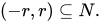
![{\displaystyle (-2,2),\;[-2,2],\;[-2,\infty ),\;[-2,2)\cup \{10\},\;[-2,2]\cup \mathbb {Q} ,\;\mathbb {R} }](https://wikimedia.org/api/rest_v1/media/math/render/svg/1ff465c9efb1e39369a9bbe8071ee416b008df07)


If is an open subset of a topological space then for every is a neighborhood of in More generally, if is any set and denotes the topological interior of in then is a neighborhood (in ) of every point and moreover, is not a neighborhood of any other point. Said differently, is a neighborhood of a point if and only if


Neighbourhood bases
In any topological space, the neighbourhood system for a point is also a neighbourhood basis for the point. The set of all open neighbourhoods at a point forms a neighbourhood basis at that point. For any point in a metric space, the sequence of open balls around with radius form a countable neighbourhood basis . This means every metric space is first-countable.


Given a space with the indiscrete topology the neighbourhood system for any point only contains the whole space, .
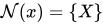
In the weak topology on the space of measures on a space a neighbourhood base about is given by where are continuous bounded functions from to the real numbers and are positive real numbers.





Seminormed spaces and topological groups
In a seminormed space, that is a vector space with the topology induced by a seminorm, all neighbourhood systems can be constructed by translation of the neighbourhood system for the origin,

This is because, by assumption, vector addition is separately continuous in the induced topology. Therefore, the topology is determined by its neighbourhood system at the origin. More generally, this remains true whenever the space is a topological group or the topology is defined by a pseudometric.
Properties
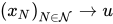
[edit]Suppose and let be a neighbourhood basis for in Make into a directed set by partially ordering it by superset inclusion Then is not a neighborhood of in if and only if there exists an -indexed net in such that for every (which implies that in ).


See also
[edit]- Base (topology) – Collection of open sets used to define a topology
- Filter on a set – Family of subsets representing "large" sets
- Filters in topology – Use of filters to describe and characterize all basic topological notions and results
- Locally convex topological vector space – Vector space with a topology defined by convex open sets
- Neighbourhood (mathematics) – Open set containing a given point
- Subbase – Collection of subsets that generate a topology
- Tubular neighborhood – Neighborhood of a submanifold
References
[edit]- ^ Usually, "neighbourhood" refers to a neighbourhood of a point and it will be clearly indicated if it instead refers to a neighborhood of a set. So for instance, a statement such as "a neighbourhood in " that does not refer to any particular point or set should, unless somehow indicated otherwise, be taken to mean "a neighbourhood of some point in "
- ^ Most authors do not require that neighborhoods be open sets because writing "open" in front of "neighborhood" when this property is needed is not overly onerous and because requiring that they always be open would also greatly limit the usefulness of terms such as "closed neighborhood" and "compact neighborhood".
- ^ Mendelson, Bert (1990) [1975]. Introduction to Topology (Third ed.). Dover. p. 41. ISBN 0-486-66352-3.
- ^ Bourbaki 1989, pp. 17–21.
- ^ a b Willard 2004, pp. 31–37.
- ^ Willard, Stephen (1970). General Topology. Addison-Wesley Publishing. ISBN 9780201087079. (See Chapter 2, Section 4)
Bibliography
[edit]- Bourbaki, Nicolas (1989) [1966]. General Topology: Chapters 1–4 [Topologie Générale]. Éléments de mathématique. Berlin New York: Springer Science & Business Media. ISBN 978-3-540-64241-1. OCLC 18588129.
- Dixmier, Jacques (1984). General Topology. Undergraduate Texts in Mathematics. Translated by Berberian, S. K. New York: Springer-Verlag. ISBN 978-0-387-90972-1. OCLC 10277303.
- Willard, Stephen (2004) [1970]. General Topology. Mineola, N.Y.: Dover Publications. ISBN 978-0-486-43479-7. OCLC 115240.
Neighbourhood system
View on GrokipediaBasic Definitions
Neighbourhood of a point
In a topological space , where denotes the collection of open sets satisfying the standard axioms (closed under arbitrary unions and finite intersections, with and ), an open neighbourhood of a point is any set such that and .[3] This concept directly ties the local environment of to the global structure defined by . A more general notion of neighbourhood extends this to capture broader local properties: a set is a neighbourhood of if there exists an open neighbourhood of such that .[4] Unlike open neighbourhoods, general neighbourhoods need not themselves be open sets; for instance, in the real line with the standard topology, the half-open interval is a neighbourhood of because it contains the open interval for small , yet is not open.[3] This distinction is essential for analyzing local structure around points, as general neighbourhoods allow for sets that approximate openness near without requiring full openness, facilitating the study of continuity, limits, and convergence in topology.[4] The collection of all neighbourhoods of a fixed point forms the neighbourhood system at .[3]Neighbourhood system
In topology, the neighbourhood system of a point in a topological space is the collection of all neighbourhoods of , which forms a structured family satisfying specific axioms that ensure consistency with the topology.[3] This system captures the local structure around and allows the topology to be reconstructed entirely from the family of such systems for all points in .[1] Formally, for a point , the neighbourhood system (also denoted ) is a collection of subsets of such that:- (i) for all ;
- (ii) if and , then ;
- (iii) if , then ;
- (iv) for each , there exists such that for all .
Neighbourhood filter
In topology, the neighbourhood filter at a point in a space , denoted , is the filter generated by the neighbourhood system at . Specifically, serves as a filter base for , consisting of all subsets of that contain some member of . This structure satisfies the standard filter axioms: is non-empty (as ), closed under finite intersections (the intersection of any two sets in contains a common neighbourhood from ), and upward closed (if and , then ).[6] A defining property of is that it is the finest filter on (in the sense of containing the maximal collection of sets) for which is the unique adherent point. This means that for every set , lies in the closure of (i.e., every neighbourhood of intersects ), and no other point satisfies this condition for all . In non- spaces, the adherent points may include the closure of , but remains the maximal such filter ensuring 's adherence.[7] The neighbourhood filter fully determines the local topology at in any topological space, as the open sets containing are precisely the open members of . This local characterization allows to underpin concepts like convergence and continuity near , with the filter's structure reflecting the space's topological properties at that point.[6]Neighbourhood Bases and Subbases
Neighbourhood basis
In a topological space , a neighbourhood basis at a point is defined as a subfamily of the neighbourhood system such that for every neighbourhood , there exists some satisfying .[8] This condition ensures that generates the full neighbourhood system through inclusions, providing a minimal collection that captures all local structure around .[9] The property of as a local basis for the topology at follows directly from this inclusion: every open set containing must intersect the basis elements appropriately, allowing the topology to be recovered locally via unions and intersections involving . Formally, the defining relation is This setup distinguishes a neighbourhood basis from the full system by its generative role, where elements of serve as "fundamental" neighbourhoods sufficient to approximate any other.[8] A key theorem states that in any topological space, the collection of all open neighbourhoods of itself forms a neighbourhood basis at , as for any neighbourhood of , the definition of neighbourhood guarantees an open set with .[4] Additionally, second-countable spaces—those admitting a countable basis for the entire topology—possess countable neighbourhood bases at every point, linking global countability to local structure.[10]Neighbourhood subbasis
A neighbourhood subbasis at a point in a topological space is a family of neighbourhoods of such that the collection of all finite intersections of elements from forms a neighbourhood basis at .[11] This structure provides a coarser collection than a full neighbourhood basis, where the generated basis is defined as and satisfies the neighbourhood basis condition: for every , there exists such that .[11] Neighbourhood subbases are instrumental in generating topologies efficiently, analogous to subbases for the open sets, by allowing the specification of a topology through a smaller family whose finite intersections yield the required basis elements.[11] In particular, they facilitate the construction of product topologies, where a subbasis at a point consists of sets of the form with and with , and the finite intersections of these form the standard neighbourhood basis for the product topology.[12]Examples
Metric spaces
In metric spaces, the neighbourhood system at a point is determined by the open balls induced by the metric. Consider the metric space where . The neighbourhood system at consists of all subsets containing an open interval for some . Thus, all such open intervals belong to , and so do closed intervals , as each contains an open ball around 0. However, the singleton excludes since no open ball is contained within it, and the ray does likewise because every open ball around 0 includes points less than 0.[3] The collection of all open balls for and forms a basis for the neighbourhood system in any metric space , as every neighbourhood of contains such a ball. In separable metric spaces like with the Euclidean metric, restricting to balls centered at points with rational coordinates and rational radii yields a countable basis, since the rationals are countable and dense.[13] In with the Euclidean metric, a subbasis for the neighbourhood systems can be formed by open half-spaces, such as sets of the form for points , directions , and ; finite intersections of these yield open balls. For , this reduces to open rays and for , whose unions generate the standard topology.[14] In complete metric spaces, Cauchy sequences relate to shrinking neighbourhoods: a sequence is Cauchy if, for every , there exists such that the tail lies within a ball of radius , ensuring convergence to a limit where tails enter every neighbourhood of that limit.[15]Discrete and indiscrete topologies
In the discrete topology on a set , every subset of is open, which implies that the neighbourhood system at any point consists of all subsets of that contain .[3][16][17] This structure arises because the singleton is open, and thus any set containing qualifies as a neighbourhood by including an open set around . A neighbourhood basis at is given by the collection , as every neighbourhood contains this singleton.[3][17] The singletons themselves can serve as a neighbourhood subbasis, generating the full power set topology through unions.[16] For a concrete example, consider a finite discrete space such as with the discrete topology. Here, every subset is open, so the neighbourhoods of are and , which correspond to the power set of restricted to sets containing .[3][16] This illustrates the maximal richness of the neighbourhood system in the discrete case, where no separation assumptions are violated, and points are maximally isolated. In contrast, the indiscrete (or trivial) topology on has only and as open sets, leading to a minimal neighbourhood system where for every .[3][16][17] Any neighbourhood must contain an open set around , but the only non-empty open set is itself, so no proper subset of (except possibly , which does not contain ) can be a neighbourhood. The collection forms a neighbourhood basis at each , and since it is already a singleton, no distinct subbasis is required beyond this.[3][18] This extreme minimality in the indiscrete topology results in pathological convergence properties: every net in converges to every point in , as the only neighbourhood of any point is , which any net is constantly contained within.[17][19] Such behaviour highlights the indiscrete topology as the coarsest possible, providing a boundary case for studying neighbourhood systems where no non-trivial local structure exists.Properties
Fundamental axioms
A neighbourhood system on a topological space consists of a family , where for each , is a collection of subsets of satisfying the following fundamental axioms:- (N0): For every , . This ensures that each element of contains the point , aligning with the intuitive notion of a neighbourhood of a point.[3]
- (N1): If and , then . This upward closure property implies that any superset of a neighbourhood is also a neighbourhood.[3]
- (N2): If , then . This guarantees that the intersection of any two neighbourhoods of is itself a neighbourhood of .[3]
- (N3): For every , there exists such that for all , . This axiom captures the local consistency of the system, ensuring that neighbourhoods are "uniform" in small regions around .[3]