
Recent from talks
Lockheed X-7
Knowledge base stats:
Talk channels stats:
Members stats:
Lockheed X-7
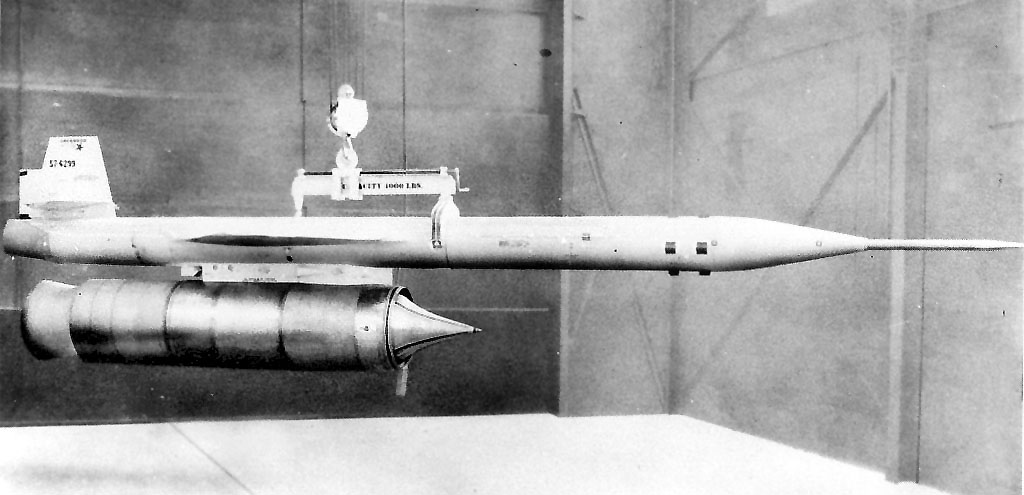
The Lockheed X-7 (dubbed the "Flying Stove Pipe") is an American unmanned test bed of the 1950s for ramjet engines and missile guidance technology. It was the basis for the later Lockheed AQM-60 Kingfisher, a system used to test American air defenses against nuclear missile attack.
Development of the Kingfisher was first initiated in December 1946. The X-7 was called into production by the United States Air Force requirement for the development of an unmanned ramjet test plane with a top speed of at least Mach 3 (3,200 km/h; 2,000 mph).
The X-7 project was developed under the AMC designator MX-883 and was given in the Lockheed in-house designation L-171. The L-171 was initially designated the PTV-A-1 by the USAF but was later designated the X-7 in 1951. Despite its first launch being a failure, after re-development of the original ramjet, following test flights were successful. A total of 130 X-7 flights were conducted from April 1951 to July 1960.
The X-7 laid the foundation for the AQM-60 Kingfisher. Being the testbed for several yearlong projects, the X-7 underwent many structural changes to adapt more closely for its intended purpose. The Kingfisher was put up against three surface to air missiles designed to test the capabilities of the X-7; SAM-A-7/MIM-3 Nike Ajax, SAM-A-25/MIM-14 Nike Hercules, and IM-99/CIM-10 Bomarc were the missiles used in the tests. During the testing of the SAMs, the X-7 outperformed the missiles and a very small number of critical hits were achieved. Due to pressure and embarrassment of the military, the X-7 project was terminated in the mid-1960s.
Besides the surface to air missile tests, the X-7 project was also used to test communication equipment for acceleration tests, testing aerodynamics, booster propellants, thermodynamics, and parachutes.
The X-7 was constructed from steel, unlike its successors such as the A-12 and YF-12 which used titanium. These X-7 planes had wings constructed from stainless steel and a fuselage made from a nickel alloy. The use of steel was due to the inability of aluminum to endure air friction heating at hypersonic speeds, years before the widespread introduction of titanium.
The engines developed for the X-7/AQM-60 were designed to operate for a short time, to test the design for the CIM-10 Bomarc. They were redesigned with better materials for use on the hypersonic Lockheed D-21 drone launched from the back of a Lockheed M-21, a derivative of the Lockheed A-12, or from under the wing of a Boeing B-52 Stratofortress.
The X-7 was launched at speed release from the underside of either a B-29 or B-50 carrier plane. The jet would then take over and build up speed to its top speed of 1,600 km/h (1,000 mph), but was later redesigned to push Mach 4.3 (4,680 km/h; 2,910 mph).
Hub AI
Lockheed X-7 AI simulator
(@Lockheed X-7_simulator)
Lockheed X-7
The Lockheed X-7 (dubbed the "Flying Stove Pipe") is an American unmanned test bed of the 1950s for ramjet engines and missile guidance technology. It was the basis for the later Lockheed AQM-60 Kingfisher, a system used to test American air defenses against nuclear missile attack.
Development of the Kingfisher was first initiated in December 1946. The X-7 was called into production by the United States Air Force requirement for the development of an unmanned ramjet test plane with a top speed of at least Mach 3 (3,200 km/h; 2,000 mph).
The X-7 project was developed under the AMC designator MX-883 and was given in the Lockheed in-house designation L-171. The L-171 was initially designated the PTV-A-1 by the USAF but was later designated the X-7 in 1951. Despite its first launch being a failure, after re-development of the original ramjet, following test flights were successful. A total of 130 X-7 flights were conducted from April 1951 to July 1960.
The X-7 laid the foundation for the AQM-60 Kingfisher. Being the testbed for several yearlong projects, the X-7 underwent many structural changes to adapt more closely for its intended purpose. The Kingfisher was put up against three surface to air missiles designed to test the capabilities of the X-7; SAM-A-7/MIM-3 Nike Ajax, SAM-A-25/MIM-14 Nike Hercules, and IM-99/CIM-10 Bomarc were the missiles used in the tests. During the testing of the SAMs, the X-7 outperformed the missiles and a very small number of critical hits were achieved. Due to pressure and embarrassment of the military, the X-7 project was terminated in the mid-1960s.
Besides the surface to air missile tests, the X-7 project was also used to test communication equipment for acceleration tests, testing aerodynamics, booster propellants, thermodynamics, and parachutes.
The X-7 was constructed from steel, unlike its successors such as the A-12 and YF-12 which used titanium. These X-7 planes had wings constructed from stainless steel and a fuselage made from a nickel alloy. The use of steel was due to the inability of aluminum to endure air friction heating at hypersonic speeds, years before the widespread introduction of titanium.
The engines developed for the X-7/AQM-60 were designed to operate for a short time, to test the design for the CIM-10 Bomarc. They were redesigned with better materials for use on the hypersonic Lockheed D-21 drone launched from the back of a Lockheed M-21, a derivative of the Lockheed A-12, or from under the wing of a Boeing B-52 Stratofortress.
The X-7 was launched at speed release from the underside of either a B-29 or B-50 carrier plane. The jet would then take over and build up speed to its top speed of 1,600 km/h (1,000 mph), but was later redesigned to push Mach 4.3 (4,680 km/h; 2,910 mph).
Recent media