
Recent from talks
MIM-3 Nike Ajax
Knowledge base stats:
Talk channels stats:
Members stats:
MIM-3 Nike Ajax
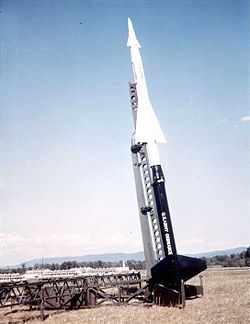
The Nike Ajax was an American guided surface-to-air missile (SAM) developed by Bell Labs for the United States Army. The world's first operational guided surface-to-air missile, the Nike Ajax was designed to attack conventional bomber aircraft flying at high subsonic speeds and altitudes above 50,000 feet (15 km). Nike entered service in 1954 and was initially deployed within the United States to defend against Soviet bomber attacks, though it was later deployed overseas to protect US military bases, and was also sold to various allied militaries. Some examples remained in use until the 1970s.
Originally known simply as "Nike", it gained the "Ajax" as part of a 1956 renaming effort that resulted from the introduction of the similarly named Nike Hercules. It was initially given the identifier SAM-A-7 (Surface-to-air, Army, design 7) as part of an early tri-service identification system, but later changed to MIM-3 in 1962.
Technological development during the 1950s quickly rendered the MIM-3 obsolete. It was unable to defend against more capable bombers or multiple targets in formation, and had relatively short range. Even while Nike was being deployed, these concerns led to the contracts for the greatly improved MIM-14 Nike Hercules, which began deployment in 1959. As Hercules developed, the threat moved from bombers to ICBMs, and the LIM-49 Nike Zeus anti-ballistic missile project started to address these. All of the Nike projects were led by Bell Labs, due to their early work in radar guidance systems during World War II.
Part of the Nike Ajax development program designed a new solid fuel rocket motor used for the missile's booster. This had originally been designed for the United States Navy's missiles, and was enlarged for the Nike efforts. The rocket found applications outside the military world as the Ajax missiles were decommissioned in the 1960s. Many sounding rockets used the booster as their first or second stage, and many of those used "Nike" in their name.
The inherent inaccuracy of anti-aircraft artillery means that when shells reach their targets they are effectively randomly distributed in the target area. This distribution is much larger than the lethal radius of any given shell, so the chance that any one shell will damage or destroy its target is very small. Successful anti-aircraft gunnery therefore requires as many rounds to be fired as possible. During the Blitz, British anti-aircraft gunners fired 49,044 shells in January 1941 for 12 kills, almost 4,100 shells per success. German gunners did better against Allied daylight raids, firing an estimated average of 2,800 shells to down a single Boeing B-17 Flying Fortress.
Flying faster means that the aircraft passes through the range of a gun more rapidly, reducing the number of rounds a particular gun can fire at that aircraft. Flying at higher altitudes often has a similar effect, as it requires larger shells to reach those altitudes, and this typically results in slower firing rates for a variety of practical reasons. Aircraft using jet engines roughly doubled the speed and altitude over piston-powered designs, limiting the number of shells so greatly that the chance of hitting the bomber dropped almost to zero. As early as 1942, German flak commanders were keenly aware of the problem, and expecting to face jet bombers, they began developing missiles to supplant their guns.
The western allies maintained air superiority for much of the war and their anti-aircraft systems did not see as much pressure to improve. Nevertheless, by the mid-war period, the US Army had reached the same conclusion as their German counterparts: artillery-based anti-aircraft weapons were no longer useful. Accordingly, in February 1944 the Army Ground Forces sent the Army Service Forces (ASF) a request for information on the possibility of building a "major caliber anti-aircraft rocket torpedo". The ASF concluded that it was too early to tell if this was possible, and suggested concentrating on a program of general rocket development instead.
The introduction of German jet bombers late in 1944 led to a re-evaluation of this policy, and on 26 January 1945 the Army Chief of Ordnance issued a requirement for a new guided missile system. The request was passed to Bell Labs, then a world leader in radar, radio control, and automated aiming systems (see Hendrik Wade Bode).
Hub AI
MIM-3 Nike Ajax AI simulator
(@MIM-3 Nike Ajax_simulator)
MIM-3 Nike Ajax
The Nike Ajax was an American guided surface-to-air missile (SAM) developed by Bell Labs for the United States Army. The world's first operational guided surface-to-air missile, the Nike Ajax was designed to attack conventional bomber aircraft flying at high subsonic speeds and altitudes above 50,000 feet (15 km). Nike entered service in 1954 and was initially deployed within the United States to defend against Soviet bomber attacks, though it was later deployed overseas to protect US military bases, and was also sold to various allied militaries. Some examples remained in use until the 1970s.
Originally known simply as "Nike", it gained the "Ajax" as part of a 1956 renaming effort that resulted from the introduction of the similarly named Nike Hercules. It was initially given the identifier SAM-A-7 (Surface-to-air, Army, design 7) as part of an early tri-service identification system, but later changed to MIM-3 in 1962.
Technological development during the 1950s quickly rendered the MIM-3 obsolete. It was unable to defend against more capable bombers or multiple targets in formation, and had relatively short range. Even while Nike was being deployed, these concerns led to the contracts for the greatly improved MIM-14 Nike Hercules, which began deployment in 1959. As Hercules developed, the threat moved from bombers to ICBMs, and the LIM-49 Nike Zeus anti-ballistic missile project started to address these. All of the Nike projects were led by Bell Labs, due to their early work in radar guidance systems during World War II.
Part of the Nike Ajax development program designed a new solid fuel rocket motor used for the missile's booster. This had originally been designed for the United States Navy's missiles, and was enlarged for the Nike efforts. The rocket found applications outside the military world as the Ajax missiles were decommissioned in the 1960s. Many sounding rockets used the booster as their first or second stage, and many of those used "Nike" in their name.
The inherent inaccuracy of anti-aircraft artillery means that when shells reach their targets they are effectively randomly distributed in the target area. This distribution is much larger than the lethal radius of any given shell, so the chance that any one shell will damage or destroy its target is very small. Successful anti-aircraft gunnery therefore requires as many rounds to be fired as possible. During the Blitz, British anti-aircraft gunners fired 49,044 shells in January 1941 for 12 kills, almost 4,100 shells per success. German gunners did better against Allied daylight raids, firing an estimated average of 2,800 shells to down a single Boeing B-17 Flying Fortress.
Flying faster means that the aircraft passes through the range of a gun more rapidly, reducing the number of rounds a particular gun can fire at that aircraft. Flying at higher altitudes often has a similar effect, as it requires larger shells to reach those altitudes, and this typically results in slower firing rates for a variety of practical reasons. Aircraft using jet engines roughly doubled the speed and altitude over piston-powered designs, limiting the number of shells so greatly that the chance of hitting the bomber dropped almost to zero. As early as 1942, German flak commanders were keenly aware of the problem, and expecting to face jet bombers, they began developing missiles to supplant their guns.
The western allies maintained air superiority for much of the war and their anti-aircraft systems did not see as much pressure to improve. Nevertheless, by the mid-war period, the US Army had reached the same conclusion as their German counterparts: artillery-based anti-aircraft weapons were no longer useful. Accordingly, in February 1944 the Army Ground Forces sent the Army Service Forces (ASF) a request for information on the possibility of building a "major caliber anti-aircraft rocket torpedo". The ASF concluded that it was too early to tell if this was possible, and suggested concentrating on a program of general rocket development instead.
The introduction of German jet bombers late in 1944 led to a re-evaluation of this policy, and on 26 January 1945 the Army Chief of Ordnance issued a requirement for a new guided missile system. The request was passed to Bell Labs, then a world leader in radar, radio control, and automated aiming systems (see Hendrik Wade Bode).
Recent media
