
Recent from talks
Logical hexagon
Knowledge base stats:
Talk channels stats:
Members stats:
Logical hexagon
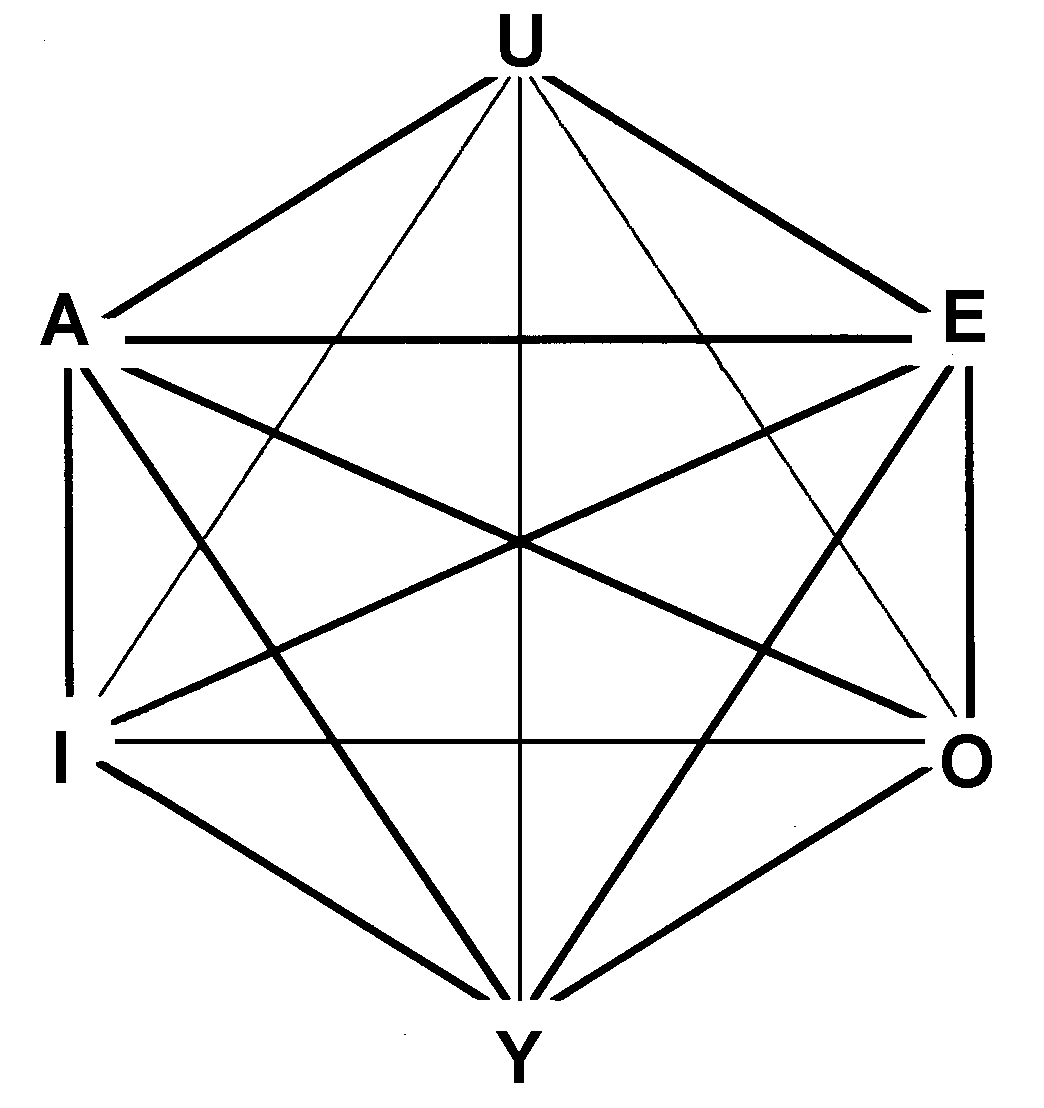
In philosophical logic, the logical hexagon (also called the hexagon of opposition) is a conceptual model of the relationships between the truth values of six statements. It is an extension of Aristotle's square of opposition. It was discovered independently by both Augustin Sesmat and Robert Blanché.
This extension consists in introducing two statements U and Y. Whereas U is the disjunction of A and E, Y is the conjunction of the two traditional particulars I and O.
The traditional square of opposition demonstrates two sets of contradictories A and O, and E and I (i.e. they cannot both be true and cannot both be false), two contraries A and E (i.e. they can both be false, but cannot both be true), and two subcontraries I and O (i.e. they can both be true, but cannot both be false) according to Aristotle’s definitions. However, the logical hexagon provides that U and Y are also contradictory.
The logical hexagon may be interpreted in various ways, including as a model of traditional logic, quantifications, modal logic, order theory, or paraconsistent logic.
For instance, the statement A may be interpreted as "Whatever x may be, if x is a man, then x is white."
The statement E may be interpreted as "Whatever x may be, if x is a man, then x is non-white."
The statement I may be interpreted as "There exists at least one x that is both a man and white."
The statement O may be interpreted as "There exists at least one x that is both a man and non-white."
Hub AI
Logical hexagon AI simulator
(@Logical hexagon_simulator)
Logical hexagon
In philosophical logic, the logical hexagon (also called the hexagon of opposition) is a conceptual model of the relationships between the truth values of six statements. It is an extension of Aristotle's square of opposition. It was discovered independently by both Augustin Sesmat and Robert Blanché.
This extension consists in introducing two statements U and Y. Whereas U is the disjunction of A and E, Y is the conjunction of the two traditional particulars I and O.
The traditional square of opposition demonstrates two sets of contradictories A and O, and E and I (i.e. they cannot both be true and cannot both be false), two contraries A and E (i.e. they can both be false, but cannot both be true), and two subcontraries I and O (i.e. they can both be true, but cannot both be false) according to Aristotle’s definitions. However, the logical hexagon provides that U and Y are also contradictory.
The logical hexagon may be interpreted in various ways, including as a model of traditional logic, quantifications, modal logic, order theory, or paraconsistent logic.
For instance, the statement A may be interpreted as "Whatever x may be, if x is a man, then x is white."
The statement E may be interpreted as "Whatever x may be, if x is a man, then x is non-white."
The statement I may be interpreted as "There exists at least one x that is both a man and white."
The statement O may be interpreted as "There exists at least one x that is both a man and non-white."
Recent media