



Community hub
Recent from talks
Contribute something
Nothing was collected or created yet.
Modal logic
View on WikipediaModal logic is a kind of logic used to represent statements about necessity and possibility. In philosophy and related fields it is used as a tool for understanding concepts such as knowledge, obligation, and causation. For instance, in epistemic modal logic, the formula can be used to represent the statement that is known. In deontic modal logic, that same formula can represent that is a moral obligation. Modal logic considers the inferences that modal statements give rise to. For instance, most epistemic modal logics treat the formula as a tautology, representing the principle that only true statements can count as knowledge. However, this formula is not a tautology in deontic modal logic, since what ought to be true can be false.


Modal logics are formal systems that include unary operators such as and , representing possibility and necessity respectively. For instance the modal formula can be read as "possibly " while can be read as "necessarily ". In the standard relational semantics for modal logic, formulas are assigned truth values relative to a possible world. A formula's truth value at one possible world can depend on the truth values of other formulas at other accessible possible worlds. In particular, is true at a world if is true at some accessible possible world, while is true at a world if is true at every accessible possible world. A variety of proof systems exist which are sound and complete with respect to the semantics one gets by restricting the accessibility relation. For instance, the deontic modal logic D is sound and complete if one requires the accessibility relation to be serial.


While the intuition behind modal logic dates back to antiquity, the first modal axiomatic systems were developed by C. I. Lewis in 1912. The now-standard relational semantics emerged in the mid twentieth century from work by Arthur Prior, Jaakko Hintikka, and Saul Kripke. Recent developments include alternative topological semantics such as neighborhood semantics as well as applications of the relational semantics beyond its original philosophical motivation.[1] Such applications include game theory,[2] moral and legal theory,[2] web design,[2] multiverse-based set theory,[3] and social epistemology.[4]
Syntax of modal operators
[edit]Modal logic differs from other kinds of logic in that it uses modal operators such as and . The former is conventionally read aloud as "necessarily", and can be used to represent notions such as moral or legal obligation, knowledge, historical inevitability, among others. The latter is typically read as "possibly" and can be used to represent notions including permission, ability, compatibility with evidence. While well-formed formulas of modal logic include non-modal formulas such as , it also contains modal ones such as , , , and so on.


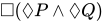
Thus, the language of basic propositional logic can be defined recursively as follows.

- If is an atomic formula, then is a formula of .
- If is a formula of , then is too.
- If and are formulas of , then is too.
- If is a formula of , then is too.
- If is a formula of , then is too.


Modal operators can be added to other kinds of logic by introducing rules analogous to #4 and #5 above. Modal predicate logic is one widely used variant which includes formulas such as . In systems of modal logic where and are duals, can be taken as an abbreviation for , thus eliminating the need for a separate syntactic rule to introduce it. However, separate syntactic rules are necessary in systems where the two operators are not interdefinable.


Common notational variants include symbols such as and in systems of modal logic used to represent knowledge and and in those used to represent belief. These notations are particularly common in systems which use multiple modal operators simultaneously. For instance, a combined epistemic-deontic logic could use the formula read as "I know P is permitted". Systems of modal logic can include infinitely many modal operators distinguished by indices, i.e. , , , and so on.
![{\displaystyle [K]}](https://wikimedia.org/api/rest_v1/media/math/render/svg/3b6c25071903364b1b51e69ffa99ec95f6d122d5)

![{\displaystyle [B]}](https://wikimedia.org/api/rest_v1/media/math/render/svg/6e6c6caf9d188e4a608dfdac98bbcd140a9ea106)

![{\displaystyle [K]\langle D\rangle P}](https://wikimedia.org/api/rest_v1/media/math/render/svg/1ab815e1cafde8af9ed31ce6efde3d9c47f1c2e2)


Semantics
[edit]Relational semantics
[edit]Basic notions
[edit]The standard semantics for modal logic is called the relational semantics. In this approach, the truth of a formula is determined relative to a point which is often called a possible world. For a formula that contains a modal operator, its truth value can depend on what is true at other accessible worlds. Thus, the relational semantics interprets formulas of modal logic using models defined as follows.[5]
- A relational model is a tuple where:

- is a set of possible worlds
- is a binary relation on
- is a valuation function which assigns a truth value to each pair of an atomic formula and a world, (i.e. where is the set of atomic formulae)




The set is often called the universe. The binary relation is called an accessibility relation, and it controls which worlds can "see" each other for the sake of determining what is true. For example, means that the world is accessible from world . That is to say, the state of affairs known as is a live possibility for . Finally, the function is known as a valuation function. It determines which atomic formulas are true at which worlds.


Then we recursively define the truth of a formula at a world in a model :

- iff
- iff
- iff and
- iff for every element of , if then
- iff for some element of , it holds that and





According to this semantics, a formula is necessary with respect to a world if it holds at every world that is accessible from . It is possible if it holds at some world that is accessible from . Possibility thereby depends upon the accessibility relation , which allows us to express the relative nature of possibility. For example, we might say that given our laws of physics it is not possible for humans to travel faster than the speed of light, but that given other circumstances it could have been possible to do so. Using the accessibility relation we can translate this scenario as follows: At all of the worlds accessible to our own world, it is not the case that humans can travel faster than the speed of light, but at one of these accessible worlds there is another world accessible from those worlds but not accessible from our own at which humans can travel faster than the speed of light.
Frames and completeness
[edit]The choice of accessibility relation alone can sometimes be sufficient to guarantee the truth or falsity of a formula. For instance, consider a model whose accessibility relation is reflexive. Because the relation is reflexive, we will have that for any regardless of which valuation function is used. For this reason, modal logicians sometimes talk about frames, which are the portion of a relational model excluding the valuation function.


- A relational frame is a pair where is a set of possible worlds, is a binary relation on .


The different systems of modal logic are defined using frame conditions. A frame is called:
- reflexive if w R w, for every w in G
- symmetric if w R u implies u R w, for all w and u in G
- transitive if w R u and u R q together imply w R q, for all w, u, q in G.
- serial if, for every w in G there is some u in G such that w R u.
- Euclidean if, for every u, t, and w, w R u and w R t implies u R t (by symmetry, it also implies t R u, as well as t R t and u R u)
The logics that stem from these frame conditions are:
- K := no conditions
- D := serial
- T := reflexive
- B := reflexive and symmetric
- S4 := reflexive and transitive
- S5 := reflexive and Euclidean
The Euclidean property along with reflexivity yields symmetry and transitivity. (The Euclidean property can be obtained, as well, from symmetry and transitivity.) Hence if the accessibility relation R is reflexive and Euclidean, R is provably symmetric and transitive as well. Hence for models of S5, R is an equivalence relation, because R is reflexive, symmetric and transitive.
We can prove that these frames produce the same set of valid sentences as do the frames where all worlds can see all other worlds of W (i.e., where R is a "total" relation). This gives the corresponding modal graph which is total complete (i.e., no more edges (relations) can be added). For example, in any modal logic based on frame conditions:
- if and only if for some element u of G, it holds that and w R u.

If we consider frames based on the total relation we can just say that
- if and only if for some element u of G, it holds that .
We can drop the accessibility clause from the latter stipulation because in such total frames it is trivially true of all w and u that w R u. But this does not have to be the case in all S5 frames, which can still consist of multiple parts that are fully connected among themselves but still disconnected from each other.
All of these logical systems can also be defined axiomatically, as is shown in the next section. For example, in S5, the axioms , and (corresponding to symmetry, transitivity and reflexivity, respectively) hold, whereas at least one of these axioms does not hold in each of the other, weaker logics.



Topological semantics
[edit]Modal logic has also been interpreted using topological structures. For instance, the Interior Semantics interprets formulas of modal logic as follows.
A topological model is a tuple where is a topological space and is a valuation function which maps each atomic formula to some subset of . The basic interior semantics interprets formulas of modal logic as follows:
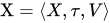


- iff
- iff
- iff and
- iff for some we have both that and also that for all


Topological approaches subsume relational ones, allowing non-normal modal logics. The extra structure they provide also allows a transparent way of modeling certain concepts such as the evidence or justification one has for one's beliefs. Topological semantics is widely used in recent work in formal epistemology and has antecedents in earlier work such as David Lewis and Angelika Kratzer's logics for counterfactuals.
Axiomatic systems
[edit]
The first formalizations of modal logic were axiomatic. Numerous variations with very different properties have been proposed since C. I. Lewis began working in the area in 1912. Hughes and Cresswell (1996), for example, describe 42 normal and 25 non-normal modal logics. Zeman (1973) describes some systems Hughes and Cresswell omit.
Modern treatments of modal logic begin by augmenting the propositional calculus with two unary operations, one denoting "necessity" and the other "possibility". The notation of C. I. Lewis, much employed since, denotes "necessarily p" by a prefixed "box" (□p) whose scope is established by parentheses. Likewise, a prefixed "diamond" (◇p) denotes "possibly p". Similar to the quantifiers in first-order logic, "necessarily p" (□p) does not assume the range of quantification (the set of accessible possible worlds in Kripke semantics) to be non-empty, whereas "possibly p" (◇p) often implicitly assumes (viz. the set of accessible possible worlds is non-empty). Regardless of notation, each of these operators is definable in terms of the other in classical modal logic:

- □p (necessarily p) is equivalent to ¬◇¬p ("not possible that not-p")
- ◇p (possibly p) is equivalent to ¬□¬p ("not necessarily not-p")
Hence □ and ◇ form a dual pair of operators.
In many modal logics, the necessity and possibility operators satisfy the following analogues of de Morgan's laws from Boolean algebra:
- "It is not necessary that X" is logically equivalent to "It is possible that not X".
- "It is not possible that X" is logically equivalent to "It is necessary that not X".
Precisely what axioms and rules must be added to the propositional calculus to create a usable system of modal logic is a matter of philosophical opinion, often driven by the theorems one wishes to prove; or, in computer science, it is a matter of what sort of computational or deductive system one wishes to model. Many modal logics, known collectively as normal modal logics, include the following rule and axiom:
- N, Necessitation Rule: If p is a theorem/tautology (of any system/model invoking N), then □p is likewise a theorem (i.e. ).
- K, Distribution Axiom: □(p → q) → (□p → □q).

The weakest normal modal logic, named "K" in honor of Saul Kripke, is simply the propositional calculus augmented by □, the rule N, and the axiom K. K is weak in that it fails to determine whether a proposition can be necessary but only contingently necessary. That is, it is not a theorem of K that if □p is true then □□p is true, i.e., that necessary truths are "necessarily necessary". If such perplexities are deemed forced and artificial, this defect of K is not a great one. In any case, different answers to such questions yield different systems of modal logic.
Adding axioms to K gives rise to other well-known modal systems. One cannot prove in K that if "p is necessary" then p is true. The axiom T remedies this defect:
- T, Reflexivity Axiom: □p → p (If p is necessary, then p is the case.)
T holds in most but not all modal logics. Zeman (1973) describes a few exceptions, such as S10.
Other well-known elementary axioms are:
- 4:
- B:
- D:
- 5:


These yield the systems (axioms in bold, systems in italics):
- K := K + N
- T := K + T
- S4 := T + 4
- S5 := T + 5
- D := K + D.
K through S5 form a nested hierarchy of systems, making up the core of normal modal logic. But specific rules or sets of rules may be appropriate for specific systems. For example, in deontic logic, (If it ought to be that p, then it is permitted that p) seems appropriate, but we should probably not include that . In fact, to do so is to commit the naturalistic fallacy (i.e. to state that what is natural is also good, by saying that if p is the case, p ought to be permitted).
The commonly employed system S5 simply makes all modal truths necessary. For example, if p is possible, then it is "necessary" that p is possible. Also, if p is necessary, then it is necessary that p is necessary. Other systems of modal logic have been formulated, in part because S5 does not describe every kind of modality of interest.
Structural proof theory
[edit]Sequent calculi and systems of natural deduction have been developed for several modal logics, but it has proven hard to combine generality with other features expected of good structural proof theories, such as purity (the proof theory does not introduce extra-logical notions such as labels) and analyticity (the logical rules support a clean notion of analytic proof). More complex calculi have been applied to modal logic to achieve generality.[citation needed]
Decision methods
[edit]Analytic tableaux provide the most popular decision method for modal logics.[6]
Modal logics in philosophy
[edit]Alethic logic
[edit]Modalities of necessity and possibility are called alethic modalities. They are also sometimes called special modalities, from the Latin species. Modal logic was first developed to deal with these concepts, and only afterward was extended to others. For this reason, or perhaps for their familiarity and simplicity, necessity and possibility are often casually treated as the subject matter of modal logic. Moreover, it is easier to make sense of relativizing necessity, e.g. to legal, physical, nomological, epistemic, and so on, than it is to make sense of relativizing other notions.
In classical modal logic, a proposition is said to be
- possible if it is not necessarily false (regardless of whether it is actually true or actually false);
- necessary if it is not possibly false (i.e. true and necessarily true);
- contingent if it is not necessarily false and not necessarily true (i.e. possible but not necessarily true);
- impossible if it is not possibly true (i.e. false and necessarily false).
In classical modal logic, therefore, the notion of either possibility or necessity may be taken to be basic, where these other notions are defined in terms of it in the manner of De Morgan duality. Intuitionistic modal logic treats possibility and necessity as not perfectly symmetric.
For example, suppose that while walking to the convenience store we pass Friedrich's house, and observe that the lights are off. On the way back, we observe that they have been turned on.
- "Somebody or something turned the lights on" is necessary.
- "Friedrich turned the lights on", "Friedrich's roommate Max turned the lights on" and "A burglar named Adolf broke into Friedrich's house and turned the lights on" are contingent.
- All of the above statements are possible.
- It is impossible that Socrates (who has been dead for over two thousand years) turned the lights on.
(Of course, this analogy does not apply alethic modality in a truly rigorous fashion; for it to do so, it would have to axiomatically make such statements as "human beings cannot rise from the dead", "Socrates was a human being and not an immortal vampire", and "we did not take hallucinogenic drugs which caused us to falsely believe the lights were on", ad infinitum. Absolute certainty of truth or falsehood exists only in the sense of logically constructed abstract concepts such as "it is impossible to draw a triangle with four sides" and "all bachelors are unmarried".)
For those having difficulty with the concept of something being possible but not true, the meaning of these terms may be made more comprehensible by thinking of multiple "possible worlds" (in the sense of Leibniz) or "alternate universes"; something "necessary" is true in all possible worlds, something "possible" is true in at least one possible world.
Physical possibility
[edit]Something is physically, or nomically, possible if it is permitted by the laws of physics.[citation needed] For example, current theory is thought to allow for there to be an atom with an atomic number of 126,[7] even if there are no such atoms in existence. In contrast, while it is logically possible to accelerate beyond the speed of light,[8] modern science stipulates that it is not physically possible for material particles or information.[9]
Metaphysical possibility
[edit]Philosophers[who?] debate if objects have properties independent of those dictated by scientific laws. For example, it might be metaphysically necessary, as some who advocate physicalism have thought, that all thinking beings have bodies[10] and can experience the passage of time. Saul Kripke has argued that every person necessarily has the parents they do have: anyone with different parents would not be the same person.[11]
Metaphysical possibility has been thought to be more restricting than bare logical possibility[12] (i.e., fewer things are metaphysically possible than are logically possible). However, its exact relation (if any) to logical possibility or to physical possibility is a matter of dispute. Philosophers[who?] also disagree over whether metaphysical truths are necessary merely "by definition", or whether they reflect some underlying deep facts about the world, or something else entirely.
Epistemic logic
[edit]Epistemic modalities (from the Greek episteme, knowledge), deal with the certainty of sentences. The □ operator is translated as "x is certain that…", and the ◇ operator is translated as "For all x knows, it may be true that…" In ordinary speech both metaphysical and epistemic modalities are often expressed in similar words; the following contrasts may help:
A person, Jones, might reasonably say both: (1) "No, it is not possible that Bigfoot exists; I am quite certain of that"; and, (2) "Sure, it's possible that Bigfoots could exist". What Jones means by (1) is that, given all the available information, there is no question remaining as to whether Bigfoot exists. This is an epistemic claim. By (2) he makes the metaphysical claim that it is possible for Bigfoot to exist, even though he does not: there is no physical or biological reason that large, featherless, bipedal creatures with thick hair could not exist in the forests of North America (regardless of whether or not they do). Similarly, "it is possible for the person reading this sentence to be fourteen feet tall and named Chad" is metaphysically true (such a person would not somehow be prevented from doing so on account of their height and name), but not alethically true unless you match that description, and not epistemically true if it is known that fourteen-foot-tall human beings have never existed.[citation needed]
From the other direction, Jones might say, (3) "It is possible that Goldbach's conjecture is true; but also possible that it is false", and also (4) "if it is true, then it is necessarily true, and not possibly false". Here Jones means that it is epistemically possible that it is true or false, for all he knows (Goldbach's conjecture has not been proven either true or false), but if there is a proof (heretofore undiscovered), then it would show that it is not logically possible for Goldbach's conjecture to be false—there could be no set of numbers that violated it. Logical possibility is a form of alethic possibility; (4) makes a claim about whether it is possible (i.e., logically speaking) that a mathematical truth to have been false, but (3) only makes a claim about whether it is possible, for all Jones knows, (i.e., speaking of certitude) that the mathematical claim is specifically either true or false, and so again Jones does not contradict himself. It is worthwhile to observe that Jones is not necessarily correct: It is possible (epistemically) that Goldbach's conjecture is both true and unprovable.
Epistemic possibilities also bear on the actual world in a way that metaphysical possibilities do not. Metaphysical possibilities bear on ways the world might have been, but epistemic possibilities bear on the way the world may be (for all we know). Suppose, for example, that I want to know whether or not to take an umbrella before I leave. If you tell me "it is possible that it is raining outside" – in the sense of epistemic possibility – then that would weigh on whether or not I take the umbrella. But if you just tell me that "it is possible for it to rain outside" – in the sense of metaphysical possibility – then I am no better off for this bit of modal enlightenment.
Some features of epistemic modal logic are in debate. For example, if x knows that p, does x know that it knows that p? That is to say, should □P → □□P be an axiom in these systems? While the answer to this question is unclear,[13] there is at least one axiom that is generally included in epistemic modal logic, because it is minimally true of all normal modal logics (see the section on axiomatic systems):
- K, Distribution Axiom: .

It has been questioned whether the epistemic and alethic modalities should be considered distinct from each other. The criticism states that there is no real difference between "the truth in the world" (alethic) and "the truth in an individual's mind" (epistemic).[14] An investigation has not found a single language in which alethic and epistemic modalities are formally distinguished, as by the means of a grammatical mood.[15]
Temporal logic
[edit]Temporal logic is an approach to the semantics of expressions with tense, that is, expressions with qualifications of when. Some expressions, such as '2 + 2 = 4', are true at all times, while tensed expressions such as 'John is happy' are only true sometimes.
In temporal logic, tense constructions are treated in terms of modalities, where a standard method for formalizing talk of time is to use two pairs of operators, one for the past and one for the future (P will just mean 'it is presently the case that P'). For example:
- FP : It will sometimes be the case that P
- GP : It will always be the case that P
- PP : It was sometime the case that P
- HP : It has always been the case that P
There are then at least three modal logics that we can develop. For example, we can stipulate that,
- is the case at some time t
- is the case at every time t


Or we can trade these operators to deal only with the future (or past). For example,


or,


The operators F and G may seem initially foreign, but they create normal modal systems. FP is the same as ¬G¬P. We can combine the above operators to form complex statements. For example, PP → □PP says (effectively), Everything that is past and true is necessary.
It seems reasonable to say that possibly it will rain tomorrow, and possibly it will not; on the other hand, since we cannot change the past, if it is true that it rained yesterday, it cannot be true that it may not have rained yesterday. It seems the past is "fixed", or necessary, in a way the future is not. This is sometimes referred to as accidental necessity. But if the past is "fixed", and everything that is in the future will eventually be in the past, then it seems plausible to say that future events are necessary too.
Similarly, the problem of future contingents considers the semantics of assertions about the future: is either of the propositions 'There will be a sea battle tomorrow', or 'There will not be a sea battle tomorrow' now true? Considering this thesis led Aristotle to reject the principle of bivalence for assertions concerning the future.
Additional binary operators are also relevant to temporal logics (see Linear temporal logic).
Versions of temporal logic can be used in computer science to model computer operations and prove theorems about them. In one version, ◇P means "at a future time in the computation it is possible that the computer state will be such that P is true"; □P means "at all future times in the computation P will be true". In another version, ◇P means "at the immediate next state of the computation, P might be true"; □P means "at the immediate next state of the computation, P will be true". These differ in the choice of Accessibility relation. (P always means "P is true at the current computer state".) These two examples involve nondeterministic or not-fully-understood computations; there are many other modal logics specialized to different types of program analysis. Each one naturally leads to slightly different axioms.
Deontic logic
[edit]Likewise talk of morality, or of obligation and norms generally, seems to have a modal structure. The difference between "You must do this" and "You may do this" looks a lot like the difference between "This is necessary" and "This is possible". Such logics are called deontic, from the Greek for "duty".
Deontic logics commonly lack the axiom T semantically corresponding to the reflexivity of the accessibility relation in Kripke semantics: in symbols, . Interpreting □ as "it is obligatory that", T informally says that every obligation is true. For example, if it is obligatory not to kill others (i.e. killing is morally forbidden), then T implies that people actually do not kill others. The consequent is obviously false.

Instead, using Kripke semantics, we say that though our own world does not realize all obligations, the worlds accessible to it do (i.e., T holds at these worlds). These worlds are called idealized worlds. P is obligatory with respect to our own world if at all idealized worlds accessible to our world, P holds. Though this was one of the first interpretations of the formal semantics, it has recently come under criticism.[16]
One other principle that is often (at least traditionally) accepted as a deontic principle is D, , which corresponds to the seriality (or extendability or unboundedness) of the accessibility relation. It is an embodiment of the Kantian idea that "ought implies can". (Clearly the "can" can be interpreted in various senses, e.g. in a moral or alethic sense.)

Intuitive problems with deontic logic
[edit]When we try to formalize ethics with standard modal logic, we run into some problems. Suppose that we have a proposition K: you have stolen some money, and another, Q: you have stolen a small amount of money. Now suppose we want to express the thought that "if you have stolen some money, it ought to be a small amount of money". There are two likely candidates,
- (1)
- (2)


But (1) and K together entail □Q, which says that it ought to be the case that you have stolen a small amount of money. This surely is not right, because you ought not to have stolen anything at all. And (2) does not work either: If the right representation of "if you have stolen some money it ought to be a small amount" is (2), then the right representation of (3) "if you have stolen some money then it ought to be a large amount" is . Now suppose (as seems reasonable) that you ought not to steal anything, or . But then we can deduce via and (the contrapositive of ); so sentence (3) follows from our hypothesis (of course the same logic shows sentence (2)). But that cannot be right, and is not right when we use natural language. Telling someone they should not steal certainly does not imply that they should steal large amounts of money if they do engage in theft.[17]





Doxastic logic
[edit]Doxastic logic concerns the logic of belief (of some set of agents). The term doxastic is derived from the ancient Greek doxa which means "belief". Typically, a doxastic logic uses □, often written "B", to mean "It is believed that", or when relativized to a particular agent s, "It is believed by s that".
Extensions
[edit]Modal logics may be extended to fuzzy form with calculi in the class of fuzzy Kripke models.[18]
Modal logics may also be enhanced via base-extension semantics for the classical propositional systems. In this case, the validity of a formula can be shown by an inductive definition generated by provability in a ‘base’ of atomic rules.[19]
Intuitionistic modal logics are used in different areas of application, and they have often risen from different sources. The areas include the foundations of mathematics, computer science and philosophy. In these approaches, often modalities are added to intuitionistic logic to create new intuitionistic connectives and to simulate the monadic elements of intuitionistic first order logic.[20]
Metaphysical questions
[edit]In the most common interpretation of modal logic, one considers "logically possible worlds". If a statement is true in all possible worlds, then it is a necessary truth. If a statement happens to be true in our world, but is not true in all possible worlds, then it is a contingent truth. A statement that is true in some possible world (not necessarily our own) is called a possible truth.
Under this "possible worlds idiom", to maintain that Bigfoot's existence is possible but not actual, one says, "There is some possible world in which Bigfoot exists; but in the actual world, Bigfoot does not exist". However, it is unclear what this claim commits us to. Are we really alleging the existence of possible worlds, every bit as real as our actual world, just not actual? Saul Kripke believes that 'possible world' is something of a misnomer – that the term 'possible world' is just a useful way of visualizing the concept of possibility.[21] For him, the sentences "you could have rolled a 4 instead of a 6" and "there is a possible world where you rolled a 4, but you rolled a 6 in the actual world" are not significantly different statements, and neither commit us to the existence of a possible world.[22] David Lewis, on the other hand, made himself notorious by biting the bullet, asserting that all merely possible worlds are as real as our own, and that what distinguishes our world as actual is simply that it is indeed our world – this world.[23] That position is a major tenet of "modal realism". Some philosophers decline to endorse any version of modal realism, considering it ontologically extravagant, and prefer to seek various ways to paraphrase away these ontological commitments. Robert Adams holds that 'possible worlds' are better thought of as 'world-stories', or consistent sets of propositions. Thus, it is possible that you rolled a 4 if such a state of affairs can be described coherently.[24]
Computer scientists will generally pick a highly specific interpretation of the modal operators specialized to the particular sort of computation being analysed. In place of "all worlds", you may have "all possible next states of the computer", or "all possible future states of the computer".
Further applications
[edit]Modal logics have begun to be used in areas of the humanities such as literature, poetry, art and history.[25][26] In the philosophy of religion, modal logics are commonly used in arguments for the existence of God.[27]
History
[edit]The basic ideas of modal logic date back to antiquity. Aristotle developed a modal syllogistic in Book I of his Prior Analytics (ch. 8–22), which Theophrastus attempted to improve.[28] There are also passages in Aristotle's work, such as the famous sea-battle argument in De Interpretatione §9, that are now seen as anticipations of the connection of modal logic with potentiality and time. In the Hellenistic period, the logicians Diodorus Cronus, Philo the Dialectician and the Stoic Chrysippus each developed a modal system that accounted for the interdefinability of possibility and necessity, accepted axiom T (see § Axiomatic systems), and combined elements of modal logic and temporal logic in attempts to solve the notorious Master Argument.[29] The earliest formal system of modal logic was developed by Avicenna, who ultimately developed a theory of "temporally modal" syllogistic.[30] Modal logic as a self-aware subject owes much to the writings of the Scholastics, in particular William of Ockham and John Duns Scotus, who reasoned informally in a modal manner, mainly to analyze statements about essence and accident.
In the 19th century, Hugh MacColl made innovative contributions to modal logic, but did not find much acknowledgment.[31] C. I. Lewis founded modern modal logic in a series of scholarly articles beginning in 1912 with "Implication and the Algebra of Logic".[32][33] Lewis was led to invent modal logic, and specifically strict implication, on the grounds that classical logic grants paradoxes of material implication such as the principle that a falsehood implies any proposition.[34] This work culminated in his 1932 book Symbolic Logic (with C. H. Langford),[35] which introduced the five systems S1 through S5.
After Lewis, modal logic received little attention for several decades. Nicholas Rescher has argued that this was because Bertrand Russell rejected it.[36] However, Jan Dejnozka has argued against this view, stating that a modal system which Dejnozka calls "MDL" is described in Russell's works, although Russell did believe the concept of modality to "come from confusing propositions with propositional functions", as he wrote in The Analysis of Matter.[37]
Ruth C. Barcan (later Ruth Barcan Marcus) developed the first axiomatic systems of quantified modal logic — first and second order extensions of Lewis' S2, S4, and S5.[38][39][40] Arthur Norman Prior warned her to prepare well in the debates concerning quantified modal logic with Willard Van Orman Quine, because of bias against modal logic.[41]
The contemporary era in modal semantics began in 1959, when Saul Kripke (then only a 18-year-old Harvard University undergraduate) introduced the now-standard Kripke semantics for modal logics. These are commonly referred to as "possible worlds" semantics. Kripke and A. N. Prior had previously corresponded at some length. Kripke semantics is basically simple, but proofs are eased using semantic-tableaux or analytic tableaux, as explained by E. W. Beth.
A. N. Prior created modern temporal logic, closely related to modal logic, in 1957 by adding modal operators [F] and [P] meaning "eventually" and "previously". Vaughan Pratt introduced dynamic logic in 1976. In 1977, Amir Pnueli proposed using temporal logic to formalise the behaviour of continually operating concurrent programs. Flavors of temporal logic include propositional dynamic logic (PDL), (propositional) linear temporal logic (LTL), computation tree logic (CTL), Hennessy–Milner logic, and T.[clarification needed]
The mathematical structure of modal logic, namely Boolean algebras augmented with unary operations (often called modal algebras), began to emerge with J. C. C. McKinsey's 1941 proof that S2 and S4 are decidable,[42] and reached full flower in the work of Alfred Tarski and his student Bjarni Jónsson (Jónsson and Tarski 1951–52). This work revealed that S4 and S5 are models of interior algebra, a proper extension of Boolean algebra originally designed to capture the properties of the interior and closure operators of topology. Texts on modal logic typically do little more than mention its connections with the study of Boolean algebras and topology. For a thorough survey of the history of formal modal logic and of the associated mathematics, see Robert Goldblatt (2006).[43]
See also
[edit]

- Accessibility relation
- Conceptual necessity
- Counterpart theory
- David Kellogg Lewis
- De dicto and de re
- Description logic
- Doxastic logic
- Dynamic logic
- Enthymeme
- Free choice inference
- Hybrid logic
- Interior algebra
- Interpretability logic
- Kripke semantics
- Metaphysical necessity
- Modal verb
- Multimodal logic
- Multi-valued logic
- Neighborhood semantics
- Provability logic
- Regular modal logic
- Relevance logic
- Strict conditional
- Two-dimensionalism
Notes
[edit]- ^ Blackburn, Patrick; de Rijke, Maarten; Venema, Yde (2001). Modal Logic. Cambridge Tracts in Theoretical Computer Science. Cambridge University Press. ISBN 9780521527149.
- ^ a b c van Benthem, Johan (2010). Modal Logic for Open Minds (PDF). CSLI. S2CID 62162288. Archived from the original (PDF) on 19 February 2020.
- ^ Hamkins, Joel (2012). "The set-theoretic multiverse". The Review of Symbolic Logic. 5 (3): 416–449. arXiv:1108.4223. doi:10.1017/S1755020311000359. S2CID 33807508.
- ^ Baltag, Alexandru; Christoff, Zoe; Rendsvig, Rasmus; Smets, Sonja (2019). "Dynamic Epistemic Logics of Diffusion and Prediction in Social Networks". Studia Logica. 107 (3): 489–531. doi:10.1007/s11225-018-9804-x. S2CID 13968166.
- ^ Fitting and Mendelsohn. First-Order Modal Logic. Kluwer Academic Publishers, 1998. Section 1.6
- ^ Girle 2014.
- ^ "Press release: Superheavy Element 114 Confirmed: A Stepping Stone to the Island of Stability". Lawrence Berkeley National Laboratory. 24 September 2009.
- ^ Feinberg, G. (1967). "Possibility of Faster-Than-Light Particles". Physical Review. 159 (5): 1089–1105. Bibcode:1967PhRv..159.1089F. doi:10.1103/PhysRev.159.1089. See also Feinberg's later paper: Phys. Rev. D 17, 1651 (1978)
- ^ Einstein, Albert (30 June 1905). "Zur Elektrodynamik bewegter Körper". Annalen der Physik. 17 (10): 891–921. Bibcode:1905AnP...322..891E. doi:10.1002/andp.19053221004.
- ^ Stoljar, Daniel. "Physicalism". The Stanford Encyclopedia of Philosophy. Retrieved 16 December 2014.
- ^ Saul Kripke Naming and Necessity Harvard University Press, 1980, p. 113.
- ^ Thomson, Judith and Alex Byrne (2006). Content and Modality : Themes from the Philosophy of Robert Stalnaker. Oxford: Oxford University Press. p. 107. ISBN 9780191515736. Retrieved 16 December 2014.
- ^ cf. Blindsight and Subliminal perception for negative empirical evidence
- ^ Eschenroeder, Erin; Sarah Mills; Thao Nguyen (30 September 2006). William Frawley (ed.). The Expression of Modality. The Expression of Cognitive Categories. Mouton de Gruyter. pp. 8–9. ISBN 978-3-11-018436-5. Retrieved 3 January 2010.
- ^ Nuyts, Jan (November 2000). Epistemic Modality, Language, and Conceptualization: A Cognitive-pragmatic Perspective. Human Cognitive Processing. John Benjamins Publishing Co. p. 28. ISBN 978-90-272-2357-9.
- ^ See, e.g., Hansson, Sven (2006). "Ideal Worlds—Wishful Thinking in Deontic Logic". Studia Logica. 82 (3): 329–336. doi:10.1007/s11225-006-8100-3. S2CID 40132498.
- ^ Ted Sider's Logic for Philosophy, unknown page. http://tedsider.org/books/lfp.html
- ^ A. M. Mironov, "Fuzzy Modal Logics" Journal of Mathematical Sciences, Springer, Volume 128, pages 3461–3483, (2005) [1]
- ^ Timo Eckhardt and David Pym "Base-extension semantics for modal logic" Logic Journal of the IGPL Volume 33, Issue 2, April 2025
- ^ F. Wolter et al "Intuitionistic Modal Logic" in Logic and Foundations of Mathematics, Sppringer 1999, pp 227-238
- ^ Kripke, Saul. Naming and Necessity. (1980; Harvard UP), pp. 43–5.
- ^ Kripke, Saul. Naming and Necessity. (1980; Harvard UP), pp. 15–6.
- ^ David Lewis, On the Plurality of Worlds (1986; Blackwell).
- ^ Adams, Robert M. Theories of Actuality. Noûs, Vol. 8, No. 3 (Sep., 1974), particularly pp. 225–31.
- ^ See [2] and [3]
- ^ Andrew H. Miller, "Lives Unled in Realist Fiction", Representations 98, Spring 2007, The Regents of the University of California, ISSN 0734-6018, pp. 118–134.
- ^ Stacey, Gregory R. P. (August 2023). "Modal Ontological Arguments". Philosophy Compass. Vol. 18, no. 8. doi:10.1111/phc3.12938.
- ^ Bobzien, Susanne. "Ancient Logic". In Zalta, Edward N. (ed.). Stanford Encyclopedia of Philosophy.
- ^ Bobzien, S. (1993). "Chrysippus' Modal Logic and its Relation to Philo and Diodorus", in K. Doering & Th. Ebert (eds), Dialektiker und Stoiker, Stuttgart 1993, pp. 63–84.
- ^ History of logic: Arabic logic, Encyclopædia Britannica.
- ^ Lukas M. Verburgt (2020). "The Venn-MacColl Dispute in Nature". History and Philosophy of Logic. 41 (3): 244–251. doi:10.1080/01445340.2020.1758387. S2CID 219928989. Here: p.244.
- ^ Lewis, C. I. (1912). "Implication and the Algebra of Logic." Mind, 21(84):522–531.
- ^ Ballarin, Roberta. "Modern Origins of Modal Logic". The Stanford Encyclopedia of Philosophy. Retrieved 30 August 2020.
- ^ Lewis, C. I. (1917). "The issues concerning material implication." Journal of Philosophy, Psychology, and Scientific Methods, 14:350–356.
- ^ Clarence Irving Lewis and Cooper Harold Langford (1932). Symbolic Logic (1st ed.). Dover Publications.
- ^ Rescher, Nicholas (1979). "Russell and Modal Logic". In George W. Roberts (ed.). Bertrand Russell Memorial Volume. London: George Allen and Unwin. p. 146.
- ^ Dejnozka, Jan (1990). "Ontological Foundations of Russell's Theory of Modality" (PDF). Erkenntnis. 32 (3): 383–418. doi:10.1007/bf00216469. S2CID 121002878. Retrieved 22 October 2012.; quote is cited from Russell, Bertrand (1927). The Analysis of Matter. pp. 173.
- ^ Ruth C. Barcan (March 1946). "A Functional Calculus of First Order Based on Strict Implication". Journal of Symbolic Logic. 11 (1): 1–16. doi:10.2307/2269159. JSTOR 2269159. S2CID 250349611.
- ^ Ruth C. Barcan (December 1946). "The Deduction Theorem in a Functional Calculus of First Order Based on Strict Implication". Journal of Symbolic Logic. 11 (4): 115–118. doi:10.2307/2268309. JSTOR 2268309. S2CID 31880455.
- ^ Ruth C. Barcan (March 1947). "The Identity of Individuals in a Strict Functional Calculus of Second Order". Journal of Symbolic Logic. 12 (1): 12–15. doi:10.2307/2267171. JSTOR 2267171. S2CID 43450340.
- ^ Ruth Barcan Marcus, Modalities: Philosophical Essays, Oxford University Press, 1993, p. x.
- ^ McKinsey, J. C. C. (1941). "A Solution of the Decision Problem for the Lewis Systems S2 and S4, with an Application to Topology". J. Symb. Log. 6 (4): 117–134. doi:10.2307/2267105. JSTOR 2267105. S2CID 3241516.
- ^ Robert Goldbaltt, Mathematical Modal Logic: A view of its evolution
References
[edit]- This article includes material from the Free On-line Dictionary of Computing, used with permission under the GFDL.
- Barcan-Marcus, Ruth JSL 11 (1946) and JSL 112 (1947) and "Modalities", OUP, 1993, 1995.
- Beth, Evert W., 1955. "Semantic entailment and formal derivability", Mededlingen van de Koninklijke Nederlandse Akademie van Wetenschappen, Afdeling Letterkunde, N.R. Vol 18, no 13, 1955, pp 309–42. Reprinted in Jaakko Intikka (ed.) The Philosophy of Mathematics, Oxford University Press, 1969 (Semantic Tableaux proof methods).
- Beth, Evert W., "Formal Methods: An Introduction to Symbolic Logic and to the Study of Effective Operations in Arithmetic and Logic", D. Reidel, 1962 (Semantic Tableaux proof methods).
- Blackburn, P.; van Benthem, J.; and Wolter, Frank; Eds. (2006) Handbook of Modal Logic. North Holland.
- Blackburn, Patrick; de Rijke, Maarten; and Venema, Yde (2001) Modal Logic. Cambridge University Press. ISBN 0-521-80200-8
- Chagrov, Aleksandr; and Zakharyaschev, Michael (1997) Modal Logic. Oxford University Press. ISBN 0-19-853779-4
- Chellas, B. F. (1980) Modal Logic: An Introduction. Cambridge University Press. ISBN 0-521-22476-4
- Cresswell, M. J. (2001) "Modal Logic" in Goble, Lou; Ed., The Blackwell Guide to Philosophical Logic. Basil Blackwell: 136–58. ISBN 0-631-20693-0
- Fitting, Melvin; and Mendelsohn, R. L. (1998) First Order Modal Logic. Kluwer. ISBN 0-7923-5335-8
- James Garson (2006) Modal Logic for Philosophers. Cambridge University Press. ISBN 0-521-68229-0. A thorough introduction to modal logic, with coverage of various derivation systems and a distinctive approach to the use of diagrams in aiding comprehension.
- Girle, Rod (2000) Modal Logics and Philosophy. Acumen (UK). ISBN 0-7735-2139-9. Proof by refutation trees. A good introduction to the varied interpretations of modal logic.
- Girle, Rod (2014). Modal Logics and Philosophy (2nd ed.). Taylor & Francis. ISBN 978-1-317-49217-7.
- Goldblatt, Robert (1992) "Logics of Time and Computation", 2nd ed., CSLI Lecture Notes No. 7. University of Chicago Press.
- —— (1993) Mathematics of Modality, CSLI Lecture Notes No. 43. University of Chicago Press.
- —— (2006) "Mathematical Modal Logic: a View of its Evolution", in Gabbay, D. M.; and Woods, John; Eds., Handbook of the History of Logic, Vol. 6. Elsevier BV.
- Goré, Rajeev (1999) "Tableau Methods for Modal and Temporal Logics" in D'Agostino, M.; Gabbay, D.; Haehnle, R.; and Posegga, J.; Eds., Handbook of Tableau Methods. Kluwer: 297–396.
- Hughes, G. E., and Cresswell, M. J. (1996) A New Introduction to Modal Logic. Routledge. ISBN 0-415-12599-5
- Jónsson, B. and Tarski, A., 1951–52, "Boolean Algebra with Operators I and II", American Journal of Mathematics 73: 891–939 and 74: 129–62.
- Kracht, Marcus (1999) Tools and Techniques in Modal Logic, Studies in Logic and the Foundations of Mathematics No. 142. North Holland.
- Lemmon, E. J. (with Scott, D.) (1977) An Introduction to Modal Logic, American Philosophical Quarterly Monograph Series, no. 11 (Krister Segerberg, series ed.). Basil Blackwell.
- Lewis, C. I. (with Langford, C. H.) (1932). Symbolic Logic. Dover reprint, 1959.
- Prior, A. N. (1957) Time and Modality. Oxford University Press.
- Snyder, D. Paul "Modal Logic and its applications", Van Nostrand Reinhold Company, 1971 (proof tree methods).
- Zeman, J. J. (1973) Modal Logic. Reidel. Employs Polish notation.
- "History of logic", Britannica Online.
Further reading
[edit]- Ruth Barcan Marcus, Modalities, Oxford University Press, 1993.
- D. M. Gabbay, A. Kurucz, F. Wolter and M. Zakharyaschev, Many-Dimensional Modal Logics: Theory and Applications, Elsevier, Studies in Logic and the Foundations of Mathematics, volume 148, 2003, ISBN 0-444-50826-0. [Covers many varieties of modal logics, e.g. temporal, epistemic, dynamic, description, spatial from a unified perspective with emphasis on computer science aspects, e.g. decidability and complexity.]
- Andrea Borghini, A Critical Introduction to the Metaphysics of Modality, New York: Bloomsbury, 2016.
External links
[edit]- Internet Encyclopedia of Philosophy:
- "Modal Logic: A Contemporary View" – by Johan van Benthem.
- "Rudolf Carnap's Modal Logic" – by MJ Cresswell.
- Stanford Encyclopedia of Philosophy:
- "Modal Logic" – by James Garson.
- "Modern Origins of Modal Logic" – by Roberta Ballarin.
- "Provability Logic" – by Rineke Verbrugge.
- Edward N. Zalta, 1995, "Basic Concepts in Modal Logic."
- John McCarthy, 1996, "Modal Logic."
- Molle a Java prover for experimenting with modal logics
- Suber, Peter, 2002, "Bibliography of Modal Logic."
- List of Logic Systems List of many modal logics with sources, by John Halleck.
- Advances in Modal Logic. Biannual international conference and book series in modal logic.
- S4prover A tableaux prover for S4 logic
- "Some Remarks on Logic and Topology" – by Richard Moot; exposits a topological semantics for the modal logic S4.
- LoTREC The most generic prover for modal logics from IRIT/Toulouse University
| International | |
|---|---|
| National | |

Modal logic
View on GrokipediaSyntax
Propositional Foundation
In classical propositional logic, the foundational elements consist of propositional variables, denoted by symbols such as , which stand for atomic propositions that are either true or false but lack internal structure.[5] These variables represent the simplest well-formed formulas (wffs), serving as the indivisible units from which all compound expressions in the language are constructed.[6] The syntax of propositional logic employs a set of binary and unary connectives to combine these atomic propositions into more intricate formulas. Negation () is a unary connective that forms the denial of a given proposition, such as , meaning "not ".[7] Conjunction () and disjunction () are binary connectives that link two propositions to express "and" and "or," respectively, as in or .[8] Implication (), another binary connective, represents material implication, forming expressions like , which is true unless is true and is false.[9] These connectives enable the systematic building of compound propositions that capture relational logical structures. Well-formed formulas are generated through a recursive definition to ensure syntactic validity and clarity. Every propositional variable is a wff; if is a wff, then is a wff; and if both and are wffs, then , , and are wffs.[10] Parentheses are mandatory around compound subformulas to resolve precedence and avoid ambiguity, preventing misinterpretation of operator associations in nested expressions.[7] An illustrative example of a valid propositional formula that exemplifies logical consistency is the tautology , which holds true for any assignment of truth values to since the antecedent and consequent are identical. This propositional framework provides the syntactic base upon which modal logic introduces additional operators to express notions of necessity and possibility.[5]Modal Operators and Formulas
Modal logic extends the syntax of propositional logic by incorporating unary modal operators that express notions of necessity and possibility. The primary operators are the necessity operator, denoted , and the possibility operator, denoted , where is defined equivalently as for any formula .[11] The set of modal formulas consists of all propositional formulas and is closed under the standard propositional connectives such as negation (), conjunction (), disjunction (), and implication (), as well as under the application of and to any modal formula.[11] Modal operators can be nested to arbitrary depths, allowing for complex expressions such as or , where and are propositional variables. In systems with multiple modalities—such as those distinguishing epistemic, deontic, or temporal notions—operators are often indexed, for example to denote epistemic necessity applied to .[11] A simple example of a modal formula is , which can be read as "it is necessary that implies ." This illustrates how modal operators combine with propositional connectives to form more expressive statements.[11]Semantics
Kripke Semantics
Kripke semantics, introduced by Saul Kripke, offers a relational framework for interpreting modal logic formulas using structures known as possible worlds.[12] This approach models necessity and possibility through accessibility relations between worlds, providing a foundation for evaluating modal operators like (necessity) and (possibility).[12] A Kripke frame consists of a non-empty set of possible worlds and a binary accessibility relation , which determines how worlds are connected to one another.[12] A Kripke model extends a frame by adding a valuation function , where is the set of propositional variables, assigning truth values to atomic propositions at each world.[12] The truth of a modal formula at a world in a model , denoted , is defined recursively. For a propositional variable , if and only if .[12] For negation, if and only if . For conjunction, if and only if and . The modal operators are interpreted via the accessibility relation: if and only if for all such that , ; and if and only if there exists such that and .[12] To illustrate, consider a simple model with worlds and , where (unidirectional accessibility from to ) and , . At , is false because but is false at ; at , is vacuously true since no worlds are accessible from .[12] A modal formula is valid if it is true at every world in every model; conversely, is satisfiable if there exists a model and a world where it is true.[12]Alternative Semantics
Neighborhood semantics provides an alternative to relational Kripke frames by interpreting modal operators using a collection of subsets of the set of worlds, known as neighborhoods, assigned to each world. In this framework, a neighborhood model consists of a set of worlds and a neighborhood function , where for each world , is the set of neighborhoods at .[13] The truth condition for the necessity operator is defined such that if and only if the proposition set belongs to .[13] This semantics allows for greater flexibility in modeling modalities that do not satisfy the standard normality conditions of Kripke semantics, such as closure under arbitrary intersections.[13] Neighborhood frames often incorporate additional properties to capture specific logical behaviors. Monotonicity, for instance, requires that if and , then , which validates the distribution axiom .[13] Other closure properties include closure under finite intersections, which ensures , or under complements and unions for more complex logics.[13] These properties enable the semantics to model non-normal modal logics, where the necessity operator may not behave as a normal modal operator in the Kripke sense.[14] Topological semantics interprets modal logic over a topological space , where is the collection of open sets, and a valuation assigns propositions to subsets of . The necessity operator is defined such that if and only if holds at every world in some open neighborhood of , or equivalently, , where denotes the interior operator.[15] The dual possibility operator corresponds to the closure operator , with true at if belongs to the closure of , meaning that every open neighborhood of intersects .[15] This setup naturally captures reflexive and transitive modalities, as the interior operator is always reflexive and monotonic, and in certain spaces, transitive.[15] Neighborhood and topological semantics differ from Kripke semantics in their treatment of accessibility, replacing binary relations with set-theoretic structures, which allows validation of formulas invalid in relational models, such as those in monotonic but non-normal logics.[13] They coincide with Kripke semantics for normal modal logics like S4, where neighborhood frames can be restricted to principal filters corresponding to accessible worlds, but diverge for non-normal logics, where Kripke frames fail to model the full range of behaviors.[13] For instance, in S4, topological models validate the same theorems as transitive and reflexive Kripke frames.[15] A brief historical note highlights that neighborhood semantics, including its topological variant for S4, was developed independently by Dana Scott and Richard Montague in 1970, extending earlier topological ideas from McKinsey and Tarski's work on intuitionistic logic.[13]Proof Systems
Axiomatic Systems
Axiomatic systems in modal logic provide a deductive framework for deriving valid modal formulas, extending the Hilbert-style approach used in classical propositional logic. These systems specify a set of axiom schemata and inference rules that allow the construction of proofs as finite sequences of formulas. Modal formulas, constructed from propositional variables, logical connectives, and modal operators, serve as the objects of these derivations.[16] The foundational axiomatic system is K, which includes all instances of propositional tautologies as axioms, along with the modal axiom schema K: . The inference rules are modus ponens—from and , infer —and necessitation—from , infer . A formula is a theorem of K, denoted , if there exists a finite sequence of formulas ending in such that each formula in the sequence is either a propositional tautology, an instance of axiom K, or obtained from earlier formulas in the sequence via modus ponens or necessitation. System K is consistent, meaning no contradiction is derivable within it.[16][17] Extensions of K are formed by adding further axiom schemata to capture specific structural properties, resulting in normal modal logics. The T axiom yields the system KT. The 4 axiom produces K4. The 5 axiom , where , gives K5. The B axiom leads to KB. Combinations of these, such as KT4 (S4) or KT4B (S5), define richer systems while preserving the rules of modus ponens and necessitation.[16] A representative theorem of system K is . The direction follows from the fact that is a tautology; by necessitation, ; applying axiom K yields ; and modus ponens gives . A symmetric argument yields , and propositional logic combines these to . For the converse, is a tautology, so by necessitation, ; axiom K gives ; the tautology then allows modus ponens twice to derive . Thus, the biconditional holds.[16]Tableaux and Automated Methods
Semantic tableaux provide an analytic proof method for modal logic, extending the propositional case by incorporating Kripke-style semantics through labeled nodes that represent worlds and accessibility relations. In this system, tableau branches consist of signed formulas prefixed by world labels (e.g., indicating that formula is true at world ), along with relation assertions like denoting accessibility between worlds and . The method proceeds by refutation: to prove a formula valid, construct a tableau for (falsity at an initial world ) and show all branches close, where closure occurs if a branch contains both and for some atomic , or contradictory relations. This approach ensures soundness and completeness relative to Kripke models for the basic modal logic K.[19] The propositional rules mirror classical tableaux: non-branching rules for conjunctions and implications (e.g., from , add and ), and branching for disjunctions and negated conjunctions (e.g., from , branch to and ). Modal rules handle necessity () and possibility () via accessibility: for the existential modality, the rule for non-deterministically adds a new world , the relation , and (introducing a successor where holds). For the universal modality, the rule for adds a new world , , and (witnessing a successor where fails). These rules create labeled structures that, if open, yield a countermodel; closure across all branches proves unsatisfiability.[19][20] A representative example illustrates closure for an unsatisfiable formula, such as , which asserts the existence and non-existence of an accessible world satisfying . Begin the tableau with initial world , which branches to and (equivalent to ). Applying the rule for adds a new world , the relation , and . The rule for requires (i.e., ) at every accessible world from , including the newly introduced , so add . This creates a contradiction at with and , closing the branch. Thus, all paths close, demonstrating the method's ability to detect modal inconsistencies through relational labeling.[19][21] Automated methods for modal logic leverage these tableaux for decision procedures, often translating formulas to satisfiability problems in propositional logic (SAT) or first-order logic (FOL) to exploit existing solvers. One approach encodes modal formulas into SAT by unfolding the Kripke structure up to a bounded depth, representing worlds as propositional variables layered by modality depth, with clauses enforcing accessibility and truth propagation; this is effective for fragments with bounded tree-width models. Alternatively, translation to FOL via standard embeddings (e.g., using predicates for propositions and a binary relation for accessibility) allows first-order theorem provers to handle validity, preserving the monadic fragment's properties. The finite model property of decidable modal fragments—where every satisfiable formula has a finite model of size exponential in the formula length—ensures termination and decidability for these translations, as only finitely many models need checking up to equivalence.[22][23] The computational complexity of satisfiability in multi-modal logics, including the basic logic K with multiple accessibility relations, is PSPACE-complete, reflecting the space needed to explore exponential-depth models nondeterministically while reusing storage via Savitch's theorem. This holds even for transitive or reflexive extensions like S4, though S5 drops to NP-complete due to equivalence relations allowing polynomial witnesses. These results underscore the practical challenges and theoretical limits for automated verification in modal systems.Core Modal Logics
The Logic K
The logic K, often denoted , is the minimal normal modal logic, serving as the basic system upon which stronger modal logics are built. It extends the theorems of classical propositional logic by incorporating the unary modal operator for necessity, along with its dual possibility operator defined by the equivalence . The distinctive axiom of K is the distribution principle: This axiom captures the idea that if something is necessarily true that implies , then necessity distributes over that implication. The system is closed under the standard rules of modus ponens and necessitation: if , then .[11][3] A key property of K is that it imposes no structural constraints on the accessibility relation in its Kripke semantics, allowing to be any arbitrary binary relation between possible worlds. This generality contrasts with extensions of K that add axioms corresponding to properties like reflexivity or transitivity of . Semantically, a formula holds at a world in a Kripke model if holds at every world such that , with no further restrictions on . The duality between and is a fundamental theorem derivable in K, enabling equivalent formulations of modal claims in terms of possibility.[11][3] K is sound and complete with respect to the class of all Kripke frames: a formula is a theorem of K if and only if it is valid in every such frame. This correspondence ensures that the deductive power of K precisely captures the semantic notion of necessity and possibility across arbitrary relational structures. Additional theorems in K include distribution variants, such as , which follow from the core axiom and propositional reasoning.[11][3]Common Axiomatic Extensions
Common axiomatic extensions of the basic modal logic K arise by incorporating additional axioms that enforce specific structural properties on the accessibility relation R in Kripke frames, thereby defining logics sound and complete with respect to corresponding classes of frames.[24] These extensions, such as T, S4, B, and S5, are normal modal logics that extend K while preserving its deductive power, and they play a central role in applications requiring modalities like necessity and possibility under relational constraints.[24] The logic T, also known as KT, extends K with the axiom T: . This axiom corresponds to reflexive frames, where for every world w, wRw holds.[24] In such logics, the necessity operator exhibits idempotence in the sense that is provable, reflecting the stability of necessary truths across accessible worlds.[24] T serves as a foundation for many applied modal systems, capturing basic notions of actuality alongside possibility. For transitivity, the axiom 4: is added to K (or T) to yield S4, which is sound and complete over transitive and reflexive frames (preorders).[24] In S4, the accessibility relation ensures that necessity propagates indefinitely, making it suitable for cumulative modalities like knowledge or obligation.[24] A further extension, S4.3, incorporates the .3 axiom: , corresponding to frames that are linear orders—reflexive, transitive, and connected, meaning that for any worlds w, v, x if wRv and wRx then either vRx or xRv.[25] This logic captures ordered structures without branching, as in directed timelines or linear reasoning chains.[25] Symmetry is addressed by the B axiom: , added to T to form B (or KT B), which validates over reflexive and symmetric frames.[24] Combining transitivity with symmetry yields S5, equivalent to K + T + 4 + B or K + 5 (where 5 is ), complete for equivalence relations (reflexive, transitive, symmetric).[24] S5's equivalence classes model partitioned domains, such as possible worlds grouped by mutual accessibility, ideal for absolute modalities.[24] The correspondence between these modal axioms and first-order properties of frames is formalized by the Goldblatt-Thomason theorem, which states that an elementary class of Kripke frames is axiomatizable by a set of modal formulas if and only if it is closed under generated subframes, p-morphic images, and disjoint unions, while reflecting ultrafilter extensions.[26] This result highlights the expressive power of modal logic in defining frame classes via Sahlqvist formulas, linking syntactic axioms directly to semantic constraints.[26]Philosophical Applications
Alethic and Metaphysical Modality
Alethic modalities concern statements about necessity and possibility, where the necessity operator is interpreted as asserting that a proposition is true in all possible worlds, and the possibility operator as true in at least one possible world. This framework, rooted in possible worlds semantics, provides a philosophical tool for analyzing metaphysical truths that hold independently of contingent facts. In this context, metaphysical necessity captures what must be the case due to the fundamental nature of reality, such as essential properties or identities.[11][27] A key development in alethic modal logic was C.I. Lewis's introduction of strict implication, defined as equivalent to , which avoids the paradoxes of material implication by requiring that the antecedent necessitates the consequent across all possible worlds. Lewis proposed this to better model philosophical conditionals involving necessity, influencing systems like S4 and S5. For instance, strict implication distinguishes cases where "if A, then B" holds robustly due to modal strength, rather than mere truth-functional overlap.[11][28] Metaphysical necessity is often contrasted with physical (or nomic) necessity, where denotes truth in all physically possible worlds governed by the laws of nature, while metaphysical necessity applies more broadly to all logically coherent worlds. Physical necessities include propositions like "water boils at 100°C at standard pressure," which hold under current natural laws but could vary in metaphysically possible worlds with different physics. In contrast, metaphysical necessities encompass logical truths such as , which obtain regardless of physical contingencies. This distinction highlights a hierarchy of modalities, with metaphysical being stricter and more ontologically fundamental.[29][29] The adoption of possible worlds semantics for alethic modalities sparked significant philosophical debate, particularly the Quine-Lewis controversy over ontological commitments. Willard Van Orman Quine argued that quantifying over possible worlds introduces unclear intensional entities and essentialist assumptions, rendering modal discourse metaphysically suspect and preferable to avoid. David Lewis countered by defending modal realism, positing concrete possible worlds as the reductive basis for modality, where necessity is simply truth across all such worlds, thereby committing ontology to their existence without primitive modal primitives. This debate underscores the tension between modal logic's explanatory power in metaphysics and concerns about its realism. Kripke semantics offers a formal interpretation aligning with these philosophical uses, treating necessity via accessibility relations among worlds.[27][30][11]Epistemic and Doxastic Logics
Epistemic logic is a branch of modal logic that formalizes the concept of knowledge for rational agents, using the necessity operator to denote that agent knows proposition .[31] This framework originated with Jaakko Hintikka's seminal work, which distinguished knowledge from mere true belief by modeling knowledge via possible worlds semantics where accessibility relations represent an agent's indistinguishability between worlds. In standard epistemic logic, the semantics employ S5 axioms, corresponding to equivalence relations on worlds: reflexivity ensures factivity (), ensuring that knowledge implies truth; transitivity captures positive introspection (), meaning if an agent knows something, they know that they know it; and euclideaness supports negative introspection (), meaning if an agent does not know something, they know that they do not know it.[31] A key example of factivity is the axiom , which states that if agent knows proposition , then must be true in the actual world.[31] For defeasible or non-idealized knowledge, variants like KD45 are used, dropping reflexivity to allow for situations where knowledge is not necessarily veridical, though S5 remains the typical system for idealized knowledge with full introspection.[31] Doxastic logic extends this to model belief rather than knowledge, using the operator to indicate that agent believes .[32] Unlike epistemic logic, doxastic logic standardly employs the KD45 system, which includes the distribution axiom () and necessitation rule, along with transitivity (axiom 4: ) and euclideaness (axiom 5: ), but omits the truth axiom (T: ), allowing beliefs to be false.[32] This reflects that beliefs need not correspond to reality, though they satisfy introspection properties similar to knowledge.[32] Doxastic logic encounters puzzles such as Moore sentences, exemplified by or , which assert a fact while denying knowledge or belief in it; these are assertable in natural language yet lead to inconsistencies in standard S5 epistemic logic due to factivity and introspection, prompting debates on the limits of formalizing subjective attitudes.[33] In multi-agent settings, epistemic logic introduces group notions like common knowledge for a group , defined as the fixed point of the "everyone knows" operator , such that holds if is known by all, everyone knows that all know, and so on ad infinitum; this requires infinite iterations in Kripke models with transitive closures of union accessibility relations. Robert Aumann's analysis showed that common priors and common knowledge prevent rational agents from agreeing to disagree on probabilities. Distributed knowledge , in contrast, captures what the group would know if they pooled information perfectly, defined over the intersection of individual accessibility relations, satisfying S5-like properties but without requiring actual communication.[31]Deontic and Temporal Logics
Deontic logic formalizes reasoning about normative concepts such as obligation, permission, and prohibition, treating these as modalities analogous to necessity and possibility in alethic modal logic. The foundational operators include , denoting that is obligatory; , defined as , indicating that is forbidden; and , equivalent to , signifying that is permitted. These operators apply to propositions or action types, enabling the expression of norms like "it ought to be the case that ."[34] The standard system for deontic logic, known as Standard Deontic Logic (SDL) or the KD system, extends the modal logic K by adding the axiom (the D axiom), which ensures that obligations are possible, but omits the T axiom (), as obligations do not necessarily entail that their content is actualized.[34] This framework, developed through reductions to alethic modal logic, avoids assuming that what is obligatory must occur, allowing for the possibility of norm violation.[34] Despite its influence, SDL encounters paradoxes that challenge its adequacy for normative reasoning. Ross's paradox arises from the inference , as in the obligation to mail a letter implying an obligation to mail it or burn it, which intuitively weakens the norm without justification. Similarly, Forrester's gentle murder paradox involves premises like "if Smith murders Jones, he ought to do so gently" and "Smith will murder Jones," leading to the counterintuitive conclusion that Smith ought to murder Jones gently, conflating conditional norms with unconditional ones.[35] To address these issues, dyadic deontic logics introduce conditional operators such as , expressing obligation to given , which resolves paradoxes by distinguishing contexts without deriving unintended disjunctive or conditional obligations. For instance, can represent a conditional obligation where triggers the duty for , avoiding the dilution seen in monadic systems. Temporal logic, a modal extension for reasoning about time, was pioneered to analyze tensed statements and future contingencies. Key operators include for " always holds in the future," (dual of ) for " holds at some future time," for " has always held in the past," and (dual of ) for " held at some past time." These enable formulas like , capturing enduring conditional obligations over time. Temporal logics differ in their conception of time: linear-time logics, such as Linear Temporal Logic (LTL), assume a single timeline where paths are total orders, suitable for sequential processes.[36] In contrast, branching-time logics like Computation Tree Logic (CTL) model time as a tree of possible futures, incorporating path quantifiers (e.g., for all paths, for some path) to express properties like inevitability () or possibility (). This distinction allows LTL to focus on linear progressions while CTL handles nondeterminism in decision points.[36]Advanced Extensions
Dynamic and Hybrid Logics
Dynamic logic extends basic modal logic by incorporating the notion of programs or actions as modalities, allowing reasoning about how states change after executing certain operations. In propositional dynamic logic (PDL), the box operator is interpreted semantically to mean that after executing the program , the formula necessarily holds in all possible resulting states.[37] Dually, the diamond operator asserts that there exists a possible execution of after which holds.[37] This framework builds on Kripke semantics but augments transition relations with program executions, where programs are constructed from atomic actions using operations like sequencing (), nondeterministic choice (), and Kleene star () for iteration.[37] Key axioms in dynamic logic capture the interaction between programs and propositions. For instance, the conjunction axiom states that , ensuring that necessity after a program preserves conjunctions.[37] Test programs, denoted , represent conditional assertions that succeed only if holds, with the axiom linking them to implication.[37] Some variants of PDL, such as those incorporating concurrency, support parallel composition to model concurrent actions, where transitions interleave those of and .[37] An illustrative example is the formula , which asserts that after assigning to variable , the condition holds in all resulting states, useful for verifying program semantics in computational models.[37] Hybrid logic further enriches modal logic by adding nominals and operators that enable explicit reference to individual worlds, bridging the gap between modal and first-order expressivity without full quantification. Nominals, denoted , are atomic formulas true at exactly one world in a Kripke model.[38] The binder binds the variable to the current world of evaluation, allowing to refer back to that specific state.[38] The satisfaction operator asserts that is true at the world named by nominal , facilitating jumps to arbitrary points in the model.[38] These features, including nominals as jumps and binders as guards, support precise state referencing and have been formalized in systems like those explored in early hybrid languages.[38] Dynamic logic can be seen as evolving from temporal logics, which model time as actions, providing a precursor for action-based modalities.[39]Non-Classical Variants
Non-classical variants of modal logic deviate from the classical bivalent framework by incorporating alternative truth values, relevance conditions, or constructive principles, often to better model uncertainty, vagueness, or non-explosive reasoning. Unlike standard Kripke semantics for classical modal logic K, which assumes crisp accessibility relations and bivalent truth, these variants modify the underlying logic to handle graded or intuitionistic modalities.[11] Intuitionistic modal logic combines the intuitionistic propositional base, which rejects the law of excluded middle and emphasizes constructive proofs, with modal operators for necessity (□) and possibility (◇). Semantics employ Kripke models featuring a partial order ≤ for monotonicity of intuitionistic connectives (if and , then ) and a binary accessibility relation R for modalities, where if for all and all such that , it holds that , and if there exists with and . Frame conditions like confluence ensure compatibility: if , then there exists with . A key distinction from classical modal logic is that fails, as R need not be reflexive and intuitionistic logic lacks double negation elimination, preventing necessity from implying truth at the current world without additional conditions such as reflexivity. Necessity here is constructive, requiring verifiable proofs of φ at all accessible future worlds rather than mere potential truth.[40] Fuzzy modal logic extends the classical framework to many-valued logics with truth values in the unit interval [0,1], accommodating degrees of truth for vague or imprecise statements. In Gödel fuzzy modal logic, conjunction (∧) is interpreted as the minimum (min) and disjunction (∨) as the maximum (max), while implication (→) follows the Gödel t-norm: if , otherwise . Semantics use fuzzy Kripke frames with a fuzzy accessibility relation , where the truth value of necessity is , aggregating the infimum over degrees of accessibility weighted by the Gödel implication of φ's truth in accessible worlds. This allows modalities to reflect gradual necessity or possibility, with possibility defined dually via supremum. The logic admits strong completeness and is PSPACE-complete, enabling axiomatizations that extend basic fuzzy logic BL with modal rules.[41] Relevance modal logics, often denoted as R-mods, integrate modal operators into relevant logics to prevent the explosion principle (from a contradiction, anything follows) by enforcing relevance between premises and conclusions in implications. Building on Routley-Meyer semantics, models consist of a set of worlds W, a ternary Routley relation R ⊆ W³ for strict implication, and operations like Routley star (*) for negation, where holds if for all b, c with R a b c and , it follows that , ensuring the antecedent and consequent share propositional content via relevance constraints (e.g., postulates like addition and contraction are restricted). Modal extensions incorporate binary relations for □ and ◇, with general frames providing completeness relative to relevant algebras. These logics maintain paraconsistency, avoiding irrelevant deductions, and differ from classical modal logics by using ternary relations instead of binary ones, thus modeling stricter conditions for necessity in resource-sensitive or information-theoretic contexts.[42] An application of fuzzy modal logic arises in artificial intelligence for handling vagueness, such as modeling gradual possibility degrees for imprecise concepts like "tall" or "likely." In qualitative fuzzy modal logics like QFL2, possibility measures extend to fuzzy propositions via Zadeh's principle: the possibility of a fuzzy event A is , where π(w) is the possibility of world w and ∧ is a t-norm. Modalities compare degrees, e.g., holds if , enabling reasoning about comparative possibilities in belief or knowledge representation under uncertainty, with soundness and completeness relative to fuzzy frames. This framework supports AI systems in decision-making with vague data, such as natural language processing or expert systems.[43]Applications Beyond Philosophy
In Computer Science
Modal logic plays a central role in computer science, particularly in formal verification techniques for ensuring the correctness of concurrent and distributed systems. Model checking, a key application, uses branching-time modal logics like Computation Tree Logic (CTL) to verify properties of finite-state systems by exhaustively exploring their state spaces. CTL extends propositional logic with path quantifiers (such as "for all paths" and "there exists a path") and temporal operators (next, always, eventually, until), enabling the specification of safety and liveness properties in concurrent programs. The seminal algorithm for CTL model checking, which runs in time linear in the product of the model and formula sizes, was developed by Clarke, Emerson, and Sistla in 1986, allowing efficient verification of hardware and software systems against modal specifications.[44] For more expressive needs, the propositional μ-calculus incorporates least fixed-point operators to handle recursive definitions, capturing temporal logics like CTL and Linear Temporal Logic (LTL) as fragments; this makes it foundational for advanced verification tools that translate LTL formulas into automata for on-the-fly checking. Kozen's 1983 work established the μ-calculus's decidability and equivalence to alternating Turing machines, underscoring its computational power in fixpoint-based verification.[45] In multi-agent systems, epistemic modal logic formalizes agents' knowledge and beliefs, aiding analysis of distributed computing scenarios where agents reason about others' information. The muddy children puzzle exemplifies this: n children with muddy foreheads deduce their own muddiness through iterative public announcements, modeled using Kripke structures where accessibility relations represent indistinguishability of worlds based on agents' knowledge. This puzzle, analyzed in Fagin et al.'s 1995 framework, illustrates common knowledge as a fixed point of iterated knowledge operators, essential for protocols like coordinated attack or Byzantine agreement in distributed systems. Epistemic logics thus enable verification of knowledge-based properties in multi-agent environments, such as ensuring that agents achieve mutual knowledge after message exchanges.[46] Dynamic modal logic supports program verification by interpreting modalities over program executions, connecting closely to Hoare logic's partial correctness assertions. Propositional dynamic logic (PDL), introduced by Harel in 1979, uses box and diamond operators to express postconditions reachable via programs, generalizing Hoare triples {P} α {Q} where α is a regular program. This framework allows proving program properties through axiomatic semantics, with test and iteration constructs handling conditionals and loops. Extensions link dynamic logic to separation logic, where modal operators like "precisely" or "at-most" quantify heap access in concurrent settings, enabling modular reasoning about shared mutable data without aliasing errors. Demri and Deterding's 2004 survey highlights how these modals bridge separation logic's separating conjunction with Kripke-style semantics for permissions and resources.[47][48] Post-2000 developments integrate modal logic into programming languages and AI planning. Modal types, inspired by judgmental reconstructions of modal logics, encode computational effects, staging, and distributed protocols directly in type systems; for instance, Pfenning and Wong's 1995 work interprets modal proofs as distributed programs, using necessity modalities for local state and possibility for communication.[49] In AI planning, extensions of the Planning Domain Definition Language (PDDL) incorporate epistemic modals to handle incomplete information and knowledge updates, as in E-PDDL, which standardizes multi-agent epistemic planning problems with Kripke models for belief states. These advancements enable planners to generate sequences achieving knowledge goals, such as coordinated actions in uncertain environments. Recent research (as of 2025) explores the integration of modal logic with large language models (LLMs) to enhance their logical reasoning capabilities. Studies evaluate LLMs' performance on modal inference tasks, revealing limitations in handling necessity and possibility, and propose frameworks to incorporate modal structures for improved reasoning in natural language processing and AI systems.[50][51]In Mathematics and Linguistics
In mathematics, modal logic finds significant applications in formalizing concepts of provability, set theory, and structural semantics. Provability logic, particularly the system GL, extends basic modal logic to capture the properties of formal provability within arithmetic systems. In GL, the necessity operator interprets as " is provable," satisfying axioms such as the necessitation rule and the distribution axiom , alongside the Löb axiom .[52] This system provides a precise framework for interpreting Gödel's incompleteness theorems; for instance, the principle reflects that if a sentence is provable, then its provability is also provable, aligning with the formalized self-referential properties in Gödel's construction.[53] Second-order modal logic extends these ideas to higher expressive power, enabling the encoding of set-theoretic structures where modalities quantify over predicates or sets. This allows for the interpretation of second-order arithmetic within modal frameworks, where necessity operators bind over higher-order variables to model concepts like set existence across possible worlds.[54] In set theory, such logics facilitate the analysis of modal forcing, treating accessibility relations as set-theoretic functors that preserve hierarchical structures like the cumulative hierarchy. Coalgebraic semantics provides a categorical generalization of Kripke semantics for modal logics, viewing models as coalgebras over endofunctors on sets or more general categories. This approach unifies diverse modal systems by defining satisfaction through predicate liftings that correspond to the functor's structure, enabling the study of bisimulation and logical equivalence in a coalgebraic setting. Connections to category theory further integrate modal operators as functors or monads; for example, the box operator can be seen as a comonad on the category of Kripke frames, preserving limits and facilitating adjointness relations that mirror necessity-possibility dualities. In linguistics, modal logic underpins formal semantics for natural language phenomena like tense, aspect, and interrogation. Montague grammar incorporates modal operators to handle temporal and aspectual expressions, treating tenses as modalities over time points; for instance, the past tense operator shifts evaluation to an earlier reference time, formalized as where accesses prior worlds in a linear time frame.[56] This integration allows for compositional semantics of sentences involving modals, such as "John will have left," by combining tense modalities with aspectual perfectivity.[57] Inquisitive semantics extends modal logic to questions using the possibility operator , interpreting it as projecting inquisitive content that supports multiple propositional alternatives. In this framework, a question like "Is p or q?" is semantically , where holds in a state if the state supports at least one complete resolution of 's alternatives, enabling a unified treatment of assertions and inquiries.[58] This approach contrasts with traditional declarative semantics by emphasizing information states, thus capturing the dynamic updates in discourse.Historical Development
Early Foundations
The foundations of modal logic trace back to Aristotle's development of modal syllogisms in the Prior Analytics, where he extended his assertoric syllogistic to incorporate modalities of necessity and possibility. Aristotle treated necessary propositions as those that cannot be otherwise and possible (or contingent) propositions as those that are neither necessary nor impossible, allowing premises to be qualified with these operators—such as two necessary premises yielding a necessary conclusion in figures like Barbara (NNN)—while systematically analyzing mixed cases, including necessary with assertoric or contingent premises. This framework addressed validity through demonstrations mirroring non-modal syllogisms, though with adaptations like ecthesis for certain invalid forms, establishing modal logic as an integral part of deductive reasoning about what must, may, or cannot hold.[59] Medieval logicians built upon these Aristotelian roots, with significant advancements by Avicenna (Ibn Sina) in the 11th century, who systematized modal propositions into an eight-fold classification incorporating temporal dimensions, such as "always" (perpetual) and "sometime" (temporal possibility). Avicenna refined Aristotle's modalities by distinguishing referential (essential, tied to the subject's nature) from non-referential (accidental) readings, enabling a more nuanced treatment of temporal modals in categorical syllogisms and expanding the square of opposition to account for perpetual and absolute propositions. His innovations, detailed in works like the Shifāʾ, addressed ambiguities in Aristotle's mixed modal syllogisms and introduced quantified hypothetical syllogisms with modal conditionals, influencing subsequent Islamic and Latin traditions in logic.[60] In the early 20th century, Clarence Irving Lewis revitalized modal logic amid dissatisfaction with the material implication of Principia Mathematica (1910–1913) by Bertrand Russell and Alfred North Whitehead, which permitted paradoxes such as a false antecedent implying any consequent. Lewis proposed strict implication in his 1918 A Survey of Symbolic Logic, defining it as the necessity of the consequent given the antecedent (¬◇(p ∧ ¬q)), to capture intuitive notions of logical consequence without these flaws, and outlined initial systems like S1 with axioms for possibility (◇) and rules like uniform substitution. Building on this, Lewis and Cooper Harold Langford provided an algebraic semantics for modal operators treated as monadic functions on propositions in their 1932 Symbolic Logic, which formalized pre-Kripke interpretations of necessity and possibility through Boolean structures extended to unary operations.[61][62] The 1930s marked a pivotal formalization with Lewis and Cooper Harold Langford's Symbolic Logic (1932), which axiomatized a hierarchy of systems S1 through S5, progressing from the minimal S1 (weakest, without transitivity) to S5 (strongest, with Euclidean and reflexive properties like ◇p → □◇p). These systems used possibility as primitive and defined necessity as ¬◇¬p, with added postulates—such as S4's transitivity (□p → □□p) and S5's symmetry— to delineate varying modal strengths while avoiding the paradoxes of material implication, thus establishing a rigorous syntactic foundation for alethic modal logic that influenced subsequent philosophical and logical inquiry.[62][63]Modern Expansions
The introduction of Kripke models in 1963 marked a pivotal advancement in modal logic by providing a relational semantics that revolutionized the understanding of completeness for various modal systems. Saul Kripke's framework defined models as sets of possible worlds connected by accessibility relations, enabling precise semantic characterizations of modal operators like necessity and possibility, and establishing soundness and completeness theorems for systems such as K, T, S4, and S5.[64] This approach addressed longstanding issues in axiomatic completeness by grounding modal validity in graph-like structures, influencing subsequent developments in non-classical logics. Building on Kripke's semantics, correspondence theory emerged in the 1960s and 1970s as a key area of expansion, linking modal formulas to first-order properties of accessibility relations. Pioneered by researchers like Johan van Benthem and Saul Kripke, this theory demonstrated how specific axioms correspond to relational constraints, such as reflexivity for the T axiom (□p → p) or transitivity for the 4 axiom (□p → □□p). The Sahlqvist theorem of 1975 provided a general method for establishing such correspondences for a broad class of modal formulas, facilitating algorithmic checks for canonicity and completeness in extended systems.[11] During the 1970s and 1980s, refinements to epistemic and deontic logics further expanded modal frameworks, integrating them with philosophical and computational concerns. Jaakko Hintikka's 1962 work on epistemic logic, refined in subsequent analyses, formalized knowledge and belief operators using Kripke models with S5-like accessibility for idealized agents, enabling distinctions between justified true belief and mere possibility.[31] Similarly, G.H. von Wright's foundational deontic logic from 1951 saw advancements in the 1970s, incorporating contrary-to-duty obligations and defeasible norms to better model ethical reasoning. In parallel, Amir Pnueli's 1977 introduction of linear temporal logic (LTL) adapted modal operators (e.g., "eventually" and "always") for verifying program properties, laying groundwork for model checking in computer science.[36] The 1990s and beyond saw dynamic and hybrid logics as major extensions, enhancing expressiveness for computational and structural applications. David Harel's contributions in the 1980s, culminating in comprehensive treatments by the 1990s, developed dynamic logic to reason about program transitions using modal operators over actions, with [α]φ denoting postcondition φ after executing program α.[65] Hybrid logics, advanced by Jerry Seligman in the 1990s, added nominals (state labels) and binders to Kripke models, allowing direct reference to worlds and bridging modal logic with first-order expressivity. Coalgebraic generalizations, initiated in the late 1990s, unified modal semantics across categories beyond sets, treating modalities as homomorphisms on coalgebras for endofunctors, thus encompassing probabilistic and game-theoretic logics. The μ-calculus, formalized by Dexter Kozen in 1983, integrated least fixed points into modal logic, providing a decidable fragment for expressing infinite behaviors in verification, such as safety properties in concurrent systems, and highlighting modal logic's deepening integration with computer science.[66] In the 2020s, modal logic has extended to quantum and AI domains, addressing contemporary challenges. Quantum modal logics formalize superposition and measurement using orthomodular lattices with modal operators, as in Kenji Tokuo's 2024 framework.[67] A follow-up 2025 work by Tokuo proves decidability for basic quantum modalities via Harrop's lemma.[68] Deontic variants have been applied to AI ethics, with post-2020 works like deontic temporal logic verifying ethical constraints in autonomous systems, such as obligation persistence over time in decision-making algorithms.[69]References
- https://www.[routledge](/page/Routledge).com/A-New-Introduction-to-Modal-Logic/Cresswell-Hughes/p/book/9780415126007
- https://www.[researchgate](/page/ResearchGate).net/publication/220271063_Some_Second_Order_Set_Theory