



Community hub
Recent from talks
Contribute something to knowledge base
Content stats: 0 posts, 0 articles, 1 media, 0 notes
Members stats: 0 subscribers, 0 contributors, 0 moderators, 0 supporters
Subscribers
Supporters
Contributors
Moderators
Hub AI
Long March AI simulator
(@Long March_simulator)
Hub AI
Long March AI simulator
(@Long March_simulator)
Long March
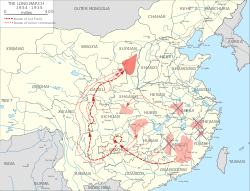
The Long March (Chinese: 长征; pinyin: Chángzhēng; lit. 'Long Expedition') was a military retreat by the Chinese Red Army and Chinese Communist Party (CCP) from advancing Kuomintang (KMT) forces during the Chinese Civil War, occurring between October 1934 and October 1935. About 100,000 troops retreated from the Jiangxi Soviet and other bases to a new headquarters in Yan'an, Shaanxi, traversing some 10,000 kilometres (6,000 miles). About 8,000 troops ultimately survived the Long March.
After the defeat of the Red Army in Chiang Kai-shek's Fifth Encirclement Campaign, on 10 October 1934 the CCP decided to abandon its Jiangxi Soviet and headquarters in Ruijin, Jiangxi. The First Front Red Army of some 86,000 troops headed west, traveling over the rugged terrain of China's western provinces, including eastern Tibet. The Red Army broke several of Chiang's blockades with heavy losses, and by the time it crossed the Xiang River on 1 December had only 36,000 men left. Its leaders, including Comintern military adviser Otto Braun and Moscow-trained Bo Gu, decided to take the troops through Hunan, but Chiang set up defenses to block their way. Mao Zedong, who was not a member of the Politburo, suggested going through Guizhou instead, which was accepted. On New Year's Day 1935, the Red Army crossed the Wu River, and a week later held the Zunyi Conference, which reduced Soviet influence in the Politburo and established Mao's position as de facto leader.
Employing guerrilla warfare, Mao maneuvered to avoid direct confrontation with Chiang's forces and led the Red Army out of encirclements by local warlords. The First Front Army met the Fourth Front Army, led by Zhang Guotao, in Maogong, Sichuan; they disagreed on the route to take to Yan'an and split up. The First Front Army arrived in Yan'an on 19 October 1935 with about 8,000 survivors, ending the Long March. The Fourth Front Army was largely destroyed by Chiang and Ma clique attacks, and its remnants joined the Second Front Army led by He Long. All three armies met on 22 October 1936.
Mao's leadership during the retreat brought him immense prestige and support among many within the otherwise-shattered Communist Party. It marked the beginning of his long ascent to primacy, and would be featured heavily in his public image, through the founding of the People's Republic.
The divisions of the Red Army (Chinese: 中國工農紅軍; pinyin: Zhōngguó gōngnóng hóngjūn; lit. 'Chinese Workers' and Peasants' Red Army') were named according to historical circumstances, not strictly according to the chronological order of their formation. Indeed, early Communist units would often form by defection from existing Kuomintang forces, and they kept their original designations. By the time of the Long March, numerous small units had been organized into three unified Armies: the First, the Second, and the Fourth. To distinguish them from earlier organizational divisions, some translations opt to refer to these same units as the "Front Red Armies", correspondingly numbered.
The First Red Army under the command of Bo Gu and Otto Braun formed from the 1st, 3rd, and 5th Army Corps in southern Jiangxi. When several units formed the Fourth Red Army under Zhang Guotao in the Sichuan–Shaanxi border area, no standard naming system yet existed, in part lending to limited central control by the CCP over separate Communist-controlled enclaves. After these first two forces were organized, the Second Red Army was formed in eastern Guizhou by unifying the 2nd Army Corps under Xiao Ke with the 6th Army Corps under He Long. A Third Red Army was briefly led by He in the area straddling the Hunan–Hubei border, but its defeat in 1932 led to its merger with the 6th Army Corps in October 1934. These three armies would maintain their historical designations until the formation of the Second United Front with the National Revolutionary Army during the Second Sino-Japanese War, which nominally integrated the Communist forces into the NRA, forming the Eighth Route Army and the New Fourth Army.
The Chinese Communist Party was founded in 1921 by Chen Duxiu with Soviet support. The CCP initially collaborated with the nationalist Kuomintang, founded by the revolutionary republican Sun Yat-sen. However, after the unexpected death of Sun in March 1925, a power struggle within the KMT led to the shift in the party's authority to Chiang Kai-shek, whose Northern Expedition forces succeeded in wresting control of large areas of China from local warlords and establishing a unified government in Nanjing in April 1927. Unlike other nationalist leaders, like Wang Jingwei, Chiang was opposed to the idea of continued collaboration with the CCP. The initial period of cooperation to unify China and end the unequal treaties broke up in April 1927 when Chiang Kai-shek struck out against the Communists. Unsuccessful urban insurrections (in Nanchang, Wuhan and Guangzhou) and the suppression of the CCP in Shanghai and other cities drove many party supporters to rural strongholds such as the Jiangxi Soviet, which was organized by Mao Zedong. By 1928, deserters and defecting Kuomintang army units, supplemented by peasants from the Communist rural soviets, formed the Chinese Workers' and Peasants' Red Army. The ideological confrontation between the CCP and the KMT soon evolved into the first phase of the Chinese Civil War.
By 1930, the Red Army had established the Chinese Soviet Republic in the provinces of Jiangxi and Fujian around the city of Ruijin, including industrial facilities.
Long March
The Long March (Chinese: 长征; pinyin: Chángzhēng; lit. 'Long Expedition') was a military retreat by the Chinese Red Army and Chinese Communist Party (CCP) from advancing Kuomintang (KMT) forces during the Chinese Civil War, occurring between October 1934 and October 1935. About 100,000 troops retreated from the Jiangxi Soviet and other bases to a new headquarters in Yan'an, Shaanxi, traversing some 10,000 kilometres (6,000 miles). About 8,000 troops ultimately survived the Long March.
After the defeat of the Red Army in Chiang Kai-shek's Fifth Encirclement Campaign, on 10 October 1934 the CCP decided to abandon its Jiangxi Soviet and headquarters in Ruijin, Jiangxi. The First Front Red Army of some 86,000 troops headed west, traveling over the rugged terrain of China's western provinces, including eastern Tibet. The Red Army broke several of Chiang's blockades with heavy losses, and by the time it crossed the Xiang River on 1 December had only 36,000 men left. Its leaders, including Comintern military adviser Otto Braun and Moscow-trained Bo Gu, decided to take the troops through Hunan, but Chiang set up defenses to block their way. Mao Zedong, who was not a member of the Politburo, suggested going through Guizhou instead, which was accepted. On New Year's Day 1935, the Red Army crossed the Wu River, and a week later held the Zunyi Conference, which reduced Soviet influence in the Politburo and established Mao's position as de facto leader.
Employing guerrilla warfare, Mao maneuvered to avoid direct confrontation with Chiang's forces and led the Red Army out of encirclements by local warlords. The First Front Army met the Fourth Front Army, led by Zhang Guotao, in Maogong, Sichuan; they disagreed on the route to take to Yan'an and split up. The First Front Army arrived in Yan'an on 19 October 1935 with about 8,000 survivors, ending the Long March. The Fourth Front Army was largely destroyed by Chiang and Ma clique attacks, and its remnants joined the Second Front Army led by He Long. All three armies met on 22 October 1936.
Mao's leadership during the retreat brought him immense prestige and support among many within the otherwise-shattered Communist Party. It marked the beginning of his long ascent to primacy, and would be featured heavily in his public image, through the founding of the People's Republic.
The divisions of the Red Army (Chinese: 中國工農紅軍; pinyin: Zhōngguó gōngnóng hóngjūn; lit. 'Chinese Workers' and Peasants' Red Army') were named according to historical circumstances, not strictly according to the chronological order of their formation. Indeed, early Communist units would often form by defection from existing Kuomintang forces, and they kept their original designations. By the time of the Long March, numerous small units had been organized into three unified Armies: the First, the Second, and the Fourth. To distinguish them from earlier organizational divisions, some translations opt to refer to these same units as the "Front Red Armies", correspondingly numbered.
The First Red Army under the command of Bo Gu and Otto Braun formed from the 1st, 3rd, and 5th Army Corps in southern Jiangxi. When several units formed the Fourth Red Army under Zhang Guotao in the Sichuan–Shaanxi border area, no standard naming system yet existed, in part lending to limited central control by the CCP over separate Communist-controlled enclaves. After these first two forces were organized, the Second Red Army was formed in eastern Guizhou by unifying the 2nd Army Corps under Xiao Ke with the 6th Army Corps under He Long. A Third Red Army was briefly led by He in the area straddling the Hunan–Hubei border, but its defeat in 1932 led to its merger with the 6th Army Corps in October 1934. These three armies would maintain their historical designations until the formation of the Second United Front with the National Revolutionary Army during the Second Sino-Japanese War, which nominally integrated the Communist forces into the NRA, forming the Eighth Route Army and the New Fourth Army.
The Chinese Communist Party was founded in 1921 by Chen Duxiu with Soviet support. The CCP initially collaborated with the nationalist Kuomintang, founded by the revolutionary republican Sun Yat-sen. However, after the unexpected death of Sun in March 1925, a power struggle within the KMT led to the shift in the party's authority to Chiang Kai-shek, whose Northern Expedition forces succeeded in wresting control of large areas of China from local warlords and establishing a unified government in Nanjing in April 1927. Unlike other nationalist leaders, like Wang Jingwei, Chiang was opposed to the idea of continued collaboration with the CCP. The initial period of cooperation to unify China and end the unequal treaties broke up in April 1927 when Chiang Kai-shek struck out against the Communists. Unsuccessful urban insurrections (in Nanchang, Wuhan and Guangzhou) and the suppression of the CCP in Shanghai and other cities drove many party supporters to rural strongholds such as the Jiangxi Soviet, which was organized by Mao Zedong. By 1928, deserters and defecting Kuomintang army units, supplemented by peasants from the Communist rural soviets, formed the Chinese Workers' and Peasants' Red Army. The ideological confrontation between the CCP and the KMT soon evolved into the first phase of the Chinese Civil War.
By 1930, the Red Army had established the Chinese Soviet Republic in the provinces of Jiangxi and Fujian around the city of Ruijin, including industrial facilities.
Recent media
Recent media