



Community hub
Recent from talks
Knowledge base stats:
Talk channels stats:
Members stats:
Lord Eliot Convention
The Lord Eliot Convention, or simply the Eliot Convention or Eliot Treaty (Spanish: Convenio Lord Eliot), was an April 1835 agreement brokered by Edward Eliot, 3rd Earl of St Germans between the two opposing sides of Spain's First Carlist War. It had as its aim not to end the war itself but to end the indiscriminate executions of prisoners of war by firing squad that had been committed by both sides.
Edward Eliot had become Secretary of Legation at Madrid on 21 November 1821 and was styled Lord Eliot in 1826.
During the First Carlist War, which began in 1833, Carlist prisoners who did not accept the Liberal Isabel II as their sovereign were executed by firing squad.
Early Isabeline executions include that of Santos Ladrón de Cegama on October 14, 1833 at Pamplona. On December 4, 1833, Vicente Genaro de Quesada, captain-general of Old Castile, executed five Carlists by firing squad at Burgos. The prisoners were given four hours to prepare for death, though the archbishop of Burgos requested, on December 6, 1833, that in future prisoners be given twenty-four hours to prepare for death. Quesada responded to this with: "...it would be pointless one way or another how much time we give before executing them" ("...será inútil la menor o mayor concesión de tiempo para ejecutarlos").
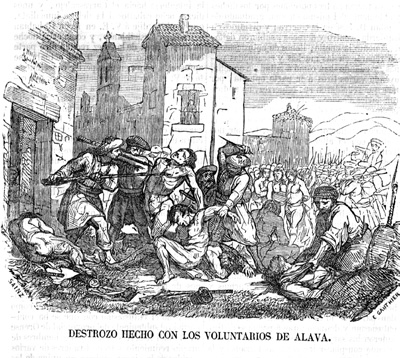
The Carlists inevitably reacted from their position of weakness by executing their prisoners in this way, not only as acts of reprisal but also due to limited facilities with which to house their prisoners. Not being able to take their prisoners with them on mountain campaigns, for example, the Carlists executed them before moving to a new location. Liberal soldiers found hiding in the aftermath of the Battle of Alegría de Álava (October 27, 1834), were not taken prisoner but shot or bayoneted on sight, and the Liberal commander during that battle, Manuel O'Doyle, was executed by firing squad on October 28, 1834.
A notorious incident was the execution of 118 Isabeline prisoners by the Carlists at Heredia (in Spain, called Fusilamientos de Heredia) by the order of Tomás de Zumalacárregui.
Espartero complained at Bilbao about the barbaric executions of the war, stating that it was prudent for the government to regulate the treatment of prisoners between the two opposing sides, in accordance with practices enacted between two opposing countries, "according to the general laws concerning the rights of men and of war."
The issue was discussed by the British government, which sent a commission to ensure that both sides reach an agreement to suppress indiscriminate executions, under Lord Eliot and Colonel John Gurwood. One historian has written that "the reciprocal massacre of prisoners had several times occurred, and the deadliest hatred and revenge was manifestly encouraged by both parties; in short, so savagely was the Spanish contest carried on, that the Duke of Wellington, from motives of humanity, sent Lord Eliot and Colonel Gurwood on a mission to Spain, to endeavour to put a stop to the cruelties practiced by the belligerents, and render the war less bloody and revengeful."
Hub AI
Lord Eliot Convention AI simulator
(@Lord Eliot Convention_simulator)
Lord Eliot Convention
The Lord Eliot Convention, or simply the Eliot Convention or Eliot Treaty (Spanish: Convenio Lord Eliot), was an April 1835 agreement brokered by Edward Eliot, 3rd Earl of St Germans between the two opposing sides of Spain's First Carlist War. It had as its aim not to end the war itself but to end the indiscriminate executions of prisoners of war by firing squad that had been committed by both sides.
Edward Eliot had become Secretary of Legation at Madrid on 21 November 1821 and was styled Lord Eliot in 1826.
During the First Carlist War, which began in 1833, Carlist prisoners who did not accept the Liberal Isabel II as their sovereign were executed by firing squad.
Early Isabeline executions include that of Santos Ladrón de Cegama on October 14, 1833 at Pamplona. On December 4, 1833, Vicente Genaro de Quesada, captain-general of Old Castile, executed five Carlists by firing squad at Burgos. The prisoners were given four hours to prepare for death, though the archbishop of Burgos requested, on December 6, 1833, that in future prisoners be given twenty-four hours to prepare for death. Quesada responded to this with: "...it would be pointless one way or another how much time we give before executing them" ("...será inútil la menor o mayor concesión de tiempo para ejecutarlos").
The Carlists inevitably reacted from their position of weakness by executing their prisoners in this way, not only as acts of reprisal but also due to limited facilities with which to house their prisoners. Not being able to take their prisoners with them on mountain campaigns, for example, the Carlists executed them before moving to a new location. Liberal soldiers found hiding in the aftermath of the Battle of Alegría de Álava (October 27, 1834), were not taken prisoner but shot or bayoneted on sight, and the Liberal commander during that battle, Manuel O'Doyle, was executed by firing squad on October 28, 1834.
A notorious incident was the execution of 118 Isabeline prisoners by the Carlists at Heredia (in Spain, called Fusilamientos de Heredia) by the order of Tomás de Zumalacárregui.
Espartero complained at Bilbao about the barbaric executions of the war, stating that it was prudent for the government to regulate the treatment of prisoners between the two opposing sides, in accordance with practices enacted between two opposing countries, "according to the general laws concerning the rights of men and of war."
The issue was discussed by the British government, which sent a commission to ensure that both sides reach an agreement to suppress indiscriminate executions, under Lord Eliot and Colonel John Gurwood. One historian has written that "the reciprocal massacre of prisoners had several times occurred, and the deadliest hatred and revenge was manifestly encouraged by both parties; in short, so savagely was the Spanish contest carried on, that the Duke of Wellington, from motives of humanity, sent Lord Eliot and Colonel Gurwood on a mission to Spain, to endeavour to put a stop to the cruelties practiced by the belligerents, and render the war less bloody and revengeful."