Hubbry Logo
Mid-range speakerMid-range speakerMain
Open search
Mid-range speaker
Community hub
Mid-range speaker
logo
8 pages, 0 posts
0 subscribers
Be the first to start a discussion here.
Mid-range speaker
Mid-range speaker
from Wikipedia
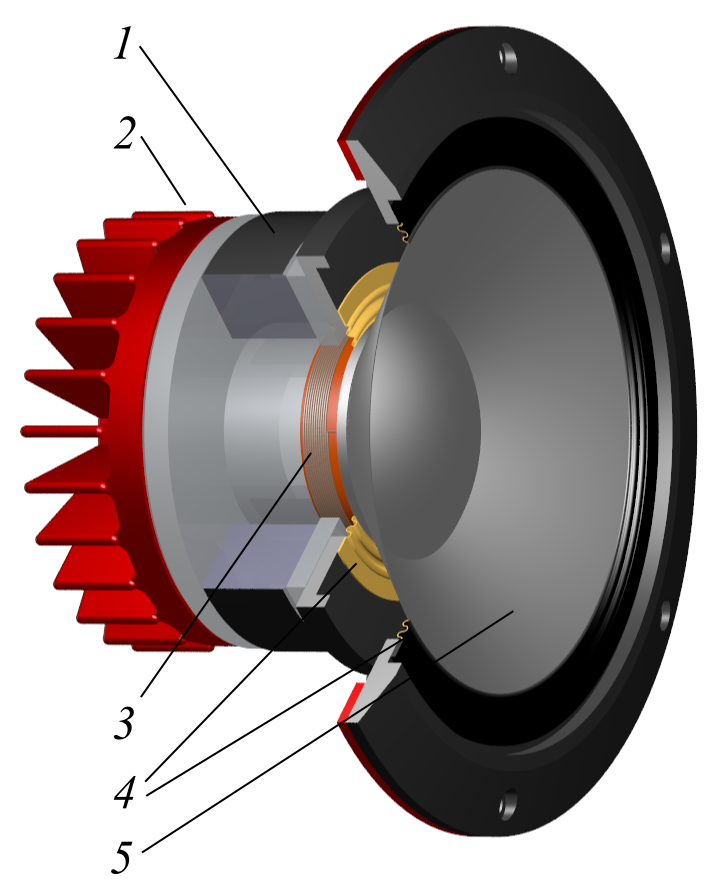
Cutaway view of a dynamic mid-range speaker
  1. Magnet
  2. Cooler
  3. Voicecoil
  4. Suspension
  5. Membrane

A mid-range speaker is a loudspeaker driver that reproduces sound in the frequency range from 200 to 2,000 Hz.[1]

Mid-range drivers are usually cone types or, less commonly, dome types, or compression horn drivers. The radiating diaphragm of a cone mid-range unit is a truncated cone, with a voice coil attached at the neck, along with the spider portion of the suspension, and with the cone surround at the wide end. Cone mid-range drivers typically resemble small woofers. The most common material used for mid-range cones is paper, occasionally impregnated and/or surface-treated with polymers or resins in order to improve vibrational damping. Other mid-range cone materials include plastics such as polypropylene, Cobex, Bextrene, woven Kevlar, fiberglass, carbon fiber, or light metal alloys based on aluminium, magnesium, titanium, or other alloys. The radiating surface of a dome mid-range is typically a 90-degree section of a sphere, made from cloth, metal, or plastic film, with its suspension and voice coil co-located at the outer edge of the dome. Most professional concert mid-range drivers are compression drivers coupled to horns. A very few mid-ranges are electrostatic drivers, planar magnetic drivers, or ribbon drivers.

A mid-range driver is called upon to handle the most significant part of the audible sound spectrum, the region where the most fundamental frequencies are emitted by musical instruments, and, most importantly, the human voice, lie. This region contains most sounds that are the most familiar to the human ear, and where discrepancies from faithful reproduction are most easily observed. It is therefore paramount that a mid-range driver of good quality be capable of low-distortion reproduction.

Most television sets and small radios, especially AM receivers, have only a single mid-range driver, or two for stereo sound. With human speech being the most important aspect of television audio and AM radio, it works out well. Since the ear is most sensitive to the middle frequencies produced by a mid-range the driver and amplifier can both be low power, while still delivering what is perceived to be good sound both in terms of volume and quality.

Installation issues

[edit]

Mid-range drivers are usually used in three-way multi-driver speaker systems. There are therefore special considerations involved in the acoustic join between the mid-range and both the low frequency (woofers) and the high frequency drivers (tweeters). The nature of the drivers on both sides of the mid-range, and the mid-range itself affect the selection of crossover frequency and slope. Nearly all crossovers are passive circuits, designed to match the characteristics of the drivers and their mounting, and are built of capacitors, inductors, and resistors. Active or 'electronic' crossovers are used in some high performance hi-fi speakers, and in professional sound reinforcement systems.

Placement of the mid-range (and tweeter) drivers on the enclosure baffle significantly affect the output of the driver, and the material surrounding the mid-range and tweeter drivers on the baffle can produce (or inhibit) reflections of energy from the baffle face, or other items, further influencing the output. Grilles, especially those with structural frames, can further modify the output of the entire speaker system. One of the terms used in design circles to describe some of these diffraction and reflection artifacts is the baffle step effect.

When a mid-range speaker is mounted in the same box as a woofer, it will have its own small sub-enclosure, or a sealed back, to prevent the woofer's backwave radiation into the box from affecting the mid-range's cone or dome motion.

See also

[edit]

References

[edit]
Revisions and contributorsEdit on WikipediaRead on Wikipedia
from Grokipedia
A speaker, also known as a midrange driver, is a specialized component designed to reproduce audio signals in the middle portion of the human hearing spectrum, serving as a key element in multi-way speaker systems alongside woofers for low frequencies and tweeters for high frequencies. These drivers are essential for delivering clear and detailed sound reproduction, particularly for elements like human vocals and the fundamental tones of most musical instruments. In three-way enclosures, mid-range speakers work with passive crossovers to receive and amplify only the appropriate frequency band from the input signal, ensuring balanced overall audio performance. The typical of a speaker is 300 Hz to 5 kHz, though it varies by design; common ranges include 300-5000 Hz, 500-4000 Hz, and 800 Hz to 5 kHz. This range aligns closely with the ear's greatest sensitivity, making mid-range drivers crucial for perceived in music and speech, as they handle the core content where most auditory information is concentrated. Mid-range speakers often feature cone diameters of 3 to 6.5 inches, constructed from materials like paper, , or metal to optimize efficiency and minimize within their operational band. Common types include cone drivers for general hi-fi and use, dome drivers for compact installations, and compression horn drivers favored in professional sound reinforcement for higher efficiency and controlled dispersion. Applications span such as home theater systems and televisions, professional setups like recording studios and live sound stages, and automotive audio, where they enhance clarity without requiring excessive power. Proper integration with enclosure design and crossover networks is vital to avoid resonances and achieve a smooth across the full audible spectrum.

Fundamentals

Definition and Role in Audio Systems

A mid-range speaker, also referred to as a driver, is a specialized component engineered to reproduce audio signals within the mid-frequency , typically 300 Hz to 5 kHz, though it varies; common ranges include 300-5000 Hz, 500-4000 Hz, and 800 Hz to 5 kHz. This range can vary by system design. As a core element in multi-driver audio setups, the mid-range speaker focuses on delivering precise reproduction of sounds where human hearing is most sensitive, encompassing the fundamental frequencies of speech and . In audio systems, the mid-range speaker plays a pivotal role by handling vocals, the primary tones of instruments such as guitars and , and the content that forms the bulk of audible and . It bridges the low-frequency domain managed by woofers (bass) and the high-frequency domain covered by tweeters (treble), ensuring a cohesive soundstage. This specialization is essential for achieving clarity and natural in multi-way configurations, such as two-way or three-way speaker systems, where crossover networks divide the input signal to direct mid-frequencies exclusively to the mid-range driver. Without effective mid-range performance, overall audio fidelity suffers, as this band contains roughly 90% of the perceptual information in typical recordings. Compared to full-range speakers, which attempt to cover the entire audible spectrum from 20 Hz to 20 kHz, mid-range drivers concentrate on a narrower band to enhance accuracy and minimize . This focused approach allows for superior detail in critical mid-frequencies, contributing to more lifelike sound reproduction in professional and consumer applications.

Historical Development

The origins of mid-range speakers can be traced to the early 20th century, when full-range horn designs dominated audio reproduction but revealed limitations in covering the full audible spectrum with uniform quality. In the 1920s, Bell Laboratories advanced horn-loaded systems, such as exponential horns introduced in 1926, which were primarily used in theaters and public address setups but struggled with mid-frequency clarity and efficiency across broader ranges. These shortcomings necessitated frequency division, paving the way for specialized drivers. By the 1930s, Bell Labs developed the first two-way loudspeakers with divided frequency ranges in 1931, marking an early step toward multi-way systems that separated low and high frequencies, though dedicated mid-range components were not yet formalized. The emergence of distinct mid-range drivers solidified in the 1930s and 1940s amid the growth of cinema and public address applications, with post-World War II consumer hi-fi systems accelerating their adoption. Altec Lansing's 1944 Duplex driver in the 604 series integrated and functions in a design for mid and high frequencies. Their Voice of the Theater systems from the late 1940s featured horn-loaded s handling mid and high frequencies for enhanced vocal reproduction. In the 1950s, mid-range drivers gained popularity in home hi-fi setups to support emerging recordings and improved handling. The shift from mono to in the mid-1950s, driven by LP records and tape, heightened demands on mid-range performance to support spatial imaging and instrument separation, influencing designs toward more precise handling in consumer systems. Key innovations in the focused on cone-based drivers for improved in the 300 Hz to 5 kHz range, addressing and content. KEF's B110 bass-midrange driver, introduced in the mid-to-late , utilized a Bextrene cone for reduced compared to traditional paper, though it faced challenges with mid-band resonances around 1.5 kHz. By the , dome mid-range designs gained traction, particularly in European hi-fi speakers, offering wider dispersion and lower for better off-axis response; small fabric or metal domes (typically 38-50 mm) became common in German brands until the mid-1980s, when larger cone drivers regained favor for broader . In the 2000s, the integration of (DSP) revolutionized mid-range optimization through active crossovers, allowing precise electronic frequency division and correction in real-time. This advancement, prominent in studio monitors and home theater systems in the mid-2000s, enabled finer control over mid-range precision, phase alignment, and distortion reduction without relying solely on passive components, significantly enhancing performance in multi-way configurations for both consumer and . Since the 2010s, mid-range drivers have incorporated advanced materials such as , composites, and carbon fiber to further minimize and improve rigidity, while DSP integration has become standard in active speaker systems for real-time optimization as of 2025.

Design Principles

Driver Types and Configurations

Mid-range drivers are engineered in various physical forms to efficiently reproduce frequencies typically between 300 Hz and 5 kHz, though it varies; common ranges include 300-5000 Hz, 500-4000 Hz, and 800 Hz to 5 kHz, with and dome types representing the primary categories. drivers dominate mid-range applications due to their versatility and prevalence in both consumer and systems, generally featuring diameters of 4 to 8 inches for effective piston-like motion that supports substantial without excessive . Dome drivers, conversely, utilize a curved hemispherical diaphragm, commonly sized from 1 to 3 inches, to achieve a more uniform radiating surface that promotes smoother off-axis response and reduced in the upper . These drivers, often constructed with or metal diaphragms, excel in applications requiring precise transient reproduction and wide dispersion. Mid-range drivers appear in several configurations tailored to and performance goals. Standalone mid-range units are standard in three-way loudspeaker setups, positioned between the woofer and tweeter to isolate mid-frequency duties and minimize intermodulation. Coaxial configurations combine the mid-range with the tweeter in a concentric arrangement, aligning acoustic centers for phase-coherent output and improved imaging. Planar or ribbon variants, employed in high-end systems, leverage thin-film diaphragms driven along their length to deliver low-distortion mid-range with exceptional clarity and speed. Driver size directly affects frequency allocation and capability within the mid-range spectrum. Smaller drivers, exemplified by 3-inch models, target higher mid-range bands from about 1 to 5 kHz, benefiting from lower mass for agile response but with moderated power handling. Larger 6-inch drivers, by contrast, handle lower mid-range from 200 Hz to 1 kHz, providing greater efficiency and displacement for dynamic passages. Notable examples illustrate evolutionary contrasts: dynamic cone mid-ranges like the vintage 5-inch B110, a staple in classic BBC-inspired monitors for its balanced output across the mid-band, versus modern beryllium dome designs such as the 3-inch BlieSMa M74B-6, which employs advanced diaphragm to suppress breakup modes and extend usable bandwidth.

Materials and Construction

Mid-range speakers employ a variety of cone materials chosen for their acoustic properties, balancing lightness, rigidity, and to reproduce frequencies typically between 300 Hz and 5 kHz, though it varies; common ranges include 300-5000 Hz, 500-4000 Hz, and 800 Hz to 5 kHz with clarity and minimal coloration. cones, derived from pulp formulations such as or , are favored for their lightweight construction and inherent internal , which contributes to a natural, responsive sound in the mid-range spectrum. cones, often reinforced with fillers like or glass , offer excellent moisture resistance and low distortion, making them suitable for environments prone to humidity, such as automotive applications, while maintaining a lightweight profile for efficient . For enhanced performance, advanced like (an aramid ) or carbon are used, providing superior rigidity and low resonance characteristics that reduce unwanted vibrations and ensure precise mid-range reproduction, particularly in high-end systems demanding wide . The voice coil assembly in mid-range drivers typically features copper or aluminum windings to drive the cone effectively within the . Copper coils are preferred for their high conductivity and ease of , enabling reliable power handling and low resistance, while aluminum coils reduce overall mass for improved efficiency and faster response times, though they require specialized joining methods to mitigate brittleness under heat. These coils are wound on formers made from (a thermoset ), which offers low mass, non-conductivity, and high thermal tolerance, ensuring structural integrity during extended operation. The magnet structure, often utilizing for its compact size and high flux density (typically 1-2 Tesla) or ferrite for cost-effective strength, generates the necessary to interact with the voice coil, with enabling lighter designs without sacrificing performance in professional mid-range applications. Surrounds and spiders are critical for controlling cone excursion and maintaining linearity in mid-range drivers. Foam or rubber surrounds facilitate greater excursion while sealing the driver and centering the voice coil; foam provides lighter weight and flexibility for enhanced efficiency, whereas rubber offers superior durability and resistance to environmental degradation. Progressive spiders, constructed from materials like or polyester-cotton, feature varying compliance to precisely manage cone movement—more flexible at low excursions for smooth response and stiffer at higher levels to suppress distortion and ensure accurate mid-range detail. Construction techniques further enhance durability and acoustic isolation in mid-range speakers. Dust caps, typically made from , felt, or aluminum, protect the voice coil gap from debris and contaminants while contributing to the driver's by influencing air movement. Baskets are commonly cast from aluminum to provide rigidity and effective vibration , minimizing resonances that could color the mid-range output and ensuring stable mounting in enclosures. For mid-range isolation, sealed back designs enclose the driver to prevent rear-wave interference with the cone's motion, promoting cleaner sound reproduction, whereas open-back configurations allow some acoustic but require careful integration to avoid phase issues. Material and construction choices in mid-range speakers involve inherent trade-offs between weight, efficiency, , and . Lighter materials like paper or boost efficiency and speed but may compromise on , leading to potential resonances unless reinforced; conversely, rigid options such as or carbon fiber enhance transient accuracy and reduce distortion at the expense of added weight, which can lower overall sensitivity. These balances are optimized through to achieve the desired mid-range without excessive mass that hinders quick response or that withstands prolonged use.

Technical Performance

Frequency Response and Crossover Integration

Mid-range speakers are designed to reproduce frequencies within a core band of approximately 300 Hz to 5,000 Hz, though it varies; common ranges include 300-5000 Hz, 500-4000 Hz, and 800 Hz to 5 kHz, which encompasses the fundamental range of human vocals and many musical instruments. A flat within this band is crucial to minimize coloration, ensuring natural reproduction without emphasizing or attenuating specific harmonics that could alter the perceived . Crossover networks are essential for integrating speakers with and , directing appropriate bands to each driver while attenuating others. Passive crossovers, built into the speaker enclosure, employ capacitors and inductors to form filters; for example, a second-order Butterworth configuration might implement a 500 Hz for the mid-range from the woofer and a 3 kHz for the mid-range to the tweeter, achieving a 12 dB per roll-off. Active crossovers, processed via processors (DSP) before amplification, offer greater precision with adjustable slopes typically ranging from 12 to 24 dB per , allowing fine-tuning of transition points without passive component losses. The magnitude of the for an nth-order Butterworth low-pass crossover filter, illustrating the attenuation above the fcf_c, is given by: H(f)=11+(ffc)2n|H(f)| = \frac{1}{\sqrt{1 + \left( \frac{f}{f_c} \right)^{2n}}}
Add your contribution
Related Hubs
User Avatar
No comments yet.