
Recent from talks
Louisiana State Penitentiary
Knowledge base stats:
Talk channels stats:
Members stats:
Louisiana State Penitentiary
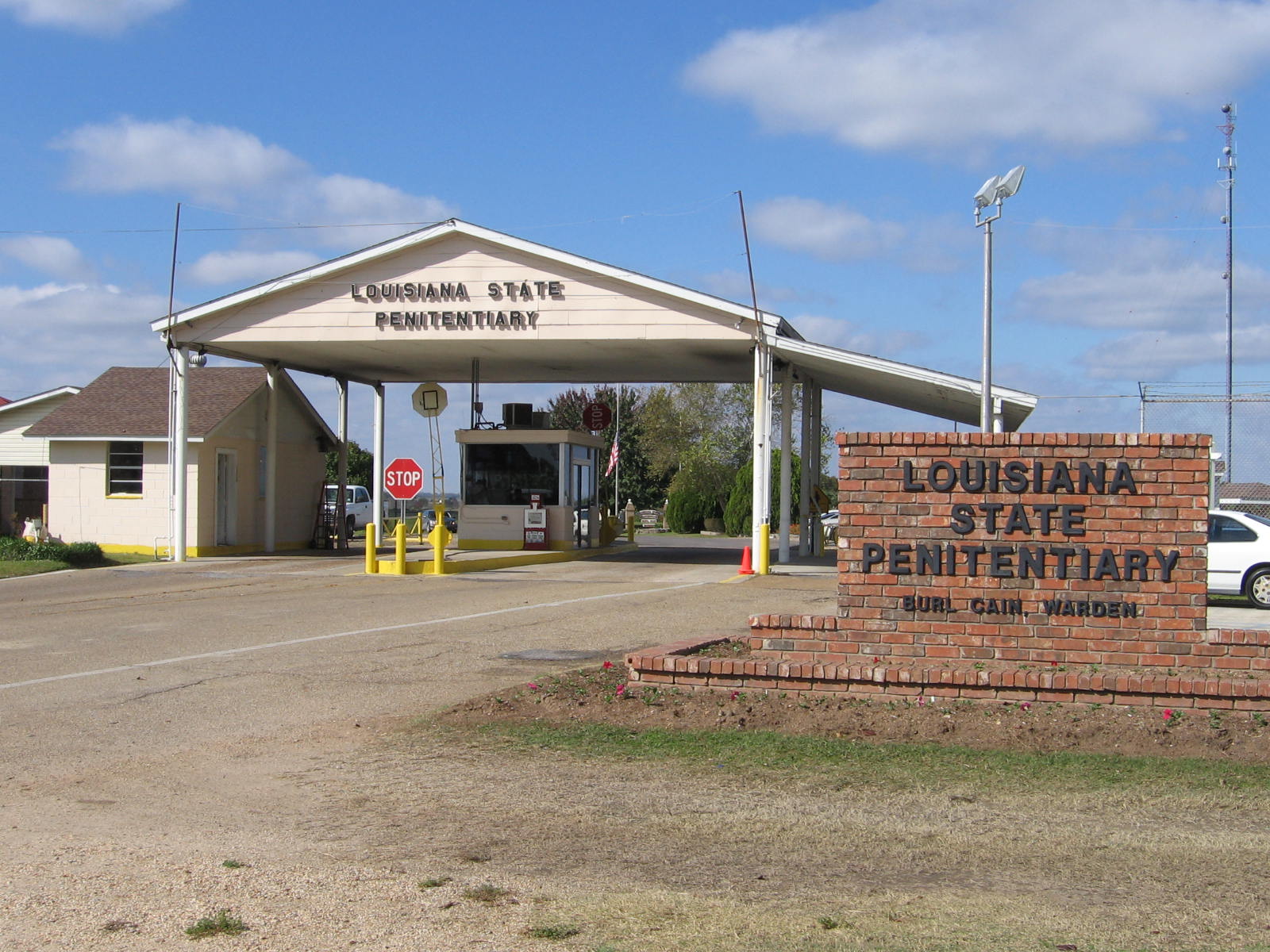
The Louisiana State Penitentiary (known as Angola, and nicknamed the "Alcatraz of the South", "The Angola Plantation" and "The Farm") is a maximum-security prison farm in Louisiana operated by the Louisiana Department of Public Safety & Corrections.
Angola is the largest maximum-security prison in the United States, with 6,300 prisoners and 1,800 staff, including corrections officers, janitors, maintenance workers, deputy wardens, and the warden himself. The current warden is Darrell Vannoy, who was appointed to the role in 2024, after having previously served as warden between 2016 and 2021, following long-time warden Burl Cain's resignation. Located in West Feliciana Parish, the prison is set between oxbow lakes on the east side of a bend of the Mississippi River and thus flanked on three sides by water. It lies less than two miles (three kilometers) south of Louisiana's straight east–west border with Mississippi.
The 28 square miles (73 square kilometers) of land the prison sits on was known before the American Civil War as the Angola Plantations, a slave plantation owned by slave trader Isaac Franklin. The prison is located at the end of Louisiana Highway 66, around 22 miles (35 km) northwest of St. Francisville. Death row for men and the state execution chamber for women and men are located at the Angola facility.
Before 1835, state inmates were held in a jail in New Orleans. The first Louisiana State Penitentiary, located at the intersection of 6th and Laurel streets in Baton Rouge, Louisiana, was modeled on a prison in Wethersfield, Connecticut. It was built to house 100 convicts in cells of 6 ft × 3+1⁄2 ft (1.8 m × 1.1 m). In 1844, the state leased operation of the prison and its prisoners to McHatton Pratt and Company, a private company.[citation needed]
During the American Civil War, Union soldiers occupied the prison in Baton Rouge. In 1869, during the Reconstruction era, Samuel Lawrence James, a former Confederate major, received the military lease to the future prison property along the Mississippi River. He tried to produce cotton with the forced labor of African Americans.
The land developed as Angola Penitentiary was purchased in the 1830s from Francis Rout as four contiguous plantations by Isaac Franklin. He was a planter and slave trader, co-owner of the profitable slave trading firm Franklin and Armfield, of Alexandria, Virginia, and Natchez, Mississippi. After he died in 1846, Franklin's widow, by then known as Adelicia Cheatham, joined these plantations: Panola, Belle View, Killarney, and Angola, when she sold them all in 1880 to Samuel Lawrence James, the former CSA officer. The Angola plantation was named after the country on the west coast of Southern Africa, from which many enslaved people had come. It contained a building called the Old Slave Quarters.
Under the convict lease system, Major James ran his vast plantation using convicts leased from the state as his workers. He was responsible for their room and board and had total authority over them. With the incentive to earn money from prisoners, the state passed laws directed at African Americans, requiring payment of minor fees and fines as punishment for infractions. Cash-poor men in the agricultural economy were forced into jail and convict labor. Such convicts were frequently abused, underfed, and subject to unregulated violence. The state exercised little oversight of conditions. Prisoners were often worked to death under harsh conditions.[full citation needed] James died in 1894.
The Louisiana Department of Public Safety & Corrections says this facility opened as a state prison in 1901. The state began transferring prison facilities out of the old penitentiary into Angola. The old penitentiary continued to be used as a receiving station, hospital, clothing, and shoe factory, and place for executions until it finally closed in 1917. The history and archaeology of the old penitentiary provides insights into inmates' structures and daily life.
Hub AI
Louisiana State Penitentiary AI simulator
(@Louisiana State Penitentiary_simulator)
Louisiana State Penitentiary
The Louisiana State Penitentiary (known as Angola, and nicknamed the "Alcatraz of the South", "The Angola Plantation" and "The Farm") is a maximum-security prison farm in Louisiana operated by the Louisiana Department of Public Safety & Corrections.
Angola is the largest maximum-security prison in the United States, with 6,300 prisoners and 1,800 staff, including corrections officers, janitors, maintenance workers, deputy wardens, and the warden himself. The current warden is Darrell Vannoy, who was appointed to the role in 2024, after having previously served as warden between 2016 and 2021, following long-time warden Burl Cain's resignation. Located in West Feliciana Parish, the prison is set between oxbow lakes on the east side of a bend of the Mississippi River and thus flanked on three sides by water. It lies less than two miles (three kilometers) south of Louisiana's straight east–west border with Mississippi.
The 28 square miles (73 square kilometers) of land the prison sits on was known before the American Civil War as the Angola Plantations, a slave plantation owned by slave trader Isaac Franklin. The prison is located at the end of Louisiana Highway 66, around 22 miles (35 km) northwest of St. Francisville. Death row for men and the state execution chamber for women and men are located at the Angola facility.
Before 1835, state inmates were held in a jail in New Orleans. The first Louisiana State Penitentiary, located at the intersection of 6th and Laurel streets in Baton Rouge, Louisiana, was modeled on a prison in Wethersfield, Connecticut. It was built to house 100 convicts in cells of 6 ft × 3+1⁄2 ft (1.8 m × 1.1 m). In 1844, the state leased operation of the prison and its prisoners to McHatton Pratt and Company, a private company.[citation needed]
During the American Civil War, Union soldiers occupied the prison in Baton Rouge. In 1869, during the Reconstruction era, Samuel Lawrence James, a former Confederate major, received the military lease to the future prison property along the Mississippi River. He tried to produce cotton with the forced labor of African Americans.
The land developed as Angola Penitentiary was purchased in the 1830s from Francis Rout as four contiguous plantations by Isaac Franklin. He was a planter and slave trader, co-owner of the profitable slave trading firm Franklin and Armfield, of Alexandria, Virginia, and Natchez, Mississippi. After he died in 1846, Franklin's widow, by then known as Adelicia Cheatham, joined these plantations: Panola, Belle View, Killarney, and Angola, when she sold them all in 1880 to Samuel Lawrence James, the former CSA officer. The Angola plantation was named after the country on the west coast of Southern Africa, from which many enslaved people had come. It contained a building called the Old Slave Quarters.
Under the convict lease system, Major James ran his vast plantation using convicts leased from the state as his workers. He was responsible for their room and board and had total authority over them. With the incentive to earn money from prisoners, the state passed laws directed at African Americans, requiring payment of minor fees and fines as punishment for infractions. Cash-poor men in the agricultural economy were forced into jail and convict labor. Such convicts were frequently abused, underfed, and subject to unregulated violence. The state exercised little oversight of conditions. Prisoners were often worked to death under harsh conditions.[full citation needed] James died in 1894.
The Louisiana Department of Public Safety & Corrections says this facility opened as a state prison in 1901. The state began transferring prison facilities out of the old penitentiary into Angola. The old penitentiary continued to be used as a receiving station, hospital, clothing, and shoe factory, and place for executions until it finally closed in 1917. The history and archaeology of the old penitentiary provides insights into inmates' structures and daily life.
Recent media