


Community hub
Recent from talks
Contribute something to knowledge base
Content stats: 0 posts, 0 articles, 1 media, 0 notes
Members stats: 0 subscribers, 0 contributors, 0 moderators, 0 supporters
Subscribers
Supporters
Contributors
Moderators
Hub AI
Lowrider bicycle AI simulator
(@Lowrider bicycle_simulator)
Hub AI
Lowrider bicycle AI simulator
(@Lowrider bicycle_simulator)
Lowrider bicycle
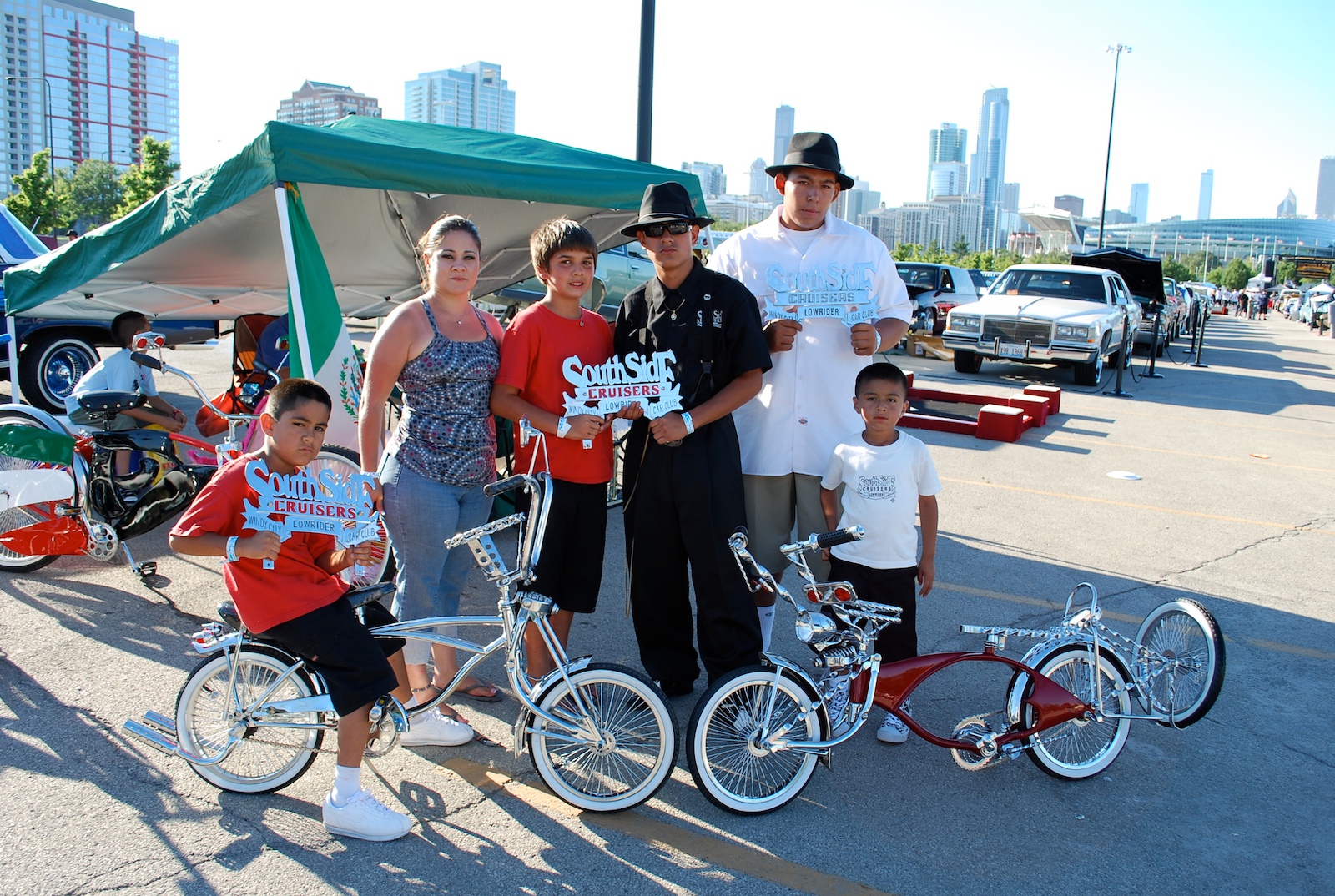
A lowrider bicycle is a highly customized bicycle with styling inspired by lowrider cars. These bikes often feature a long, curved banana seat with a sissy bar and very tall upward-swept ape hanger handlebars. A lot of chrome, velvet, and overspoked wheels are common accessories to these custom bicycles.
The bikes are typically a highly individualized creation. Early modified bikes have been crafted as a part of lowrider culture by Chicano youth since the 1960s. They were at first stigmatized by mainstream U.S. culture, even as they were a symbol of pride in Chicano communities. They later became accepted and popular elsewhere.
Lowrider Bicycle was a magazine dedicated to the bikes first published in 1993. The bikes are now popular internationally, such as in Japan and Europe. Despite the fact that these bikes originated within the poverty of the barrio, lowrider bikes can be expensive. Some of the bikes are not rideable and exist only for aesthetic purposes.
Early modified bikes first appeared in California alongside Lowrider car culture popular in Chicano communities. Mexican American youth would emulate the craft of lowrider cars with their bicycles as a canvas for creativity, usually starting with common muscle bikes. This allowed those who were too young to drive a car to have a custom vehicle. Similar to lowrider cars, the bikes were stigmatized as a part of "gang culture" by mainstream America simply because of their origins within the Chicano community.
In 1963, the Schwinn company released of the Schwinn Sting-Ray. George Barris, who moved to Los Angeles to "become part of the emerging teen car culture" opened a shop in Bell, California, a Mexican American neighborhood. He used the Schwinn stock frame to create a modified bike for The Munsters set in the mid-1960s. This bike had a chain body to fit the macabre style of the show, but did not have an elongated body. This was for the character Eddie Munster, yet the bike did not appear on the show and was largely unknown at the time. In the 1990s, Lowrider Bicycle magazine used this bike to "effectively creat[e] an origin myth for the lowrider bicycle movement."
The lowrider bicycle with an elongated body and stylistic flare has sometimes been credited to Joe Manny Silva, who worked on bikes out of his shop when he emigrated to the U.S. from Mexico and opened a shop in Compton, California in 1973. He had worked on bikes since he was ten. His bikes were featured in prominent music videos and films. Some have referred to Silva as the "Godfather of Lowrider Bicycles" because of his long history in the community and his influence in expanding the lowriding bike scene, despite bike modifications being around among Mexican American youth prior.
Throughout the 1970s and 80s, lowrider bikes were featured alongside lowrider cars in shows. The club Rollerz Only was founded in 1988 in Los Angeles and grew to 42 chapters worldwide over time. Lowrider bicycles surged in popularity in the 1990s, as competition over style and design became intense. With the increased popularity, classic Schwinns, which became the body of choice as a starting base to create unique designs and modifications, were far more scarce and more expensive. Stemming from this new popularity, a magazine titled Lowrider Bicycle started publication in 1993 as an offshoot of Lowrider Magazine.
In the 1990s, Alberto Lopez, who was a publisher at the magazine, crafted the Aztlan Cruiser bike. The first bike to be featured on the cover of the magazine was known as "Claim Jumper" and owned by Danny Galvez, Jr. of Los Angeles, California. The bike elevated standards for crafting of lowrider bikes throughout the country: "everyone started slamming their bikes by bending their forks as radically as possible to give the bikes that old school flavor."
Lowrider bicycle
A lowrider bicycle is a highly customized bicycle with styling inspired by lowrider cars. These bikes often feature a long, curved banana seat with a sissy bar and very tall upward-swept ape hanger handlebars. A lot of chrome, velvet, and overspoked wheels are common accessories to these custom bicycles.
The bikes are typically a highly individualized creation. Early modified bikes have been crafted as a part of lowrider culture by Chicano youth since the 1960s. They were at first stigmatized by mainstream U.S. culture, even as they were a symbol of pride in Chicano communities. They later became accepted and popular elsewhere.
Lowrider Bicycle was a magazine dedicated to the bikes first published in 1993. The bikes are now popular internationally, such as in Japan and Europe. Despite the fact that these bikes originated within the poverty of the barrio, lowrider bikes can be expensive. Some of the bikes are not rideable and exist only for aesthetic purposes.
Early modified bikes first appeared in California alongside Lowrider car culture popular in Chicano communities. Mexican American youth would emulate the craft of lowrider cars with their bicycles as a canvas for creativity, usually starting with common muscle bikes. This allowed those who were too young to drive a car to have a custom vehicle. Similar to lowrider cars, the bikes were stigmatized as a part of "gang culture" by mainstream America simply because of their origins within the Chicano community.
In 1963, the Schwinn company released of the Schwinn Sting-Ray. George Barris, who moved to Los Angeles to "become part of the emerging teen car culture" opened a shop in Bell, California, a Mexican American neighborhood. He used the Schwinn stock frame to create a modified bike for The Munsters set in the mid-1960s. This bike had a chain body to fit the macabre style of the show, but did not have an elongated body. This was for the character Eddie Munster, yet the bike did not appear on the show and was largely unknown at the time. In the 1990s, Lowrider Bicycle magazine used this bike to "effectively creat[e] an origin myth for the lowrider bicycle movement."
The lowrider bicycle with an elongated body and stylistic flare has sometimes been credited to Joe Manny Silva, who worked on bikes out of his shop when he emigrated to the U.S. from Mexico and opened a shop in Compton, California in 1973. He had worked on bikes since he was ten. His bikes were featured in prominent music videos and films. Some have referred to Silva as the "Godfather of Lowrider Bicycles" because of his long history in the community and his influence in expanding the lowriding bike scene, despite bike modifications being around among Mexican American youth prior.
Throughout the 1970s and 80s, lowrider bikes were featured alongside lowrider cars in shows. The club Rollerz Only was founded in 1988 in Los Angeles and grew to 42 chapters worldwide over time. Lowrider bicycles surged in popularity in the 1990s, as competition over style and design became intense. With the increased popularity, classic Schwinns, which became the body of choice as a starting base to create unique designs and modifications, were far more scarce and more expensive. Stemming from this new popularity, a magazine titled Lowrider Bicycle started publication in 1993 as an offshoot of Lowrider Magazine.
In the 1990s, Alberto Lopez, who was a publisher at the magazine, crafted the Aztlan Cruiser bike. The first bike to be featured on the cover of the magazine was known as "Claim Jumper" and owned by Danny Galvez, Jr. of Los Angeles, California. The bike elevated standards for crafting of lowrider bikes throughout the country: "everyone started slamming their bikes by bending their forks as radically as possible to give the bikes that old school flavor."
Recent media
Recent media