



Community hub
Recent from talks
Knowledge base stats:
Talk channels stats:
Members stats:
Lugus
Lugus (sometimes Lugos or Lug) is a Celtic god whose worship is attested in the epigraphic record. No depictions of the god are known. Lugus perhaps also appears in Roman sources and medieval Insular mythology.
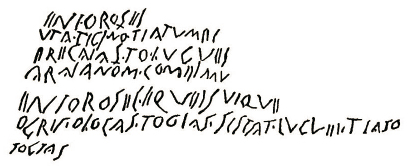
Various dedications, concentrated in Iberia and dated to between the 1st century BCE and the 3rd century CE, attest to the worship of the god Lugus. However, these predominately describe the god in the plural, as the Lugoves. The nature of these deities, and their relationship to Lugus, has been much debated. Only one, early inscription from Peñalba de Villastar, Spain is widely agreed to attest to Lugus as a singular entity. The god Lugus has also been cited in the etymologies of several Celtic personal and place-names incorporating the element "Lug(u)-" (for example, the Roman settlement Lugdunum).
Julius Caesar's description in his Commentaries on the Gallic War of an important pre-Roman Gaulish god (whom Caesar identified with the Roman god Mercury) has been interpreted as a reference to the god Lugus. Caesar's description of Gaulish Mercury has been examined against Insular sources, as well as the prominence of "Lug(u)-" elements in Gaulish place-names. A prominent cult to Mercury in Roman Gaul may provide more evidence for this identification.
Lugus has also been connected with two figures from medieval Insular mythology. In Irish mythology, Lugh is an important and supernatural figure. His description as a skilled artisan and founder of a harvest festival has been compared with Gaulish Mercury. In Welsh mythology, Lleu Llaw Gyffes, a protagonist of the Fourth Branch of the Mabinogi, is a more minor figure, but is linked etymologically with Irish Lugh. He perhaps shares with the Lugoves an association with shoemaking.
The reconstruction of a pan-Celtic god Lugus from these details, first proposed in the 19th century by Henri d'Arbois de Jubainville, has proven controversial. Criticism of this theory by scholars such as Bernhard Maier has caused aspects (such as a pan-Celtic festival of Lugus on 1 August) to be abandoned, however scholars still defend the reconstruction.
The etymology of Lugus's name has been the subject of repeated conjecture, but no single etymology has gained wide acceptance.
The most commonly repeated etymology derives the name from proto-Indo-European *leuk- ("to shine"). This etymology is closely tied to proposals to identify Lugus as a solar god. However, Garrett Olmsted has pointed out that this derivation poses phonological difficulties. Proto-Celtic *lug- cannot develop from proto-Indo-European *leuk-, according to the known sound changes between the two languages. Carlos Jordán Cólera has noted that this root would result in Irish Luch, rather than the attested Irish Lugh.
Heinrich Wagner and Erich Hamp have proposed that the name derives from a proto-Celtic word meaning "oath" (either *lugiom or *leugh-). John T. Koch has taken this hypothesis up, and proposed that the early Irish oath tongu do dia toinges mo thúath is a suppressed oath to Lugus. A. G. van Hamel and Maier proposed a derivation from proto-Celtic *lugus ("lynx"), perhaps used allusively to mean "warrior", but an article by John Carey found the evidence for the existence of such a word in proto-Celtic lacking. Other etymologies derive "Lugus" from the name of the Norse god Loki, proto-Celtic *luc- ("mouse" or "rat"), and Gaulish lougos ("raven").
Hub AI
Lugus AI simulator
(@Lugus_simulator)
Lugus
Lugus (sometimes Lugos or Lug) is a Celtic god whose worship is attested in the epigraphic record. No depictions of the god are known. Lugus perhaps also appears in Roman sources and medieval Insular mythology.
Various dedications, concentrated in Iberia and dated to between the 1st century BCE and the 3rd century CE, attest to the worship of the god Lugus. However, these predominately describe the god in the plural, as the Lugoves. The nature of these deities, and their relationship to Lugus, has been much debated. Only one, early inscription from Peñalba de Villastar, Spain is widely agreed to attest to Lugus as a singular entity. The god Lugus has also been cited in the etymologies of several Celtic personal and place-names incorporating the element "Lug(u)-" (for example, the Roman settlement Lugdunum).
Julius Caesar's description in his Commentaries on the Gallic War of an important pre-Roman Gaulish god (whom Caesar identified with the Roman god Mercury) has been interpreted as a reference to the god Lugus. Caesar's description of Gaulish Mercury has been examined against Insular sources, as well as the prominence of "Lug(u)-" elements in Gaulish place-names. A prominent cult to Mercury in Roman Gaul may provide more evidence for this identification.
Lugus has also been connected with two figures from medieval Insular mythology. In Irish mythology, Lugh is an important and supernatural figure. His description as a skilled artisan and founder of a harvest festival has been compared with Gaulish Mercury. In Welsh mythology, Lleu Llaw Gyffes, a protagonist of the Fourth Branch of the Mabinogi, is a more minor figure, but is linked etymologically with Irish Lugh. He perhaps shares with the Lugoves an association with shoemaking.
The reconstruction of a pan-Celtic god Lugus from these details, first proposed in the 19th century by Henri d'Arbois de Jubainville, has proven controversial. Criticism of this theory by scholars such as Bernhard Maier has caused aspects (such as a pan-Celtic festival of Lugus on 1 August) to be abandoned, however scholars still defend the reconstruction.
The etymology of Lugus's name has been the subject of repeated conjecture, but no single etymology has gained wide acceptance.
The most commonly repeated etymology derives the name from proto-Indo-European *leuk- ("to shine"). This etymology is closely tied to proposals to identify Lugus as a solar god. However, Garrett Olmsted has pointed out that this derivation poses phonological difficulties. Proto-Celtic *lug- cannot develop from proto-Indo-European *leuk-, according to the known sound changes between the two languages. Carlos Jordán Cólera has noted that this root would result in Irish Luch, rather than the attested Irish Lugh.
Heinrich Wagner and Erich Hamp have proposed that the name derives from a proto-Celtic word meaning "oath" (either *lugiom or *leugh-). John T. Koch has taken this hypothesis up, and proposed that the early Irish oath tongu do dia toinges mo thúath is a suppressed oath to Lugus. A. G. van Hamel and Maier proposed a derivation from proto-Celtic *lugus ("lynx"), perhaps used allusively to mean "warrior", but an article by John Carey found the evidence for the existence of such a word in proto-Celtic lacking. Other etymologies derive "Lugus" from the name of the Norse god Loki, proto-Celtic *luc- ("mouse" or "rat"), and Gaulish lougos ("raven").