



Community hub
Recent from talks
Contribute something to knowledge base
Content stats: 0 posts, 0 articles, 1 media, 0 notes
Members stats: 0 subscribers, 0 contributors, 0 moderators, 0 supporters
Subscribers
Supporters
Contributors
Moderators
Hub AI
Lunar Orbiter program AI simulator
(@Lunar Orbiter program_simulator)
Hub AI
Lunar Orbiter program AI simulator
(@Lunar Orbiter program_simulator)
Lunar Orbiter program
The Lunar Orbiter program was a series of five uncrewed lunar orbiter missions launched by the United States in 1966 and 1967. Intended to help select Apollo landing sites by mapping the Moon's surface, they provided the first photographs from lunar orbit and photographed both the Moon and Earth.
All five missions were successful, and 99 percent of the lunar surface was mapped from photographs taken with a resolution of 60 meters (200 ft) or better. The first three missions were dedicated to imaging 20 potential crewed lunar landing sites, selected based on Earth-based observations. These were flown at low-inclination orbits. The fourth and fifth missions were devoted to broader scientific objectives and were flown in high-altitude polar orbits. Lunar Orbiter 4 photographed the entire nearside and nine percent of the far side, and Lunar Orbiter 5 completed the far side coverage and acquired medium (20 m or 66 ft) and high (2 m or 6 ft 7 in) resolution images of 36 preselected areas. All of the Lunar Orbiter spacecraft were launched by Atlas-Agena-D launch vehicles.
The Lunar Orbiters had an imaging system which consisted of a dual-lens camera, a film processing unit, a readout scanner, and a film handling apparatus. Both lenses, a 610 mm (24 in) narrow angle high resolution (HR) lens and an 80 mm (3.1 in) wide angle medium resolution (MR) lens, placed their frame exposures on a single roll of 70 mm film. The axes of the two cameras were coincident so the area imaged in the HR frames were centered within the MR frame areas. The film was moved during exposure to compensate for the spacecraft velocity, which was estimated by an electro-optical sensor. The film was then processed, scanned, and the images transmitted back to Earth.
During the Lunar Orbiter missions, the first pictures of Earth as a whole were taken, beginning with Earth-rise over the lunar surface by Lunar Orbiter 1 in August, 1966. The first full picture of the whole Earth was taken by Lunar Orbiter 5 on 8 August 1967. A second photo of the whole Earth was taken by Lunar Orbiter 5 on 10 November 1967.
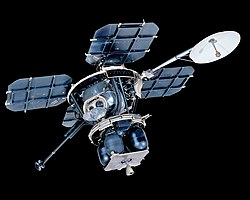
The Boeing-Eastman Kodak proposal was announced by NASA on 20 December 1963. The main bus of the Lunar Orbiter had the general shape of a truncated cone, 1.65 m (5 ft 5 in) tall and 1.5 m (4 ft 11 in) in diameter at the base. The spacecraft was composed of three decks supported by trusses and an arch. The equipment deck at the base of the craft held the battery, transponder, flight programmer, inertial reference unit (IRU), Canopus star tracker, command decoder, multiplex encoder, traveling-wave tube amplifier (TWTA), and the photographic system. Four solar panels were mounted to extend out from this deck with a total span across of 3.72 m (12.2 ft). Also extending out from the base of the spacecraft were a high gain antenna on a 1.32 m (4 ft 4 in) boom and a low-gain antenna on a 2.08 m (6 ft 10 in) boom. Above the equipment deck, the middle deck held the velocity control engine, propellant, oxidizer, and pressurization tanks, Sun sensors, and micrometeoroid detectors. The third deck consisted of a heat shield to protect the spacecraft from the firing of the velocity control engine. The nozzle of the engine protruded through the center of the shield. Mounted on the perimeter of the top deck were four attitude control thrusters.
Power of 375 W was provided by the four solar arrays containing 10,856 n/p solar cells which would directly run the spacecraft and also charge the 12 A·h nickel-cadmium battery. The batteries were used during the brief periods of occultation when no solar power was available. Propulsion for major maneuvers was provided by the gimballed velocity control engine, a hypergolic 440 newtons (100 lbf) thrust Marquardt Corp. rocket motor. Three axis stabilization and attitude control were provided by four 4 newtons (1 lbf) nitrogen gas jets. Navigational knowledge was provided by five Sun sensors, the Canopus star sensor, and the inertial navigation system. Communications were via a 10 W transmitter and the directional one-meter diameter high-gain antenna for transmission of photographs, and a 0.5 W transmitter and omnidirectional low-gain antenna for other communications. Both transmitters operated in the S band at about 2295 MHz. Thermal control was maintained by a multilayer aluminized Mylar and Dacron thermal blanket which enshrouded the main bus, special paint, insulation, and small heaters.
Originally, the Air Force had offered NASA several spare cameras from the KH-7 GAMBIT program, but then authorities became concerned over security surrounding the classified cameras, including the possibility of images of the Moon giving away their resolution. Some proposals were made that NASA not publish the orbital parameters of the Lunar Orbiter probes so that the resolution of the images could not be calculated through their altitude. In the end, NASA's existing camera systems, while lower resolution, proved to be adequate for the needs of the mission.
Kodak created and constructed eight photographic subsystems for the Lunar Orbiter program, five of which were used in space missions of 1966 and 1967. The camera used two lenses to simultaneously expose a wide-angle and a high-resolution image on the same film. The wide-angle, medium resolution mode used an 80 mm F 2.8 Xenotar lens manufactured by Schneider Kreuznach of West Germany. The high-resolution mode used a 610 mm F 5.6 Panoramic lens manufactured by the Pacific Optical Company. The cameras exposed negatives on 65 mm Kodak Bimat film, which was then developed onboard using a semidry process. The subsystem's photomultiplier then scanned the images by a for transmission to Earth as analog video. The receiving stations on Earth then transferred the video images back onto film, which was then shipped to Kodak in Rochester for final processing and printing. This system was adapted under permission of the NRO from the SAMOS E-1 reconnaissance camera, built by Kodak for a short-lived USAF near-realtime satellite imaging project.
Lunar Orbiter program
The Lunar Orbiter program was a series of five uncrewed lunar orbiter missions launched by the United States in 1966 and 1967. Intended to help select Apollo landing sites by mapping the Moon's surface, they provided the first photographs from lunar orbit and photographed both the Moon and Earth.
All five missions were successful, and 99 percent of the lunar surface was mapped from photographs taken with a resolution of 60 meters (200 ft) or better. The first three missions were dedicated to imaging 20 potential crewed lunar landing sites, selected based on Earth-based observations. These were flown at low-inclination orbits. The fourth and fifth missions were devoted to broader scientific objectives and were flown in high-altitude polar orbits. Lunar Orbiter 4 photographed the entire nearside and nine percent of the far side, and Lunar Orbiter 5 completed the far side coverage and acquired medium (20 m or 66 ft) and high (2 m or 6 ft 7 in) resolution images of 36 preselected areas. All of the Lunar Orbiter spacecraft were launched by Atlas-Agena-D launch vehicles.
The Lunar Orbiters had an imaging system which consisted of a dual-lens camera, a film processing unit, a readout scanner, and a film handling apparatus. Both lenses, a 610 mm (24 in) narrow angle high resolution (HR) lens and an 80 mm (3.1 in) wide angle medium resolution (MR) lens, placed their frame exposures on a single roll of 70 mm film. The axes of the two cameras were coincident so the area imaged in the HR frames were centered within the MR frame areas. The film was moved during exposure to compensate for the spacecraft velocity, which was estimated by an electro-optical sensor. The film was then processed, scanned, and the images transmitted back to Earth.
During the Lunar Orbiter missions, the first pictures of Earth as a whole were taken, beginning with Earth-rise over the lunar surface by Lunar Orbiter 1 in August, 1966. The first full picture of the whole Earth was taken by Lunar Orbiter 5 on 8 August 1967. A second photo of the whole Earth was taken by Lunar Orbiter 5 on 10 November 1967.
The Boeing-Eastman Kodak proposal was announced by NASA on 20 December 1963. The main bus of the Lunar Orbiter had the general shape of a truncated cone, 1.65 m (5 ft 5 in) tall and 1.5 m (4 ft 11 in) in diameter at the base. The spacecraft was composed of three decks supported by trusses and an arch. The equipment deck at the base of the craft held the battery, transponder, flight programmer, inertial reference unit (IRU), Canopus star tracker, command decoder, multiplex encoder, traveling-wave tube amplifier (TWTA), and the photographic system. Four solar panels were mounted to extend out from this deck with a total span across of 3.72 m (12.2 ft). Also extending out from the base of the spacecraft were a high gain antenna on a 1.32 m (4 ft 4 in) boom and a low-gain antenna on a 2.08 m (6 ft 10 in) boom. Above the equipment deck, the middle deck held the velocity control engine, propellant, oxidizer, and pressurization tanks, Sun sensors, and micrometeoroid detectors. The third deck consisted of a heat shield to protect the spacecraft from the firing of the velocity control engine. The nozzle of the engine protruded through the center of the shield. Mounted on the perimeter of the top deck were four attitude control thrusters.
Power of 375 W was provided by the four solar arrays containing 10,856 n/p solar cells which would directly run the spacecraft and also charge the 12 A·h nickel-cadmium battery. The batteries were used during the brief periods of occultation when no solar power was available. Propulsion for major maneuvers was provided by the gimballed velocity control engine, a hypergolic 440 newtons (100 lbf) thrust Marquardt Corp. rocket motor. Three axis stabilization and attitude control were provided by four 4 newtons (1 lbf) nitrogen gas jets. Navigational knowledge was provided by five Sun sensors, the Canopus star sensor, and the inertial navigation system. Communications were via a 10 W transmitter and the directional one-meter diameter high-gain antenna for transmission of photographs, and a 0.5 W transmitter and omnidirectional low-gain antenna for other communications. Both transmitters operated in the S band at about 2295 MHz. Thermal control was maintained by a multilayer aluminized Mylar and Dacron thermal blanket which enshrouded the main bus, special paint, insulation, and small heaters.
Originally, the Air Force had offered NASA several spare cameras from the KH-7 GAMBIT program, but then authorities became concerned over security surrounding the classified cameras, including the possibility of images of the Moon giving away their resolution. Some proposals were made that NASA not publish the orbital parameters of the Lunar Orbiter probes so that the resolution of the images could not be calculated through their altitude. In the end, NASA's existing camera systems, while lower resolution, proved to be adequate for the needs of the mission.
Kodak created and constructed eight photographic subsystems for the Lunar Orbiter program, five of which were used in space missions of 1966 and 1967. The camera used two lenses to simultaneously expose a wide-angle and a high-resolution image on the same film. The wide-angle, medium resolution mode used an 80 mm F 2.8 Xenotar lens manufactured by Schneider Kreuznach of West Germany. The high-resolution mode used a 610 mm F 5.6 Panoramic lens manufactured by the Pacific Optical Company. The cameras exposed negatives on 65 mm Kodak Bimat film, which was then developed onboard using a semidry process. The subsystem's photomultiplier then scanned the images by a for transmission to Earth as analog video. The receiving stations on Earth then transferred the video images back onto film, which was then shipped to Kodak in Rochester for final processing and printing. This system was adapted under permission of the NRO from the SAMOS E-1 reconnaissance camera, built by Kodak for a short-lived USAF near-realtime satellite imaging project.
Recent media
Recent media