
Recent from talks
Lunar standstill
Knowledge base stats:
Talk channels stats:
Members stats:
Lunar standstill
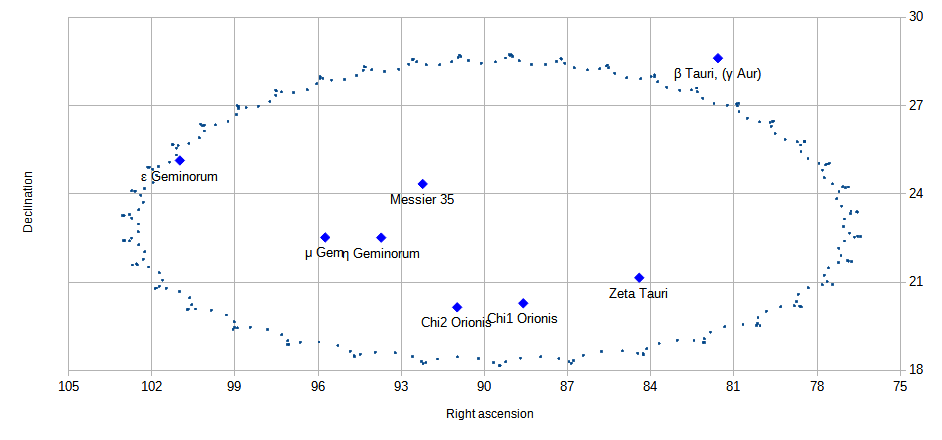
A lunar standstill or lunistice (reminiscent of solstice) is the relative position of the Moon furthest north or furthest south from the celestial equator (measured as an angle expressed in degrees called declination of a celestial coordinate system, analogous to latitude). The Moon comes to an apparent so-called standstill as it changes at that point direction of wandering between northern and southern positions in the course of a month (specifically a tropical month of about 27.3 days). The degree of lunar standstills changes over the course of 18.6 years, between positions of about 18.134° (north or south) and 28.725° (north or south), due to lunar precession. These extremes are called the minor and major lunar standstills.
The last minor lunar standstill was in October 2015, and the next one will be in 2034. The previous major lunar standstill was in 2006 and the most recent in December 2024.
At this time the northern lunistice occurs when the Moon is seen in the direction of Taurus, northern Orion, Gemini, or sometimes the southernmost part of Auriga (as at the time of a major lunistice). The southern lunistice occurs when the Moon is in Sagittarius or Ophiuchus. Due to precession of the Earth's axis, the northernmost and southernmost locations of the Moon in the sky move westward, and in about 13,000 years the northern lunistice will occur in Sagittarius and Ophiuchus and the southern lunistice in the area of Gemini.
During a minor lunar standstill, tidal forces are slightly increased in some places, leading to increased amplitude of tides and tidal flooding.
At a major lunar standstill, the Moon's range of declination, and consequently its range of azimuth at moonrise and moonset, reaches a maximum. As a result, viewed from the middle latitudes, the Moon's altitude at upper culmination (the daily moment when the object appears to contact the observer's meridian) changes in two weeks from its maximum possible value to its minimum possible value above the horizon, due north or due south (depending on the observer's hemisphere). Similarly, its azimuth at moonrise changes from northeast to southeast and at moonset from northwest to southwest.
The times of lunar standstills appear to have had special significance for the Bronze Age societies who built the megalithic monuments in Britain and Ireland. It also has significance for some neopagan religions. Evidence also exists that alignments to the moonrise or moonset on the days of lunar standstills can be found in ancient sites of other ancient cultures, such as at Chaco Canyon in New Mexico, Chimney Rock in Colorado and Hopewell Sites in Ohio.
A major lunar standstill occurs when the Moon's declination reaches a maximum monthly limit, at around 28.72° north or south, whereas a minor lunar standstill occurs when the declination reaches a minimum monthly limit, at around 18.13° north or south. The exact values depend on the exact positions of the Sun, the Moon, the lunar nodes, and the perigee.
Lunistices occur near in time to equinoxes and eclipses. This is because the Moon's orbital inclination has periodic terms, and the main periodic term increases the inclination by 0.135° whenever the Sun lines up with the nodes of the Moon's orbit, in other words at the middle of an eclipse season. Since lunistices occur around the time when the nodes are lined up with the celestial equinox, and since the Sun is near a node, this means they occur around the time when the Sun is at a celestial equinox, that is, around the vernal or autumnal equinox.
Hub AI
Lunar standstill AI simulator
(@Lunar standstill_simulator)
Lunar standstill
A lunar standstill or lunistice (reminiscent of solstice) is the relative position of the Moon furthest north or furthest south from the celestial equator (measured as an angle expressed in degrees called declination of a celestial coordinate system, analogous to latitude). The Moon comes to an apparent so-called standstill as it changes at that point direction of wandering between northern and southern positions in the course of a month (specifically a tropical month of about 27.3 days). The degree of lunar standstills changes over the course of 18.6 years, between positions of about 18.134° (north or south) and 28.725° (north or south), due to lunar precession. These extremes are called the minor and major lunar standstills.
The last minor lunar standstill was in October 2015, and the next one will be in 2034. The previous major lunar standstill was in 2006 and the most recent in December 2024.
At this time the northern lunistice occurs when the Moon is seen in the direction of Taurus, northern Orion, Gemini, or sometimes the southernmost part of Auriga (as at the time of a major lunistice). The southern lunistice occurs when the Moon is in Sagittarius or Ophiuchus. Due to precession of the Earth's axis, the northernmost and southernmost locations of the Moon in the sky move westward, and in about 13,000 years the northern lunistice will occur in Sagittarius and Ophiuchus and the southern lunistice in the area of Gemini.
During a minor lunar standstill, tidal forces are slightly increased in some places, leading to increased amplitude of tides and tidal flooding.
At a major lunar standstill, the Moon's range of declination, and consequently its range of azimuth at moonrise and moonset, reaches a maximum. As a result, viewed from the middle latitudes, the Moon's altitude at upper culmination (the daily moment when the object appears to contact the observer's meridian) changes in two weeks from its maximum possible value to its minimum possible value above the horizon, due north or due south (depending on the observer's hemisphere). Similarly, its azimuth at moonrise changes from northeast to southeast and at moonset from northwest to southwest.
The times of lunar standstills appear to have had special significance for the Bronze Age societies who built the megalithic monuments in Britain and Ireland. It also has significance for some neopagan religions. Evidence also exists that alignments to the moonrise or moonset on the days of lunar standstills can be found in ancient sites of other ancient cultures, such as at Chaco Canyon in New Mexico, Chimney Rock in Colorado and Hopewell Sites in Ohio.
A major lunar standstill occurs when the Moon's declination reaches a maximum monthly limit, at around 28.72° north or south, whereas a minor lunar standstill occurs when the declination reaches a minimum monthly limit, at around 18.13° north or south. The exact values depend on the exact positions of the Sun, the Moon, the lunar nodes, and the perigee.
Lunistices occur near in time to equinoxes and eclipses. This is because the Moon's orbital inclination has periodic terms, and the main periodic term increases the inclination by 0.135° whenever the Sun lines up with the nodes of the Moon's orbit, in other words at the middle of an eclipse season. Since lunistices occur around the time when the nodes are lined up with the celestial equinox, and since the Sun is near a node, this means they occur around the time when the Sun is at a celestial equinox, that is, around the vernal or autumnal equinox.
Recent media