Hubbry Logo
Taurus (constellation)Taurus (constellation)Main
Open search
Taurus (constellation)
Community hub
Taurus (constellation)
logo
8 pages, 0 posts
0 subscribers
Be the first to start a discussion here.
Taurus (constellation)
from Wikipedia
Taurus
Constellation
Taurus
AbbreviationTau[1]
GenitiveTauri[1]
Pronunciation/ˈtɔːrəs/ TOR-əs;
genitive /ˈtɔːr/ TOR-eye[1][2]
Symbolismthe Bull[1]
Right ascension4.9h [3]
Declination19°[3]
QuadrantNQ1
Area797 sq. deg. (17th)
Main stars19
Bayer/Flamsteed
stars
132
Stars brighter than 3.00m4
Stars within 10.00 pc (32.62 ly)3
Brightest starAldebaran (α Tau) (0.85m)
Nearest starWISE 0410+1502[4]: 84 
Messier objects2
Meteor showers
Bordering
constellations
Visible at latitudes between +90° and −60°.
Best visible at 21:00 (9 p.m.) during the month of January.

Taurus (Latin, 'Bull') is one of the constellations of the zodiac and is located in the northern celestial hemisphere. Taurus is a large and prominent constellation in the Northern Hemisphere's winter sky. It is one of the oldest constellations, dating back to the Early Bronze Age at least, when it marked the location of the Sun during the spring equinox. Its importance to the agricultural calendar influenced various bull figures in the mythologies of Ancient Sumer, Akkad, Assyria, Babylon, Egypt, Greece, and Rome. Its traditional astrological symbol is (♉︎), which resembles a bull's head.

A number of features exist that are of interest to astronomers. Taurus hosts two of the nearest open clusters to Earth, the Pleiades and the Hyades, both of which are visible to the naked eye. At first magnitude, the red giant Aldebaran is the brightest star in the constellation. In the northeast part of Taurus is Messier 1, more commonly known as the Crab Nebula, a supernova remnant containing the Crab Pulsar. One of the closest regions of active star formation, the Taurus-Auriga complex, crosses into the northern part of the constellation. The variable star T Tauri is the prototype of a class of pre-main-sequence stars.

Characteristics

[edit]

Taurus is a large and prominent constellation in the Northern Hemisphere's winter sky, between Aries to the west and Gemini to the east; to the north lies Perseus and Auriga, to the southeast Orion, to the south Eridanus, and to the southwest Cetus. In late November-early December, Taurus reaches opposition (furthest point from the Sun) and is visible the entire night. By late March, it is setting at sunset and completely disappears behind the Sun's glare from May to July.[5]

This constellation forms part of the zodiac and hence is intersected by the ecliptic. This circle across the celestial sphere forms the apparent path of the Sun as the Earth completes its annual orbit. As the orbital plane of the Moon and the planets lie near the ecliptic, they can usually be found in the constellation Taurus during some part of each year.[5] The galactic plane of the Milky Way intersects the northeast corner of the constellation and the galactic anticenter is located near the border between Taurus and Auriga. Taurus is the only constellation crossed by all three of the galactic equator, celestial equator, and ecliptic. A ring-like galactic structure known as Gould's Belt passes through the constellation.[6]

The recommended three-letter abbreviation for the constellation, as adopted by the International Astronomical Union in 1922, is "Tau".[7] The official constellation boundaries, as set by Belgian astronomer Eugène Delporte in 1930, are defined by a polygon of 26 segments. In the equatorial coordinate system, the right ascension coordinates of these borders lie between 03h 23.4m and 05h 53.3m , while the declination coordinates are between 31.10° and −1.35°.[8] Because a small part of the constellation lies to the south of the celestial equator, this can not be a completely circumpolar constellation at any latitude.[9]

Features

[edit]

Stars

[edit]
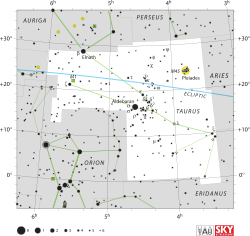
The constellation Taurus as it can be seen by the naked eye.[10] The constellation lines have been added for clarity.

Bayer gave the most prominent stars Bayer designations Alpha through Omega, and the Latin letters A through u. Later designated three stars as Delta and two stars as Theta, Kappa, Sigma, Omega, and the Latin letter A. The star g Tauri was dropped after it was found to be a duplicate of Kappa Ceti (Kappa1 and Kappa2)[11]

There are four stars above magnitude 3 in Taurus. The brightest member of this constellation is Aldebaran, an orange-hued, spectral class K5 III giant star.[12] Its name derives from الدبران al-dabarān, Arabic for "the follower", probably from the fact that it follows the Pleiades during the nightly motion of the celestial sphere across the sky.[13][14][15] Forming the profile of a Bull's face is a V or K-shaped asterism of stars. This outline is created by prominent members of the Hyades,[16] the nearest distinct open star cluster after the Ursa Major Moving Group.[17] In this profile, Aldebaran forms the bull's bloodshot eye, which has been described as "glaring menacingly at the hunter Orion",[18] a constellation that lies just to the southeast. Aldebaran has around 116% the mass of the Sun.[19] It also hosts a candidate exoplanet.[19]

The Hyades span about 5° of the sky, so that they can only be viewed in their entirety with binoculars or the unaided eye.[20] It includes a naked eye double star, Theta Tauri (the proper name of Theta2 Tauri is Chamukuy),[21] with a separation of 5.6 arcminutes.[22]

HP Tauri, a T Tauri variable star and triple system

In the northwestern quadrant of the Taurus constellation lie the Pleiades (M45), one of the best known open clusters, easily visible to the naked eye. The seven most prominent stars in this cluster are at least visual magnitude six, and so the cluster is also named the "Seven Sisters". However, many more stars are visible with even a modest telescope.[23] Astronomers estimate that the cluster has approximately 500–1,000 stars, all of which are around 100 million years old. However, they vary considerably in type. The Pleiades themselves are represented by large, bright stars; also many small brown dwarfs and white dwarfs exist. The cluster is estimated to dissipate in another 250 million years.[24] The Pleiades cluster is classified as a Shapley class c and Trumpler class I 3 r n cluster, indicating that it is irregularly shaped and loose, though concentrated at its center and detached from the star-field.[25]

To the east, the two horns of the bull are formed by Beta (β) Tauri and Zeta (ζ) Tauri; two star systems that are separated by 8°. Beta is a white, spectral class B7 III giant star known as El Nath, which comes from the Arabic phrase "the butting", as in butting by the horns of the bull.[26] At magnitude 1.65, it is the second brightest star in the constellation, and shares the border with the neighboring constellation of Auriga. As a result, it also bears the designation Gamma Aurigae. Zeta Tauri (the proper name is Tianguan[21]) is an eclipsing binary star that completes an orbit every 133 days.[12]

The star Lambda (λ) Tauri is an eclipsing binary star. This system consists of a spectral class B3 star being orbited by a less massive class A4 star. The plane of their orbit lies almost along the line of sight to the Earth. Every 3.953 days the system temporarily decreases in brightness by 1.1 magnitudes as the brighter star is partially eclipsed by the dimmer companion. The two stars are separated by only 0.1 astronomical units, so their shapes are modified by mutual tidal interaction. This results in a variation of their net magnitude throughout each orbit.[27]

Central area of constellation Taurus, showing Aldebaran at the lower left

Located about 1.8° west of Epsilon (ε) Tauri is T Tauri, the prototype of a class of variable stars called T Tauri stars. This star undergoes erratic changes in luminosity, varying between magnitude 9 to 13 over a period of weeks or months.[5] This is a newly formed stellar object that is just emerging from its envelope of gas and dust, but has not yet become a main sequence star.[28] The surrounding reflection nebula NGC 1555 is illuminated by T Tauri, and thus is also variable in luminosity.[29] To the north lies Kappa Tauri, a visual double star consisting of two A7-type components. The pair have a separation of just 5.6 arc minutes, making them a challenge to split with the naked eye.[30]

Brightest stars of Taurus
Proper name Designation Light years Apparent magnitude
Aldebaran α Tauri 65 0.87
Elnath β Tauri 131 1.65
Alcyone A η Tauri 368 2.85
Tianguan ζ Tauri 417 2.97
Chamukuy θ Tauri 149 3.40
Sadr al Tauri λ Tauri 370 3.41
Ain ε Tauri 155 3.53
Omicron Tauri ο Tauri 211 3.61
Atlas A 27 Tauri 380 3.62
Prima Hyadum γ Tauri 154 3.65

Deep-sky objects

[edit]

In the northern part of the constellation to the northeast of the Pleiades lies the Crystal Ball Nebula, known by its catalogue designation of NGC 1514. This planetary nebula is of historical interest following its discovery by German-born English astronomer William Herschel in 1790. Prior to that time, astronomers had assumed that nebulae were simply unresolved groups of stars. However, Herschel could clearly resolve a star at the center of the nebula that was surrounded by a nebulous cloud of some type. In 1864, English astronomer William Huggins used the spectrum of this nebula to deduce that the nebula is a luminous gas, rather than stars.[31]

Brightest NGC objects in Taurus[32]
Identifier Mag. Object type
NGC 1514 10.9 planetary nebula
NGC 1647 6.4 open cluster
NGC 1746 6 asterism[33]
NGC 1817 7.7 open cluster
NGC 1952 8.4 supernova remnant (M1)

North-west of ζ Tauri by 1.15 degrees is the Crab Nebula (M1), a supernova remnant. This expanding nebula was created by a Type II supernova explosion, which was seen from Earth on July 4, 1054. It was bright enough to be observed during the day and is mentioned in Chinese historical texts. At its peak, the supernova reached magnitude −4, but the nebula is currently magnitude 8.4 and requires a telescope to observe.[34][35] North American peoples also observed the supernova, as evidenced from a painting on a New Mexican canyon and various pieces of pottery that depict the event. However, the remnant itself was not discovered until 1731, when John Bevis found it.[24]

IRAS 05437+2502, a nebula

This constellation includes part of the Taurus-Auriga complex, or Taurus dark clouds, a star-forming region containing sparse, filamentary clouds of gas and dust. This spans a diameter of 98 light-years (30 parsecs) and contains 35,000 solar masses of material, which is both larger and less massive than the Orion Nebula.[36] At a distance of 490 light-years (150 parsecs), this is one of the nearest active star forming regions.[37] Located in this region, about 10° to the northeast of Aldebaran, is an asterism NGC 1746 spanning a width of 45 arcminutes.[33]

Meteor showers

[edit]

During November, the Taurid meteor shower appears to radiate from the general direction of this constellation. The Beta Taurid meteor shower occurs during the months of June and July in the daytime, and is normally observed using radio techniques.[38] Between 18 and 29 October, both the Northern Taurids and the Southern Taurids are active; though the latter stream is stronger.[39] However, between November 1 and 10, the two streams equalize.[39]

History and mythology

[edit]
Taurus as depicted in the astronomical treatise Book of Fixed Stars by the Persian astronomer Abd al-Rahman al-Sufi, c. 964
Taurus as depicted in Urania's Mirror, a set of constellation cards published in London c. 1825. The constellation typically represents only the front half of the Bull.

The identification of the constellation of Taurus with a bull is very old, certainly dating to the Chalcolithic, and perhaps even to the Upper Paleolithic. Michael Rappenglück of LMU Munich believes that Taurus is represented in a cave painting at the Hall of the Bulls in the caves at Lascaux (dated to roughly 15,000 BC), which he believes is accompanied by a depiction of the Pleiades.[40][41] The name "seven sisters" has been used for the Pleiades in the languages of many cultures, including indigenous groups of Australia, North America and Siberia. This suggests that the name may have a common ancient origin.[42]

Taurus marked the point of vernal (spring) equinox in the Chalcolithic and the Early Bronze Age, from about 4000 BC to 1700 BC, after which it moved into the neighboring constellation Aries.[43] The Pleiades were closest to the Sun at vernal equinox around the 23rd century BC. In Babylonian astronomy, the constellation was listed in the MUL.APIN as GU4.AN.NA, "The Bull of Heaven".[44] Although it has been claimed that "when the Babylonians first set up their zodiac, the vernal equinox lay in Taurus,"[45] there is a claim that the MUL.APIN tablets indicate[44] that the vernal equinox was marked by the Babylonian constellation known as "the hired man" (the modern Aries).[46]

In the Old Babylonian Epic of Gilgamesh, the goddess Ishtar sends Taurus, the Bull of Heaven, to kill Gilgamesh for spurning her advances.[47] Enkidu tears off the bull's hind part and hurls the quarters into the sky where they become the stars we know as Ursa Major and Ursa Minor. Some locate Gilgamesh as the neighboring constellation of Orion, facing Taurus as if in combat,[48] while others identify him with the sun whose rising on the equinox vanquishes the constellation. In early Mesopotamian art, the Bull of Heaven was closely associated with Inanna, the Sumerian goddess of sexual love, fertility, and warfare. One of the oldest depictions shows the bull standing before the goddess' standard; since it has 3 stars depicted on its back (the cuneiform sign for "star-constellation"), there is good reason to regard this as the constellation later known as Taurus.[49]

The same iconic representation of the Heavenly Bull was depicted in the Dendera zodiac, an Egyptian bas-relief carving in a ceiling that depicted the celestial hemisphere using a planisphere. In these ancient cultures, the orientation of the horns was portrayed as upward or backward. This differed from the later Greek depiction where the horns pointed forward.[50] To the Egyptians, the constellation Taurus was a sacred bull that was associated with the renewal of life in spring. When the spring equinox entered Taurus, the constellation would become covered by the Sun in the western sky as spring began. This "sacrifice" led to the renewal of the land.[51] To the early Hebrews, Taurus was the first constellation in their zodiac and consequently it was represented by the first letter in their alphabet, Aleph.[52]

In Greek mythology, Taurus was identified with Zeus, who assumed the form of a magnificent white bull to abduct Europa, a legendary Phoenician princess. In illustrations of Greek mythology, only the front portion of this constellation is depicted; this was sometimes explained as Taurus being partly submerged as he carried Europa out to sea. A second Greek myth portrays Taurus as Io, a mistress of Zeus. To hide his lover from his wife Hera, Zeus changed Io into the form of a heifer.[53] Greek mythographer Acusilaus marks the bull Taurus as the same that formed the myth of the Cretan Bull, one of The Twelve Labors of Heracles.[54]

Taurus became an important object of worship among the Druids. Their Tauric religious festival was held while the Sun passed through the constellation.[43] Among the arctic people known as the Inuit, the constellation is called Sakiattiat and the Hyades is Nanurjuk, with the latter representing the spirit of the polar bear. Aldebaran represents the bear, with the remainder of the stars in the Hyades being dogs that are holding the beast at bay.[55]

In Buddhism, legends hold that Gautama Buddha was born when the full moon was in Vaisakha, or Taurus.[56] Buddha's birthday is celebrated with the Wesak Festival, or Vesākha, which occurs on the first or second full moon when the Sun is in Taurus.[57]

In 1990, due to the precession of the equinoxes, the position of the Sun on the first day of summer (June 21) crossed the IAU boundary of Gemini into Taurus.[58] The Sun will slowly move through Taurus at a rate of 1° east every 72 years until approximately 2600 AD, at which point it will be in Aries on the first day of summer[citation needed].

Astrology

[edit]

As of 2008, the Sun appears in the constellation Taurus from May 13 to June 21.[59] In tropical astrology, the Sun is considered to be in the sign Taurus from April 20 to May 20.[60]

Space exploration

[edit]

The space probe Pioneer 10 is moving in the direction of this constellation, though it will not be nearing any of the stars in this constellation for many thousands of years, by which time its batteries will be long dead.[61]

Solar eclipse of May 29, 1919

[edit]

Several stars in the Hyades star cluster, including Kappa Tauri, were photographed during the total solar eclipse of May 29, 1919, by the expedition of Arthur Eddington in Príncipe and others in Sobral, Brazil, that confirmed Albert Einstein's prediction of the bending of light around the Sun according to his general theory of relativity which he published in 1915.[62]

See also

[edit]

References

[edit]

Book references

[edit]
[edit]
Revisions and contributorsEdit on WikipediaRead on Wikipedia
from Grokipedia
Taurus is a large and prominent zodiac constellation in the , depicting a bull and recognized as one of the oldest constellations, dating back to at least the Early . It spans 797 square degrees of the sky, ranking as the 17th largest among the 88 officially recognized by the (IAU), and lies near the with between 3h 24m and 5h 53m and from +29° to +3°. The constellation is best visible in the evening sky from through in the , appearing high overhead during winter months. Key features include the bright orange giant star (Alpha Tauri), the constellation's brightest member at an apparent magnitude of 0.86, located about 65 light-years away and serving as the bull's fiery eye in the V-shaped asterism of the Hyades open . The Hyades, the nearest open to at 153 light-years, forms the bull's face with over 200 stars, though Aldebaran is not a true member but lies along the line of sight. Nearby, the renowned (M45 or Seven Sisters) is a young open containing over 1,000 stars, about 440 light-years distant, with six to seven hot blue B-type stars visible to the and the entire group spanning roughly 2 degrees— the size of the full moon. Taurus also hosts the (M1), a prominent from an explosion observed in 1054 CE, located 6,500 light-years away with an apparent magnitude of 8.4, making it a popular target for amateur telescopes. In mythology, Taurus draws from ancient Sumerian lore as the Bull of Heaven, slain by , and in Greek tradition, it represents either disguised as a white bull abducting Europa or the subdued by , influencing its zodiacal role as the second sign, associated with the period from about April 20 to May 20. The constellation's position along the has made it significant in calendars and navigation across various ancient cultures, including Mesopotamian and Egyptian traditions.

Physical Characteristics

Visibility and Seasonal Appearance

Taurus is positioned along the as the second zodiacal constellation, following Aries, and serves as a key marker in the path of the Sun, , and planets across the sky. The defines its boundaries to span approximately 3 to 6 hours in and about 28 degrees in (from +3° to +31°), covering an area of 797 square degrees in the . In the , Taurus becomes visible rising in the east during late autumn evenings, reaching its highest point in the winter sky from to , when it is well-placed for observation after sunset. During this period, the constellation culminates near midnight in , offering optimal viewing conditions under clear skies. It remains observable until early spring, setting in the west by late , while in the , it appears prominently from late spring through autumn. Taurus is visible from latitudes between +90° and -65°, making it accessible to most observers worldwide except near the South Pole. Visibility is affected by light pollution, which obscures fainter stars and clusters; in urban areas, the bright V-shaped asterism remains detectable, but rural sites with minimal skyglow allow for clearer views of extended features like the Hyades and Pleiades. Observers at higher northern latitudes enjoy longer viewing windows in winter, while those nearer the equator may see it lower on the horizon, requiring unobstructed eastern views. The constellation presents a distinctive V-shaped asterism, with the Hyades outlining the bull's face and horns, spanning about 5.5 degrees across the sky, and the Pleiades cluster positioned as the bull's shoulder nearby. , the constellation's brightest star, highlights the V's apex as the bull's fiery eye.

Boundaries and Extent

The official boundaries of the constellation Taurus were established by the (IAU) in 1930, based on delineations proposed by Belgian astronomer Eugène Delporte in 1928. These boundaries were drawn along lines of constant and for the epoch B1875.0, ensuring that every point on the is assigned to exactly one of the 88 modern constellations without overlap or ambiguity. Taurus spans from 3h 24m to 5h 53m and from +3° to +31°, covering an area of 797 square degrees and ranking as the 17th largest constellation. This polygonal boundary, defined by 26 segments in equatorial coordinates, encloses key features like the Hyades and clusters while excluding nearby objects assigned to adjacent regions. The constellation shares borders with Aries to the west, and Auriga to the north, Gemini to the east, Orion to the southeast, Eridanus to the south, and Cetus to the southwest. Delporte's delimitations followed vertical lines and horizontal parallels where possible, but adjusted for natural separations between asterisms to maintain traditional figures; for Taurus, this included allocating the variable star (in Cetus) outside its limits despite proximity. Prior to IAU standardization, Taurus lacked fixed boundaries, with depictions varying by observer. In Johann Bayer's 1603 star atlas Uranometria, Taurus was illustrated as a with prominent stars forming the horns ( as the eye), face, and forelegs, extending irregularly across the zodiac without precise edges, often overlapping with neighboring patterns like the in as interpreted in some traditions. This fluid approach persisted from Ptolemy's 2nd-century catalog until Delporte's rigorous grid resolved inconsistencies for modern cataloging.

Stellar and Cluster Features

Prominent Stars

, designated α Tauri, is the brightest star in Taurus, with an apparent visual magnitude of 0.86, making it one of the top 15 brightest stars in the . This orange giant star has a spectral type of K5 III and lies approximately 65 light-years from . It occupies a prominent position in the constellation's asterism, marking the bull's eye. The second-brightest star in Taurus is Elnath, or β Tauri, which shines at an of 1.65 and ranks as the 26th brightest star overall. Classified as a blue-white giant of spectral type B7 III, it is located about 131 light-years away. Historically, Elnath was considered part of both Taurus and the neighboring constellation Auriga, receiving the designation γ Aurigae before modern boundaries were established. Zeta Tauri, with an of 3.0, is a notable multiple consisting of a primary of spectral type B1 III and a close companion. The system is situated roughly 410 light-years from the Sun and exhibits variability due to its binary nature, with the components separated by about 0.4 arcseconds. RV Tauri, a classic example of an RV Tauri , displays a distinctive with alternating deep and shallow minima, resulting in brightness fluctuations from about magnitude 9.5 to 13.5. This , with spectral type varying from G2eIa to M2Ia, has a primary pulsation period of approximately 78.9 days and is located around 4,700 light-years away. The variability arises from radial pulsations in its envelope, characteristic of post-asymptotic giant branch stars. Lambda Tauri forms a triple star system where the inner pair constitutes an eclipsing binary with an of 3.95 days and a low eccentricity of 0.025. The primary is a B3 V star, and the eclipses cause the combined magnitude to vary between 3.37 and 3.91, with a separation of about 0.05 astronomical units between the inner components. A third star orbits the close pair at a wider separation of roughly 0.3 arcseconds, completing its in about 33 days.

Open Clusters

Taurus hosts two of the most prominent open clusters in the , the Hyades and the (M45), both visible to the and serving as key examples of young stellar aggregates bound by gravity yet slowly dispersing over time. These clusters illustrate the dynamics of regions, with member stars sharing common origins, ages, and motions through space, as revealed by precise from missions like and . Open clusters in Taurus provide valuable benchmarks for studying due to their proximity and accessibility for amateur and professional observations alike. Recent data have refined their distances and revealed detailed 3D structures, including tidal tails for the Hyades. The Hyades is the nearest open cluster to , located approximately 153 light-years away, making it an ideal target for detailed kinematic studies. It contains more than 200 , primarily main-sequence dwarfs and giants, with an estimated age of about 625 million years, indicating a mature but still cohesive group. The cluster spans an angular size of 5.5 degrees across the sky, roughly equivalent to 11 times the Moon's diameter, forming a distinctive V-shaped asterism that outlines the "face" of the in Taurus. Evidence from measurements shows the Hyades is expanding, with stars evaporating from the core over hundreds of millions of years, as traced by 's high-precision data revealing tidal tails and a prolate structure. , a bright foreground star at half the cluster's distance, lies along the but is not a member. Farther out at 444 light-years, the (M45) is a younger , aged around 100 million years, containing over 1,000 stars when including those detectable in observations that reveal fainter, cooler members embedded in dusty nebulosity. This loose aggregate, with an of about 2 degrees, forms the famous "Seven Sisters" asterism, though binoculars can resolve up to 14 bright stars under dark skies, while telescopes uncover denser swarms and subtle reflection nebulae. cataloged it as M45 in 1771 during his survey of comet-like objects. Gaia's observations have confirmed its distance and , aiding in membership determination. Both clusters are easily observed seasonally in the northern winter sky, with the Hyades prominent to the as a hazy patch requiring no optical aid for its core, though enhance fainter outliers. The , brighter overall, benefits from or small telescopes (e.g., 50mm or larger) to resolve its intricate stellar patterns beyond the unaided view. Historically, the Hyades has been recognized since antiquity in various cultures for its rainy associations in mythology, predating telescopic observations.

Deep-Sky Objects

Nebulae

The (M1) is a prominent in Taurus, resulting from the of a massive star observed in 1054 CE. This event produced a bright "guest star" visible during the daytime for nearly two months and at night for almost two years, as recorded in Chinese, , Japanese, and Native American chronicles. Located approximately 6,500 light-years from , the nebula spans about 11 light-years and is expanding at roughly 1,500 km/s due to the initial blast wave. At its center lies the (PSR B0531+21), a rapidly rotating with a 33-millisecond period that powers the nebula's luminous filaments through a relativistic wind. In 2023, 's provided new infrared observations of the , uncovering details about its dust and gas composition. The Taurus-Auriga complex encompasses a vast molecular cloud, approximately 100 light-years across, rich in dark nebulae and serving as an active star-forming region. This extended structure, located about 430 light-years away, includes dense cores where low-mass stars are born amid cold gas and dust. Notable features include Barnard 27, a prominent dark nebula that obscures background starlight and outlines filamentary structures within the cloud. Reflection nebulae surround the Pleiades star cluster in Taurus, where interstellar dust scatters blue light from the hot, young stars, creating ethereal glows. The Maia Nebula (NGC 1432), one such example, appears as a hazy patch near the star Maia, illuminated by reflected stellar radiation. These features were first clearly imaged and identified in the 1920s by Edwin Hubble using the Hooker Telescope, revealing the dust's role in scattering shorter wavelengths preferentially.

Other Objects

Taurus hosts several notable variable phenomena and discrete deep-sky objects beyond its prominent nebulae and clusters. One such feature is Hind's Variable Nebula, cataloged as NGC 1555 (and sometimes associated with NGC 1554), a illuminated by the young , located approximately 400 light-years away and spanning about 4 light-years across. This nebula's visibility has varied dramatically over decades, fading from view in the late 19th century and reappearing in the 20th, due to changes in the illuminating star's brightness and outflow activity. Discovered by John Russell Hind in 1852, it exemplifies variable reflection nebulae tied to pre-main-sequence . Among the galaxies in Taurus, the interacting pair NGC 1409 and NGC 1410 stands out as a dynamic system of lenticular galaxies undergoing mass transfer. NGC 1409, a quiescent lenticular galaxy with an apparent visual magnitude of 15.4, interacts with the more active NGC 1410, a peculiar lenticular or elliptical galaxy classified as a Seyfert 2 with an apparent magnitude of about 14.0. Observations reveal an intergalactic "pipeline" of gas and dust flowing between them, connecting their distorted structures roughly 300 million light-years distant, corresponding to redshifts of z ≈ 0.026 for both. This pair, discovered in the 18th and 19th centuries by William Herschel and R. J. Mitchell respectively, provides a nearby example of galaxy merging processes. Taurus also contains exoplanetary systems, particularly within its s. A representative example is HD 285507 b, a orbiting the K4.5V HD 285507 in the Hyades cluster, with a mass of 0.92 masses and an of 6.09 days. Discovered in 2014 via measurements, this eccentric planet (e ≈ 0.45) is the first hot Jupiter confirmed in an open cluster, offering insights into planetary formation in dense stellar environments about 625 million years old. The host star, at visual magnitude 10.5, lies roughly 153 light-years away.

Meteor Showers

Taurids

The Taurids form a complex of annual meteor showers visible in the constellation Taurus, comprising the Northern and Southern branches. The Southern Taurids are active from early to late , with a peak around November 5, while the Northern Taurids extend from mid- to early , peaking around November 12. Their radiant lies near the in Taurus, and the (ZHR) reaches 5-10 per hour during peaks under . These showers originate from debris trails left by Comet 2P/Encke, a short-period comet with an of 3.3 years that orbits the Sun within the inner solar system. As Encke passes perihelion, it ejects dust and rocky fragments, creating elongated streams that crosses twice yearly, generating the Northern and Southern Taurids. Taurid meteors enter 's atmosphere at a relatively slow speed of 28 km/s, producing long, persistent trails often in white or orange hues. The showers are renowned for frequent bright fireballs, which can rival the in brilliance and are visible over wide areas. Larger fragments within the Encke complex pose a minor risk of atmospheric airbursts or impacts, prompting ongoing surveillance for potential hazards. Records of intense Taurid activity appear in ancient texts dating back to around 2000 BCE, indicating early human observations of meteor storms from the stream. Systematic modern monitoring commenced with the International Meteor Organization (IMO), founded in 1988, which compiles visual and radar data to analyze annual variations and swarm encounters. In 2025, designated a Taurid swarm year, enhanced activity with more fireballs was observed around early .

Beta Taurids

The Beta Taurids constitute a daytime meteor shower within the broader Taurid complex, with its radiant positioned near the star in the constellation Taurus. The shower is active annually from June 15 to July 5, reaching its peak on June 25, corresponding to a solar longitude of approximately 94° where crosses the densest portion of the stream. Although the estimated (ZHR) is around 5 meteors per hour under ideal conditions, the shower's daytime occurrence renders it invisible to the , necessitating detection via radio and methods for observation and analysis. Meteors from the Beta Taurids enter 's atmosphere at velocities of about 27 km/s, contributing to their energetic trails. The stream originates from debris in the orbit of Comet 2P/Encke, the primary parent body of the Taurid complex, with the Beta Taurids representing fragments encountered during Earth's summer passage through the resonant swarm. This shower exhibits a notable propensity for fireballs produced by larger meteoroids, which can generate bright daytime flares visible under clear conditions and are closely monitored for orbital perturbations indicative of potentially hazardous near-Earth objects within the stream. Observations of the Beta Taurids have relied on forward-scatter techniques since the 1960s, enabling measurements of flux, mass distribution, and peak activity that correlate strongly with the solar longitude of 94°, providing insights into the stream's evolution and density variations over time. The radiant overlaps with that of the main , but the Beta Taurids are distinguished by their reliance on instrumental detection.

Mythology and Historical Development

Ancient Mesopotamian and Egyptian Origins

In ancient , the constellation Taurus was known as GU.AN.NA, or "," a designation appearing in Sumerian texts as early as the third millennium BCE. This celestial bull featured prominently in the , composed around 2100 BCE, where the goddess (later Ishtar) releases the from to wreak havoc on earth as punishment for 's rejection of her advances; the creature's defeat by and underscores themes of and mortality. The bull's association with the storm god Ishkur (Akkadian Adad), depicted standing atop a bull symbolizing thunderous power and fertility-bringing rains, linked the constellation to seasonal agricultural cycles and atmospheric phenomena. Cuneiform star catalogs further formalized Taurus's identity, with the MUL.APIN compendium from the seventh century BCE identifying the Hyades star cluster as the "Stars of the Bull's Face," forming the constellation's prominent V-shaped head near the bright star . Archaeological evidence from the (fourth millennium BCE) reveals bull motifs in seals, sculptures, and temple reliefs, portraying the animal as a emblem of , strength, and agricultural abundance, often in scenes evoking plowing and . These representations, found at sites like and , highlight the bull's role in early urban societies as a mediator between human labor and divine favor for fertile lands. In , Taurus connected to sacred bovine imagery, particularly through the goddess , a embodying love, music, and fertility, whose temple at features the constellation in its zodiac ceiling relief from circa 50 BCE. The depicts Taurus as a bull amid Greco-Egyptian astronomical motifs, aligning with earlier bull-headed deities like Apis, the living incarnation of or , revered for ensuring inundations and crop yields. This portrayal reflects Taurus's integration into Egyptian cosmology as a symbol of renewal and cosmic order, influencing later Hellenistic interpretations of the bull.

Greek and Roman Interpretations

In , the constellation Taurus is most prominently associated with the tale of disguising himself as a magnificent white bull to abduct the Phoenician princess Europa, as recounted in Ovid's (Book 2, lines 833–875, c. 8 AD). According to the narrative, , enamored with Europa, transformed into a tame bull amid her father's herds on the shores of ; she and her companions approached to adorn him with flowers, after which he carried her across the sea to , where he revealed his true form and fathered upon her. To commemorate the event, is said to have placed the bull among the stars as the constellation Taurus, symbolizing his triumphant seduction and the divine favor bestowed upon Europa, who became the queen of . Alternative interpretations linked Taurus to other bovine figures in Greek lore, reflecting the constellation's versatile iconography. One variant identifies it with Io, a mortal priestess of and lover of , whom the god transformed into a white heifer to conceal her from his jealous wife; , discovering the ruse, set the hundred-eyed Argus to guard Io, and after his slaying, tormented her further with a gadfly that drove her to wander as far as , where she regained human form. Another tradition connects Taurus to the , a sea-sent beast from that King of refused to sacrifice, leading to Pasiphaë's unnatural union with it and the birth of the ; captured as ' seventh labor, the bull was later released, roamed to Marathon, and was slain by , after which the gods immortalized it in the heavens alongside other Herculean adversaries like the and Hydra. These myths, while distinct, underscore Taurus's representation of divine caprice, monstrous fertility, and heroic conquest in Hellenistic storytelling. The astronomer Claudius formalized Taurus's stellar configuration in his (2nd century AD), cataloging it as one of the 48 ancient constellations with 28 principal stars, including the Hyades cluster forming the bull's face—regarded in classical lore as "rainy stars" whose portended wet weather due to their mythological ties to weeping nymphs. described the Hyades as a V-shaped group marking the bull's snout and eyes, with the bright red star ) as the southern eye, emphasizing the constellation's role in delineating the zodiac's path. This systematic depiction influenced subsequent Greco-Roman astronomy, blending empirical observation with mythic resonance. Roman literature adapted these Greek traditions, integrating Taurus into epic narratives of voyage and destiny; its stars, including the Hyades, evoke the bull's mythic strength amid navigational perils and symbolize Rome's foundational journey from . Such references highlight Taurus's evolution from Mesopotamian bull-god prototypes—briefly echoed in Greek lore as a primordial sky-beast—into a Roman of imperial endurance and cosmic order.

Cultural and Astrological Role

Astrological Associations

In , Taurus occupies the second position in the zodiac as a fixed sign, spanning approximately April 20 to May 20 in the tropical system, and is ruled by , the planet associated with , , and material pleasures, which underscores its symbolism of stability, sensuality, and a grounded appreciation for the tangible world. This positioning emphasizes endurance and a methodical approach to life, with the as its emblem representing unyielding determination and a nurturing connection to nature's bounty. Individuals born under Taurus are often characterized by persistent reliability, a materialistic focus on security and comfort, and a stubborn resistance to change, traits that manifest in their preference for routine and loyalty in relationships. In terms of compatibility, Taurus harmonizes best with fellow earth signs like Virgo and Capricorn, sharing practical values and a mutual emphasis on building lasting foundations, though it can also form deep bonds with water signs for emotional depth. The astrological concept of Taurus evolved from the Babylonian sidereal zodiac around the BCE, where it was linked to the constellation's imagery as a of agricultural and strength, transitioning to the tropical system formalized by in his 2nd-century CE Tetrabiblos, which aligned signs with seasons rather than for interpretive purposes. Medieval astrologers further developed these ideas; for instance, the 13th-century Italian scholar Guido Bonatti, in his influential Liber Astronomiae (c. 1277), described Taurus's qualities as embodying the 's robust power and steadfast nature, influencing later European astrological traditions. In modern pop culture, Taurus's traits of resilience and artistic sensibility are exemplified by celebrities like singer , born on May 5, 1988, whose emotive and unapologetic authenticity reflect the sign's Venusian depth and determination. Horoscopes featuring Taurus often highlight these archetypes in media, advising on career stability and romantic loyalty, perpetuating the sign's role in contemporary and .

Representations in Non-Western Cultures

In Chinese astronomy, the constellation Taurus forms part of the White Tiger of the West (Xī Fāng Bái Hǔ), one of the Four Symbols representing the western quadrant of the sky and associated with the metal element and autumn. The Pleiades star cluster within Taurus is known as Mǎo (昴), interpreted as the "hairy head" of the White Tiger, serving as the fifth lunar mansion in the Twenty-Eight Mansions system and contributing to calendrical observations for seasonal transitions, including markers for spring activities. In Hindu traditions, Taurus encompasses portions of the nakshatras Krittika and Rohini, integral to Vedic and mythology. Krittika, spanning from 26°40' Aries to 10°00' Taurus and including the , is ruled by , the fire god, but is mythologically linked to the six Krittikas as foster mothers or nursemaids of the war deity (also known as Skanda), symbolizing purification and nurturing energy. Rohini, covering 10°00' to 23°20' Taurus and centered on , is governed by (a form of the creator god ), representing growth and fertility as one of the 27 wives of the moon god , embodying creative and prosperous forces. Among Native American cultures, the in Taurus hold seasonal and ancestral significance, often serving as a natural calendar for agricultural timing. The refer to the as Chuhukon ("those who cling together"), viewing them as ancestral origins from which their people descended, and using their winter nighttime positions alongside to measure time for rituals and planting preparations. The Lakota associate the with a legend of seven girls chased by bears to , where they were elevated to the sky for protection, interpreting the cluster as a symbol of unity and divine safeguarding that signals seasonal changes for communal activities like harvesting and renewal. While the bull shape of Taurus itself appears less prominently, the constellation's rising aligns with broader stories of celestial guidance for planting cycles across tribes. In Islamic and traditions, the are called Al-Thurayya, a prominent cluster in Taurus celebrated in for marking time and evoking themes of beauty, transience, and nocturnal journeys, as seen in verses where their position signals rest after travel or the onset of flowering seasons. , the brightest star in Taurus, is known as Al-Dabaran ("the Follower"), named for trailing the across the sky, and was vital in medieval Islamic for determining direction and latitude during sea voyages, reflecting the advanced astronomical heritage of Arab scholars.

Astronomical Significance

Historical Observations and Discoveries

One of the earliest significant astronomical events associated with Taurus occurred in 1054 AD, when Chinese astronomers recorded the appearance of a brilliant "guest star" in the constellation, visible even during daylight for approximately 23 days and brighter than at around apparent magnitude -5. This supernova explosion, observed between the horns of the bull, marked the death of a massive star and left behind the expanding remnant known as the . In 1610, turned his newly constructed telescope toward the in Taurus, resolving what had appeared as a nebulous mass to the into a multitude of individual stars, thereby challenging the Aristotelian view of fixed, unchanging celestial spheres and demonstrating the power of telescopic observation to reveal the discrete nature of stellar groupings. Advancing into the 19th century, spectroscopic studies began to unlock the physical properties of Taurus's stars; in 1868, Italian astronomer Angelo Secchi classified the spectrum of , the constellation's brightest star, as a Type II yellow giant, characterized by strong metallic lines similar to those in the Sun's spectrum, laying foundational work for modern stellar classification systems. A pivotal 20th-century observation linked Taurus to fundamental physics during the total of May 29, 1919, when British astronomer led expeditions to and Sobral to measure the gravitational deflection of starlight from the Hyades cluster passing near the Sun's limb, confirming Albert Einstein's general with deflections matching predictions of 1.75 arcseconds for stars at the limb.

Modern Research and Exploration

Modern research on the Taurus constellation has leveraged space-based observatories and advanced ground-based instruments to uncover detailed structures and dynamics within its key features, including the Crab Nebula and open clusters like the Hyades and Pleiades. In radio astronomy, the 1968 discovery of the Crab pulsar (PSR B0531+21) at the heart of the Crab Nebula marked a pivotal advancement, with observations by the Cambridge University radio astronomy group using the Mullard Radio Astronomy Observatory identifying periodic signals with a 33-millisecond rotation period. This neutron star powers the nebula's expansion, emitting energy at a rate of approximately 103810^{38} erg/s through its spin-down luminosity, as measured from multi-wavelength studies of its pulsed emission across radio, optical, X-ray, and gamma-ray spectra. The has provided high-resolution imaging that revealed intricate details in Taurus's nebular and stellar environments. In the , Hubble's Wide Field Planetary Camera 2 captured images of dust lanes and reflection nebulae in the cluster, highlighting wispy interstellar dust structures interacting with young stars and suggesting environments conducive to formation around these B-type stars. Similarly, Hubble observations in the late identified a prominent jet and counter-jet emanating from the pulsar's vicinity, extending along the nebula's symmetry axis and demonstrating high-velocity outflows reaching speeds of about 0.3c, which illuminate the dynamics of evolution. The European Space Agency's Gaia mission, launched in 2013, has revolutionized in Taurus by providing precise and data for millions of stars. In its 2018 Data Release 2 (DR2), Gaia refined the distance to the Hyades cluster to approximately 153 light-years (46.5 parsecs), confirming its status as the nearest and enabling detailed 3D mapping of its structure. This release also measured proper motions for over 181,000 stars in the Hyades region, revealing the cluster's expansion and tidal interactions with the Way's , which contribute to the stripping of low-mass members. Exoplanet surveys have further highlighted Taurus's potential for hosting diverse planetary systems, with the (TESS) playing a key role. techniques, such as those using the Automated Planet Finder Telescope, have complemented TESS transits by quantifying orbital parameters and masses for several candidates in Taurus, underscoring the region's richness in sub-Jovian worlds despite its proximity to the . In 2025, Hubble imaged a stellar nursery in the , highlighting active regions approximately 430 light-years away. Additionally, radio observations of the DF Tau revealed insights into interactions and planet formation.

References

Add your contribution
Related Hubs
User Avatar
No comments yet.