
Recent from talks
Lunokhod programme
Knowledge base stats:
Talk channels stats:
Members stats:
Lunokhod programme
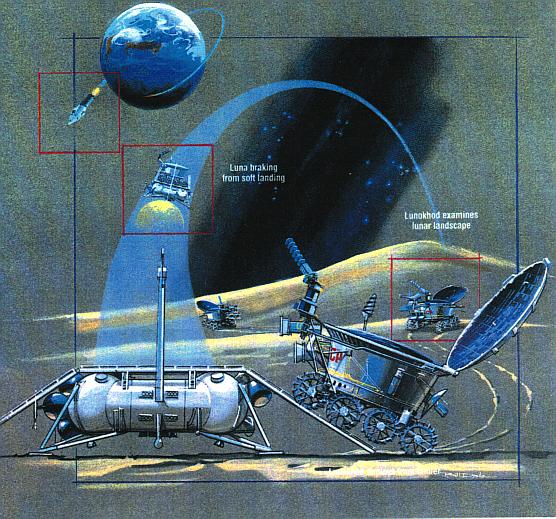
Lunokhod (Russian: Луноход, IPA: [lʊnɐˈxot], "Moonwalker") was a series of Soviet robotic lunar rovers designed to land on the Moon between 1969 and 1977. Lunokhod 1 was the first roving remote-controlled robot to land on an extraterrestrial body.
The 1969 Lunokhod 1A (Lunokhod 0, Lunokhod No. 201) was destroyed during launch, the 1970 Lunokhod 1 and the 1973 Lunokhod 2 landed on the Moon, and Lunokhod 3 (Lunokhod No. 205, planned for 1977) was never launched. The successful missions were in operation concurrently with the Zond and Luna series of Moon flyby, orbiter and landing missions.
The Lunokhods were primarily designed to support the Soviet human Moon missions during the Moon race. Instead, they were used as remote-controlled robots for exploration of the lunar surface and returning pictures, after the Apollo human lunar landings and cancellation of the Soviet human Moon programme.
The Lunokhods were transported to the lunar surface by Luna spacecraft, which were launched by Proton-K rockets.
Lunokhod's original primary mission was to be the back-up for L3 crewed Moon expeditions and for the later Zvezda lunar base.[citation needed] For mission safety, weeks before the human mission on a LK lander, an LK-R uncrewed lander from the L3 lunar expedition complex and two Lunokhod automated rovers would be sent to the Moon for a preliminary study of the surface around LK-R and LK sites, to act as radio beacons for precision landings of LK-R and LK, and for a visual evaluation of the status of the site.
In mid-1968, at the facility KIP-10 or NIP-10 (КИП-10 or НИП-10, located at 45°03′10″N 33°53′25″E / 45.052703°N 33.890256°E) in the closed town Shkolnoye (Simferopol-28), near Simferopol, Crimea, a lunodrom (лунодром - Moondrome, located at 45°03′15″N 33°53′37″E / 45.054212°N 33.893627°E) was built. It covered an area of one hectare (120 meters by 70 meters) and was very similar to some parts of the lunar surface. It was constructed using more than 3,000 cubic meters of soil, and included 54 craters up to 16 m in diameter and around about 160 rocks of various sizes. The whole area was surrounded with bricks, painted in gray and black. It was used to analyze problems with the Lunokhod chassis and cosmonaut's skill to control one.
Closed town Simferopol-28 contained the most significant tracking facility in the Soviet Union, having the largest number of antennas, the largest area, and the most personnel of any of the Soviet tracking facilities. The facility was one of a network of ten facilities which contain earth satellite vehicle tracking equipment and provide command/control for Soviet near-space civil and military events. Additionally, this facility supported all lunar programmes of the Soviet Union, in association with the Evpatoria Deep Space Tracking Facility.
At least four complete vehicles were constructed, with the serial numbers 201, 203, 204 and 205.[citation needed]
Hub AI
Lunokhod programme AI simulator
(@Lunokhod programme_simulator)
Lunokhod programme
Lunokhod (Russian: Луноход, IPA: [lʊnɐˈxot], "Moonwalker") was a series of Soviet robotic lunar rovers designed to land on the Moon between 1969 and 1977. Lunokhod 1 was the first roving remote-controlled robot to land on an extraterrestrial body.
The 1969 Lunokhod 1A (Lunokhod 0, Lunokhod No. 201) was destroyed during launch, the 1970 Lunokhod 1 and the 1973 Lunokhod 2 landed on the Moon, and Lunokhod 3 (Lunokhod No. 205, planned for 1977) was never launched. The successful missions were in operation concurrently with the Zond and Luna series of Moon flyby, orbiter and landing missions.
The Lunokhods were primarily designed to support the Soviet human Moon missions during the Moon race. Instead, they were used as remote-controlled robots for exploration of the lunar surface and returning pictures, after the Apollo human lunar landings and cancellation of the Soviet human Moon programme.
The Lunokhods were transported to the lunar surface by Luna spacecraft, which were launched by Proton-K rockets.
Lunokhod's original primary mission was to be the back-up for L3 crewed Moon expeditions and for the later Zvezda lunar base.[citation needed] For mission safety, weeks before the human mission on a LK lander, an LK-R uncrewed lander from the L3 lunar expedition complex and two Lunokhod automated rovers would be sent to the Moon for a preliminary study of the surface around LK-R and LK sites, to act as radio beacons for precision landings of LK-R and LK, and for a visual evaluation of the status of the site.
In mid-1968, at the facility KIP-10 or NIP-10 (КИП-10 or НИП-10, located at 45°03′10″N 33°53′25″E / 45.052703°N 33.890256°E) in the closed town Shkolnoye (Simferopol-28), near Simferopol, Crimea, a lunodrom (лунодром - Moondrome, located at 45°03′15″N 33°53′37″E / 45.054212°N 33.893627°E) was built. It covered an area of one hectare (120 meters by 70 meters) and was very similar to some parts of the lunar surface. It was constructed using more than 3,000 cubic meters of soil, and included 54 craters up to 16 m in diameter and around about 160 rocks of various sizes. The whole area was surrounded with bricks, painted in gray and black. It was used to analyze problems with the Lunokhod chassis and cosmonaut's skill to control one.
Closed town Simferopol-28 contained the most significant tracking facility in the Soviet Union, having the largest number of antennas, the largest area, and the most personnel of any of the Soviet tracking facilities. The facility was one of a network of ten facilities which contain earth satellite vehicle tracking equipment and provide command/control for Soviet near-space civil and military events. Additionally, this facility supported all lunar programmes of the Soviet Union, in association with the Evpatoria Deep Space Tracking Facility.
At least four complete vehicles were constructed, with the serial numbers 201, 203, 204 and 205.[citation needed]
Recent media