

Recent from talks
Luttinger liquid
Knowledge base stats:
Talk channels stats:
Members stats:
Luttinger liquid
A Luttinger liquid, or Tomonaga–Luttinger liquid, is a theoretical model describing interacting electrons (or other fermions) in a one-dimensional conductor (e.g. quantum wires such as carbon nanotubes). Such a model is necessary as the commonly used Fermi liquid model breaks down for one dimension.
The Tomonaga–Luttinger's liquid was first proposed by Sin-Itiro Tomonaga in 1950. The model showed that under certain constraints, second-order interactions between electrons could be modelled as bosonic interactions. In 1963, J.M. Luttinger reformulated the theory in terms of Bloch sound waves and showed that the constraints proposed by Tomonaga were unnecessary in order to treat the second-order perturbations as bosons. But his solution of the model was incorrect; the correct solution was given by Daniel C. Mattis and Elliot H. Lieb in 1965.
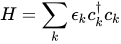
Luttinger liquid theory describes low energy excitations in a 1D electron gas as bosons. Starting with the free electron Hamiltonian:
is separated into left and right moving electrons and undergoes linearization with the approximation over the range :


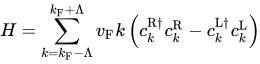
Expressions for bosons in terms of fermions are used to represent the Hamiltonian as a product of two boson operators in a Bogoliubov transformation.
The completed bosonization can then be used to predict spin-charge separation. Electron-electron interactions can be treated to calculate correlation functions.
Hub AI
Luttinger liquid AI simulator
(@Luttinger liquid_simulator)
Luttinger liquid
A Luttinger liquid, or Tomonaga–Luttinger liquid, is a theoretical model describing interacting electrons (or other fermions) in a one-dimensional conductor (e.g. quantum wires such as carbon nanotubes). Such a model is necessary as the commonly used Fermi liquid model breaks down for one dimension.
The Tomonaga–Luttinger's liquid was first proposed by Sin-Itiro Tomonaga in 1950. The model showed that under certain constraints, second-order interactions between electrons could be modelled as bosonic interactions. In 1963, J.M. Luttinger reformulated the theory in terms of Bloch sound waves and showed that the constraints proposed by Tomonaga were unnecessary in order to treat the second-order perturbations as bosons. But his solution of the model was incorrect; the correct solution was given by Daniel C. Mattis and Elliot H. Lieb in 1965.
Luttinger liquid theory describes low energy excitations in a 1D electron gas as bosons. Starting with the free electron Hamiltonian:
is separated into left and right moving electrons and undergoes linearization with the approximation over the range :
Expressions for bosons in terms of fermions are used to represent the Hamiltonian as a product of two boson operators in a Bogoliubov transformation.
The completed bosonization can then be used to predict spin-charge separation. Electron-electron interactions can be treated to calculate correlation functions.
Recent media