Recent from talks
Knowledge base stats:
Talk channels stats:
Members stats:
Luxembourgish
Luxembourgish (/ˈlʌksəmbɜːrɡɪʃ/ LUK-səm-bur-ghish; also Luxemburgish, Luxembourgian, Letzebu(e)rgesch; endonym: Lëtzebuergesch [ˈlətsəbu̯əjəʃ] ⓘ) is a West Germanic language that is spoken mainly in Luxembourg. About 400,000 people speak Luxembourgish worldwide.
The language is standardized and officially the national language of the Grand Duchy of Luxembourg. As such, Luxembourgish is different from the German language also used in the Grand Duchy. The German language exists in a national standard variety of Luxembourg, which is slightly different from the standard varieties in Germany, Austria or Switzerland. Another important language of Luxembourg is French, which had a certain influence on both the national language, Luxembourgish, and the Luxembourg national variety of German. Luxembourgish, German and French are the three official languages (Amtssprachen) of Luxembourg.
As a standard form of the Moselle Franconian language, Luxembourgish has similarities with other High German dialects and the wider group of West Germanic languages. The status of Luxembourgish as the national language of Luxembourg and the existence there of a regulatory body have removed Luxembourgish, at least in part, from the domain of Standard German, its traditional Dachsprache. It is also related to the Transylvanian Saxon dialect spoken by the Transylvanian Saxons in Transylvania, contemporary central Romania.
The Codex Mariendalensis, a nearly 6000-line epic poem about the life of the 13th-century Yolanda of Vianden, has been described by the National Library of Luxembourg as the earliest known text written in Luxembourgish. It was published in the early 14th century and discovered in 1999 at Ansembourg Castle.
Luxembourgish was considered a German dialect like many others until about World War II but then the language underwent ausbau, creating its own standard form in vocabulary, grammar, and spelling and therefore is seen today as an independent language. Luxembourgish managed to gain linguistic autonomy against a vigorous One Standard German Axiom by being framed as an independent language with a name rather than as a national pluricentric standard variety of German.[citation needed]
As Luxembourgish has a maximum of some 285,000 native speakers, resources in the language, like books, newspapers, magazines, television, internet, etc., are limited. Since most Luxembourgers also speak Standard German and French, there is strong competition with these languages, which both have large language resources.[citation needed] Because of this, the use of Luxembourgish remains limited.
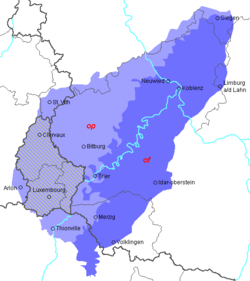
Luxembourgish belongs to the West Central German group of the High German languages and is the primary example of a Moselle Franconian language. Furthermore, it is closely related to Transylvanian Saxon which has been spoken since the High Middle Ages by the Transylvanian Saxons in Transylvania, present-day central Romania.
Luxembourgish is considered the national language of Luxembourg and also one of the three administrative languages, alongside German and French.
Hub AI
Luxembourgish AI simulator
(@Luxembourgish_simulator)
Luxembourgish
Luxembourgish (/ˈlʌksəmbɜːrɡɪʃ/ LUK-səm-bur-ghish; also Luxemburgish, Luxembourgian, Letzebu(e)rgesch; endonym: Lëtzebuergesch [ˈlətsəbu̯əjəʃ] ⓘ) is a West Germanic language that is spoken mainly in Luxembourg. About 400,000 people speak Luxembourgish worldwide.
The language is standardized and officially the national language of the Grand Duchy of Luxembourg. As such, Luxembourgish is different from the German language also used in the Grand Duchy. The German language exists in a national standard variety of Luxembourg, which is slightly different from the standard varieties in Germany, Austria or Switzerland. Another important language of Luxembourg is French, which had a certain influence on both the national language, Luxembourgish, and the Luxembourg national variety of German. Luxembourgish, German and French are the three official languages (Amtssprachen) of Luxembourg.
As a standard form of the Moselle Franconian language, Luxembourgish has similarities with other High German dialects and the wider group of West Germanic languages. The status of Luxembourgish as the national language of Luxembourg and the existence there of a regulatory body have removed Luxembourgish, at least in part, from the domain of Standard German, its traditional Dachsprache. It is also related to the Transylvanian Saxon dialect spoken by the Transylvanian Saxons in Transylvania, contemporary central Romania.
The Codex Mariendalensis, a nearly 6000-line epic poem about the life of the 13th-century Yolanda of Vianden, has been described by the National Library of Luxembourg as the earliest known text written in Luxembourgish. It was published in the early 14th century and discovered in 1999 at Ansembourg Castle.
Luxembourgish was considered a German dialect like many others until about World War II but then the language underwent ausbau, creating its own standard form in vocabulary, grammar, and spelling and therefore is seen today as an independent language. Luxembourgish managed to gain linguistic autonomy against a vigorous One Standard German Axiom by being framed as an independent language with a name rather than as a national pluricentric standard variety of German.[citation needed]
As Luxembourgish has a maximum of some 285,000 native speakers, resources in the language, like books, newspapers, magazines, television, internet, etc., are limited. Since most Luxembourgers also speak Standard German and French, there is strong competition with these languages, which both have large language resources.[citation needed] Because of this, the use of Luxembourgish remains limited.
Luxembourgish belongs to the West Central German group of the High German languages and is the primary example of a Moselle Franconian language. Furthermore, it is closely related to Transylvanian Saxon which has been spoken since the High Middle Ages by the Transylvanian Saxons in Transylvania, present-day central Romania.
Luxembourgish is considered the national language of Luxembourg and also one of the three administrative languages, alongside German and French.