Hubbry Logo
FG 42FG 42Main
Open search
FG 42
Community hub
FG 42
logo
8 pages, 0 posts
0 subscribers
Be the first to start a discussion here.
FG 42
FG 42
from Wikipedia

The FG 42 (German: Fallschirmjägergewehr 42, "paratrooper rifle 42") is a selective-fire 7.92×57mm Mauser automatic rifle[4][5] produced in Nazi Germany during World War II.[6] The weapon was developed specifically for the use of the Fallschirmjäger airborne infantry in 1942 and was used in very limited numbers until the end of the war.

Key Information

It combined the characteristics and firepower of a light machine gun in a lightweight form slightly shorter (but considerably bulkier and heavier) than the standard-issue Karabiner 98k bolt-action infantry rifle. Considered one of the most advanced weapon designs of World War II,[7][8] the FG 42 influenced post-war small arms development, and many features of its design, such as general shape, stock style, gas-rotating bolt operation and sheet metal and plastic construction were copied by the US Army when it developed the M60 machine gun.[9]

History

[edit]
A German Fallschirmjäger poses with his early model FG 42 (Ausführung "C") in France, 1944.
The FG 42 was used by paratroopers of the Fallschirmjäger Lehrbattalion (Paratroopers' Instructional Battalion) to try out new equipment during the raid to free Benito Mussolini in September 1943.

At the time of the Battle of Crete (Operation Mercury), German Fallschirmjäger (parachute infantry) were equipped with the same assortment of small arms as the Heer, carrying only 9×19mm Parabellum chambered pistols and hand grenades on them during parachute jumps, with 9×19mm Parabellum submachine guns, 7.92×57mm Mauser chambered rifles, and crew-served weapons stored separately in containers that were dropped from the wing of the exit craft. The German RZ parachute harness, with one single riser and two straps attached to the body, making the paratrooper land on his hands and knees in a forward roll, did not allow heavier equipment such as rifles and machine guns to be safely carried during airborne jumps. At Crete, long-range rifle and machine gun fire from dug-in Commonwealth defenders inflicted heavy casualties on the outgunned German paratroopers in the early stages of battle as they attempted to retrieve their support weapons from containers scattered all over the battlefield.[10] These combat experiences demonstrated the need for a rifle that could be carried by the paratrooper during a drop.

The classifications of the development and production Ausführungen (types) are as follows:

  • Type A - First design
  • Type B - Revised model prototype
  • Type C - "LC-6" prototype
  • Type D - First Fallschirmjägergewehr; acceptance trials
  • Type E - First production Fallschirmjägergewehr (sometimes called the Modell I ("Type I")
  • Type F - First stamped receiver Fallschirmjägergewehr
  • Type G - Final production model Fallschirmjägergewehr (sometimes called the Modell II ("Type II")

Development

[edit]

In 1941, the German Air Force (Luftwaffe) requested a selective-fire hand-held weapon for the paratroopers; Senior Staff Air Secretary Ossenbach at the GL/C Erprobungsstelle-6 (GL/C E-6—the Luftwaffe Weapons Development Branch at Tarnewitz near Wismar) was approached informally to develop this special new weapon.[10] The Reich Air Ministry (Reichsluftfahrtministerium or RLM) sought to develop a universal shoulder-fired automatic rifle that could replace the bolt-action rifle, submachine gun, and light machine gun in the air assault role.[7] The proposed weapon would also simplify logistics and provide greater firepower to the individual paratrooper.

The RLM attempted to initiate a formal weapons development program through the Heereswaffenamt (the HWaA, or Army Ordnance Department)—responsible for German small arms development—but conflicting priorities and friction with the Army (the HWaA dismissed the undertaking as unrealistic and offered its G 41(W) semi-automatic rifle instead) led to an independent development by the Luftwaffe. Plans were laid out to form a central authority for the new program at the Luftwaffe's Erprobungstelle coastal testing station at Tarnewitz. The engineers on staff had acquired considerable expertise developing lightweight automatic weapons, having successfully converted the MG 15 aircraft machine gun to a ground configuration.[11] However, due to the high casualties sustained by the paratroopers during Operation Mercury, Hitler changed his mind about the usefulness of airborne assaults and the plans were terminated.[11] Nevertheless, Luftwaffe Reichsmarschall Hermann Göring privately ordered the continuation of the project.[11]

The RLM went directly to German industry with its plans—the so-called LC-6 specification issued 14 December 1941 mentioned amongst others that the weapon should not exceed 1,000 mm (39.4 in) in length, should not be significantly heavier than the Karabiner 98k bolt action standard service rifle, should be able to fire single shots from a closed bolt, provide fully automatic fire from an open bolt, feed from detachable 10- or 20-round magazines and be able to mount a bayonet and use rifle grenades. Louis Stange converted some FG 42 into 7.92×33mm Kurz, which was an intermediate cartridge promoted by the Heer (developed for the promising MP 43 assault rifle), the Luftwaffe favored the long-range potential of the 7.92×57mm Mauser full-power rifle cartridge and this chambering was one of the main design prerequisites.[7][12]

Prototypes

[edit]

Six manufacturers were solicited for prototype designs: Gustloff-Werke, Mauser, Johannes Großfuß Metall- und Lackierwarenfabrik, C.G. Hänel, Rheinmetall-Borsig and Heinrich Krieghoff Waffenfabrik.[7][11] Several contracts were awarded but only a few prototypes are known to have been submitted. Mauser offered a version of the MG 81 (rejected due to excessive weight and its belt-fed operation)[13] while Krieghoff presented a rising-block prototype, which too was quickly dropped. A design credited to Rheinmetall-Borsig's Louis Stange of Sömmerda who had previously worked on the MG 34 proved satisfactory and underwent military trials conducted by the GL/C E-6 test station at Tarnewitz in mid-1942.[7] This early prototype, known under the factory designation Gerät 450 ("device 450") or Ausführung "A" ("type A"), was intended to be a pure sheet metal design, using pressed steel in the construction of the receiver, buttstock and corrugated handguard. The proposed system of operation was modeled on that used in World War I Lewis light machine gun, with a gas-operated turning bolt action geared to a spiral (clock-type) recoil spring.[14] The type "A" was never produced beyond model form, but the basic design layout was retained for further development.[15]

With the basic characteristics of the LC-6 accepted, a series of modifications followed. The revised Ausführung "B" replaced the sheet metal handguard with a resin-impregnated fiber type that provided protection against heat and a better grip when wet.[15]

These tests exposed several shortcomings, addressed by Stange in April 1942 with the LC-6/II prototype. The prototype was then submitted to a series of endurance tests led by the HWA and further modified to increase functional reliability and durability, resulting in the final LC-6/III prototype variant that was ultimately accepted into production as the FG 42. Fifty rifles were fabricated by Rheinmetall-Borsig for evaluation purposes by the end of 1942.

A pre-series batch of 50 rifles was produced in early 1943 and 6 examples were sent to GL/C E-6 for additional testing. Almost identical to the LC-6/III, these guns differ from later models by using a smooth sheet metal buttstock and an experimental muzzle brake. The weapons experienced serious malfunctions: one rifle suffered a catastrophic failure after firing only 2,100 rounds, a soldier was injured when attempting to fire a rifle grenade and the pressed metal buttstock would deform after launching a small number of rifle grenades.

Production

[edit]

Several other improvements were made before being authorized for large-scale production. The original Rheinmetall design used chrome-nickel steel heavily in many essential components, a strategic alloy in short supply. When the Luftwaffe was finally given permission to produce 3,000 rifles for combat trials, the material specifications were changed to accommodate the use of manganese steel as a substitute.[7] The Heinrich Krieghoff company of Suhl (authors of the previous unsuccessful LC-6 tender) was contracted to manufacture the FG 42 in limited quantity as Rheinmetall did not have the capacity to bring the FG 42 into serial production.

The weapon system underwent continuous development. Its expedited development, remedial changes to the original design and ever-changing Luftwaffe requirements resulted in a myriad of variants.[7] Post-war literature typically identifies three versions, however the Germans did not give them separate designations; the Modell I, and Modell II were never officially referenced and period documents simply refer to the weapon as the 'Fallschirmjägergewehr 42' or "FG 42", and the reference was always made to the latest production model.[16]

First operational use

[edit]

The weapon saw first operational use during the Gran Sasso raid (Unternehmen Eiche) in September 1943 when German paratroopers and Waffen-SS commandos rescued Italian dictator Benito Mussolini from his captors – 200 well-equipped Carabinieri guards. However, during the whole airborne operation (which was personally ordered by Hitler) not a single shot was fired.

Deployment

[edit]
A Fallschirmjäger firing the early FG 42 in June 1944

After approximately 2,000 FG 42s had been produced by Krieghoff, supplies of the manganese steel from which the receivers were forged were diverted to other needs; this meant a redesign was required to use stamped sheet metal in its place. Field reports that the lightweight rifle was not sturdy enough to handle full-power rifle ammunition in cyclic mode made Krieghoff engineers design the Type G. Improvements were: relocating the bipod from the front of the handguard to the muzzle to reduce shot dispersion; changing the pistol grip angle to near vertical; enlarging the handguard and changing the stock from stamped steel to wood to minimize overheating, adding weight to the bolt and lengthen its travel to reduce the cyclic rate of fire. Also a four position gas regulator was fitted, the bolt and recoil spring were changed to wound wire, a case deflector was fitted and the muzzle brake and the bayonet mount was changed. These changes, particularly the pistol grip change and the bipod relocation, are clearly visible on late-model FG 42s. Production models also had a simple flip-out spike bayonet under the barrel hidden by the bipod. In the later version the bayonet was shortened from around 10 inches (250 mm) to around 6 inches (150 mm). There were never enough FG 42s to arm most Fallschirmjäger as originally intended, however most were employed in the western front following the events of D-Day, with the particular use of FG 42 during the Battle of Carentan and the Falaise Pocket (nearly a quarter of all FG 42 produced were in the hands of the 2nd Parachute Division).

Design details

[edit]
Cross-section of the FG 42 Ausführung E, known informally as the "early model". Characteristics of the early models were the bipod placement (hinged to the barrel collar in front of the handguard), forged receiver, ribbed buttstock, and the sharply angled pistol grip.
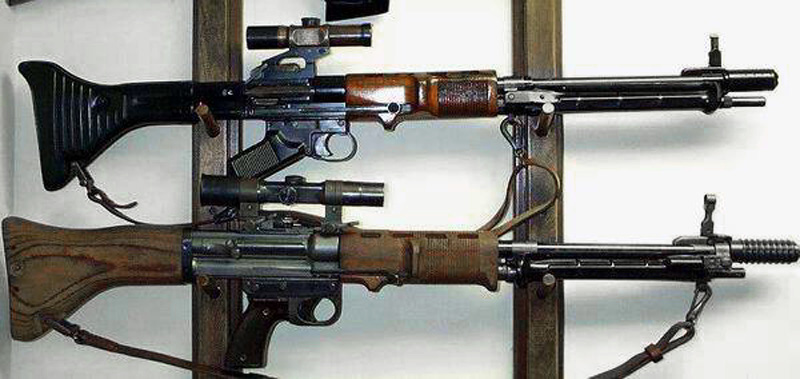
Top to bottom: late model FG 42, early model FG 42 with folded down sight lines and StG 44
late model FG 42 grip

General configuration/layout

[edit]

The FG 42 was a select-fire air-cooled weapon and one of the first to incorporate the "straight-line" recoil configuration. This layout, combined with the side magazine, placed both the center of gravity and the position of the shoulder stock nearly in line with the longitudinal axis of the bore, a feature increasing controllability during burst or automatic fire.[16] The operating system was derived from that used in the successful Lewis light machine gun with a gas piston-actuated rotating bolt locking mechanism.[16] The angled pistol grip on the first model was to maintain familiarity with the Kar98k as well as drop container storage and making it less likely to snag on all the straps of parachute equipment in a descent.

This system used pressurized exhaust gases from the bore and channeled them through a port drilled in the barrel into a gas cylinder located under the barrel. The rapid build-up of propellant gases imparted rearward pressure on a long-stroke piston, driving it backwards, while an extension of the bolt carrier interacted with a helical camming slot machined into the bolt carrier, converting this linear movement into an angular velocity and forcing the bolt into a rotary motion, clearing the locking nuts and unlocking it near the end of the bolt carrier's travel. The weapon was locked into battery by two lugs on the bolt head which recessed into appropriate cavities machined into the receiver walls. Owing to its main intended use by paratroopers, the rear sight (which necessarily was rather high due to the straight stock design) was a flip-up construction.[6] The iron sight line had a 530 mm (20.9 in) sight radius and consisted of an open-pointed-post-type front sight, and a diopter-type rear sight. It was graduated for 7.92×57mm Mauser cartridges from 100 to 1,200 m (109 to 1,312 yd) in 100 m (109 yd) increments. On later models the post front sight was hooded to reduce glare under unfavourable light conditions and add protection for the post.[17]

The top of the receiver of the FG 42 was specifically machined with a long dovetail type base designed to accept telescopic sight mounts. The scope mount featured locking lever(s) that allowed quick installation and removal of a telescopic sight depending on the specific combat scenario; general combat or in a limited sniping role. The telescopic sights used on the FG 42 were the ZFG42 or ZF4.[6]

Receiver specifics and magazine feeding

[edit]

The receiver was a sophisticated, machined alloy forging with the magazine housing placed on the left-hand side and the ejection port on the right. Whilst not a true bullpup rifle design the seemingly awkward placement of the magazine housing (horizontally to the side rather than directly beneath the receiver) allowed the bolt mechanism to extend into the buttstock assembly, effectively reducing the overall length of the weapon as the magazine well did not interfere with the location of the pistol grip. The pistol grip was integrated into the trigger group assembly, a separate housing containing the trigger mechanism and fire control components, and was formed from pressed sheet metal during fabrication from two separate halves and then welded together.[16]

The rifle fed from either a 10- or 20-round detachable box magazine or standard 5-round stripper clips into an empty magazine in the gun.[18] The empty weight of the 100 mm (3.9 in) long 10-round magazine is 185 g (6.5 oz) and of the 150 mm (5.9 in) long 20-round magazine 290 g (10 oz).[6]

Firing

[edit]

The FG 42 fired in semi-automatic mode from a closed bolt, accomplished by delaying the release of the firing pin (mounted on the bolt carrier and released by the front sear notch) until after the trigger had been pressed; the short lock time, and little movement in the action during firing translated into greater single-shot accuracy.[16] When operating in the automatic mode, the sear mechanism was designed to fire from an open bolt by simultaneously releasing both the bolt and bolt carrier; and with this mode selected, the bolt would remain open between bursts to provide maximum cooling.[16] This had the advantage of preventing a phenomenon known as "cook off" where the heat of repeated rounds being fired caused a chambered round to overheat and prematurely ignite the powder or primer. The rotating fire selector switch was situated in the trigger group, above the pistol grip on the right side. The charge lever also served as the safety,[16] disabling the sear mechanism when engaged.

Testing

[edit]

The FG 42 was intended to fill a niche in Nazi Germany's arsenal and was produced only in small numbers. It was somewhat well received by paratroopers when tested, but it did have its drawbacks. The FG 42 had a 20-round, or sometimes 10 round, magazine that was mounted on the left side of the rifle. Though a side-mounted magazine was common in submachine guns of the time, the larger magazine with heavier ammunition of a full-powered rifle tended to unbalance the weapon. In addition controllable bursts were difficult. This made full-automatic fire only marginally useful. The FG 42 used a fairly sophisticated muzzle device that did help with recoil and muzzle flash, but made blast and noise much greater than on other similar weapons. The US M14 rifle had similar problems, and attempts were made to upgrade that rifle the same way with an in-line stock and muzzle device.

Influences/derivatives

[edit]
US experimental T44 belt-feeding machine gun developed from the German FG 42 and MG 42

The American M41 Johnson LMG has many parallels with the contemporary FG 42. Both had in-line stocks, fed from the left side, and both fired from the open bolt in automatic mode and closed bolt in semi-automatic mode. Despite these similarities, there is no evidence that either weapon had any effect on the design of the other. As they were both seeking to solve similar problems, it is reasonable to expect that each weapon's respective engineers approached these problems similarly but independently, unaware of the developments of their counterparts.

It is not easy to determine the significance of the FG 42 in terms of weapons history. With a slightly longer barrel and belt-feeding the weapon would have been an excellent light machine gun. Its designer Louis Stange knew that, he also built a prototype with belt feed.[17]

Some features, such as the details of the gas-operated bolt selection process, were studied by US Army engineers after the war. These, along with some aspects of the MG 42 general-purpose machine gun, are commonly reported to have been incorporated in the similarly troubled M60 general-purpose machine gun. The last known derivatives of the FG 42 were the Swiss Sturmgewehr 52 and M60 machine gun.[9]

The scarcity and prohibitive cost of genuine FG 42s in contemporary firearms collecting circles has brought about an industry of reproduction FG 42 style rifles by manufacturers in US and Germany.

Users

[edit]
  •  Germany: Used during World War II. Intended for use by all German airborne troops, but was never produced in sufficient numbers for standardized use.

See also

[edit]

References

[edit]

Bibliography

[edit]
[edit]
Revisions and contributorsEdit on WikipediaRead on Wikipedia
from Grokipedia
The Fallschirmjägergewehr 42 (FG 42), meaning " rifle 42," was a selective-fire chambered in , developed specifically for the Luftwaffe's () units during . Designed as a versatile, lightweight weapon to replace multiple firearms carried by paratroopers, the FG 42 combined the roles of a , , and in a single platform, featuring gas-operated action with a long-stroke piston and . Its development was spurred by the heavy losses suffered by German paratroopers during the 1941 Battle of Crete, where the lack of automatic weapons after landing proved disastrous, prompting Luftwaffe chief Hermann Göring to demand a new rifle meeting stringent LC-6 specifications for portability and firepower. After prototypes from Rheinmetall and other firms, production began in 1942 under firms like Heinrich Krieghoff, yielding approximately 7,000 units across two main variants: the early Type E (milled receiver) and the later Type G (stamped receiver for cost efficiency). Technical specifications included an overall length of about 945 mm, a 500 mm barrel, unloaded weight of 4.25 kg, and a cyclic up to 900 rounds per minute, fed by 20-round magazines inserted horizontally from the side. Despite its innovative design—influencing post-war weapons like the U.S. —the FG 42 saw limited combat deployment due to high production costs, material shortages, and reliability issues in full-automatic fire, appearing in battles such as , , and from 1943 onward.

Background and development

Origins and requirements

The in May 1941 marked a turning point for German airborne forces, as paratroopers endured exceptionally high casualties—about 4,000 killed or wounded—owing to their limited armament upon landing, which consisted primarily of pistols and grenades while heavier weapons like rifles and machine guns arrived in separate drop containers that were often scattered or lost, depriving them of immediate automatic against entrenched Allied defenders. Luftwaffe General , who commanded the airborne operation during the battle, identified these deficiencies firsthand and subsequently advocated for a versatile new that paratroopers could carry personally during jumps, enabling rapid engagement upon touchdown to provide both aimed fire and automatic support until support weapons could be retrieved. This push culminated in 1942, when Luftwaffe chief Hermann Göring authorized the development of a universal combat weapon specifically for Fallschirmjäger units, designed to consolidate the roles of the bolt-action rifle, submachine gun, and light machine gun into one compact, multi-purpose system that would enhance paratrooper survivability and firepower in airborne assaults. The resulting Luftwaffe specification, designated LC-6, outlined stringent criteria to meet these tactical needs: a total weight not exceeding 4.2 kg (9.3 lb) for portability comparable to the ; selective-fire capability supporting both semi-automatic precision shots and full-automatic bursts; chambering in the standard cartridge for logistical compatibility; a detachable 20-round box magazine for sustained fire; an effective range of at least 400 meters; and an overall length under 1,000 mm to facilitate jumps without encumbrance.

Design process

In early 1942, the German Luftwaffe's technical office issued a requirement for a new tailored to the needs of paratroopers, prompting several arms manufacturers to develop proposals. Although multiple firms, including and , were initially consulted for input on feasibility and components, six companies were solicited but only two comprehensive designs were submitted: one from Rheinmetall-Borsig AG and another from Heinrich Waffenfabrik. Rheinmetall-Borsig, under the leadership of chief small arms designer Louis Stange—who had previously contributed to the —was selected as the primary developer in mid-1942 due to the innovative nature of its proposal. Stange's team incorporated expertise from industry collaborators, focusing on a gas-operated system with a long-stroke beneath the barrel and a locking mechanism to ensure reliable operation under airborne conditions. The core design goals emphasized construction using stamped steel components to facilitate and reduce overall weight to approximately 4.2 kg, while maintaining compatibility with the standard cartridge. An inline configuration was adopted to align the impulse directly with the shooter's shoulder, minimizing muzzle climb during full-automatic fire, and the weapon was engineered for selective-fire capability in both semi-automatic and full-automatic modes. These elements addressed the Luftwaffe's emphasis on a versatile weapon that could serve as both a and a light support gun without excessive bulk. By November 1942, initial specifications were finalized, specifying an overall length of 975 mm, a barrel length of 450 mm, a muzzle velocity of 760 m/s, and a cyclic rate of fire ranging from 500 to 900 rounds per minute depending on the trigger pull. Key engineering challenges included achieving controllability in full-automatic mode while ensuring the rifle remained compact for parachute drops, leading to the integration of a pistol grip for improved handling and a folding metal buttstock that allowed the weapon to collapse to under 800 mm for transport. Stange's design balanced these demands by prioritizing stamped fabrication over machined parts, which not only cut production costs but also enhanced durability for paratrooper use.

Prototypes and initial testing

The first prototypes of the FG 42 were completed by Rheinmetall-Borsig in mid-1942 as a response to the Luftwaffe's urgent requirements for a . This initial model incorporated a wooden for stability during early handling trials, but designers quickly transitioned to a stamped in subsequent iterations to better meet weight constraints and enhance durability for airborne operations. In mid-1942, the prototypes underwent rigorous evaluation at the Luftwaffe's Tarnewitz proving ground, where they demonstrated promising performance but encountered significant reliability challenges. The gas system was prone to clogging, and magazine feeding proved unreliable under muddy and adverse field conditions, prompting critical modifications including an increase in length to improve gas flow and adjustments to the bolt tilt angle for smoother operation. Following these refinements, the weapon received approval for limited production by late , with initial output in from the Heereswaffenamt, with particular emphasis on its suitability for use; survivability tests involved dropping fully loaded rifles from an altitude equivalent to 300 meters to simulate deployment impacts, confirming structural integrity without major damage. Key performance metrics from these trials included an average grouping of 5 cm at 100 meters in semi-automatic mode, highlighting its precision potential, though sustained full-automatic fire led to rapid overheating, necessitating operational limits to bursts of no more than 100 rounds to prevent barrel warping.

Production and deployment

Manufacturing challenges

The production of the FG 42 was severely constrained by Germany's wartime resource limitations and strategic priorities, resulting in limited output despite its innovative design. Although the rifle was developed by Rheinmetall-Borsig, the company lacked the capacity for serial due to commitments to other weapons projects, leading to the contract being awarded to the firm in for initial manufacturing. Overall totaled approximately 7,000 to 10,000 units across both major variants by the war's end, far short of broader deployment needs for units. Early efforts focused on the Type I model, but output was capped at around 2,000 rifles due to acute shortages of specialized materials like for lightweight components. To address reliability issues with the stamped construction and improve durability, the subsequent Type II variant employed a precision-milled receiver instead of stamped , which reduced reliance on certain scarce materials but increased complexity and expense compared to the original design and standard rifles like the , exacerbating resource strains amid escalating Allied bombing campaigns that disrupted supply chains and factory operations. Manufacturing was centered at Krieghoff's facilities in , , with later dispersal to smaller sites to evade intensified air raids, though this fragmentation contributed to inconsistencies in assembly quality during the final production phases. Labor challenges, including shortages of skilled machinists and heavy dependence on forced workers, further hampered efficiency and led to variable reliability in early batches, underscoring the rifle's status as a high-precision weapon ill-suited to mass wartime fabrication.

Variants and modifications

The FG 42 underwent significant evolutionary changes during its production, resulting in two primary models: Type I (also known as E for early) and Type II (also known as G for late). The Type I, produced from early 1943 to 1944, featured a stamped receiver, a vented handguard for cooling, a crude folding bipod, and a side-mounted positioned high on the receiver. Approximately 2,000 units were manufactured, but the suffered from reliability issues, including frequent jamming due to the lighter stamped construction. In response to field feedback and production refinements, the Type II was introduced in late and continued into 1945. This variant employed a stronger milled receiver, an enclosed handguard to protect the user's hands from the hot barrel, an improved bipod with better stability, and a lowered magazine well for enhanced and balance. Around 5,000 units were produced, offering superior reliability over the Type I, though at the cost of increased weight—approximately 4.6 kg unloaded. Minor wartime adaptations included scoped configurations for designated marksmen, equipped with Zf 4 telescopic sights (4x magnification) mounted via a side rail; a limited number such rifles were assembled, primarily on Type II models. Limited tropicalized versions, with features like ventilated wooden stocks to suit Mediterranean climates, were fielded during the Italian campaign. Experimental 10-round magazines were also developed as alternatives to the standard 20-round capacity, primarily for the Type I to reduce weight during airborne drops, though they saw minimal adoption. Following Germany's surrender, Allied forces captured examples of the FG 42 and conducted evaluations, including tests by U.S. and British ordnance teams, which highlighted the rifle's innovative gas-operated system but confirmed challenges with full-power cartridge recoil in full-automatic fire.

Operational history

The FG 42 saw its first combat deployment during Operation Eiche, the on September 12, 1943, when elements of Regiment 7 used the rifle in a daring glider-borne to rescue from his captors atop the Gran Sasso massif in . The operation succeeded with minimal resistance, and paratroopers praised the weapon's lightweight construction and maneuverability, which allowed for quick handling during the surprise attack on the remote hotel. Subsequent deployments expanded the FG 42's role across multiple theaters, primarily with elite units facing Allied advances. In the Italian Campaign from late 1943 to 1944, the rifle equipped paratroopers in defensive actions, including battles around and , where its compact design aided mobility in rugged terrain. During the Normandy Invasion in June 1944, availability was restricted to the 7th Flieger Division, with units employing it in intense hedgerow fighting against U.S. and British airborne forces. The weapon also featured in , the Allied landings in southern France in August 1944, supporting counterattacks by the 1st Division near the Rhône Valley, and in the Ardennes Offensive from December 1944 to January 1945, where it bolstered and paratrooper assaults amid harsh winter conditions. In combat, the FG 42 excelled in the high-rate-of-fire scenarios typical of assaults, delivering 700–800 rounds per minute to provide immediate upon landing or in close-quarters urban and forested engagements. However, its 20-round limited sustained , often requiring frequent reloads that exposed users, while the gas-operated mechanism overheated rapidly under full-automatic use with the powerful 7.92×57mm cartridge, reducing reliability in extended firefights. Paratroopers valued the rifle's versatility as a semi-automatic tool or light support but criticized its controllability in full-auto mode, citing excessive muzzle climb and that hindered accuracy beyond short bursts. The 's overall —only about 7,000–10,000 were produced total—left many paratroopers under-equipped.

Design and features

Operating mechanism

The FG 42 is a gas-operated utilizing a long-stroke system, in which high-pressure gases are tapped from a port in the barrel approximately one-third the barrel's distance from the chamber to drive a rigidly attached to the bolt carrier. This long-stroke ensures the travels rearward with the bolt carrier, enabling rapid cycling of the operating parts. The locking mechanism features a that engages two lugs into recesses in the barrel extension for a secure lockup. Upon firing, the rearward travel of the bolt carrier activates a cam slot, causing the bolt to rotate and unlock from the extension, facilitating extraction and ejection. The spring and buffer assembly, housed within the skeletonized metal , absorb the energy from full-automatic fire, contributing to the weapon's controllability. The cyclic varies between 500 and 900 rounds per minute, adjustable in later production models via a gas regulator that modifies size to optimize performance across different ammunition types and conditions. is provided by a cross-bolt mechanism located behind the , which blocks both the trigger and sear to prevent unintended discharge in semi-automatic or automatic modes.

Feeding and fire control

The FG 42 employed a detachable magazine with a standard capacity of 20 rounds of ammunition, though 10-round magazines were also compatible. The , patterned after those used in the , was double-stack in design and mounted on the left side of the receiver at an angle optimized for prone firing positions, allowing the shooter to maintain a low profile without the magazine interfering with the ground. Feeding occurred through a single-feed mechanism supported by the magazine follower, which assisted in presenting cartridges reliably to the chamber from the horizontal insertion point. The fire control group provided selective-fire capability via a rotating selector switch located on the left side of the receiver above the , with three positions: safe (upper), semi-automatic (middle), and full-automatic (lower). In semi-automatic mode, operation was from a , where pulling the trigger released the bolt via the sear, and a prevented follow-up shots until the trigger was released and the bolt cycled fully rearward. Full-automatic mode fired from an , with the sear configured to hold the bolt carrier rearward continuously after the initial shot, enabling sustained fire at approximately 900 rounds per minute while promoting barrel cooling between bursts. Loading involved inserting the magazine into the left-side well, where it secured via a spring-loaded catch for quick attachment and release. While primarily magazine-fed, the open-top receiver design permitted adaptation for top-loading using 5-round stripper clips through the ejection port as an emergency measure, though this was not the standard procedure. Reliability was enhanced by anti-jam lips machined into the receiver to guide cartridges smoothly, but early Type E models proved sensitive to dirt and fouling due to their stamped construction. These issues were largely resolved in the Type G variant through milled receiver fabrication, chrome-lined chambers and barrels, and simplified components, improving tolerance to environmental contaminants.

Accessories and ergonomics

The FG 42 was equipped with a folding wire that collapsed to the side, reducing the rifle's length for compact storage and transport during paratrooper jumps. This design prioritized portability without sacrificing stability when deployed, and the incorporated an optional wooden insert in later models to enhance user comfort during extended handling. Sighting options included a fixed hooded front post sight and an adjustable rear peep sight calibrated in 100-meter increments from 100 to 1,200 meters, elevated on a high-profile ramp to clear the bipod. The receiver featured a rail for mounting the Zf 4 , enabling accurate long-range engagement when required. Key accessories comprised an integral folding bipod with lightweight legs stowed along the forend, which deployed to support prone firing positions. A standard leather or web carrying sling facilitated hands-free transport, while the muzzle could accommodate the cup-type grenade launcher for firing 30 mm anti-personnel or armor-piercing rounds. In terms of , the straight-line stock configuration minimized and felt compared to traditional designs, with the rifle weighing 4.2 to 4.6 kg unloaded—light enough for airborne troops to carry one-handed if needed. However, the elevated relative to the shoulder exacerbated vertical climb during sustained full-automatic fire, demanding disciplined control for effective use.

Legacy and users

Military operators

The FG 42 was primarily operated by the airborne infantry of the German , across its 1st through 11th Parachute Divisions, which saw deployment in major theaters including at , the Eastern Front along the Neva River, and in . Total production reached approximately 7,000 units (about 2,000 early Type E and 5,000–7,000 later Type G) between 1942 and 1945, with the vast majority distributed directly to units and the remainder reserved for training and stockpiles; no wartime exports were recorded. Due to escalating shortages in late 1944, secondary allocations extended to regular infantry formations such as units, as well as SS elements including the , which employed the rifle during its combat drop in Operation Rösselsprung against in May 1944. Captured examples were evaluated and tested by U.S. forces, including personnel from the 82nd and 101st Airborne Divisions between 1944 and 1945 at facilities like ; British forces similarly tested limited numbers of seized FG 42s during operations in .

Influences and post-war impact

The FG 42 served as a conceptual precursor to the modern , combining selective-fire capability with lightweight design in a full-power cartridge platform, which influenced small arms experimentation aimed at balancing and portability for . Its innovative features, such as the inline stock for reduced and gas-operated mechanism, contributed to the of battle rifles and light machine guns during the early period. Specific post-war designs drew directly from the FG 42's architecture. The British Experimental Military 1 (EM-1) Korsac light automatic gun, developed in the late 1940s, incorporated elements of the FG 42's operating system and paratrooper-oriented ergonomics for a compact selective-fire weapon. Similarly, the Swiss Waffenfabrik 1951 (WF-51) prototype rifle, tested in the 1950s with an intermediate cartridge, replicated the FG 42's gas piston and tilting bolt mechanism to create a lighter alternative to bolt-action rifles. The U.S. M60 machine gun, introduced in 1957, adopted aspects of the FG 42's feed mechanism and stamped construction for improved reliability in sustained fire. The FG 42's universal combat role also indirectly shaped the M14 rifle's development, as U.S. Ordnance Department evaluations post-World War II highlighted its potential for adapting paratrooper rifles into versatile battle rifles. No official German derivatives were produced after the war due to the weapon's limited wartime output and the shift to new NATO standards. Captured FG 42 rifles saw limited post-war service, with reports indicating their use by North Vietnamese Army and forces during the early stages of the in the , likely sourced from wartime stockpiles in . U.S. advisors, including Green Berets, test-fired these captured examples to assess their performance against contemporary threats. In the , civilian replicas of the FG 42 have been produced for collectors and enthusiasts since the , with manufacturers like Smith Manufacturing Group (SMG Guns) creating semi-automatic versions faithful to the original Type I and Type II patterns, chambered in 7.92x57mm or . Other firms, such as Sport Systeme Dittrich, offer updated variants like the SG-13, which modernize the design with SVD-compatible magazines and improved materials while retaining the core gas system. The FG 42 has gained cultural prominence in popular media, particularly in the Call of Duty series, where it appears as a selectable weapon in titles like World at War and WWII, often depicted as a high-rate-of-fire to evoke its historical role. Due to its extreme rarity—fewer than 10,000 originals produced—authentic FG 42 rifles command premium collector values, with auction results in 2023 reaching $456,000 for a museum-grade example and earlier sales exceeding $300,000 for Type I variants.

References

Add your contribution
Related Hubs
User Avatar
No comments yet.