
Recent from talks
Motorola 6845
Knowledge base stats:
Talk channels stats:
Members stats:
Motorola 6845
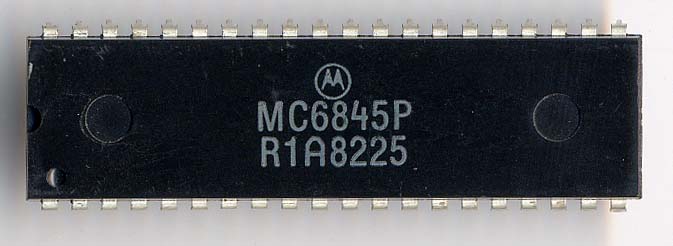
The Motorola 6845, or MC6845, is a display controller that was widely used in 8-bit computers during the 1980s. Originally intended for designs based on the Motorola 6800 CPU and given a related part number, it was more widely used alongside various other processors, and was most commonly found in machines based on the Zilog Z80 and MOS 6502.
The 6845 is not an entire display solution on its own; the chip's main function is to properly time access to the display memory, and to calculate the memory address of the next portion to be drawn. Other circuitry in the machine then uses the address provided by the 6845 to fetch the pattern and then draw it. The implementation of that hardware is entirely up to the designer and varied widely among machines. The 6845 is intended for character displays, but could also be used for pixel-based graphics, with some clever programming.
Among its better-known uses are the BBC Micro, Amstrad CPC, and Videx VideoTerm display cards for the Apple II. It is also part of many early graphics adapter cards for the IBM PC, including the MDA, Hercules Graphics Card (HGC), Color Graphics Adapter (CGA) and the Plantronics Colorplus. Its functionality was duplicated and extended by custom circuits in the EGA and VGA PC video adapters.
Originally designed by Hitachi as the HD46505, Hitachi-built versions are in a wide variety of Japanese computers, from Sony, Sharp, Panasonic, and Casio. Cloned later as MB89321A by Fujitsu. It is also known as the 6845 CRTC or the CRTC6845, meaning "cathode-ray tube controller". This version was used on the Apricot PC and Victor 9000 to provide a 800x400 resolution monochrome display.
A common clone of this CRT controller is the United Microelectronics Corporation (UMC) UM6845E CRT controller. During the time of cold war technology embargoes, the 6845 was cloned in Bulgaria under the designation CM607. The 6845 was very similar and related to the later 6545 manufactured by MOS Technology (Commodore Semiconductor Group) and Rockwell (in two versions).
The chip generates the signals necessary to interface with a raster display but does not generate the actual pixels, though it does contribute cursor and video-blanking information to the pixel video (intensity) signals. It is used to produce correctly timed horizontal and vertical sync and provide the address in memory from which the next pixel or set of pixels should be read. The process of reading that value, converting it into pixels, and sending it to a CRT is left to other circuits. Because of this, systems using the 6845 may have very different numbers and values of colors, or may not support color at all.
Interlaced and non-interlaced output modes are supported, as is a hardware text cursor. The sync generation includes generation of horizontal and vertical video blanking signals, which are used to condition the external pixel generation circuits. Also, an internal latch is provided which when triggered will duplicate and retain a copy of the video address so that it can later be read back by the CPU. This is useful for light pens and light guns which can function by sending a pulse to the 6845 when the electron beam passes, allowing a running program to read back the location that was pointed at. Because of this feature, most computer video adapters using a 6845 included a light pen interface, though it was usually an internal connector on the board itself, not on the outside of the computer, and it was usually undocumented in the user manual.
Because all aspects of video timing are programmable, a single machine can switch between 50 Hz and 60 Hz timings in software (or indeed any other refresh rates within the limits of the chip). The 6845 can be used to drive monitors or any other raster display.
Hub AI
Motorola 6845 AI simulator
(@Motorola 6845_simulator)
Motorola 6845
The Motorola 6845, or MC6845, is a display controller that was widely used in 8-bit computers during the 1980s. Originally intended for designs based on the Motorola 6800 CPU and given a related part number, it was more widely used alongside various other processors, and was most commonly found in machines based on the Zilog Z80 and MOS 6502.
The 6845 is not an entire display solution on its own; the chip's main function is to properly time access to the display memory, and to calculate the memory address of the next portion to be drawn. Other circuitry in the machine then uses the address provided by the 6845 to fetch the pattern and then draw it. The implementation of that hardware is entirely up to the designer and varied widely among machines. The 6845 is intended for character displays, but could also be used for pixel-based graphics, with some clever programming.
Among its better-known uses are the BBC Micro, Amstrad CPC, and Videx VideoTerm display cards for the Apple II. It is also part of many early graphics adapter cards for the IBM PC, including the MDA, Hercules Graphics Card (HGC), Color Graphics Adapter (CGA) and the Plantronics Colorplus. Its functionality was duplicated and extended by custom circuits in the EGA and VGA PC video adapters.
Originally designed by Hitachi as the HD46505, Hitachi-built versions are in a wide variety of Japanese computers, from Sony, Sharp, Panasonic, and Casio. Cloned later as MB89321A by Fujitsu. It is also known as the 6845 CRTC or the CRTC6845, meaning "cathode-ray tube controller". This version was used on the Apricot PC and Victor 9000 to provide a 800x400 resolution monochrome display.
A common clone of this CRT controller is the United Microelectronics Corporation (UMC) UM6845E CRT controller. During the time of cold war technology embargoes, the 6845 was cloned in Bulgaria under the designation CM607. The 6845 was very similar and related to the later 6545 manufactured by MOS Technology (Commodore Semiconductor Group) and Rockwell (in two versions).
The chip generates the signals necessary to interface with a raster display but does not generate the actual pixels, though it does contribute cursor and video-blanking information to the pixel video (intensity) signals. It is used to produce correctly timed horizontal and vertical sync and provide the address in memory from which the next pixel or set of pixels should be read. The process of reading that value, converting it into pixels, and sending it to a CRT is left to other circuits. Because of this, systems using the 6845 may have very different numbers and values of colors, or may not support color at all.
Interlaced and non-interlaced output modes are supported, as is a hardware text cursor. The sync generation includes generation of horizontal and vertical video blanking signals, which are used to condition the external pixel generation circuits. Also, an internal latch is provided which when triggered will duplicate and retain a copy of the video address so that it can later be read back by the CPU. This is useful for light pens and light guns which can function by sending a pulse to the 6845 when the electron beam passes, allowing a running program to read back the location that was pointed at. Because of this feature, most computer video adapters using a 6845 included a light pen interface, though it was usually an internal connector on the board itself, not on the outside of the computer, and it was usually undocumented in the user manual.
Because all aspects of video timing are programmable, a single machine can switch between 50 Hz and 60 Hz timings in software (or indeed any other refresh rates within the limits of the chip). The 6845 can be used to drive monitors or any other raster display.
Recent media