Hubbry Logo
Akai MPCAkai MPCMain
Open search
Akai MPC
Community hub
Akai MPC
logo
8 pages, 0 posts
0 subscribers
Be the first to start a discussion here.
Akai MPC
Akai MPC
from Wikipedia

Akai MPC
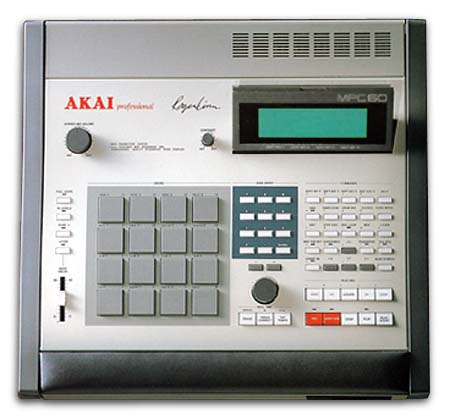
An Akai MPC60, the first MPC model
Other namesMIDI Production Center, Music Production Controller
Classification Music workstation
InventorRoger Linn
Developed1988

The Akai MPC (originally MIDI Production Center, now Music Production Center) is a series of music workstations produced by Akai from 1988 onwards. MPCs combine sampling and sequencing functions, allowing users to record portions of sound, modify them and play them back as sequences.

The first MPCs were designed by the American engineer Roger Linn, who had designed the successful LM-1 and LinnDrum drum machines in the 1980s. Linn aimed to create an intuitive instrument, with a grid of pads that can be played similarly to a traditional instrument such as a keyboard or drum kit. Rhythms can be created using samples of any sound.

The MPC had a major influence on the development of electronic and hip-hop music. It led to new sampling techniques, with users pushing its technical limits to creative effect. It had a democratizing effect on music production, allowing artists to create elaborate tracks without traditional instruments or recording studios. Its pad interface was adopted by numerous manufacturers and became standard in DJ technology.

Development

[edit]
The MPC was designed by Roger Linn (pictured in 2010), who also created the LinnDrum.

By the late 1980s, drum machines had become popular for creating beats and loops without instrumentalists, and hip-hop artists were using samplers to take portions of existing recordings and create new compositions.[1] Grooveboxes, machines that combined these functions, such as those by E-mu Systems, required knowledge of music production and cost up to $10,000.[1][2]

The original MPC, the MPC-60, was a collaboration between the Japanese company Akai and the American engineer Roger Linn. Linn had designed the successful LM-1 and LinnDrum, two of the earliest drum machines to use samples (prerecorded sounds).[3] His company, Linn Electronics, had closed following the failure of the Linn 9000, a drum machine and sampler. According to Linn, his collaboration with Akai "was a good fit because Akai needed a creative designer with ideas and I didn't want to do sales, marketing, finance or manufacturing, all of which Akai was very good at".[2]

Linn described the MPC as an attempt to "properly re-engineer" the Linn 9000.[2] He disliked reading instruction manuals and wanted to create an intuitive interface that simplified music production.[1] He designed the functions, including the panel layout and hardware specification, and created the software with his team. He credited the circuitry to a team led by the English engineer David Cockerell. Akai handled the production engineering, making the MPC "more manufacturable".[2] The first model, the MPC60 (MIDI Production Center), was released on December 8, 1988,[4] and retailed for $5,000.[1] It was followed by the MPC60 MkII and the MPC3000.[5]

After Akai went out of business in 2006,[6] Linn left the company and its assets were purchased by Numark.[7] Akai has continued to produce MPC models without Linn.[2] Linn was critical, saying: "Akai seems to be making slight changes to my old 1986 designs for the original MPC, basically rearranging the deck chairs on the Titanic."[7]

Features

[edit]
An MPC2000

Instead of the switches and small hard buttons of earlier devices, the MPC has a 4x4 grid of large pressure-sensitive rubber pads which can be played similarly to a keyboard.[1] The interface was simpler than those of competing instruments, and can be connected to a normal sound system, without the need for a studio. According to Vox, "Most importantly, it wasn't an enormous, stationary mixing panel with as many buttons as an airplane cockpit."[1]

Whereas artists had previously sampled long pieces of music, the MPC allowed them to sample smaller portions, assign them to separate pads and trigger them independently, similarly to playing a traditional instrument such as a keyboard or drum kit.[1] Rhythms can be built not just from percussion samples but any recorded sound, such as horns or synthesizers.[1]

The MPC60 only allows sample lengths of up to 13 seconds, as sampling memory was expensive at the time and Linn expected users to sample short sounds to create rhythms rather than long loops.[7] Functions are selected and samples are edited with two knobs. Red "record" and "overdub" buttons are used to save or loop beats.[1] The MPC60 has an LCD screen and came with floppy disks with sounds and instruments.[1]

Legacy

[edit]
DJ Shadow (pictured wearing an MPC shirt) created his landmark album Endtroducing..... with an MPC.
Kanye West performing with an MPC 2000XL

Linn anticipated that users would sample short sounds, such as individual notes or drum hits, to use as building blocks for compositions. However, users began sampling longer passages of music.[8] In the words of Greg Milner, the author of Perfecting Sound Forever, musicians "didn't just want the sound of John Bonham's kick drum, they wanted to loop and repeat the whole of 'When the Levee Breaks'".[8] Linn said: "It was a very pleasant surprise. After 60 years of recording, there are so many prerecorded examples to sample from. Why reinvent the wheel?"[8]

The MPC's ability to create percussion from any sound turned sampling into a new art form and allowed for new styles of music.[1] Its affordability and accessibility had a democratizing effect; musicians could create tracks without a studio or music theory knowledge, and it was inviting to musicians who did not play traditional instruments or had no music education.[1][9] Vox wrote that the MPC "challenged the notion of what a band can look like".[1] The 4x4 grid of pads was adopted by numerous manufacturers and became standard in DJ technology.[1] As of 2018, the MPC continued to be used even with the advent of digital audio workstations, and used models fetched high prices.[1]

Engadget wrote that the impact of the MPC on hip hop could not be overstated.[9] The rapper Jehst saw it as the next step in the evolution of the hip hop genre after the introduction of the TR-808, TR-909 and DMX drum machines in the 1980s.[10] The producer DJ Shadow used an MPC60 to create his influential 1996 album Endtroducing....., which is composed entirely of samples.[11] The producer J Dilla disabled the quantize feature on his MPC to create his signature "off-kilter" sampling style.[12] After J Dilla's death in 2006, his MPC was preserved in the Smithsonian National Museum of African American History and Culture in 2014.[13][14] The rapper Kanye West used the MPC to compose several of his best-known tracks and much of his breakthrough 2004 album The College Dropout.[1] West closed the 2010 MTV Video Music Awards with a performance of his 2010 track "Runaway" on an MPC.[15]

See also

[edit]

References

[edit]

Further reading

[edit]
[edit]
Revisions and contributorsEdit on WikipediaRead on Wikipedia
from Grokipedia
The MPC, or Music Production Center, is a series of standalone music production workstations developed by Professional, integrating digital sampling, sequencing, and drum programming into a compact device that revolutionized beat-making and electronic music production. Introduced in with the MPC60 model, it was designed by American audio engineer in collaboration with , combining the functionalities of a and sampler to allow musicians to record, edit, and sounds intuitively using 16 velocity- and pressure-sensitive pads. The series evolved significantly over the decades, starting with the MPC60's 12-bit sampling engine, 16-voice polyphony, and 10,490 notes of sequence memory, which set a new standard for portable production tools. Subsequent models like the MPC3000 in 1994 added 32-voice polyphony, onboard effects, and defeatable quantization, while the MPC2000 in 1997 introduced 16-bit sampling and expandable memory. By the 2000s, advancements included the MPC4000's 24-bit sampling and CD-R drive support in 2002, and modern iterations such as the MPC Live in 2017 brought battery-powered portability, touchscreen interfaces, 16GB storage, and integration with software like Ableton Live. As of 2025, the lineup includes standalone units like the MPC One+, MPC X Special Edition, and the MPC Live III, featuring Wi-Fi, Bluetooth, up to 128GB storage, and compatibility with MPC3 software for pattern-based composition across 128 tracks. Renowned for its tactile workflow and "feel" in programming rhythms, the MPC has profoundly influenced genres including hip-hop, electronic, and by democratizing sampling and production, enabling artists to create complex beats without large studio setups. Notable users such as , whose customized MPC3000 is preserved at the Smithsonian National Museum of and Culture, Kanye West, Dr. Dre, and Mark Ronson have leveraged its capabilities to shape landmark recordings, cementing its status as an iconic tool in music history.

History and Development

Origins and Early Models

The MPC series emerged from a pivotal collaboration between Professional and renowned engineer in 1986, as Akai sought to expand its digital music offerings beyond its origins in tape recording equipment. Founded in 1929 in , , Akai initially focused on consumer audio products like reel-to-reel tape recorders before entering the professional music market in the 1970s and shifting toward digital instruments in the 1980s with samplers such as the S900. Linn, who had revolutionized drum machines with his 1979 LM-1—the first to use programmable sampled drum sounds—and the 1982 , which introduced a pad-based interface for intuitive performance, brought his expertise to Akai to create an integrated sampling and sequencing workstation. This design philosophy emphasized tactile control via pads, drawing directly from the 's ergonomic approach to mimic drumming while enabling precise sample manipulation and sequencing. The inaugural model, the MPC60, debuted in as the "MIDI Production Center," priced at around $5,000 and quickly establishing the series' core workflow. It featured 16 velocity- and pressure-sensitive pads for expressive input, 16-voice polyphony to handle layered rhythms, and 12-bit sampling at 40 kHz providing 13 seconds of total mono sampling time (expandable to 26 seconds with additional ). The unit included a robust internal sequencer supporting 99 sequences, 20 songs, and up to 60,000 notes, alongside implementation and a port for loading samples from external devices like the , allowing seamless integration into studio setups without relying solely on internal . Building on the MPC60's foundation, released the MPC3000 in , the last model co-designed by Linn, which addressed key limitations through enhanced capabilities tailored for evolving production demands. It doubled polyphony to 32 voices, upgraded to 16-bit sampling at 44.1 kHz for superior audio fidelity, and offered 2 MB of standard RAM (expandable to 32 MB via SIMMs) enabling up to 188 seconds of mono sampling time (or 94 seconds ). Additional advancements included a port for direct hard disk connectivity to stream samples beyond internal limits, built-in digital effects processing with reverb, delay, chorus, and flanging, plus an analog for sound shaping—features that streamlined workflow and reduced reliance on external gear. From its introduction, the MPC60 saw rapid uptake in New York City's hip-hop production scenes during the late 1980s and early 1990s, where its compact, all-in-one design empowered beatmakers in resource-limited studios to chop vinyl samples and sequence intricate grooves. Pioneering producers like of employed the MPC60 to craft the gritty, looped beats emblematic of the era, solidifying its role as a cornerstone tool in golden age hip-hop and influencing a generation of artists.

Evolution of Later Models

The Akai MPC series advanced significantly following the MPC3000 with the release of the MPC2000 in 1997, introducing a 32-track sequencer, 2 MB of RAM expandable to 64 MB, Q-Link knobs for real-time control, and integration with ZIP drives for storage. This model emphasized enhanced sequencing capabilities and user-friendly hardware controls, building on the pad-based workflow while incorporating connectivity for external drives. The subsequent MPC2000XL in 1999 refined these features with a color LCD screen, increased sampling memory up to 64 MB, time-stretching tools, and automatic sample chopping, alongside USB connectivity for broader compatibility. By 2005, the MPC2500 shifted focus toward groove production, featuring pattern chaining, expandable flash memory via cards, and optional drives, which catered to producers seeking compact, expandable setups without relying on floppy disks. Mid-2000s developments further diversified the lineup, with the MPC4000 launched in 2002 offering 128 MB RAM, a DVD-RAM drive for direct audio import, 24-bit sampling, and phono preamps for turntable integration, positioning it as a high-end workstation for studio environments. The MPC500 in 2006 marked the series' first foray into true portability, with battery operation, a lightweight design, 12 velocity-sensitive pads, and CF card storage, enabling on-the-go production despite its limited effects processing. These models reflected Akai's response to evolving production needs, balancing power with accessibility amid the rise of digital audio workstations. The 2010s brought a transitional phase toward hybrid workflows, as the MPC Renaissance in 2010 and MPC Studio in 2013 emerged as controller-based units tied to dedicated MPC software, incorporating USB connectivity, phono preamps, and full integration with computer-based sequencing to leverage expanded processing power. This shift to software-dependent designs allowed for greater expandability but required a host computer, diverging from pure standalone operation. The MPC Live in 2017 reasserted standalone capabilities with a 7-inch , battery life up to 5 hours, 16 GB storage, and wireless integration, emphasizing portability for live and mobile use. The flagship MPC X followed in 2017 with a 10.1-inch display, 16 GB RAM, multiple outputs, and extensive I/O, solidifying the return to powerful, independent hardware. The entry-level MPC One in 2020 offered a more affordable standalone option with similar touchscreen and CV features, evoking the aesthetic of earlier models like the MPC2000XL. Recent innovations up to 2025 have enhanced standalone versatility and software synergy. The MPC Key 37, released in 2021, integrated a 37-key velocity-sensitive keyboard with MPC workflows, supporting expanded instrument plugins and portable synthesis. Special editions like the MPC X Special Edition in 2023 and MPC One Retro Edition in 2021 paid homage to classic designs, incorporating retro aesthetics such as gray panels and wooden side trims while retaining modern processors and storage. The MPC Live III, launched in 2025, features stem separation for audio analysis, support for up to 32 plugin instruments, an 8-core processor for four times the power of prior models, and built-in microphone for field recording, further bridging hardware autonomy with advanced digital tools. These developments were influenced by inMusic Brands' acquisition of Akai in 2012, which facilitated ongoing software updates and firmware enhancements, ensuring compatibility with evolving production standards.

Design and Functionality

Hardware Components

The Akai MPC series is renowned for its tactile interface, centered around a 4x4 grid of 16 velocity-sensitive pads that originated from Roger Linn's pioneering design for intuitive beat creation and sampling performance. Early models like the MPC60 featured these basic rubber pads capable of detecting strike velocity for dynamic expression, enabling producers to program rhythms with nuanced dynamics directly on the hardware. Over time, the pads evolved to include pressure (aftertouch) sensitivity for sustained control, RGB backlighting for visual feedback on pad assignments, and advanced materials for improved responsiveness; for instance, flagship models incorporate durable, responsive surfaces that withstand heavy use in studio and live settings. In 2025 models such as the MPC Live III, the introduction of MPCe pads adds 3D expressive sensing, allowing X/Y axis control for layering sounds, blending samples, and modulating parameters like note repeats during performance. Displays and controls have progressed from simple LCD screens in early units, which provided essential viewing and parameter readouts, to vibrant color interfaces in contemporary models. For example, the MPC Live features a 7-inch high-resolution for gesture-based navigation and editing, while the MPC X employs a 10.1-inch adjustable display for precise visual feedback on sequences and samples. Accompanying these are dedicated hardware controls, including Q-Link knobs—touch-sensitive endless rotaries that map to parameters like filter cutoff or volume for real-time tweaking—and arrays of backlit buttons and faders for track muting, transport functions, and effects assignment, fostering a hands-on that minimizes menu diving. Connectivity options ensure seamless integration with external gear, starting with foundational MIDI In/Out ports on early models for sequencer synchronization and support. Modern units expand this with I/O, including XLR/TRS combo jacks for microphones (often with 48V ), 1/4-inch TRS line inputs/outputs for instruments and monitors, RCA phono inputs for turntables, and digital I/O for high-fidelity connections. USB ports (Type-A for peripherals like MIDI controllers and Type-C for host connectivity), SD/CF card slots for storage expansion, and outputs for modular synth control are standard in flagships, while wireless features like MIDI and in recent models enable cable-free linking to devices and cloud-based expansions. Portability is a hallmark of select MPC designs, with battery-powered operation introduced in the compact MPC500 and refined in the Live series for on-the-go production. The MPC Live offers up to 5-6 hours of runtime on its rechargeable , supporting lightweight travel under 6 pounds, while later iterations like the Live II provide up to 5 hours depending on usage, paired with rugged, ergonomic form factors ideal for live performances and . Build quality emphasizes durability for environments, with models like the MPC X featuring a robust aluminum-reinforced , metal screen brackets, and high-grade for buttons and encoders to ensure longevity under intensive play. RGB-backlit pads provide illuminated status cues, and standalone units integrate built-in stereo speakers for immediate playback monitoring without external setups. These elements collectively enable a reliable, tactile platform that supports creative flow from inspiration to finished tracks.

Core Features and Workflow

The Akai MPC's sampling engine serves as a cornerstone of its production capabilities, enabling users to capture, manipulate, and integrate audio with . It supports time-stretching and pitch-shifting through advanced algorithms like Elastique Pro, allowing independent adjustment of and pitch without artifacts, alongside multi-sample support for creating layered keygroup instruments with up to 8 layers per program. Modern models process audio at 24-bit resolution with sample rates up to 96 kHz via ADCs and DACs, while the internal operates at 32-bit floating point for enhanced headroom; the MPC Live III introduces stem separation, isolating , vocals, , and bass from imported samples into four editable layers for remixing workflows. Sequencing in the MPC revolves around a versatile 128-track engine that accommodates both step-based and real-time input, facilitating pattern chaining for song construction and real-time recording of and audio events. Polyphony varies by model, reaching up to 64 voices in models like the MPC Live II and 256 voices in the MPC Live III, supporting complex arrangements, while integrated arpeggiators offer modes like classic, random, and pattern-based generation synced to , and note repeat functions enable rhythmic triggering with adjustable swing and timing correction. This setup integrates seamlessly with the sampling engine, allowing sequences to trigger sliced samples or multi-layered programs in a unified timeline. Effects processing enhances the MPC's ecosystem with built-in insert and master effects, including reverb, delay, EQ, and compression, applied per pad, track, or submix for precise control during mixing. The MPC software supports up to 32 VST/ plugin instances in 2025 models like the Live III, enabling hybrid processing with third-party tools while maintaining standalone operation. Workflow paradigms emphasize efficiency, such as Chop mode for automatic sample slicing based on transients, BPM, or regions to generate playable drum programs; program layering stacks up to 8 keygroups for rich timbres; and the XY pad provides real-time modulation of parameters like filter cutoff or effect depth. DAW integration via MPC2 software allows seamless transfer of sequences and audio, supporting hybrid setups where the hardware acts as a controller. Unique tools further streamline creative flows, including XYFX performance pads for gestural control of multiple effects simultaneously, clip launching in standalone modes for dynamic arrangement of audio and clips akin to live performance setups, and the autosampler for capturing multi-velocity samples from third-party instruments or plugins into MPC programs. These elements form an interconnected hardware-software ecosystem, where sampling feeds into sequencing, effects refine outputs, and intuitive paradigms like auto-chopping accelerate iterative production.

Cultural Impact and Legacy

Influence on Music Production

The Akai MPC revolutionized beat-making by introducing intuitive sample chopping and swing quantization, which standardized hip-hop production workflows throughout the 1990s. Sample chopping allowed producers to divide audio into precise segments for reassignment to , fostering creative recombination and rhythmic complexity, while swing quantization applied a subtle triplet-based groove to sequences, imparting a natural, humanized feel that distinguished MPC beats from rigid patterns. These features, first prominent in the MPC60 and refined in subsequent models like the MPC2000 with auto-slicing, streamlined the process of crafting looped, syncopated arrangements directly on hardware. The MPC played a pivotal role in shaping multiple genres, particularly during hip-hop's by enabling the characteristic boom-bap rhythms through layered, swung drum breaks and sparse sample integration. In electronic music, its detailed sequencing capabilities supported intricate pattern development in styles like IDM and , where producers leveraged the MPC's step sequencing and sample manipulation for evolving, polyrhythmic structures. Post-2018, the introduction of portable standalone units such as the MPC Live series enhanced live performance workflows, allowing battery-powered, laptop-free operation with onboard processing for real-time improvisation across genres; the MPC Live III, released in October 2025, further advances this with an eight-core CPU, 8GB RAM, 128GB storage, and clip launching capabilities. The MPC's release in democratized sampling by combining affordable hardware sampling with sequencing in a single unit, reducing reliance on expensive studio setups and enabling independent production. This shift influenced workstations, with features like Ableton's Simpler drawing from the MPC's sample slicing and playback modes to integrate hardware-inspired chopping into software environments. Akai's evolution of the MPC bridged hardware and software eras, incorporating plugin support and DAW integration while preserving tactile control, thus maintaining its centrality in hybrid production setups. Technically, the MPC's pad-based interface established a benchmark for velocity- and pressure-sensitive control, which competitors like ' adopted to emulate the MPC's 4x4 grid for intuitive beat programming and . Ongoing software updates, such as the MPC 3.0 release in 2025, have ensured its relevance by adding advanced editing tools, stem separation, and expanded plugin compatibility, adapting the platform to contemporary production demands without abandoning its core hardware ethos. In the , legal debates over sampling—sparked by high-profile lawsuits emphasizing clearance—prompted shifts toward more transformative techniques, where the MPC's time-stretching capabilities mitigated some challenges by allowing adjustments without pitch alteration, facilitating the integration of loops into new contexts while minimizing direct replication. This feature, refined across models, encouraged producers to alter source material extensively, aligning with evolving industry standards for originality amid clearance requirements.

Notable Users and Productions

The Akai MPC has been instrumental in the workflows of pioneering hip-hop producers since its inception. Producers and Q-Tip from the collective embraced the MPC in the late 1980s and early 1990s, with employing it for sample chopping on tracks like A Tribe Called Quest's "" (1991), enhancing the group's jazz-infused sound. In the 1990s, the MPC solidified its status among innovative beatmakers. extensively used the MPC3000 for his productions on Slum Village's (2000), applying techniques like quantized soul sampling to craft the album's signature off-kilter grooves. , another key figure, relied on MPC models such as the 2000XL for soul sample manipulation in his projects, including the album The Unseen (2000), where he layered obscure vinyl chops to build psychedelic hip-hop textures. Transitioning into the 2000s, prominently featured the MPC2000XL in crafting beats for his debut album (2004), using its sampling capabilities to interpolate soul and gospel elements on tracks like "." advanced the MPC's role in with the MPC software on (2010), sequencing intricate electronic patterns that blended , IDM, and hip-hop. Contemporary artists continue to leverage MPC hardware for dynamic production. and have incorporated the MPC Live for on-the-fly adjustments during live sessions and studio work, as seen in their collaborations on tracks from (2021). integrated MPC sampling into the live-band aesthetic of Malibu (2016), contributing to its fusion of funk, soul, and hip-hop. Notable production techniques underscore the MPC's enduring influence. J Dilla's "donut" loops—endless, manipulated soul samples on his MPC setups—became a blueprint for lo-fi hip-hop, as heard in his work on Donuts (2006). Additionally, the MPC's signature swing quantization has shaped trap beats throughout the , with producers like Mike WiLL Made-It applying it to patterns on hits such as Rae Sremmurd's "" (2016).

References

Add your contribution
Related Hubs
User Avatar
No comments yet.