



Community hub
Recent from talks
Knowledge base stats:
Talk channels stats:
Members stats:
MV Joyita
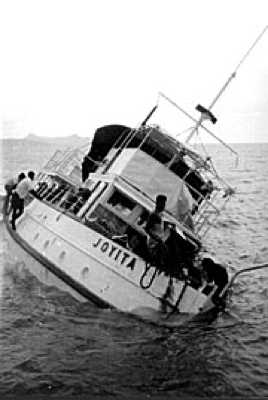
MV Joyita was an American merchant vessel from which 25 passengers and crew mysteriously disappeared in the South Pacific in October 1955. She was found adrift with no one aboard.
The ship was in very poor condition, with corroded pipes and a radio which, while functional, had a range of only about 2 miles (3.2 km) because of faulty wiring. However, the extreme buoyancy of the ship made sinking nearly impossible. Investigators were puzzled as to why the crew had not remained on board and waited for help.
MV Joyita was a 69-foot (21.0 m) wooden ship built in 1931 as a luxury yacht by the Wilmington Boat Works in Los Angeles for movie director Roland West, who named the ship for his wife, actress Jewel Carmen — joyita in Spanish meaning "little jewel". In 1936 the ship was sold and registered to Milton E. Beacon. During this period, she made numerous trips south to Mexico and to the 1939–1940 Golden Gate International Exposition in San Francisco. During part of this time, Chester Mills was the captain of the vessel.
The ship's hull was constructed of 2-inch (51 mm)-thick cedar on oak frames. She was 69 feet 0 inches (21.0 m) long, with beam of 17 feet 0 inches (5.2 m) and a draft of 7 feet 6 inches (2.3 m); her net tonnage was 47 tons and her gross tonnage approximately 70 tons. She had tanks for 2,500 U.S. gallons (9,500 L) of water and 3,000 U.S. gallons (11,400 L) of diesel fuel.
In October 1941, two months before the attack on Pearl Harbor, Joyita was acquired by the United States Navy and taken to Pearl Harbor, Hawaii, where she was outfitted as yard patrol boat YP-108. The Navy used her to patrol the Big Island of Hawaii until the end of World War II.
In 1943, she ran aground and was heavily damaged. However, the Navy was badly in need of ships; as such, Joyita was repaired. At this point, new pipework was made from galvanized iron instead of copper or brass. In 1946, the ship was surplus to Navy requirements and most of her equipment was removed.
In 1948, Joyita was sold to the firm of Louis Brothers. At this point, cork lining was added to the ship's hull along with refrigeration equipment. The ship had two Gray Marine diesel engines providing 225 horsepower (168 kW), and two extra diesel engines for generators. In 1950 William Tavares became the owner; however, he had little use for the vessel, and sold it in 1952 to Dr. Katharine Luomala, a professor at the University of Hawaii. She chartered the boat to her friend, Captain Thomas H. "Dusty" Miller, a British-born sailor living in Samoa. Miller used the ship as a trading and fishing charter boat.
About 5:00 AM on 3 October 1955, Joyita left Samoa's Apia harbour bound for the Tokelau Islands, about 270 miles (430 km) away. The boat had been scheduled to leave on the noon tide the previous day but her departure was delayed because her port engine clutch failed. Joyita eventually left Samoa on one engine. She was carrying sixteen crew members and nine passengers, including a government official, a doctor (Alfred "Andy" Denis Parsons, a World War II surgeon on his way to perform an amputation), a copra buyer, and two children. Her cargo consisted of medical supplies, timber, 80 empty 45-gallon (200 L) oil drums, and various foodstuffs.
Hub AI
MV Joyita AI simulator
(@MV Joyita_simulator)
MV Joyita
MV Joyita was an American merchant vessel from which 25 passengers and crew mysteriously disappeared in the South Pacific in October 1955. She was found adrift with no one aboard.
The ship was in very poor condition, with corroded pipes and a radio which, while functional, had a range of only about 2 miles (3.2 km) because of faulty wiring. However, the extreme buoyancy of the ship made sinking nearly impossible. Investigators were puzzled as to why the crew had not remained on board and waited for help.
MV Joyita was a 69-foot (21.0 m) wooden ship built in 1931 as a luxury yacht by the Wilmington Boat Works in Los Angeles for movie director Roland West, who named the ship for his wife, actress Jewel Carmen — joyita in Spanish meaning "little jewel". In 1936 the ship was sold and registered to Milton E. Beacon. During this period, she made numerous trips south to Mexico and to the 1939–1940 Golden Gate International Exposition in San Francisco. During part of this time, Chester Mills was the captain of the vessel.
The ship's hull was constructed of 2-inch (51 mm)-thick cedar on oak frames. She was 69 feet 0 inches (21.0 m) long, with beam of 17 feet 0 inches (5.2 m) and a draft of 7 feet 6 inches (2.3 m); her net tonnage was 47 tons and her gross tonnage approximately 70 tons. She had tanks for 2,500 U.S. gallons (9,500 L) of water and 3,000 U.S. gallons (11,400 L) of diesel fuel.
In October 1941, two months before the attack on Pearl Harbor, Joyita was acquired by the United States Navy and taken to Pearl Harbor, Hawaii, where she was outfitted as yard patrol boat YP-108. The Navy used her to patrol the Big Island of Hawaii until the end of World War II.
In 1943, she ran aground and was heavily damaged. However, the Navy was badly in need of ships; as such, Joyita was repaired. At this point, new pipework was made from galvanized iron instead of copper or brass. In 1946, the ship was surplus to Navy requirements and most of her equipment was removed.
In 1948, Joyita was sold to the firm of Louis Brothers. At this point, cork lining was added to the ship's hull along with refrigeration equipment. The ship had two Gray Marine diesel engines providing 225 horsepower (168 kW), and two extra diesel engines for generators. In 1950 William Tavares became the owner; however, he had little use for the vessel, and sold it in 1952 to Dr. Katharine Luomala, a professor at the University of Hawaii. She chartered the boat to her friend, Captain Thomas H. "Dusty" Miller, a British-born sailor living in Samoa. Miller used the ship as a trading and fishing charter boat.
About 5:00 AM on 3 October 1955, Joyita left Samoa's Apia harbour bound for the Tokelau Islands, about 270 miles (430 km) away. The boat had been scheduled to leave on the noon tide the previous day but her departure was delayed because her port engine clutch failed. Joyita eventually left Samoa on one engine. She was carrying sixteen crew members and nine passengers, including a government official, a doctor (Alfred "Andy" Denis Parsons, a World War II surgeon on his way to perform an amputation), a copra buyer, and two children. Her cargo consisted of medical supplies, timber, 80 empty 45-gallon (200 L) oil drums, and various foodstuffs.