Hubbry Logo
Mack NO 7½-ton 6x6 truckMack NO 7½-ton 6x6 truckMain
Open search
Mack NO 7½-ton 6x6 truck
Community hub
Mack NO 7½-ton 6x6 truck
logo
8 pages, 0 posts
0 subscribers
Be the first to start a discussion here.
Mack NO 7½-ton 6x6 truck
from Wikipedia

The Mack NO 7+12-ton 6x6 truck was a heavy 6x6 cargo truck designed in the 1940s by the American manufacturer Mack Trucks. It was used by the U.S. Army as an artillery tractor for heavy artillery during and after World War II. The official U.S. Army designation was: Truck, 7 1/2 ton, 6x6, Prime Mover.[2] Its G-number was (G-532).

Key Information

History

[edit]

In 1940, Mack Trucks started the development of a wheeled artillery tractor for the U.S. Army, with an off-road payload of 7+12 tons (6,803 kg), to tow the 155 mm gun, the 8 inch howitzer, the 8 inch gun, and the 240 mm howitzer.[2] A contract for the production of the vehicle was awarded in September 1940, and in January 1942 a vehicle of the NO-1 type towed the first 240 mm howitzer carriage from the Bucyrus plant in South Milwaukee, Wisconsin to the Aberdeen Proving Ground test facility.[2]

The NO-1 was the first in a series of five very similar prime mover vehicles. The NO-2 differed in details, among them a canvas cabin roof (the NO-1 had a metal roof) and the winch behind the front bumper (above the bumper in the NO-1). A total of 403 units of the NO-2 were delivered in 1943.[2] The next prime mover models, which marginally differed from the NO-2, were the NO-3 and NO-6. A total of 1,097 units of these were ordered and delivered in 1943 and 1944. The last of the series was the NO−7 model, of which 188 were delivered in 1944 and 362 in 1945. Several NO-7 were provided after the war to the European armies being rebuilt, including those of United Kingdom, France, Belgium and Netherlands.[2][3]

The models NO-4 and NO-5 were prototypes of heavy salvage vehicles, equipped with a Gar Wood crane which could swivel to the left and right. Neither model was put in production.[2][3][4]

Description

[edit]
Mack NO towing a gun; War and Peace show

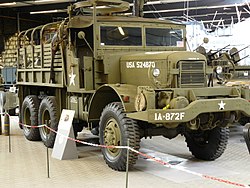
The vehicle had a typical configuration, with a hooded front engine behind which was a large driver cabin that could seat five soldiers, and a rear cargo area.

The engine was a Mack EY, 6-cylinder gasoline with a displacement of 707 cu in (11.6 L) ; generating 159 hp (119 kW) at 2100 rpm and 534 lbf⋅ft (724 N⋅m) at 800 rpm.[2] The transmission had 5 gears forward and one reverse. The installation of a transfer case with an additional reduction gear allowed high and low gearing (5F1Rx2).[1][5] Traction was in all six wheels (6x6), with 14.00-24 tires. The empty weight of the vehicle was 29,103 lb (13,201 kg), and 44,453 lb (20,164 kg) fully loaded.[1][2][5]

The gas tanks were located on both sides of the vehicle, with a total capacity of 170 US gallons (640 L; 140 imp gal). At the front of the vehicle a Garwood winch was installed with a pulling capacity of 40,000 lb (18,000 kg). It could be used to assist in placing the gun, or to help moving the vehicle if it was stuck.[1][2][3][4][5]

The cargo area was 11 ft (3.35 m) long by 8 ft (2.44 m) wide and could carry 7+12 tons (6,803 kg) of cargo. Starting with the NO-2 model, at the rear of the cargo compartment a small crane was installed to assist in placing the gun.[2] The maximum towed load of the vehicle was 50,000 lb (22,680 kg)[6]

Variants

[edit]

In total 2,053 Mack NO vehicles were built, in 7 variants as described in the following table.[2][3]

Type Model Years Produced Number Built
Artillery tractor NO-1 1
Artillery tractor NO-2 1943 403
Artillery tractor NO-3 & NO-6 1943 to 1944 1,097
Salvage vehicle NO-4 1
Salvage vehicle NO-5 1
Artillery tractor NO-7 1944 and 1945 550 (188 + 362)

See also

[edit]

References

[edit]
[edit]
Revisions and contributorsEdit on WikipediaRead on Wikipedia
from Grokipedia
The Mack NO 7½-ton 6x6 truck was a robust, six-wheel-drive prime mover developed and manufactured by the Mack Manufacturing Corporation for the U.S. military during , primarily serving as an to haul heavy ordnance such as the 155 mm M1 "Long Tom" gun and 8-inch howitzers across varied terrains. Designed for reliability in demanding conditions, it featured a low-slung optimized for loads up to 7.5 tons while maintaining off-road capability, and it played a key role in artillery operations in and the Pacific theaters from 1943 onward. Development of the Mack NO series began in 1940 in response to U.S. Army requirements for a specialized heavy to support large-caliber , evolving from earlier Mack designs like the NM 6-ton series to meet the need for greater payload and traction. Production ramped up in 1943 at Mack's facility, with 2,147 units completed by 1945 across variants including the NO-2, NO-3, NO-6, and NO-7 models, each refined for specific roles such as cab configurations and integration. These trucks were integral to wartime , enabling rapid repositioning of batteries, and some remained in service for training and reserve duties. Key specifications included a Mack EY inline-6 displacing 707 cubic inches (11.6 liters), delivering 159 horsepower at 2,100 rpm and 534 lb-ft of at 800 rpm for strong low-end pulling power. The vehicle employed a five-speed , Timken double-reduction drive axles, and could achieve a top speed of 32 mph (51 km/h) on roads, with a range of about 212 miles (340 km) from its 160-gallon . Empty weight hovered around 14.5 tons, emphasizing its heavy-duty construction with a riveted frame and military-grade tires for all-wheel drive. Variants of the Mack NO adapted the base platform for diverse applications, such as the open-cab NO-2 for prime , the enclosed-cab NO-6 for protection in colder climates, and NO-7 models, all equipped with front-mounted winches for self-recovery in mud or sand. Beyond , some were configured as carriers or dump trucks, contributing to supply lines in campaigns like the in 1944, where their durability proved vital amid rough European roads and adverse weather. Post-WWII, surplus units influenced civilian adaptations, underscoring the design's enduring legacy in heavy transport engineering.

Development and History

Origins and Requirements

In 1940, the U.S. Army sought a robust wheeled off-road to serve as a prime mover for heavy pieces, including the M1 155 mm gun, 8-inch howitzer M1, , and , amid the pre-World War II military buildup to enhance mobile firepower capabilities. Mack Trucks began development of the NO series that year in direct response to these requirements, designing a 7½-ton 6x6 truck optimized for superior traction and load-carrying in rugged terrain to support towing operations. The initial , designated NO-1, was completed and subjected to performance trials in January 1942, including a demanding demonstration where it towed a more than 900 miles from South Milwaukee, Wisconsin, to , , validating its off-road mobility and towing capacity under real-world conditions. This design effort built on Mack's established military truck heritage, notably the World War I-era model, which had proven its durability in demanding combat logistics and influenced the emphasis on rugged construction for the NO's prime mover duties.

Production and Contracts

The U.S. initiated contracts with in September 1940 for the development and production of initial prototypes of the 7½-ton 6x6 truck series, marking the beginning of its transition from to manufacturing. These early agreements focused on creating a robust prime mover capable of meeting wartime towing demands, with Mack's facility positioned as the primary production site under broader wartime contracts totaling over $398 million for various heavy trucks. Production of the Mack NO series ramped up significantly from to 1945, culminating in a total output of 2,050 units across all models, which served as essential prime movers for heavy in the U.S. Army. The early models, primarily the NO-2 variant, accounted for 403 units built in , establishing the foundational production line with open cabs and basic configurations. This was followed by mid-series output of 1,097 units (NO-3 and NO-6) between and 1944, incorporating minor refinements such as improved chassis stability in the NO-3 configuration, while later models like the NO-7 added closed cabs and enhanced recovery features, yielding 550 units from 1944 to 1945. Following , surplus Mack NO trucks were distributed to Allied nations as part of postwar military aid and reconstruction efforts, with recipients including the , , , and the in the late . These vehicles continued in service with European armies, often repurposed for towing and logistics roles, extending the operational life of the series beyond U.S. forces.

Design and Specifications

Engine and Drivetrain

The Mack NO 7½-ton 6x6 truck was powered by the Mack EY inline 6-cylinder gasoline , featuring a displacement of 707 cubic inches (11.6 L). This overhead-valve engine produced 159 horsepower (119 kW) at 2,100 rpm and delivered peak torque of 534 ft-lb (724 N⋅m) at 800 rpm, enabling robust low-speed performance essential for towing heavy artillery loads. The incorporated a paired with a dual-range , providing selectable high and low ratios for effective 6x6 drive distribution across all wheels, which enhanced traction in off-road conditions. This setup allowed for precise torque application during low-speed maneuvers, such as pulling 155 mm guns or 8-inch howitzers at speeds as low as 5 mph while maintaining control on uneven . The transmission's robust design, including a single reverse gear and integrated reduction gearing, supported the truck's operational demands without excessive complexity. Fuel capacity totaled 160 US gallons (605 L) across dual tanks, enabling a range of approximately 212 miles (340 km) on roads. Unloaded, the truck achieved a top speed of 32 mph (51 km/h), limited by its gearing to prioritize torque over velocity for artillery prime mover duties. Overall vehicle weight influenced drivetrain stress, but the system's low-end torque mitigated this during heavy hauls.

Chassis, Dimensions, and Capacities

The Mack NO 7½-ton 6x6 truck featured a heavy-duty ladder frame designed for rugged use, incorporating a 6x6 configuration to provide enhanced traction and stability on varied terrain. This frame supported beam axles across all three axles, ensuring durability under heavy loads during artillery towing operations. Key dimensions of the base configuration included an overall length of 24 ft 8 in (7.52 m), a width of 8 ft 6 in (2.59 m), and a height of 10 ft 4 in (3.15 m) to the top of the cab, allowing for transport within standard constraints while accommodating crew and equipment.
CategorySpecificationMetric Equivalent
Empty Weight29,103 lb13,201 kg
Gross Vehicle Weight (Loaded)44,453 lb20,164 kg
Payload Capacity (Cargo)7½ tons6,803 kg
Maximum Towed Load50,000 lb22,680 kg
The truck's suspension system utilized leaf springs on all axles, providing robust support for off-road mobility and load distribution. Tires measured 18.00x25, optimized for off-road traction and load-bearing in demanding environments. The engine integrated directly with the chassis via a centralized mounting, contributing to the vehicle's balanced without compromising structural integrity.

Operational Features

Cabin and Cargo Area

The Mack NO 7½-ton 6x6 truck incorporated a hooded front engine design, positioning the Mack EY inline-six gasoline engine forward of the cab to maximize interior space for the driver and accompanying artillery crew. This layout enabled an enclosed cab capable of seating up to five personnel, providing essential shelter during transport of heavy ordnance while maintaining a low profile for off-road maneuverability. The cargo bed was a sturdy wooden platform measuring 11 feet by 8 feet (3.35 m x 2.44 m), fitted with stake sides to secure artillery ammunition, howitzer components, or other equipment loads up to 6.8 tons. This configuration supported efficient loading and unloading in field conditions, with the open flatbed design prioritizing versatility for artillery prime mover duties over enclosed storage. As a soft-skinned vehicle, the truck offered minimal protection, lacking any armor plating to keep weight down for its 6x6 drivetrain. Basic canvas tops became standard from the NO-2 variant onward, providing rudimentary weatherproofing for the cab and cargo area while allowing open-top operations for better ventilation and rapid access during combat support tasks. Certain variants introduced slight cab modifications for specialized artillery roles, such as adjusted seating or mounting points, but the core enclosed remained consistent across models.

Towing and Winch Systems

The Mack NO 7½-ton 6x6 truck incorporated a front-mounted Garwood 5MB with a pulling capacity of 40,000 lb (18,144 kg), designed specifically for self-recovery operations and clearing obstacles in challenging . This was standard equipment across the series, enabling the vehicle to extract itself or assist other units from mud, sand, or inclines common in artillery deployment areas. The 's robust construction ensured reliability under the stresses of wartime conditions, contributing to the truck's effectiveness as a prime mover. At the rear, the truck featured a pintle-style towing hitch optimized for connecting to heavy artillery pieces such as the 155 mm Gun M1A1 "Long Tom," with reinforced frame mounts engineered to withstand towed loads up to 15,000 lb (7.5 short tons). This setup allowed for secure attachment and stable transport of oversized loads over rough off-road paths, where the 6x6 drivetrain provided necessary traction. Operational procedures emphasized proper alignment during hitching to prevent frame stress, with the overall towed load limits aligned to the chassis's structural capacities for safe artillery maneuvering. From the NO-2 variant onward, an auxiliary rear crane—often a manual hoist or powered lift—was integrated into the bed to facilitate loading of and positioning of gun trails during setup. This device aided in elevating heavy components like shell crates or trail ends, streamlining preparation for fire missions without requiring additional equipment. The complemented these efforts with a 200 ft cable length, supporting anchoring techniques such as deadman stakes or natural fixtures to enhance stability in off-road environments.

Variants

Artillery Tractor Models

The artillery tractor models of the Mack NO 7½-ton 6x6 truck series were developed specifically as prime movers for heavy artillery, capable of towing loads up to 22.7 tons off-road while providing reliable mobility in varied terrains during World War II. These variants shared core design elements, including a Mack EY inline-six gasoline engine producing 159 horsepower, a six-wheel-drive configuration for enhanced traction, and an integrated winch system for recovery and positioning operations. Minor evolutions across models focused on cab protection, drivetrain refinement, and system durability to meet evolving military demands without altering the external silhouette significantly. The NO-1 represented the initial , constructed as a single unit between 1940 and 1942 to demonstrate the concept of a heavy wheeled for towing. It featured a basic open cab design lacking a . Production of the NO-2 variant began in 1943, with 403 units delivered to the U.S. Army that year. This model introduced improvements over the , including a canvas roof for the open cab to provide basic weather protection and initial integration of a front-mounted for operational versatility. Subsequent refinements appeared in the NO-3 and NO-6 models, which were externally identical except for marginal enhancements in the NO-6 for improved reliability, and produced together for a total of 1,097 units between 1943 and 1944. These variants emphasized enhancements for improved reliability under heavy loads and prolonged field use, covered in U.S. Technical Manual TM 10-1679 for maintenance guidance. The NO-7 marked the final production iteration, with 550 units manufactured from 1944 to 1945. Overall, the series totaled approximately 2,050 vehicles, all optimized for towing artillery like the 155 mm M1 gun while maintaining a payload capacity of 7.5 tons.

Prototype and Specialized Variants

The Mack NO-4 was developed as a single prototype in 1943, serving as a salvage truck equipped with an integrated Gar Wood crane designed for battlefield recovery tasks, such as lifting and retrieving disabled vehicles under combat conditions. This variant modified the standard NO chassis by enlarging it to support the crane's mounting requirements, omitting the conventional cargo bed to prioritize recovery functionality. Building on this concept, the NO-5 emerged as another solitary between 1943 and 1944, configured as a heavy wrecker with an extended boom and advanced hydraulic lift mechanism to handle larger loads and more demanding salvage operations. Despite its innovative features, the NO-5 was ultimately rejected for full-scale production because of its intricate , which posed significant and challenges. Both the NO-4 and NO-5 underwent testing focused on salvage and recovery roles within , aiming to address the need for robust, on-site vehicle extraction in forward areas. However, neither advanced beyond prototyping, as their specialized adaptations proved too costly to scale, and existing vehicles from other manufacturers adequately fulfilled similar niche requirements without the added complexity. These designs highlighted Mack's exploration of heavy-duty recovery applications but underscored the practical limits of adapting the NO platform for non-standard uses.

Military Service

World War II Deployment

The Mack NO 7½-ton 6x6 truck entered U.S. Army service in 1943 as a dedicated prime mover, primarily assigned to battalions for towing heavy ordnance such as the "Long Tom" and the 8-inch Howitzer M1 in both the European and Pacific theaters. Its robust 6x6 drivetrain and 40,000-pound winch enabled effective positioning of these weapons in demanding conditions, with approximately 2,050 units produced between 1943 and 1945 to meet wartime needs. Of these, about 1,097 were provided under to allies including the , while the remainder supported U.S. operations. In the European Theater, the truck proved reliable in rough terrain and urban environments, as evidenced by its use in August 1944 during operations in , where it towed anti-tank guns and other artillery through heavily damaged streets. By late 1944, Mack NO trucks were integral to artillery support in major offensives, including advances following the and the push into , with their high torque output (534 ft-lb from the Mack EY engine) allowing sustained performance when hauling up to 50,000 pounds. However, the vehicle's substantial fuel consumption posed logistical challenges during extended marches across mud-churned battlefields in campaigns like the Italian theater from 1943 to 1944. In the Pacific Theater, the Mack NO facilitated the mobility of heavy units amid island-hopping operations, towing Long Tom guns to provide long-range against fortified Japanese positions, though its deployment there was more limited compared to due to terrain and shipping constraints. Overall, approximately 950 units were in active U.S. service by 1945, contributing to key engagements such as the by enabling rapid repositioning of batteries in winter conditions. The truck's versatility extended to recovery roles, underscoring its role as a critical asset in maneuvers throughout the war.

Post-War Applications

Following , the U.S. military demobilized excess Mack NO 7½-ton 6x6 trucks, with many entering surplus inventories for storage or disposal. Of the approximately 2,050 units produced between 1943 and 1945, a significant portion—1,097—had been exported under the program during the war, primarily to Allied forces. Post-war, refurbished examples continued in military service through foreign aid initiatives, including transfers to the armies of the , , , and the between 1946 and 1948 to support European reconstruction and residual colonial operations. Some surplus trucks underwent modifications for extended use, such as the addition of steel cargo bodies in place of original wooden ones, enabling their deployment in operations during the early era. In the United States, limited numbers were adapted for civilian heavy-hauling roles in industries like and through the , leveraging their robust 6x6 and capabilities. By the early 1950s, the Mack NO faced obsolescence due to the introduction of more efficient diesel-powered successors, such as the Mack M123 10-ton 6x6 prime mover, which offered improved fuel economy and performance for modern . Today, preserved examples are rare but maintained in collections like the Mack Trucks Historical Museum in , where a model serves as a key artifact of wartime engineering.
Add your contribution
Related Hubs
User Avatar
No comments yet.