


Community hub
Recent from talks
Contribute something
Nothing was collected or created yet.
Magic cube
View on Wikipedia | This article needs additional citations for verification. (September 2014) |

In mathematics, a magic cube is the 3-dimensional equivalent of a magic square, that is, a collection of integers arranged in an n × n × n pattern such that the sums of the numbers on each row, on each column, on each pillar and on each of the four main space diagonals are equal, the so-called magic constant of the cube, denoted M3(n).[1][2] If a magic cube consists of the numbers 1, 2, ..., n3, then it has magic constant (sequence A027441 in the OEIS)
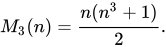
If, in addition, the numbers on every cross section diagonal also sum up to the cube's magic number, the cube is called a perfect magic cube; otherwise, it is called a semiperfect magic cube. The number n is called the order of the magic cube. If the sums of numbers on a magic cube's broken space diagonals also equal the cube's magic number, the cube is called a pandiagonal magic cube.
Alternative definition
[edit]In recent years, an alternative definition for the perfect magic cube has gradually come into use. It is based on the fact that a pandiagonal magic square has traditionally been called "perfect", because all possible lines sum correctly. That is not the case with the above definition for the cube.
Multimagic cubes
[edit]As in the case of magic squares, a bimagic cube has the additional property of remaining a magic cube when all of the entries are squared, a trimagic cube remains a magic cube under both the operations of squaring the entries and of cubing the entries (Only two of these are known, as of 2005.) A tetramagic cube remains a magic cube when the entries are squared, cubed, or raised to the fourth power.[3]
John R. Hendricks of Canada (1929–2007) has listed four bimagic cubes, two trimagic cubes, and two tetramagic cubes. Two more bimagic cubes (of the same order as those of Hendricks, but differently arranged) were found by Zhong Ming, a mathematics teacher in China. Several of these are perfect magic cubes, and remain perfect after taking powers.[4]
A mod-9 symmetric semiperfect tetramagic cube was found by Emlyn Ellis Addison in 2011.[5]
Magic cubes based on Dürer's and Gaudi Magic squares
[edit]A magic cube can be built with the constraint of a given magic square appearing on one of its faces, such as with the magic square of Dürer[6] or the magic square of Gaudi.[7]
See also
[edit]References
[edit]- ^ W., Weisstein, Eric. "Magic Cube". mathworld.wolfram.com. Retrieved 2016-12-04.
{{cite web}}: CS1 maint: multiple names: authors list (link) - ^ "Magic Cube". archive.lib.msu.edu. Retrieved 2021-04-20.
- ^ Derksen, Harm; Eggermont, Christian; van den Essen, Arno (September 2004), Multimagic squares, cubes and hypercubes, Radboud University, hdl:2066/60411
- ^ Boyer, Christian (June 5, 2020), "Multimagic cubes", Multimagie.com, retrieved 2024-04-14
- ^ Addison, Emlyn Ellis (January 1, 2022), "The Numerical Model Behind Empathy Alpha" (PDF), emlynellisaddison.com, retrieved 2025-09-21
- ^ http://sites.google.com/site/aliskalligvaen/home-page/-magic-cube-with-duerer-s-square[dead link]
- ^ http://sites.google.com/site/aliskalligvaen/home-page/-magic-cube-with-gaudi-s-square[dead link]
Andrews, William Symes (1960), "Chapter II: Magic Cubes", Magic Squares and Cubes (PDF) (2nd ed.), New York: Dover Publications, pp. 64–88, doi:10.2307/3603128, ISBN 9780486206585, JSTOR 3603128, MR 0114763, OCLC 1136401, S2CID 121770908, Zbl 1003.05500 {{citation}}: ISBN / Date incompatibility (help)
External links
[edit]- Harvey Heinz, All about Magic Cubes
- Marian Trenkler, Magic p-dimensional cubes
- Marian Trenkler, An algorithm for making magic cubes
- Marian Trenkler, On additive and multiplicative magic cubes Archived 2012-03-21 at the Wayback Machine
- Ali Skalli's magic squares and magic cubes
| Types |  | |
|---|---|---|
| Related shapes | ||
| Higher dimensional shapes | ||
| Classification | ||
| Related concepts | ||

Magic cube
View on GrokipediaDefinition and Fundamentals
Standard Definition
A magic cube of order is an array filled with the distinct positive integers from 1 to , arranged such that specific lines within the three-dimensional structure sum to the same constant value.[1] This structure extends the concept of a magic square, which is its two-dimensional analog.[1] The three-dimensional grid consists of layers, each an square, stacked along the third dimension. Within this arrangement, rows are the lines of numbers parallel to one axis within a fixed layer and fixed position along the second axis; there are such rows across all layers. Columns are analogous lines parallel to the second axis within a fixed layer and fixed position along the first axis, also totaling . Pillars, sometimes called files, are the vertical lines of numbers passing through corresponding positions in all layers, perpendicular to the layers, and there are pillars. For the cube to be magic, all rows, all columns, all pillars, and the four main space diagonals must sum to the same magic constant.[1] The magic constant for a normal magic cube of order is given by the formula This value arises from the total sum of the integers from 1 to , which is , divided by , the number of lines in each of the three directions (rows, columns, or pillars), since these lines partition the entire array without overlap.[3]Alternative Definitions
While the standard definition of a magic cube requires that the sums along all rows, columns, pillars, and the four main space diagonals (triagonals) equal the magic constant, alternative definitions relax these requirements to focus on subsets of lines, enabling constructions that are more feasible for certain orders or applications.[1] A semi-magic cube is a variation where only the rows, columns, and pillars sum to the magic constant, excluding any diagonals or triagonals. This relaxation mirrors the concept of a semi-magic square in two dimensions, prioritizing orthogonal lines for structural simplicity while forgoing the additional constraints of diagonal sums. Semi-magic cubes exist for all orders greater than or equal to 3, and they form the foundational layer for more complex constructions, as any full magic cube must also be semi-magic.[4][5] Incompletely magic cubes further loosen the criteria, requiring equal sums only in two of the three orthogonal directions (e.g., rows and columns but not pillars) or across specific planes, such as the faces of the cube. These definitions allow for partial magic properties, often used to study intermediate structures or to approximate full magic behavior in computational models. For instance, an incompletely magic cube might ensure magic sums in all horizontal and vertical planes but ignore depth-wise pillars, providing a stepping stone for algorithmic generation.[4] Terminology for these alternatives varies across mathematical literature; some sources use "magic cube" interchangeably for semi-magic or incompletely magic forms, reserving "perfect magic cube" for those where all possible lines—including planar diagonals in every orthogonal slice—sum equally, in addition to the standard requirements. This distinction, emphasized by researchers like J.R. Hendricks, highlights that "perfect" denotes a stricter pandiagonal and pantriagonal property, absent in basic magic cubes.[5][4][6] These relaxed definitions facilitate easier construction in higher orders, where the combinatorial explosion of full magic constraints becomes prohibitive. For example, while no perfect magic cube exists for order 4, semi-magic cubes of order 4 can be generated using extensions of Latin square methods, and incompletely magic versions allow exploration of order 5 and above with reduced computational demands, as demonstrated in systematic enumerations up to order 10.[5]Magic Constant
The magic constant of a normal magic cube of order , filled with the distinct integers from 1 to , is the unique value to which all rows, columns, pillars, and (in some definitions) space diagonals must sum. This constant is derived from the total sum of the numbers in the cube, given by the formula for the sum of the first natural numbers where :In any single direction (such as all rows across the cube), there are exactly lines, each containing distinct numbers, and these lines partition the entire cube without overlap, so their sums total . Thus, each line sums to
[7] The same logic applies independently to the column and pillar directions, ensuring consistency across the three orthogonal planes.[7] For verification, consider : here , so and , yielding .[8] This value confirms the required line sum for a 3×3×3 magic cube. The magic constant is essential for validating a cube's magic property: any line sum deviating from renders the arrangement invalid, as the equal-sum condition must hold uniformly.[7] As increases, scales quadratically with the cube's linear dimensions but as overall, since it approximates times the average cell value of . This scaling ties directly to the cube's volume of cells, where the total sum represents the aggregate "mass" distributed evenly across directional lines, emphasizing the balanced filling inherent to magic cubes.[7]
Historical Development
Origins and Early Examples
The concept of magic cubes originated as a three-dimensional extension of magic squares, which trace their roots to ancient China with the Lo Shu square, a 3×3 arrangement of numbers from 1 to 9 summing to 15 along rows, columns, and diagonals, first documented in literature around 650 BCE.[9] This foundational 2D structure, attributed to a legendary turtle emerging from the Yellow River, inspired later mathematical explorations into higher dimensions among European scholars during the Renaissance and beyond.[9] The earliest known attempt to construct a magic cube occurred in 1686, when Polish mathematician Adamas Kochansky extended the principles of magic squares to three dimensions, producing an additive magic cube of order 3 filled with numbers 1 through 27, where all rows, columns, pillars, and space diagonals sum to the magic constant of 42.[10] This pioneering work marked the transition from 2D to 3D magic figures, though Kochansky's construction remained relatively obscure and was primarily a theoretical elaboration rather than a widely disseminated example. Subsequent 18th- and 19th-century puzzle enthusiasts built on this idea through manual trial-and-error methods, exploring rudimentary order-3 cubes without systematic algorithms; verifiable constructions were limited to anecdotal reports in private correspondences. By the mid-19th century, interest in magic cubes grew among recreational mathematicians, emphasizing the challenges of ensuring triplanar sums without computational aids. A notable milestone came in 1875 when American puzzle enthusiast Gustavus Frankenstein published the first known perfect magic cube of order 8 in The Cincinnati Commercial, using numbers 1 to 512 with all lines, including broken diagonals, summing to 2052; Frankenstein acknowledged the possibility of prior unpublished attempts, reflecting the anecdotal nature of early explorations.[11] These 19th-century efforts highlighted the shift from isolated 2D magic squares to 3D puzzles in recreational mathematics journals and newspapers. Early 20th-century publications formalized these developments, with W.S. Andrews' 1917 book Magic Squares and Cubes providing comprehensive examples of order-3 magic cubes, including four distinct associative variants, and documenting the magic constant of 42 for the smallest cubes, thereby bridging manual constructions to more structured methods.[12] This era saw magic cubes gain traction in mathematical recreations, though systematic enumeration awaited later computational advances.Key Contributors and Milestones
In the early 20th century, systematic studies of magic cubes advanced with contributions from mathematicians exploring low-order examples. The four distinct simple magic cubes of order 3, up to rotation and reflection, were identified and enumerated, providing foundational insights into their structure.[13] For order 4, initial enumerations of subclasses, such as the 7,680 pan-3-agonal magic cubes, highlighted the growing complexity, though the total count remains unknown. During the 1950s, significant progress occurred in constructions for higher orders. Concurrently, C. B. Benson and T. H. O'Beirne advanced classifications and methods for higher-order cubes, with O'Beirne discussing perfect variants in publications like New Scientist, influencing recreational mathematics.[14] Their work emphasized practical constructions and theoretical boundaries for orders beyond 4. Building on this, computational approaches gained traction, with Richard Schroeppel proving in 1972 that any order-5 perfect magic cube must have a central value of 63, setting constraints for future searches.[15] In the 21st century, computational milestones have revolutionized enumerations and discoveries. Recent historical research in 2024 revealed that the earliest known perfect magic cube of order 7 was published in 1833 by Ferdinand Julius Brede (also known as de Fibre), predating the previously credited construction by A. H. Frost in 1866.[16] Walter Trump and Christian Boyer announced the first perfect magic cube of order 5 in 2003, using algorithmic searches to verify the magic constant of 315 across 109 lines, a feat unattainable by manual methods.[17] Subsequent efforts employed advanced algorithms to enumerate variants up to order 5, revealing millions of simple magic cubes while confirming the rarity of perfect ones, with ongoing computations exploring orders 6 and beyond.[18] These developments, rooted in earlier manual enumerations, underscore the shift to digital verification in magic cube theory.Properties and Classifications
Types of Sums and Lines
In a magic cube of order , the required sums are computed along specific geometric lines, each comprising entries that must equal the magic constant. These lines encompass straight aggregates parallel to the cube's axes as well as diagonals in three-dimensional space and within planes. The definitions distinguish between axial lines, which align with the cube's orthogonal directions, and diagonal lines, which traverse multiple dimensions. The axial lines include rows, columns, and pillars. Rows consist of horizontal lines within each of the layers (fixed depth coordinate), parallel to one base edge and spanning the width of the layer; there are such rows across all layers. Columns are lines within each layer oriented perpendicular to the rows, often interpreted as vertical within the plane of the layer (fixed depth and width coordinate, varying height in the plane); there are likewise columns. Pillars, also termed files, form vertical lines across all layers in one direction (fixed width and layer-plane height, varying depth), connecting equivalent positions through the cube's height; there are pillars. These three sets of axial lines total . Space diagonals are the primary diagonal lines penetrating the cube's volume, each connecting opposite corners and varying all three coordinates simultaneously; there are four such main space diagonals, corresponding to the distinct orientations that span the full extent of the cube.[1] Planar diagonals lie within each two-dimensional slice of the cube, such as the layers parallel to the base or cross-sections parallel to other faces. These include full diagonals, which are unbroken lines from corner to corner within the slice, and broken diagonals, which may involve wrapping around the edges of the slice in certain advanced configurations. The core set of lines for a standard magic cube thus comprises the axial lines plus the 4 main space diagonals, yielding a total of lines that must sum to the magic constant.Simple vs. Perfect Magic Cubes
A simple magic cube of order is an array filled with the distinct integers from 1 to such that the sums of the numbers along each of the lines parallel to the three principal axes—rows, columns, and pillars—and the 4 main space diagonals all equal the magic constant .[1] Planar diagonals are not required to sum to this constant in a simple magic cube.[19] For example, all four known simple magic cubes of order 3 satisfy this condition (including space diagonals) but lack fully magic planar slices.[13] In contrast, a perfect magic cube imposes stricter requirements: in addition to the orthogonal lines and 4 space diagonals, all planar diagonals within the slices orthogonal to each axis (totaling such diagonals, making each slice a magic square) must also sum to , resulting in a total of lines that achieve the magic constant.[6][20] This comprehensive summation property makes perfect magic cubes a higher class within magic cube classifications, often referred to as "Nasik cubes" in historical literature.[6] The enhanced constraints ensure greater symmetry but significantly increase construction difficulty compared to simple variants.[19] Constructing perfect magic cubes presents notable challenges, particularly for small orders. No perfect magic cubes exist for or , as proven impossible by properties of the required summations and the limited range of numbers 1 to 8 or 1 to 27.[21][19] Similarly, none exist for .[15] The smallest non-trivial perfect magic cube is of order 5, discovered in 2003 by Christian Boyer and Walter Trump after extensive computational search involving over 80,000 auxiliary order-3 cubes.[17] Earlier examples include the order-7 perfect cube by Rev. A. H. Frost in 1866 and the order-8 by Gustavus Frankenstein in 1875.[6] Enumeration reveals a stark disparity in abundance between simple and perfect magic cubes for higher orders. For order 3, exactly four simple magic cubes are known (up to rotation and reflection), while zero perfect ones exist.[13] For order 5, simple magic cubes can be generated via established methods, but perfect ones are rare, with the first fully verified example requiring advanced symmetry conditions like central symmetry.[17] This scarcity persists for larger , where perfect cubes represent a tiny fraction of simple ones due to the additional diagonal constraints, underscoring their rarity and mathematical intrigue.[20]Construction Methods
Based on Magic Squares
One common method for constructing magic cubes involves the layering technique, where n distinct or adjusted magic squares of order n are stacked to form the horizontal planes of an n×n×n cube. Each layer maintains the row and column sums of its underlying magic square, while the numbers are selected or permuted such that the pillars—vertical lines spanning all layers—also sum to the cube's magic constant of . This ensures the cube's rows, columns, and pillars align in sum, though achieving full magic properties requires careful coordination across layers to avoid discrepancies in planar sums.[22] For order-4 cubes, a specific adaptation uses Albrecht Dürer's renowned 4×4 magic square (with constant 34) as the base, replicated and permuted across the four layers to balance pillar sums at 130. By rearranging elements in subsequent layers—such as through orthogonal transformations or bit-plane manipulations derived from the square's binary representation—the resulting structure forms a semi-magic cube, where all orthogonal lines sum correctly but certain diagonals do not. This approach leverages the square's inherent symmetries, like paired sums of 17, to facilitate the 3D extension without introducing new numerical sets.[23][24] A parallel adaptation draws from the 4×4 magic square on the Passion Façade of Antoni Gaudí's Sagrada Família basilica, which features a constant of 33 and intentional deviations from normality (duplicating 10 and 14 while omitting 12 and 16). Stacking permuted versions of this square across layers yields a non-normal semi-magic cube (with repeated numbers) with pillar sums of 132, preserving the façade's thematic constant while ensuring orthogonal alignments; the resulting cube exhibits similar planar magic properties to its 2D base, such as consistent row and column totals, but with enhanced vertical harmony through layer permutations. Properties include quadrants summing to 66 and centered fours to 33, mirroring the square's design.[25][26] Despite these successes, the layering method predominantly yields semi-magic cubes, as aligning all space diagonals and broken diagonals often requires further tweaks beyond simple permutation, such as supplementary algebraic adjustments or hybrid constructions, which can disrupt the base squares' integrity. For instance, in order-4 examples, while pillars and planes sum reliably, the four main space diagonals may deviate without additional optimization, limiting the cubes to semi-magic status in most cases.[22]Direct Construction Techniques
Direct construction techniques for magic cubes employ algebraic and algorithmic approaches that build the 3D array directly, leveraging mathematical structures like orthogonal Latin squares and modular arithmetic to ensure all required lines sum to the magic constant. A prominent algebraic method uses orthogonal Latin squares to overlay symbols in three dimensions, assigning numbers to positions based on their symbol combinations. Specifically, two orthogonal Latin squares of order n are used to determine the "digits" in a base-n representation of the numbers 1 to n³, ensuring even distribution and sum parity across rows, columns, pillars, and diagonals. The entry at position (i, j, k) is calculated as a_{i,j,k} = n² · L1(i,j) + n · L2(i,k) + L3(j,k), where L1, L2, L3 are appropriately chosen Latin squares orthogonal in pairs, guaranteeing the magic properties without prior 2D constructions. This technique, generalized from Euler's work on orthogonal arrays, produces simple magic cubes for odd orders and can be adapted for even orders using additional transformations.[27] For the order-3 magic cube, explicit constructions provide placement rules derived from modular arithmetic. One such method systematically fills the cube to achieve the magic constant of 42, with examples like the cube published by T. Hugel in 1876. These rules ensure balanced distribution and verifiable magic lines through summation properties.[1] Computational enumeration relies on backtracking algorithms to generate magic cubes for higher orders, where algebraic methods become complex. The algorithm recursively fills cells with unused numbers from 1 to n³, pruning branches when partial line sums exceed the magic constant or violate parity. For n=3, exhaustive search efficiently identifies all valid cubes due to early pruning. There are 4 distinct order-3 magic cubes up to the cube's 48 symmetries (24 rotations and 24 reflections). Symmetry considerations reduce the search space by normalizing positions—e.g., fixing the center or a corner—and applying Burnside's lemma to count distinct configurations, avoiding redundant computations under group actions.[13]Advanced Variants
Multimagic Cubes
A multimagic cube of order and multiplicity is an arrangement of distinct nonnegative integers, typically from 0 to or 1 to , such that the sums along each row, column, pillar, and (in perfect variants) space diagonal equal a constant specific to each power from 1 to . This extends the standard magic cube, which corresponds to the case . For a normal bimagic cube using numbers 1 to , the magic constant for the first power is , while for the second power (squares), it is .[28] Bimagic cubes () represent the simplest nontrivial multimagic form beyond standard magic cubes. The first known bimagic cube was constructed in June 2000 by Canadian mathematician John-R. Hendricks, a semiperfect example of order 25 using numbers 1 to 15,625, with first-power constant 195,325 and second-power constant 2,034,700,525.[28] In 2003, French engineer Christian Boyer developed a non-normal bimagic cube of order 16 using numbers 0 to 4,095.[28] A perfect bimagic cube of order 25, where all space diagonals also satisfy the bimagic property, was later discovered by Chinese mathematician Zhong Ming in April 2015.[28] No bimagic cubes exist for orders 3, 4, or 5, as the required number of bimagic lines (e.g., 52 for order 4) exceeds the available bimagic series (e.g., only 8 for order 4).[29] Trimagic cubes () are exceptionally rare, demanding vast computational resources to satisfy constant sums for entries, their squares, and their cubes. The first known trimagic cube, a semiperfect example of order 64 using numbers 0 to 262,143, was discovered by Christian Boyer in 2003.[28] Boyer also constructed a perfect trimagic cube of order 256 in the same year, using numbers 0 to 16,777,215, with third-power constant 302,231,418,874,861,348,454,400.[28] No trimagic cubes are known for orders below 64, and their creation highlights the extreme constraints on entry placement to maintain multimagic properties across higher powers.[28] In general, multimagic cubes for orders less than 4 do not exist, as even basic magic cubes of such small sizes fail to support the additional power-sum equalities, with proven impossibilities for bimagic variants up to order 5.[29]Pandiagonal and Semi-Magic Cubes
A semi-magic cube, also referred to as a semiperfect magic cube in some literature, is an arrangement of the integers from 1 to such that the sums of the numbers along all lines parallel to the coordinate axes (rows, columns, and pillars) equal the magic constant , but the diagonals within the 2D cross-sections and space diagonals are not required to sum to this constant.[30] This partial property distinguishes semi-magic cubes from full magic cubes, focusing solely on the orthogonal plane sums in three dimensions while excluding diagonal constraints.[31] Semi-magic cubes exist for all orders , as their construction can be achieved through linear algebraic methods where the solution space has dimension , allowing integer solutions normalized to 1 through .[32] For order 3, examples have magic constant 42 and are associative, with opposite elements summing to .[30] Pandiagonal magic cubes represent an advanced subtype where, in addition to the standard magic properties, all broken diagonals—those that wrap around the edges of the cube in a toroidal manner—also sum to the magic constant. This wrap-around feature extends the pandiagonal property from 2D magic squares to 3D, ensuring uniformity across shifted positions.[33] Formally, a pandiagonal magic cube requires that every cross-section (the planes parallel to the faces) and every diagonal plane (the planes at 45-degree angles) is a pandiagonal magic square.[34] Such cubes exist for order , though they are imperfect, lacking the full diagonal sums required for perfect magic cubes without wrapping.[19] For prime orders , including , at least pandiagonal magic cubes can be constructed using sets of three mutually orthogonal pandiagonal Latin cubes mapped via an auxiliary function.[34] Higher-order examples, such as order 11, have been computationally enumerated, yielding 23 pandiagonal Latin cubes and 9870 orthogonal sets.[34] Pandiagonal semiperfect variants (combining semi-magic orthogonal sums with pandiagonal broken diagonals) exist for all orders and odd .[30] Hybrid variants, such as semi-pandiagonal or semi-pantriagonal cubes, incorporate wrap-around sums only in specific planes or directions, for instance requiring that 2-segment broken triagonals (space diagonals split into segments of length for even ) sum to the magic constant while other diagonals may not.[31] These provide intermediate structures between semi-magic and fully pandiagonal cubes, with examples verified for order 4 via affine transformations.[31]Examples and Enumeration
Order 3 Magic Cubes
An order 3 magic cube consists of the distinct integers from 1 to 27 arranged in a 3×3×3 array such that every row, column, pillar, and the four main space diagonals sum to the magic constant of 42. This constant is calculated as . There are exactly four distinct order 3 magic cubes when accounting for rotational and reflectional symmetries.[13] These four are the only known examples, and all feature the number 14 in the central cell, with the three central planes forming magic squares while the surface planes do not.[18] No order 3 magic cubes are perfect, as perfect magic cubes—where all possible planar diagonals also sum to the magic constant—do not exist for orders less than 5.[19] A representative example is the following arrangement, shown as three horizontal layers (with rows and columns summing to 42 in each): Layer 1:| 10 | 26 | 6 |
|---|---|---|
| 23 | 3 | 16 |
| 9 | 13 | 20 |
| 24 | 1 | 17 |
|---|---|---|
| 7 | 14 | 21 |
| 11 | 27 | 4 |
| 8 | 15 | 19 |
|---|---|---|
| 12 | 25 | 5 |
| 22 | 2 | 18 |
Higher-Order Examples
Magic cubes of order 4 represent the smallest non-trivial case beyond order 3, with the total number estimated at approximately 7 × 10¹² distinct simple magic cubes using the numbers 1 through 64.[18] However, no perfect magic cubes of order 4 exist, as proven by impossibility arguments showing that the required diagonal sums cannot consistently align with the magic constant of 130.[6] The first published simple magic cube of order 4 appeared in 1898, constructed by Hermann Schubert as an associated cube derived from Latin squares.[35] A notable example is the Dürer-derived magic cube, which extends Albrecht Dürer's famous order-4 magic square into three dimensions via binary transformations and XOR operations on orthogonal pairs, yielding orthogonal lines summing to 130; for instance, one layer incorporates the original square's structure:| 16 | 3 | 2 | 13 |
|---|---|---|---|
| 5 | 10 | 11 | 8 |
| 9 | 6 | 7 | 12 |
| 4 | 15 | 14 | 1 |