


Community hub
Magic state distillation
View on WikipediaMagic state distillation is a method for creating more accurate quantum states from multiple noisy ones, which is important[1] for building fault tolerant quantum computers. It has also been linked[2] to quantum contextuality, a concept thought to contribute to quantum computers' power.[3]
The technique was first proposed by Emanuel Knill in 2004,[4] and further analyzed by Sergey Bravyi and Alexei Kitaev the same year.[5]
Thanks to the Gottesman–Knill theorem, it is known that some quantum operations (operations in the Clifford group) can be perfectly simulated in polynomial time on a classical computer. In order to achieve universal quantum computation, a quantum computer must be able to perform operations outside this set. Magic state distillation achieves this, in principle, by concentrating the usefulness of imperfect resources, represented by mixed states, into states that are conducive for performing operations that are difficult to simulate classically.
A variety of qubit magic state distillation routines[6][7] and distillation routines for qubits[8][9][10] with various advantages have been proposed.
Stabilizer formalism
[edit]The Clifford group consists of a set of -qubit operations generated by the gates {H, S, CNOT} (where H is Hadamard and S is ) called Clifford gates. The Clifford group generates stabilizer states which can be efficiently simulated classically, as shown by the Gottesman–Knill theorem. This set of gates with a non-Clifford operation is universal for quantum computation.[5]


Magic states
[edit]Magic states are purified from copies of a mixed state .[6] These states are typically provided via an ancilla to the circuit. A magic state for the rotation operator is where . A non-Clifford gate can be generated by combining (copies of) magic states with Clifford gates.[5] Since a set of Clifford gates combined with a non-Clifford gate is universal for quantum computation, magic states combined with Clifford gates are also universal.



Purification algorithm for distilling |M〉
[edit]The first magic state distillation algorithm, invented by Sergey Bravyi and Alexei Kitaev, is as follows.[5]
- Input: Prepare 5 imperfect states.
- Output: An almost pure state having a small error probability.
- repeat
- Apply the decoding operation of the five-qubit error correcting code and measure the syndrome.
- If the measured syndrome is , the distillation attempt is successful.
- else Get rid of the resulting state and restart the algorithm.
- until The states have been distilled to the desired purity.

References
[edit]- ^ Campbell, Earl T.; Terhal, Barbara M.; Vuillot, Christophe (14 September 2017). "Roads towards fault-tolerant universal quantum computation" (PDF). Nature. 549 (7671): 172–179. arXiv:1612.07330. Bibcode:2017Natur.549..172C. doi:10.1038/nature23460. PMID 28905902. S2CID 4446310.
- ^ Howard, Mark; Wallman, Joel; Veitch, Victor; Emerson, Joseph (11 June 2014). "Contextuality supplies the 'magic' for quantum computation". Nature. 510 (7505): 351–355. arXiv:1401.4174. Bibcode:2014Natur.510..351H. doi:10.1038/nature13460. PMID 24919152. S2CID 4463585.
- ^ Bartlett, Stephen D. (11 June 2014). "Powered by magic". Nature. 510 (7505): 345–347. doi:10.1038/nature13504. PMID 24919151.
- ^ Knill, E. (2004). "Fault-Tolerant Postselected Quantum Computation: Schemes". arXiv:quant-ph/0402171. Bibcode:2004quant.ph..2171K.
{{cite journal}}: Cite journal requires|journal=(help) - ^ a b c d Bravyi, Sergey; Kitaev, Alexei (2005). "Universal quantum computation with ideal Clifford gates and noisy ancillas". Physical Review A. 71 (2) 022316. arXiv:quant-ph/0403025. Bibcode:2005PhRvA..71b2316B. doi:10.1103/PhysRevA.71.022316. S2CID 17504370.
- ^ a b Bravyi, Sergey; Haah, Jeongwan (2012). "Magic state distillation with low overhead". Physical Review A. 86 (5) 052329. arXiv:1209.2426. Bibcode:2012PhRvA..86e2329B. doi:10.1103/PhysRevA.86.052329. S2CID 4399674.
- ^ Meier, Adam; Eastin, Bryan; Knill, Emanuel (2013). "Magic-state distillation with the four-qubit code". Quantum Information & Computation. 13 (3–4): 195–209. arXiv:1204.4221. doi:10.26421/QIC13.3-4-2. S2CID 27799877.
- ^ Campbell, Earl T.; Anwar, Hussain; Browne, Dan E. (27 December 2012). "Magic-State Distillation in All Prime Dimensions Using Quantum Reed-Muller Codes". Physical Review X. 2 (4) 041021. arXiv:1205.3104. Bibcode:2012PhRvX...2d1021C. doi:10.1103/PhysRevX.2.041021.
- ^ Campbell, Earl T. (3 December 2014). "Enhanced Fault-Tolerant Quantum Computing in d -Level Systems". Physical Review Letters. 113 (23) 230501. arXiv:1406.3055. Bibcode:2014PhRvL.113w0501C. doi:10.1103/PhysRevLett.113.230501. PMID 25526106. S2CID 24978175.
- ^ Prakash, Shiroman (September 2020). "Magic state distillation with the ternary Golay code". Proceedings of the Royal Society A: Mathematical, Physical and Engineering Sciences. 476 (2241) 20200187. arXiv:2003.02717. Bibcode:2020RSPSA.47600187P. doi:10.1098/rspa.2020.0187. PMC 7544352. PMID 33071576.
| General | |||||||||
|---|---|---|---|---|---|---|---|---|---|
| Theorems | |||||||||
| Quantum communication |
| ||||||||
| Quantum algorithms | |||||||||
| Quantum complexity theory | |||||||||
| Quantum processor benchmarks | |||||||||
| Quantum computing models | |||||||||
| Quantum error correction | |||||||||
| Physical implementations |
| ||||||||
| Quantum programming | |||||||||


Magic state distillation
View on GrokipediaOverview
Definition and motivation
Magic state distillation is a quantum error correction technique that converts multiple copies of noisy, approximate non-stabilizer states—known as magic states—into fewer copies of higher-fidelity magic states using only Clifford operations and measurements. This process leverages stabilizer codes to detect and suppress errors, resulting in an exponential reduction in the error rate of the output states relative to the input error rate, scaling with the distance of the underlying code.[1] The primary motivation for magic state distillation arises from the limitations of stabilizer-based quantum computing. According to the Gottesman–Knill theorem, quantum circuits composed solely of stabilizer states, Clifford gates, and measurements in the Pauli basis can be efficiently simulated on a classical computer, lacking the full power of universal quantum computation. Magic states serve as a critical resource to extend this framework, enabling the implementation of non-Clifford operations, such as the π/4-rotation, which are essential for universal quantum gates beyond the classically simulable Clifford group.[5][1] In the context of fault-tolerant quantum computing, magic state distillation addresses fundamental obstacles to scalability. The Eastin–Knill theorem proves that no quantum error-correcting code admits a universal set of transversal gates, including non-Clifford operations, preventing simple, error-avoiding implementations of universality within stabilizer codes. By distilling high-fidelity magic states offline and injecting them via Clifford operations like the controlled-non-Clifford gate, distillation circumvents this no-go result, facilitating fault-tolerant execution of complex quantum algorithms.[6][1] Under a basic depolarizing noise model, input magic states are assumed to have fidelity $ F > 1 - \epsilon $ with respect to the ideal state, where $ \epsilon $ is the input error rate. Distillation protocols succeed in producing output states with fidelity approaching 1 exponentially in the code distance when the input $ \epsilon $ is below a protocol-specific threshold, enabling recursive purification to arbitrarily low error rates despite imperfect Clifford operations.[1]Historical development
The concept of preparing high-fidelity non-stabilizer ancillas for universal quantum computation was first proposed by Emanuel Knill in early 2004, using postselection and error-detecting codes.[7] Sergey Bravyi and Alexei Kitaev built on this later that year, introducing specific magic state distillation protocols that purify approximate non-Clifford states into high-fidelity magic states through error-correcting procedures using stabilizer codes.[1] Their work demonstrated distillation procedures for both T-type and H-type magic states with specific threshold error rates, such as approximately 0.173 for the 5-qubit code applied to T-states.[1] Early developments focused on efficient codes for specific gates. The Bravyi-Kitaev protocol utilized Reed-Muller codes, such as the 15-qubit version, to distill T-states at a 15-to-1 ratio, enabling exponential error suppression below a threshold fidelity of about 0.910.[1] Their analysis also touched on Toffoli state distillation using smaller entangled states, laying groundwork for multi-qubit non-Clifford gates, though practical implementations awaited further code constructions.[1] By 2012, Bravyi and Jeongwan Haah advanced the field with triorthogonal codes, which improved distillation thresholds and reduced overhead for T-state preparation compared to prior Reed-Muller approaches, achieving up to a twofold reduction in resources for target accuracies like 10^{-12}.[8] Key milestones in the 2010s included optimized protocols for H-states and cost analyses. In 2012, Ethan Meier and Bryan Eastin introduced a four-qubit error-detecting code for distilling the +1 eigenstate of the Hadamard gate, requiring ten input states per two output states and offering lower overhead for certain error regimes.[9] By 2017, Earl T. Campbell and Mark Howard developed a unified framework combining one round of distillation with multi-qubit gate synthesis, significantly cutting resource costs by integrating error correction and gate operations.[10] Recent theoretical advances have emphasized hardware efficiency and reduced overhead. In 2025, researchers at Inria and Alice & Bob proposed unfolded codes, a scheme adapting 3D color codes into 2D layouts for cat qubits, enabling magic state production with just 53 qubits per state—an 8.7-fold improvement over traditional methods—while maintaining fault tolerance.[11] In 2024, a zero-level distillation approach was introduced, preparing high-fidelity logical magic states directly at the physical qubit level without initial error correction layers, drastically lowering qubit and time requirements for biased-noise systems.[12] Concurrently, optimal 3D architectures for cat qubits, refined by Inria and Alice & Bob, further minimized spacetime costs in superconducting platforms by leveraging noise bias in distillation circuits. In 2024, protocols achieving constant-overhead scaling—with a scaling exponent of zero—were theoretically realized using algebraic geometry codes converted to qubit systems, eliminating growing resource demands as error thresholds tighten.[13]Theoretical Background
Stabilizer formalism
The Pauli operators form the basis for the stabilizer formalism in quantum error correction. The single-qubit Pauli operators are the identity , the bit-flip , the phase-flip , and the product , satisfying the commutation relations and the anticommutation relations .[5] For qubits, the Pauli group is generated by tensor products of these operators, including global phases , and elements commute or anticommute: for Paulis , either or .[5] A stabilizer code is defined by an abelian subgroup of the Pauli group, excluding the identity, such that all elements of commute. The code space is the simultaneous +1 eigenspace of all operators in , which is a -dimensional subspace of the -dimensional Hilbert space, where is the number of encoded logical qubits. In practice, the code is specified by a set of independent generators that generate the full group. For example, the five-qubit code, a perfect code capable of correcting any single-qubit error, has generators , , , , where the operators act on qubits 1 through 5 in sequence.[5][14] The Clifford group is the normalizer of the Pauli group in the unitary group, consisting of all unitaries such that . It is generated by the Hadamard gate , the phase gate , and the controlled-NOT (CNOT) gate, and thus includes all operations that map Pauli operators to Pauli operators under conjugation.[5] The Gottesman–Knill theorem states that any quantum circuit consisting solely of Clifford gates applied to stabilizer states (or |0⟩ and |+⟩ states, which are stabilizer states) can be efficiently simulated classically in polynomial time, using a stabilizer tableau representation that tracks the Pauli stabilizers and the state under Clifford evolution.[15] In stabilizer codes, all Clifford gates can be implemented fault-tolerantly and often transversally, meaning the logical gate is obtained by applying the physical gate independently to each qubit without error propagation beyond the code's distance. However, non-Clifford gates cannot be implemented transversally in any nontrivial stabilizer code in a way that forms a universal gate set, necessitating additional resources like distillation for fault-tolerant universality.[5][6]Magic states and resource theory
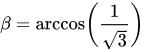
Magic states are pure quantum states that lie outside the convex hull of stabilizer states, known as the stabilizer polytope, and thus cannot be prepared using only Clifford operations on stabilizer initial states.[16] These states provide the non-Clifford resources essential for universal quantum computation, as they enable the implementation of non-Clifford gates through injection protocols involving postselected Clifford gadgets, such as a postselected controlled-controlled-Z (CCZ) gate.[1] Common examples of magic states include the T-state, defined as $ |T\rangle = \cos\beta |0\rangle + e^{i\pi/4} \sin\beta |1\rangle $, where $ \beta = \frac{1}{2} \arccos\left(\frac{1}{\sqrt{3}}\right) $, which facilitates the fault-tolerant implementation of a -rotation (T gate).[1] Another example is the H-state, $ |H\rangle = \cos(\pi/8) |0\rangle + \sin(\pi/8) |1\rangle $, used to distill fault-tolerant Hadamard gates.[17] For multi-qubit operations, the CCZ-state serves as a resource for implementing the Toffoli gate via injection, extending the Clifford hierarchy to higher levels.[17] In the resource theory of magic states, the free operations are Clifford unitaries and measurements on stabilizer states, while magic states quantify the "non-stabilizerness" or computational power beyond the stabilizer formalism.[16] Magic serves as a monotone under these free operations, with measures such as mana, defined as the logarithm of the sum of the absolute values of the discrete Wigner function over stabilizer states, providing a computable bound on the resource content.[18] Similarly, thauma measures, including min-thauma and max-thauma, offer efficient bounds on the non-stabilizerness and have been shown to outperform mana in assessing distillation efficiency.[19] Stabilizer Rényi entropy, a family of entropic monotones minimized to zero only for stabilizer states, further quantifies magic and connects to simulation complexity.[20] In the asymptotic regime, the distillation rate of magic states is limited by the relative entropy of magic, determining the optimal yield of high-fidelity magic states from noisy precursors under free operations.[16] Preparing magic states poses significant challenges due to the limitations of noisy quantum hardware, which typically produces approximate versions with errors that must be mitigated through distillation.[21] The fidelity $ F = |\langle \psi | \phi \rangle|^2 $, where $ |\psi\rangle $ is the target ideal magic state and $ |\phi\rangle $ is the approximate state, serves as the key metric for assessing preparation quality, with high fidelity required to suppress error propagation in fault-tolerant schemes.[21] Injection protocols consume magic states to implement non-Clifford gates fault-tolerantly by combining the state with Clifford corrections and postselection, ensuring that errors in the magic state do not propagate uncontrollably to the computational register.[1] For instance, injecting a T-state with appropriate Clifford operations and measurement yields a fault-tolerant T gate, while analogous procedures apply to H-states for Hadamard gates and CCZ-states for Toffoli gates, maintaining the overall error rate below thresholds.[17]Distillation Protocols
Bravyi–Kitaev protocol
The Bravyi–Kitaev protocol, introduced in 2004, provides a foundational method for distilling high-fidelity magic states using triorthogonal codes, a subclass of CSS stabilizer codes. In these codes, the generators of the X-stabilizer group and Z-stabilizer group are orthogonal (their supports have even overlap), and the logical X operator has even overlap with every even-weight codeword in the classical dual code. This structure enables the transversal application of T-gates to implement a logical non-Clifford operation while preserving the code space under Clifford corrections, allowing purification of noisy magic states through error detection via stabilizer measurements.[1] A canonical example is the 15-to-1 distillation protocol for the T-state, defined as $ |T\rangle = \cos(\pi/8) |0\rangle + e^{i\pi/4} \sin(\pi/8) |1\rangle $, which employs the quantum Reed-Muller code. This code encodes one logical qubit into 15 physical qubits and requires 15 input copies of a noisy T-state with fidelity $ F_{\text{in}} $ to produce one output T-state with improved fidelity $ F_{\text{out}} > F_{\text{in}} $ upon success. The protocol exploits the triorthogonality to align the non-Clifford phase accumulation with the code's properties, suppressing errors through postselection.[1] The distillation circuit begins by preparing the 15 noisy T-states and using 14 of them to encode the logical even-parity state $ |0_L\rangle $ (the +1-eigenspace of all Z-stabilizers), while the remaining T-state encodes the logical odd-parity component via the logical X operator, forming the superposition $ |+L\rangle = |0_L\rangle + |1_L\rangle $. Transversal T-gates are then applied to all 15 qubits, introducing phase errors that are detectable due to the code's structure. The Z-stabilizers are measured to compute the syndrome, corresponding to parity checks in the underlying classical Reed-Muller code. Success is postselected on obtaining the trivial syndrome (all even parities), after which the output logical T-state $ |T_L\rangle $ is decoded to yield a single high-fidelity $ |T\rangle $ state using Clifford operations. The success probability is approximately $ (1 - \epsilon{\text{in}})^{15} \approx 1 - 15\epsilon_{\text{in}} $ for small input error rate $ \epsilon_{\text{in}} = 1 - F_{\text{in}} $.[1] Error analysis assumes independent depolarizing noise on input states, yielding cubic error suppression: $ \epsilon_{\text{out}} \approx 35 \epsilon_{\text{in}}^3 + O(\epsilon_{\text{in}}^4) $, where the coefficient 35 arises from the number of weight-3 undetectable errors in the code. This enables recursive application to achieve arbitrarily high fidelity provided the initial $ F_{\text{in}} $ exceeds the protocol's threshold of approximately 0.859, below which errors amplify. For practical recursion to fidelities near 0.999, input states with $ F_{\text{in}} \gtrsim 0.99 $ are typically required to minimize levels and overhead.[1] The protocol generalizes to higher-level non-Clifford operations by using larger triorthogonal codes with multiple logical qubits. For instance, a code can distill a three-qubit CCZ magic state $ |CCZ\rangle = \frac{1}{\sqrt{8}} \sum_{i,j,k = 0}^{1} |i j k \rangle + \frac{e^{i \pi /4} - 1}{\sqrt{8}} |111\rangle $, enabling fault-tolerant Toffoli gates via transversal CCZ operations followed by stabilizer measurements and postselection. This framework underpins subsequent distillation advancements while establishing the core principles of error suppression in magic state preparation.[1]Other protocols
One prominent alternative to the original Bravyi–Kitaev protocol is the family of triorthogonal codes introduced by Bravyi and Haah in 2012, which enable magic state distillation with reduced overhead through stabilizer codes supporting transversal T-gates on multiple logical qubits.[8] These codes are defined by triorthogonal matrices, where the rows satisfy orthogonality conditions for pairs and triples of basis vectors, allowing recursive distillation across multiple levels to achieve high-fidelity T-states with poly-logarithmic scaling in the desired accuracy.[8] For instance, their protocols support a 13-to-1 distillation for CCZ magic states, consuming 13 noisy inputs to yield one high-fidelity output, and demonstrate thresholds up to approximately 0.995 input fidelity for T-states in optimized small codes.[8] Compared to Reed-Muller-based methods, triorthogonal codes offer lower space overhead for large-scale applications by encoding more logical qubits per physical qubit while maintaining comparable error suppression rates of order or higher.[8] A specific low-overhead protocol for T-state distillation is the 15-to-1 routine, which leverages a punctured Reed-Muller code to encode a logical T-state transversally across 15 physical qubits.[1] This circuit requires 15 input T-states, 14 CNOT gates, and syndrome measurements on ancillary qubits to detect errors, achieving cubic error suppression where the output error rate scales as for depolarizing noise .[22] The protocol's input fidelity threshold is approximately 0.859, above which the output fidelity exceeds the input, making it suitable for moderate-noise regimes without deep recursion. Its simplicity facilitates integration into surface code architectures via lattice surgery for logical operations.[22] Extensions of triorthogonal codes have targeted other magic states, such as the 2012 Meier-Eastin-Knill protocol using a four-qubit error-detecting code to distill H-states, which are eigenstates enabling non-Clifford operations like the -rotation in certain bases.[9] This routine consumes 10 input H-states per iteration to produce 2 outputs with improved fidelity, offering lower qubit costs than T-state protocols for applications requiring Hadamard-augmented universality.[9] Further optimizations by Gidney in 2019 enhanced triorthogonal code integration with surface codes by reducing gate counts through catalyzed transformations, such as converting CCZ-states to pairs of T-states, thereby cutting overall spacetime overhead by up to 50% in fault-tolerant factories.[23] Recent variants address hardware constraints in 2D architectures. Unfolded codes, proposed in 2025, adapt triorthogonal distillation for planar qubit arrays by unfolding 3D color code operations into 2D layers, reducing qubit requirements to 53 per magic state while preserving error thresholds above 0.8 fidelity for biased-noise devices. Complementing this, zero-level distillation protocols from 2024 bypass full logical encoding by preparing high-fidelity magic states directly at the physical level using minimal stabilizers, achieving approximately 50% overhead reduction in both qubits and T-depth compared to recursive methods.[12] In 2025, protocols achieving constant-overhead scaling—with a scaling exponent of zero—have been theoretically realized using algebraic geometry codes converted to qubit systems, eliminating growing resource demands as error thresholds tighten.[24]| Protocol | Target State | Input Fidelity Threshold | Qubits per Output (Level 1) | Gate Count (CNOTs, Approx.) | Overhead vs. Reed-Muller |
|---|---|---|---|---|---|
| Bravyi-Haah Triorthogonal | T / CCZ | ~0.995 (T) | 10–17 | 50–100 | Lower space (2× better at high accuracy)[8] |
| 15-to-1 Reed-Muller | T | 0.859 | 15 | 14 | Baseline (cubic suppression) |
| Meier-Eastin-Knill Four-Qubit | H | ~0.9 | 4 (per 2 outputs) | 20–30 | Lower for H-states (10:2 ratio)[9] |
| Unfolded Codes | T (biased noise) | >0.8 | 53 | Variable (2D) | 8.7× qubit reduction |
| Zero-Level | T | ~0.85 | Physical (no encoding) | Reduced by 50% | 50% total overhead cut[12] |