


Community hub
Recent from talks
Contribute something
Nothing was collected or created yet.
Superdense coding
View on Wikipedia | This article has multiple issues. Please help improve it or discuss these issues on the talk page. (Learn how and when to remove these messages)
|


In quantum information theory, superdense coding (also referred to as dense coding) is a quantum communication protocol to communicate a number of classical bits of information by only transmitting a smaller number of qubits, under the assumption of sender and receiver pre-sharing an entangled resource. In its simplest form, the protocol involves two parties, often referred to as Alice and Bob in this context, which share a pair of maximally entangled qubits, and allows Alice to transmit two bits (i.e., one of 00, 01, 10 or 11) to Bob by sending only one qubit.[1][2] This protocol was first proposed by Charles H. Bennett and Stephen Wiesner in 1970[3] (though not published by them until 1992) and experimentally actualized in 1996 by Klaus Mattle, Harald Weinfurter, Paul G. Kwiat and Anton Zeilinger using entangled photon pairs.[2] Superdense coding can be thought of as the opposite of quantum teleportation, in which one transfers one qubit from Alice to Bob by communicating two classical bits, as long as Alice and Bob have a pre-shared Bell pair.[2]
The transmission of two bits via a single qubit is made possible by the fact that Alice can choose among four quantum gate operations to perform on her share of the entangled state. Alice determines which operation to perform accordingly to the pair of bits she wants to transmit. She then sends Bob the qubit state evolved through the chosen gate. Said qubit thus encodes information about the two bits Alice used to select the operation, and this information can be retrieved by Bob thanks to pre-shared entanglement between them. After receiving Alice's qubit, operating on the pair and measuring both, Bob obtains two classical bits of information. It is worth stressing that if Alice and Bob do not pre-share entanglement, then the superdense protocol is impossible, as this would violate Holevo's theorem.
Superdense coding is the underlying principle of secure quantum secret coding. The necessity of having both qubits to decode the information being sent eliminates the risk of eavesdroppers intercepting messages.[4]
Overview
[edit]

Suppose Alice wants to send two classical bits of information (00, 01, 10, or 11) to Bob using qubits (instead of classical bits). To do this, an entangled state (e.g. a Bell state) is prepared using a Bell circuit or gate by Charlie, a third person. Charlie then sends one of these qubits (in the Bell state) to Alice and the other to Bob. Once Alice obtains her qubit in the entangled state, she applies a certain quantum gate to her qubit depending on which two-bit message (00, 01, 10 or 11) she wants to send to Bob. Her entangled qubit is then sent to Bob who, after applying the appropriate quantum gate and making a measurement, can retrieve the classical two-bit message. Observe that Alice does not need to communicate to Bob which gate to apply in order to obtain the correct classical bits from his projective measurement.
The protocol
[edit]The protocol can be split into five different steps: preparation, sharing, encoding, sending, and decoding.
Preparation
[edit]The protocol starts with the preparation of an entangled state, which is later shared between Alice and Bob. For example, the following Bell state

is prepared, where denotes the tensor product. In common usage the tensor product symbol may be omitted:

- .

Sharing
[edit]After the preparation of the Bell state , the qubit denoted by subscript A is sent to Alice and the qubit denoted by subscript B is sent to Bob. Alice and Bob may be in different locations, an unlimited distance from each other.

There may be an arbitrary period between the preparation and sharing of the entangled state and the rest of the steps in the procedure.
Encoding
[edit]By applying a quantum gate to her qubit locally, Alice can transform the entangled state into any of the four Bell states (including, of course, ). Note that this process cannot "break" the entanglement between the two qubits.
Let's now describe which operations Alice needs to perform on her entangled qubit, depending on which classical two-bit message she wants to send to Bob. We'll later see why these specific operations are performed. There are four cases, which correspond to the four possible two-bit strings that Alice may want to send.
1. If Alice wants to send the classical two-bit string 00 to Bob, then she applies the identity quantum gate, , to her qubit, so that it remains unchanged. The resultant entangled state is then

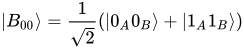
In other words, the entangled state shared between Alice and Bob has not changed, i.e. it is still . The notation indicates that Alice wants to send the two-bit string 00.

2. If Alice wants to send the classical two-bit string 01 to Bob, then she applies the quantum NOT (or bit-flip) gate, , to her qubit, so that the resultant entangled quantum state becomes
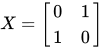
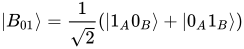
3. If Alice wants to send the classical two-bit string 10 to Bob, then she applies the quantum phase-flip gate to her qubit, so the resultant entangled state becomes
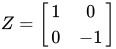
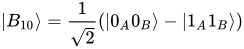
4. If, instead, Alice wants to send the classical two-bit string 11 to Bob, then she applies the quantum gate to her qubit, so that the resultant entangled state becomes
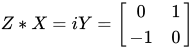
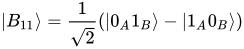
The matrices , , and are known as Pauli matrices.


Sending
[edit]After having performed one of the operations described above, Alice can send her entangled qubit to Bob using a quantum network through some conventional physical medium.
Decoding
[edit]In order for Bob to find out which classical bits Alice sent he will perform the CNOT unitary operation, with A as control qubit and B as target qubit. Then, he will perform unitary operation on the entangled qubit A. In other words, the Hadamard quantum gate H is only applied to A (see the figure above).

- If the resultant entangled state was then after the application of the above unitary operations the entangled state will become
- If the resultant entangled state was then after the application of the above unitary operations the entangled state will become
- If the resultant entangled state was then after the application of the above unitary operations the entangled state will become
- If the resultant entangled state was then after the application of the above unitary operations the entangled state will become


These operations performed by Bob can be seen as a measurement which projects the entangled state onto one of the four two-qubit basis vectors or (as you can see from the outcomes and the example below).

Example
[edit]For example, if the resultant entangled state (after the operations performed by Alice) was , then a CNOT with A as control bit and B as target bit will change to become . Now, the Hadamard gate is applied only to A, to obtain


![{\displaystyle B_{01}''={\tfrac {1}{\sqrt {2}}}\left[{\left({\tfrac {1}{\sqrt {2}}}(|0\rangle -|1\rangle )\right)}_{A}\otimes |1_{B}\rangle +{\left({\tfrac {1}{\sqrt {2}}}(|0\rangle +|1\rangle )\right)}_{A}\otimes |1_{B}\rangle \right].}](https://wikimedia.org/api/rest_v1/media/math/render/svg/8855e5d68b23169ef23da3fcf9c30a043f1e1b03)
For simplicity, subscripts may be removed:

Now, Bob has the basis state , so he knows that Alice wanted to send the two-bit string 01.
Security
[edit]Superdense coding is a form of secure quantum communication.[4] If an eavesdropper, commonly called Eve, intercepts Alice's qubit en route to Bob, all that is obtained by Eve is part of an entangled state. Without access to Bob's qubit, Eve is unable to get any information from Alice's qubit. A third party is unable to eavesdrop on information being communicated through superdense coding and an attempt to measure either qubit would collapse the state of that qubit and alert Bob and Alice.
General dense coding scheme
[edit]General dense coding schemes can be formulated in the language used to describe quantum channels. Alice and Bob share a maximally entangled state ω. Let the subsystems initially possessed by Alice and Bob be labeled 1 and 2, respectively. To transmit the message x, Alice applies an appropriate channel

on subsystem 1. On the combined system, this is effected by

where I denotes the identity map on subsystem 2. Alice then sends her subsystem to Bob, who performs a measurement on the combined system to recover the message. Let Bob's measurement be modelled by a POVM , with positive semidefinite operators such that . The probability that Bob's measuring apparatus registers the message is thus Therefore, to achieve the desired transmission, we require that where is the Kronecker delta.


![{\displaystyle p(y|x)=\langle F_{y},(\Phi _{x}\otimes I)(\omega )\rangle \equiv \operatorname {Tr} [F_{y}(\Phi _{x}\otimes I)(\omega )].}](https://wikimedia.org/api/rest_v1/media/math/render/svg/4e759b96e98248c40750cd908534fba84ea06929)
![{\displaystyle p(y|x)=\operatorname {Tr} [F_{y}(\Phi _{x}\otimes I)(\omega )]=\delta _{xy},}](https://wikimedia.org/api/rest_v1/media/math/render/svg/dd553fc5a923fc248593d2818cc1e576b9a39be1)

Experimental
[edit]The protocol of superdense coding has been actualized in several experiments using different systems to varying levels of channel capacity and fidelities. In 2004, trapped beryllium-9 ions were used in a maximally entangled state to achieve a channel capacity of 1.16 with a fidelity of 0.85.[5] In 2017, a channel capacity of 1.665 was achieved with a fidelity of 0.87 through optical fibers.[6] High-dimensional ququarts (states formed in photon pairs by non-degenerate spontaneous parametric down-conversion) were used to reach a channel capacity of 2.09 (with a limit of 2.32) with a fidelity of 0.98.[7] Nuclear magnetic resonance (NMR) has also been used to share among three parties.[8]
References
[edit]- ^ Bennett, C.; Wiesner, S. (1992). "Communication via one- and two-particle operators on Einstein-Podolsky-Rosen states". Physical Review Letters. 69 (20): 2881–2884. Bibcode:1992PhRvL..69.2881B. doi:10.1103/PhysRevLett.69.2881. PMID 10046665.
- ^ a b c Nielsen, Michael A.; Chuang, Isaac L. (9 December 2010). "2.3 Application: superdense coding". Quantum Computation and Quantum Information: 10th Anniversary Edition. Cambridge University Press. p. 97. ISBN 978-1-139-49548-6.
- ^ Stephen Wiesner. Memorial blog post by Or Sattath, with scan of Bennett's handwritten notes from 1970. See also Stephen Wiesner (1942–2021) by Scott Aaronson, which also discusses this topic.
- ^ a b Wang, Chuan; Deng, Fu-Guo; Li, Yan-Song; Liu, Xiao-Shu; Long, Gui Lu (2005-04-28). "Quantum secure direct communication with high-dimension quantum superdense coding". Physical Review A. 71 (4) 044305. doi:10.1103/PhysRevA.71.044305.
- ^ Schaetz, T.; Barrett, M. D.; Leibfried, D.; Chiaverini, J.; Britton, J.; Itano, W. M.; Jost, J. D.; Langer, C.; Wineland, D. J. (2004-07-22). "Quantum Dense Coding with Atomic Qubits". Physical Review Letters. 93 (4) 040505. doi:10.1103/PhysRevLett.93.040505. PMID 15323743.
- ^ Williams, Brian P.; Sadlier, Ronald J.; Humble, Travis S. (2017-02-01). "Superdense Coding over Optical Fiber Links with Complete Bell-State Measurements". Physical Review Letters. 118 (5) 050501. arXiv:1609.00713. doi:10.1103/PhysRevLett.118.050501. PMID 28211745.Williams, B. P., Sadlier, R. J., & Humble, T. S. (2017). Superdense Coding over Optical Fiber Links with Complete Bell-State Measurements. Physical Review Letters, 118(5).
- ^ Hu, Xiao-Min; Guo, Yu; Liu, Bi-Heng; Huang, Yun-Feng; Li, Chuan-Feng; Guo, Guang-Can (2018-07-06). "Beating the channel capacity limit for superdense coding with entangled ququarts". Science Advances. 4 (7) eaat9304. doi:10.1126/sciadv.aat9304. ISSN 2375-2548. PMC 6054506. PMID 30035231.
- ^ Wei, Daxiu; Yang, Xiaodong; Luo, Jun; Sun, Xianping; Zeng, Xizhi; Liu, Maili (2004-03-01). "NMR experimental implementation of three-parties quantum superdense coding". Chinese Science Bulletin. 49 (5): 423–426. doi:10.1007/BF02900957. ISSN 1861-9541.
Further reading
[edit]- Wilde, Mark M., 2017, Quantum Information Theory, Cambridge University Press, Also available at eprint arXiv:1106.1145
External links
[edit]- Qubits, Quantum Mechanics and Computers Course Notes
- Superdense coding: how to send two bits using one qubit on YouTube by Michael Nielsen
| General | |||||||||
|---|---|---|---|---|---|---|---|---|---|
| Theorems | |||||||||
| Quantum communication |
| ||||||||
| Quantum algorithms | |||||||||
| Quantum complexity theory | |||||||||
| Quantum processor benchmarks | |||||||||
| Quantum computing models | |||||||||
| Quantum error correction | |||||||||
| Physical implementations |
| ||||||||
| Quantum programming | |||||||||


Superdense coding
View on GrokipediaIntroduction
Definition and Overview
Superdense coding is a quantum communication protocol that enables the transmission of two classical bits of information—corresponding to the messages 00, 01, 10, or 11—by sending only one qubit over a quantum channel, assuming the sender and receiver have previously shared a maximally entangled pair of qubits. This approach doubles the capacity of a noiseless quantum channel for classical information compared to direct transmission without pre-shared entanglement, where the classical capacity is limited to one bit per qubit. In the protocol, the sender, Alice, encodes her two-bit message by applying operations to her qubit from the entangled pair and transmits that single qubit to the receiver, Bob, who then extracts the full message through a measurement involving both his original qubit and the received one. Superdense coding relies on the foundational quantum properties of qubits, which can exist in superpositions, and entanglement, which correlates the shared pair such that local operations on one qubit affect the other; these concepts are examined in detail elsewhere in this entry. The initial sharing of the entangled pair typically occurs via a classical channel or prior secure distribution, while the subsequent transmission leverages the quantum channel for the encoded qubit alone. Unlike classical coding, where each channel use transmits at most one bit without additional resources, superdense coding exploits entanglement to achieve this enhanced efficiency without requiring increased bandwidth or additional qubits. It serves as a complement to quantum teleportation, a related protocol that uses two classical bits to transmit one qubit.Historical Development
The concept of superdense coding originated in the early explorations of quantum information theory during the late 1960s and early 1970s. Stephen Wiesner first conceived the core idea in 1970 while discussing quantum conjugate coding with Charles H. Bennett, as documented in Bennett's contemporaneous notes from February 24, 1970, which outline the technique of encoding two classical bits into a single qubit using shared entanglement.[4] This innovation built on Wiesner's earlier 1968 work on conjugate coding, which laid foundational principles for leveraging quantum no-cloning and uncertainty to enhance communication efficiency, though it remained unpublished for decades due to the nascent state of quantum theory at the time.[4] The protocol was formally introduced in a seminal 1992 paper by Bennett and Wiesner, titled "Communication via One- and Two-Particle Operators on Einstein-Podolsky-Rosen States," published in Physical Review Letters. In this work, they detailed how a sender could transmit two classical bits of information by sending just one qubit to a receiver who shares a maximally entangled pair, effectively doubling the capacity of the quantum channel compared to classical limits. This publication marked the official debut of superdense coding amid the emerging field of quantum cryptography, where Wiesner's ideas had already influenced protocols like BB84 developed by Bennett and Gilles Brassard in 1984. Superdense coding emerged in parallel with early quantum cryptographic developments, highlighting entanglement's role in secure and efficient information transfer without initially focusing on practical implementations. It gained recognition as the conceptual dual to quantum teleportation, proposed by Bennett, Brassard, Crépeau, Jozsa, Peres, and Wootters in 1993, where the latter uses two classical bits to transmit one qubit—reversing the efficiency gain of superdense coding. During the 1990s quantum information boom, the protocol was highlighted in theoretical discussions for its implications in quantum communication limits, influencing subsequent advancements in quantum network architectures by demonstrating entanglement-assisted capacity enhancements.[4]Fundamental Concepts
Qubits and Quantum Superposition
A qubit serves as the basic unit of quantum information, representing a two-level quantum system that generalizes the classical bit. Formally, the state of a qubit is described by the vector where are complex coefficients satisfying the normalization condition . This mathematical form arises from the principles of quantum mechanics, allowing the qubit to encode information in a manner distinct from classical systems. In contrast to a classical bit, which assumes a definite value of either 0 or 1, a qubit exploits the superposition principle to exist as a coherent linear combination of its basis states and . This superposition enables quantum systems to perform computations on multiple states in parallel, a feature that underpins the computational advantages of quantum information processing. The Bloch sphere provides a geometric visualization of these states: pure qubit states correspond to points on the surface of a unit sphere in three-dimensional real space, with the north pole representing , the south pole , and equatorial points denoting balanced superpositions such as . This representation, originally developed for spin-1/2 particles, intuitively illustrates how quantum operations act as rotations on the sphere. Measurement of a qubit in the computational basis collapses its superposition to one of the basis states, yielding with probability or with probability , as dictated by the Born rule. In the context of superdense coding, the qubit's ability to maintain superposition is essential, as it allows a single qubit to encode two bits of classical information when an entangled partner qubit is shared in advance.Quantum Entanglement and Bell States
Quantum entanglement is a fundamental phenomenon in quantum mechanics where the quantum state of two or more particles cannot be described independently, even when separated by arbitrary distances; instead, they constitute a single quantum system characterized by a joint state that exhibits nonclassical correlations.[5] This joint state is non-separable, meaning it cannot be expressed as a tensor product of the individual states of the particles.[5] The term "entanglement" was coined by Erwin Schrödinger in 1935 to describe these peculiar interdependencies, which arise after the particles interact and persist regardless of the separation between them. In the context of quantum information, particularly for two qubits, the maximally entangled states are the Bell states, which form an orthonormal basis for the two-qubit Hilbert space and represent the purest form of entanglement.[6] These four states are: A defining property of Bell states is that measuring one qubit in the computational basis yields a result that perfectly correlates with—or anticorrelates to—the outcome of measuring the other qubit, with the distant measurement appearing to instantaneously influence the local result despite no classical communication.[5] These correlations violate classical limits, as established by Bell's theorem, and have no analog in classical physics where independent systems cannot exhibit such dependencies without signaling. Bell states are typically created starting from the unentangled state by applying a Hadamard gate to the first qubit, which introduces superposition, followed by a controlled-NOT gate with the first qubit as control and the second as target, entangling the pair into .[6] The other Bell states can be generated by additional single-qubit phase or Pauli operations on this base state. In superdense coding, a shared Bell pair such as acts as the entanglement resource, enabling one party to perform local unitary operations on their qubit that remotely imprint information onto the distant qubit, allowing the extraction of two classical bits from a single qubit transmission.[1]The Protocol
Preparation and Sharing of Entangled Qubits
In superdense coding, the protocol begins with the preparation of a maximally entangled pair of qubits in one of the Bell states, which serves as the shared quantum resource between the sender (Alice) and the receiver (Bob). This entangled resource is essential for enabling the encoding of two classical bits using a single qubit transmission. The original proposal assumes access to such a pure entangled state, typically one of the four Bell states, with the specific choice often being the state . The preparation of this Bell state can be achieved in the standard quantum circuit model by initializing two qubits in the computational basis state , applying a Hadamard gate to the first qubit to produce the superposition , and then applying a controlled-NOT (CNOT) gate with the first qubit as control and the second as target, yielding the maximally entangled state . This process assumes ideal, noiseless quantum operations to achieve unit entanglement fidelity, ensuring the resource is maximally useful for the protocol.[7] Once prepared, the entangled pair is shared by distributing one qubit to Alice and the other to Bob through a quantum channel, which may span large distances in practical implementations. This distribution requires a reliable quantum channel capable of preserving the fragile entanglement, along with authentication mechanisms to protect against tampering or unauthorized access. A secure classical channel is also presupposed for any necessary coordination between the parties, such as verifying the sharing process. With the qubits shared, Alice retains her qubit for subsequent encoding of the classical message, while Bob stores his qubit in preparation for receiving and jointly measuring the transmitted qubit to decode the information. High entanglement fidelity, close to 1, is critical for the protocol's reliability, as any degradation would reduce the distinguishability of the encoded states.Encoding Classical Information
In superdense coding, the encoding step involves the sender, Alice, modifying her qubit of a shared entangled pair to embed two classical bits of information using local quantum operations. Assuming Alice and Bob have previously shared a maximally entangled state such as the Bell state , where Alice holds the first qubit and Bob the second, Alice applies one of four specific unitary operators to her qubit based on the two-bit message she wishes to convey. The encoding scheme maps each possible two-bit string to a unique operator as follows: the identity operator for the message "00", the Pauli-X operator for "01", the Pauli-Z operator for "10", and the composite operator for "11". These operations transform the initial state into one of the four orthogonal Bell states. Specifically:- Applying leaves the state as .
- Applying yields .
- Applying produces .
- Applying results in .