Hubbry Logo
BB84BB84Main
Open search
BB84
Community hub
BB84
logo
7 pages, 0 posts
0 subscribers
Be the first to start a discussion here.
BB84
BB84
from Wikipedia

The BB84 protocol, named after its inventors Charles Bennett and Gilles Brassard in 1984, is a prepare-and-measure Quantum key distribution (QKD) protocol, in which, one party (e.g. Alice) performs the encoding by preparing the quantum states, and the other party (e.g., Bob) measures them.[1] The BB84 QKD scheme is the first quantum cryptography protocol, and has become one of the most well-studied QKD protocols.[2] The protocol is provably secure assuming a perfect implementation, relying on two conditions: (1) the quantum property that information gain is only possible at the expense of disturbing the signal if the two states one is trying to distinguish are not orthogonal (see no-cloning theorem); and (2) the existence of an authenticated public classical channel.[3] As such, the security of the BB84 protocol is fundamentally based on the principle that two non-orthogonal quantum states cannot be perfectly distinguished. This inherent limitation means that the states cannot be reliably copied, thereby ensuring a robust framework for secure quantum communication. The BB84 QKD protocol is usually explained as a method of securely communicating a private key from one party to another for use in one-time pad encryption.[4] The proof of BB84 QKD scheme depends on a perfect implementation. Side channel attacks exist, taking advantage of non-quantum sources of information. Since this information is non-quantum, it can be intercepted without measuring or cloning quantum particles.[5] The BB84 protocol provides a significant advancement in the field of quantum cryptography and represents a pioneering step toward achieving secure communication in the quantum era.[6]

Overview

[edit]

BB84 QKD system transmits individual photons through a fiber optic cable, with each photon representing a bit of data (zero or one). Polarizing filters on the sender's side set each photon's orientation, while the receiver uses beam splitters to read it. The sender and receiver then compare their photon orientations, with the matching set becoming the cryptographic key.[7] However, encoding withother degrees of freedom, e.g., phase, is also possible, and the procedures are similar.[8]

Description

[edit]
An interactive simulation of an optical implementation of the BB84 quantum key distribution protocol in the Virtual Lab by Quantum Flytrap,[9] available online. In this optical setup, bits are encoded using orthogonal polarization states of photons. Alice and Bob select their measurement bases by rotating the polarization by 0 or 45 degrees using Faraday rotators. Single-photon detectors measure the output after the photons pass through a polarizing beam splitter, which separates the polarizations.

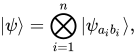
In the BB84 scheme, Alice wishes to send a private key to Bob. She begins with two strings of bits, and , each bits long. She then prepares an -qubit state written as:

where and are the -th bits of and respectively. Together, give us an index into the following four qubit states:

Note that the bit is what decides which basis is encoded in (either in the computational basis or the Hadamard basis). The qubits are now in states that are not mutually orthogonal, and thus it is impossible to distinguish all of them with certainty without knowing .

Alice sends over a public and authenticated quantum channel to Bob. Bob receives a state , where represents both the effects of noise in the channel and eavesdropping by a third party we'll call Eve. After Bob receives the string of qubits, both Bob and Eve have their own states. However, since only Alice knows , it makes it virtually impossible for either Bob or Eve to distinguish the states of the qubits. Also, after Bob has received the qubits, we know that Eve cannot be in possession of a copy of the qubits sent to Bob, by the no-cloning theorem, unless she has made measurements. Her measurements, however, risk disturbing a particular qubit with probability 1/2 if she guesses the wrong basis.

Bob proceeds to generate a string of random bits of the same length as and then measures the qubits he has received from Alice, obtaining a bit string . At this point, Bob announces publicly that he has received Alice's transmission. Alice then knows she can now safely announce , i.e., the bases in which the qubits were prepared. Bob communicates over a public channel with Alice to determine which and are not equal. Both Alice and Bob now discard the bits in and where and do not match.

From the remaining bits where both Alice and Bob measured in the same basis, Alice randomly chooses bits and discloses her choices over the public channel. Both Alice and Bob announce these bits publicly and run a check to see whether more than a certain number of them agree. If this check passes, Alice and Bob proceed to use information reconciliation and privacy amplification techniques to create some number of shared secret keys. Otherwise, they cancel and start over.

See also

[edit]

References

[edit]
Revisions and contributorsEdit on WikipediaRead on Wikipedia
from Grokipedia
BB84 is a pioneering (QKD) protocol that enables two parties, typically referred to as , to generate and share a secret cryptographic key over an insecure with unconditional security guaranteed by the laws of . Developed by Charles H. Bennett and , it was first proposed in during a conference in Bangalore, , and relies on the transmission of polarized photons to encode binary information, leveraging the fundamental principles of quantum uncertainty and no-cloning to detect any attempts. This protocol marked the inception of practical , distinguishing itself from classical methods by providing rather than computational assumptions. The protocol operates through a prepare-and-measure approach, where Alice randomly selects a bit value (0 or 1) and a measurement basis—either rectilinear (horizontal/vertical polarization) or diagonal (45°/135°)—to encode and transmit individual to Bob via an optical channel. Bob, in turn, measures each received using a randomly chosen basis, recording the outcome without knowing Alice's choices initially. Following transmission, publicly compare their basis choices over a classical channel, discarding measurements where bases mismatch (which occurs approximately 50% of the time), and retain the subset of matching basis bits to form the raw key. To ensure integrity, they sacrifice a portion of this subset (e.g., about one-third) for rate estimation; if the quantum (QBER) exceeds a threshold—typically around 11% for standard implementations—it indicates potential , prompting key discard. Post-processing steps, including correction and amplification, further refine the key to remove any residual leaked to an adversary. The security of BB84 stems from the Heisenberg uncertainty principle, which ensures that an eavesdropper () measuring photons in the wrong basis introduces detectable disturbances, as perfect copying of unknown quantum states is impossible. Theoretical proofs have established its robustness against general attacks, including coherent and collective ones, achieving positive key rates even under realistic noise conditions when quality is sufficient. Since its , BB84 has been experimentally implemented in various settings, from free-space links to fiber-optic networks, with experimental systems achieving key rates up to hundreds of kilobits per second over 100 kilometers as of 2025, while commercial systems typically operate at rates of several kilobits per second over similar distances, underpinning applications in secure communications like quantum-secured banking and government networks. Ongoing enhancements address practical challenges such as decoherence and side-channel vulnerabilities, solidifying BB84 as a foundational element of .

Background

Quantum Information Fundamentals

A , or quantum bit, serves as the fundamental unit of , analogous to the classical bit but with distinct properties that enable quantum computation and communication. Unlike a classical bit, which exists definitively in one of two states—0 or 1—a qubit can occupy a superposition of both states simultaneously, allowing it to encode more complex information. This capability arises from , where the qubit's state is represented in a two-dimensional . Quantum superposition permits a qubit to exist as a linear combination of basis states, embodying multiple potential outcomes until measured. In this framework, information encoding leverages the interference of these superimposed states, providing an exponential advantage in processing power compared to classical systems for certain tasks. Mathematically, a general qubit state can be expressed as
ψ=α0+β1,|\psi\rangle = \alpha |0\rangle + \beta |1\rangle,
where α\alpha and β\beta are complex amplitudes satisfying α2+β2=1|\alpha|^2 + |\beta|^2 = 1, ensuring probabilistic normalization. The squared magnitudes α2|\alpha|^2 and β2|\beta|^2 represent the probabilities of measuring the qubit in state 0|0\rangle or 1|1\rangle, respectively.
Quantum measurement fundamentally alters the qubit's state through wavefunction collapse, projecting it onto one of the basis states depending on the chosen measurement basis. This process is inherently probabilistic and irreversible, with the outcome determined by the Born rule, where the superposition resolves into a definite classical result. The basis in which measurement occurs dictates the possible outcomes, highlighting the context-dependent nature of quantum information extraction. The no-cloning theorem asserts that it is impossible to create an identical copy of an arbitrary unknown quantum state, a direct consequence of the linearity of quantum evolution and the superposition principle. Formally, if a unitary operation could clone any input state ψ|\psi\rangle to produce ψψ|\psi\rangle |\psi\rangle, it would fail for superpositions like α0+β1\alpha |0\rangle + \beta |1\rangle, as the output would incorrectly include cross terms such as αβ01+αβ10\alpha\beta^* |0\rangle |1\rangle + \alpha^*\beta |1\rangle |0\rangle, violating linearity. This prohibition extends to all non-orthogonal states, preventing perfect replication without prior knowledge of the state. In the context of quantum security, the theorem implies that quantum information cannot be intercepted and duplicated without detection, forming a cornerstone for protocols in quantum key distribution.

Historical Context

The foundations of , including the BB84 protocol, trace back to innovative ideas in the late 1960s and early 1970s, when physicist Stephen Wiesner developed the concept of conjugate coding while a graduate student at . Wiesner's work, which explored the use of quantum states for secure information transmission through complementary orthogonal modes like polarization, remained unpublished until 1983 but circulated informally among researchers and laid crucial groundwork for quantum-based secure communication. This idea built on emerging concepts from the 1970s, shifting focus from classical cryptographic limitations toward leveraging ' inherent uncertainties for privacy. The BB84 protocol was formally proposed in 1984 by Charles H. Bennett and during the IEEE International Conference on Computers, Systems and Signal Processing in Bangalore, , marking the first practical scheme. Their collaboration, initiated in 1979, culminated in the protocol's description in the conference proceedings, where it was presented as a method for two parties to generate a key resistant to . This development occurred amid Cold War-era imperatives for unbreakable secure communications, as governments and researchers sought alternatives to vulnerable classical amid escalating technological concerns. Subsequent refinements strengthened BB84's theoretical foundations, including the 1988 introduction of privacy amplification by Bennett, , and Jean-Marc Robert, which addressed partial information leakage through public discussion to distill a highly secure key. A key milestone came in 1989 with the first experimental demonstration by Bennett, , and colleagues, who successfully transmitted a 403-bit key over 32.5 cm using polarized photons in free space, validating the protocol's feasibility despite early technological constraints. The , established in 1982, further motivated BB84 by proving the impossibility of perfectly copying unknown quantum states, underpinning its security against interception.

Protocol Operation

Photon Encoding and Transmission

In the BB84 protocol, information is encoded onto individual photons using their polarization states as the quantum carriers. Alice prepares single photons with polarizations corresponding to binary bits in one of two non-orthogonal bases: the rectilinear basis, where horizontal polarization (0°) represents bit 0 and vertical polarization (90°) represents bit 1; and the diagonal basis, where +45° polarization represents bit 0 and -45° (or 135°) polarization represents bit 1. This choice of bases ensures that measurements in the incorrect basis yield random outcomes due to the quantum superposition of polarization states. To generate the key, Alice first creates a random binary string of bits, typically using a or quantum random source. For each bit, she independently selects the encoding basis (rectilinear or diagonal) at random with equal probability, then polarizes the corresponding accordingly. The are transmitted sequentially over a to Bob, such as an for guided transmission or free-space for line-of-sight links, preserving the polarization states to the extent allowed by the channel's . A typical experimental setup for photon preparation at Alice's side involves a source, such as a pulsed operating at wavelengths like 1550 nm for low-loss transmission, attenuated to produce weak pulses approximating single- emission. The output passes through a or (e.g., a Pockels cell) to set the desired polarization based on the bit and basis choice, followed by a or attenuator to ensure the mean photon number per pulse is much less than 1 (e.g., 0.1–0.5 photons on average). This configuration allows for high-speed encoding, with clock rates up to 1.25 Gbit/s in -based systems. In practice, ideal single-photon sources are challenging to implement, so weak coherent pulses from attenuated lasers are commonly used as an approximation, though this introduces multi-photon emission risks that can compromise security. To mitigate such vulnerabilities, decoy-state methods employ additional pulse intensities (e.g., , weak decoy, and signal states) alongside the standard BB84 pulses, enabling estimation of multi-photon contributions without altering the core encoding process.

Basis Selection and Measurement

In the BB84 protocol, upon receiving each photon from Alice, Bob independently selects a measurement basis at random, choosing between the rectilinear basis (corresponding to horizontal and vertical polarizations) or the diagonal basis (corresponding to 45° and 135° polarizations) with equal probability. This selection is performed without any prior knowledge of Alice's encoding basis, ensuring that the probability of their bases matching for any individual photon is exactly 50%. The random choice is generated locally by Bob using a secure random number generator to maintain the protocol's security properties. Bob then measures the polarization of the photon in his chosen basis, which causes the photon's quantum state to collapse onto one of the two basis states via projective . This yields a deterministic binary outcome: conventionally, horizontal or 0° polarization corresponds to bit 0, while vertical or 90° polarization corresponds to bit 1 in the rectilinear basis, with analogous assignments in the diagonal basis. If basis matches Alice's, the faithfully recovers Alice's intended bit value with near-perfect in the absence of , as the photon arrives in an eigenstate of Bob's . Conversely, if the bases mismatch, the outcome is completely random relative to Alice's bit—yielding 0 or 1 with 50% probability each—due to the incompatibility of the bases, which destroys the original superposition and any encoded , in accordance with . Practical implementations are susceptible to environmental noise in the , such as or , which can induce bit flips in the outcomes independently of the selected basis. These errors would contribute to the quantum bit error rate (QBER) if bases match.

Key Extraction

Sifting Procedure

After the quantum transmission phase, engage in a classical post-processing step known as sifting to filter their and generate a shared sifted key. This procedure relies on an authenticated public channel to compare their basis choices without revealing the actual bit values. Specifically, Bob announces the basis he used for each , and Alice reveals the basis she selected for each corresponding transmission. They then identify the positions where their bases match—either both rectilinear (e.g., horizontal/vertical polarizations) or both diagonal (e.g., 45°/135° polarizations)—and discard all bits from positions where the bases differ. The retained bits, for which the bases aligned, form the initial sifted key, which now hold in common. The sifting process follows a straightforward algorithm to ensure efficiency and security:
  1. Alice generates and publicly sends her sequence of basis choices (a string of 'R' for rectilinear or 'D' for diagonal) corresponding to the transmitted qubits.
  2. Bob compares this with his own basis sequence and identifies the matching positions, retaining only the measurement outcomes (bits) from those positions in his record.
  3. Alice performs the same comparison on her end, keeping her original bits only from the matching positions. At this stage, no bit values are exchanged; only the positions are reconciled.
This step assumes perfect reception of all qubits for simplicity, though practical implementations account for losses by including detection confirmations. If no eavesdropper is present, the sifted bits should match with due to the and basis-dependent measurement outcomes. Since independently choose bases randomly with equal probability for each , the bases match approximately 50% of the time on average, effectively halving the length of the raw key to produce the sifted key. This reduction in key length is a fundamental efficiency in the BB84 protocol, balancing the need for in basis selection against the yield of usable bits. To illustrate, consider a simple example with four qubits transmitted by Alice. The following table shows Alice's bits and bases, measurement bases and outcomes, and the resulting sifted key after discarding mismatched positions (assuming all qubits are received):
PositionAlice's BitAlice's Basis Basis MeasurementSifted?
10RR0Yes
21DR1No
30RD0No
41DD1Yes
In this case, positions 1 and 4 match in basis, yielding the sifted key bits 0 (from Alice) and 1 (from Bob), which agree. Mismatched positions (2 and 3) are discarded, reducing the key from 4 bits to 2.

Error Correction and Privacy Amplification

Following sifting, Alice and Bob publicly compare a random subset of their sifted key bits over the authenticated classical channel to estimate the quantum (QBER). This estimation step allows them to detect potential or excessive noise; if the QBER exceeds a threshold—approximately 11% under standard security proofs—they abort the protocol to prevent insecure . The remaining sifted bits, excluding the sampled subset, form the input for correction. Error correction reconciles any remaining discrepancies in this input string arising from channel noise or imperfections in the quantum transmission, without fully revealing the key content to an eavesdropper. A seminal approach is the Cascade protocol, which operates iteratively through multiple rounds of public discussion over an authenticated classical channel. In each round, Alice and Bob divide their bit strings into blocks, compute and exchange parity information for subsets of blocks, and use the disclosed parities to identify and correct errors within those blocks; this process discards erroneous blocks and repeats on refined subsets until the error rate falls below a threshold or the key is fully reconciled. More modern methods employ low-density parity-check (LDPC) codes, which encode the sifted key into a structured form allowing efficient decoding via belief propagation algorithms, enabling reconciliation with lower information leakage compared to Cascade for certain error regimes. These protocols publicly exchange parity bits or syndromes, leaking a controlled amount of information about the key, quantified as leak_{EC}, which depends on the reconciliation efficiency and must be subtracted from the final key length. Typical quantum key distribution (QKD) systems using BB84 can correct errors up to a quantum bit error rate (QBER) of approximately 11%, beyond which secure key extraction becomes infeasible under standard security proofs. After error correction yields a shared corrected key, privacy amplification reduces any residual information an eavesdropper, , might hold to negligible levels, ensuring the final key's . This step applies a random function from a universal_2 hash family to the corrected key, hashing it to a shorter length that extracts a unpredictable to even if she possesses partial knowledge of the original string. The choice of is publicly agreed upon but not revealed until after application, preserving during the process. Eve's potential information on the key is bounded by the binary entropy function of the QBER, with I_E \leq H(e), where H(e) = -e \log_2 e - (1-e) \log_2 (1-e) and e denotes the QBER; this bound arises from the phase error rate being upper-limited by the observed bit error rate in BB84. The length of the final secure key, n', is then given by n' = n [1 - H(e) - \mathrm{leak_{EC}}], where n is the length of the corrected key and \mathrm{leak_{EC}} accounts for the information disclosed during error correction. Error correction and privacy amplification are typically iterated if initial attempts yield insufficient key length or exceed security parameters, with parameter adjustments based on estimated QBER to achieve against any quantum adversary.

Security Analysis

Eavesdropping Detection Mechanisms

The BB84 protocol detects eavesdropping attempts by an eavesdropper, often denoted as , through the estimation of the (QBER) in the sifted key bits shared between . After the sifting procedure, where publicly compare their basis choices and retain only the matching bits, they randomly select a of these sifted bits—known as sacrifice bits—and publicly reveal them to compute the QBER without compromising the of the entire key. This QBER represents the fraction of bits where Alice's sent value differs from Bob's measured value, which should be near zero in the absence of or interference. If the estimated QBER exceeds a predefined threshold, the protocol aborts the process, and the parties restart to prevent any potential information leakage to . In a basic individual attack, intercepts each and measures it in a randomly chosen basis before resending a prepared to Bob in the same basis. If selects the wrong basis (which occurs with probability 1/2), her measurement collapses the into an incorrect state relative to Bob's measurement basis, resulting in an error with probability 1/2 in those cases. Consequently, this attack induces an average QBER of approximately 25% in the sifted key, which is easily detectable even with a small subsample of bits. More sophisticated optimal eavesdropping strategies, such as entanglement-based attacks, aim to minimize disturbance while maximizing 's information gain. In these schemes, entangles her probe qubits with the incoming qubits using an optimal interaction, such as an asymmetric cloning operation, and later measures her probes to infer the key bits. For instance, a controlled-NOT (CNOT)-based cloning attack creates imperfect clones that introduce a controlled amount of error, allowing partial access but still causing a detectable QBER that scales with her —for example, to gain up to 0.5 bits of information per sifted bit (the Holevo bound), the disturbance corresponds to about 11% QBER. These attacks, while more subtle than naive measurements, remain detectable because any attempt to copy or observe the quantum states introduces unavoidable errors due to the , which prohibits perfect replication of unknown quantum states. The detection threshold for QBER is typically set around 11% in practical implementations, balancing security against tolerable channel noise; exceeding this value prompts abortion, as it indicates potential eavesdropping beyond what privacy amplification can reliably mitigate. This quantum-originated disturbance provides a fundamental advantage over classical key distribution, where passive eavesdropping leaves no detectable trace.

Theoretical Security Guarantees

The theoretical security of the BB84 protocol is information-theoretically secure in the asymptotic limit against any quantum adversary, including those with unbounded computational power. This unconditional security was first rigorously established in the 1990s through proofs by Mayers in 1996 and by Lo and Chau in 1999, which demonstrated that Alice and Bob can distill a secret key indistinguishable from a uniformly random string, provided the quantum bit error rate (QBER) remains below a threshold of approximately 11%. These proofs leverage the fundamental principles of quantum mechanics, showing that any eavesdropping attempt by Eve introduces detectable disturbances, allowing the protocol to abort if security is compromised. A simplified version of the proof was later provided by Shor and Preskill in 2000, reducing BB84 to an entanglement purification protocol whose security follows from quantum error-correcting codes. The key security parameter in BB84 is the ε-security, which quantifies the final key's indistinguishability from a perfectly random . Specifically, the protocol achieves ε-secure , where ε measures the maximum advantage an adversary could gain in distinguishing the key, typically set to values like ε < 10^{-10} to ensure negligible risk in practical applications. This parameter arises from the trace distance between the actual and the ideal state after privacy amplification, bounding Eve's probability of guessing the key correctly to at most 1/2 + ε/2. The proofs rely on the quantum , which limits Eve's ability to simultaneously gain about measurements in complementary bases. In the entanglement-based equivalent to BB84, Eve's probe interacts with the shared entangled state, but the relation bounds her knowledge: if Eve has partial about Alice's bit value in the Z-basis (used for the key), her in the X-basis (used for checking) is correspondingly high. Eve's accessible about the sifted key is thus upper-bounded by the binary of the QBER, H(QBER), leading to zero extractable in the infinite-key limit after privacy amplification, as the key length is chosen to exceed the bound by a security margin. This bound is formalized by the Holevo quantity, where the mutual information between Alice and Eve satisfies I(A:E)χ(QBER)=QBERlog2(1QBER)+(1QBER)log2(11QBER),I(A:E) \leq \chi(\text{QBER}) = \text{QBER} \log_2 \left( \frac{1}{\text{QBER}} \right) + (1 - \text{QBER}) \log_2 \left( \frac{1}{1 - \text{QBER}} \right), which equals the binary entropy function H(QBER). Privacy amplification then hashes the key to a length that minimizes Eve's information to below ε, ensuring security even against collective or coherent attacks in the asymptotic regime. While asymptotically secure, BB84's guarantees are affected by finite-key effects, which introduce additional ε terms scaling as O(1/√n) for key length n, requiring adjusted thresholds and amplification parameters. Additionally, the proofs assume ideal devices, leaving vulnerabilities to side-channel attacks in real implementations.

Implementations

Experimental Realizations

The first proof-of-principle demonstration of the BB84 protocol was achieved by Bennett et al. in , using polarization-encoded faint pulses from a transmitted over a short free-space distance of 0.32 m between two stations in a setting. This experiment verified the core principles of , including basis sifting and eavesdropping detection through quantum bit error rate (QBER) estimation, generating a 403-bit key despite rudimentary single-photon detection using photomultiplier tubes. Subsequent early implementations shifted to to explore practical transmission channels. In 1993, Muller et al. reported the first BB84 realization over 1.1 km of fiber at 800 nm wavelength, employing polarization encoding and germanium avalanche photodiodes (APDs) for detection, achieving secure at rates of tens of bits per second with QBER below 5%. This work highlighted the feasibility of fiber-based BB84 while addressing , which was compensated using active feedback loops to maintain low error rates. Significant progress in the extended distances substantially. A landmark experiment by Muller, Zbinden, and Gisin in 1996 demonstrated BB84 over 23 km of installed under-lake telecom (crossing ) using a phase-coding "" configuration at 1300 nm, yielding a QBER of approximately 5.7% and net key rates around 210 bits per second after sifting, error correction, and privacy amplification. Typical metrics across these experiments included QBER values of 1-5% and raw key rates up to several kbit/s over distances under 10 km, constrained by of about 0.2 dB/km and detector efficiencies around 10%. Key technical challenges in these realizations centered on photon loss and detector imperfections. Fiber attenuation and coupling losses reduced photon detection probabilities exponentially with distance, often limiting secure keys to short ranges without advanced techniques like decoy states (introduced later). Dark counts in single-photon detectors, typically on the order of 10^{-5} per gate, introduced errors mimicking , necessitating low repetition rates (e.g., 100-1000 kHz) and precise time-gating to discriminate signal from noise. Detection efficiencies below 20% for InGaAs APDs at telecom wavelengths further exacerbated losses, prompting innovations in interferometer stability and automatic polarization compensation. In the , free-space demonstrations complemented fiber efforts, enabling tests in uncontrolled environments. Kurtsiefer et al. in 2002 implemented polarization-encoded BB84 over a 23.4 km free-space link between two mountains using weak coherent pulses at 850 nm, attaining a QBER of about 4% and a secure key rate of approximately 100 bits per second despite atmospheric turbulence and background . This experiment underscored free-space viability for mobile or precursors, with challenges like beam wandering mitigated via and pointing-tracking systems. By the , laboratory setups refined BB84 for higher performance, incorporating decoy-state protocols to counter photon-number-splitting attacks. ID Quantique's systems, for instance, demonstrated lab-based BB84 over 50 km of with QBER under 1.5% and key rates exceeding 1 Mbit/s raw, using improved superconducting detectors with efficiencies over 90% and dark count rates below 1 Hz. These advancements addressed persistent issues like multi-photon emissions from weak coherent sources through intensity modulation, paving the way for robust controlled-environment testing while maintaining theoretical security benchmarks.

Practical Deployments

One of the earliest commercial deployments of BB84-based (QKD) systems began with ID Quantique's Cerberis platform, introduced in 2007, which integrates quantum channels with classical optical networks to enable secure over fiber links up to approximately 100 km. This system has been utilized in real-world applications, such as securing in , , and has evolved through multiple generations, with the Cerberis XG variant supporting metropolitan-scale deployments by combining BB84 protocols with decoy-state enhancements for improved security against photon-number-splitting attacks. By 2025, such systems have been adopted in sectors including banking, government, and data centers, demonstrating reliable integration with existing encryption infrastructure like AES for end-to-end quantum-safe communication. Network-level integrations of BB84 have expanded through dedicated QKD infrastructures. The Swiss Quantum Network, operational since its initial deployment in in 2011 and expanded by 2021, employs decoy-state BB84 protocols across urban fiber links to provide continuous for secure data transmission in metropolitan areas. Similarly, the QKD Network, established in the early 2010s by NICT and , utilizes one-way decoy-state BB84 systems to connect multiple nodes over distances up to 90 km, supporting applications like real-time video in a multi-user metropolitan setup. In , the Quantum (QIA), funded under the EU's Quantum Flagship program since 2018, has advanced BB84-based QKD in prototype networks, focusing on scalable quantum repeaters and entanglement distribution to bridge longer distances in future quantum internet architectures. Satellite-based deployments have further extended BB84's reach. China's Micius , launched in 2016, demonstrated decoy-state BB84 for intercontinental over 1200 km in , enabling secure links between ground stations. By 2025, hybrid satellite-ground networks using BB84 protocols support global QKD applications. Recent advancements from 2020 to 2025 have enhanced BB84's practicality through hybrid approaches and protocol refinements. Hybrid systems combining BB84 QKD with (PQC), such as lattice-based algorithms, have been deployed to provide layered security, where QKD generates symmetric keys and PQC handles authentication, mitigating risks from both quantum and classical threats in operational networks. Decoy-state BB84 implementations, which use weak coherent pulses with intensity modulation to counter on multi-photon emissions, have achieved key rates of up to 1 Mbps over 50 km of fiber, enabling high-throughput secure links suitable for data-intensive applications like financial transactions. Despite these progressions, practical deployments of BB84 face significant challenges, including high equipment costs exceeding millions of euros per node due to specialized detectors and lasers, limiting adoption to high-value sectors. Transmission distances remain constrained to 100-200 km without quantum , as loss in fiber optics degrades key rates beyond this range. Integration with emerging and networks poses additional hurdles, such as synchronizing quantum channels with high-speed classical traffic and addressing latency in mobile environments, though pilot projects are exploring co-propagation over shared fibers. Standardization efforts have addressed interoperability for BB84-based QKD. The European Telecommunications Standards Institute (ETSI) provides guidelines through its Industry Specification Group on QKD, including ETSI GS QKD 014 for key delivery APIs that ensure seamless integration across vendor systems. Similarly, the National Institute of Standards and Technology (NIST) supports BB84 interoperability via its standardization, with frameworks for hybrid QKD-PQC systems that define secure key encapsulation mechanisms compatible with decoy-state protocols. These standards facilitate multi-vendor deployments, as demonstrated in ETSI-compliant testbeds achieving cross-system key rates without protocol mismatches.

References

Add your contribution
Related Hubs
User Avatar
No comments yet.