


Community hub
Recent from talks
Knowledge base stats:
Talk channels stats:
Members stats:
Magnetic helicity
In plasma physics, magnetic helicity is a measure of the linkage, twist, and writhe of a magnetic field.
Magnetic helicity is used to analyze systems with very low resistivity, including many astrophysical environments. When resistivity is low, magnetic helicity is approximately conserved over long timescales. Magnetic helicity dynamics are important in studies of solar flares and coronal mass ejections. It is relevant in the dynamics of the solar wind. Its approximate conservation is significant in dynamo processes. It also plays a role in fusion research, including reversed field pinch experiments.
When a magnetic field contains magnetic helicity, it can drive the formation of large-scale structures from small-scale ones. This process is referred to as inverse transfer in Fourier space. In three dimensions, magnetic helicity supports growth toward larger scales. In contrast, many three-dimensional flows in ordinary fluid mechanics are turbulent and exhibit a direct cascade in which large-scale vortices break up into smaller ones that dissipate through viscous effects. By a parallel but inverted process, small helical magnetic structures with nonzero magnetic helicity combine to form large-scale magnetic fields. This behavior is observed in the dynamics of the heliospheric current sheet, a large magnetic structure in the Solar System.
The concept of helicity emerged in the mid-20th century within fluid dynamics, where British fluid dynamicist H. K. Moffatt connected the knottedness of vortex lines to a conserved integral he termed helicity. In magnetohydrodynamics, Dutch-American astrophysicist Lodewijk Woltjer proved that magnetic helicity is an ideal invariant and characterized minimum energy states at fixed helicity. German-American geophysicist Walter M. Elsasser's dynamo work provided an early theoretical foundation for such invariants in cosmic magnetism.
During the 1970s and 1980s, the concept was further developed through advances in turbulence theory, laboratory plasma experiments, and topology. Uriel Frisch and collaborators predicted an inverse transfer of magnetic helicity toward larger scales, which was later confirmed numerically and interpreted as a pathway to self-organization in magnetized turbulence. American plasma physicist J. B. Taylor introduced relaxation theory for confined plasmas, arguing that low resistivity allows rapid relaxation to a force-free state that preserves helicity. He emphasized that during relaxation "only total magnetic helicity survives." On the topological front, American mathematician Mitchell A. Berger and American astrophysicist George B. Field introduced relative magnetic helicity to extend the invariant to volumes with magnetic flux crossing their boundaries. American plasma physicists John M. Finn and Thomas M. Antonsen Jr. provided an equivalent gauge-invariant expression, describing a "general gauge invariant definition."
From the 1990s onward, magnetic helicity became an important observational and diagnostic tool in solar physics and space physics. German solar physicist Norbert Seehafer reported that current helicity in active regions is "predominantly negative in the northern" and "positive in the southern hemisphere," establishing an empirical hemispheric rule that motivated extensive follow-up research. American solar physicists Alexei A. Pevtsov, Richard C. Canfield, and Thomas R. Metcalf mapped helicity patterns in active regions and demonstrated its latitudinal variation, helping to connect photospheric measurements to coronal dynamics and ejections. Analyses of the solar wind and heliosphere used helicity to interpret large-scale magnetic structure and transport.
Scientists have debated how best to define and measure helicity in realistic, open systems and how to interpret local proxies. Relative magnetic helicity is now the standard approach for volumes with flux crossing the boundary, while current helicity and other proxies are used when full three-dimensional measurements are unavailable. Ongoing discussions address gauge issues and whether a meaningful local helicity density can be defined in weakly inhomogeneous turbulence, leading to proposed gauge-invariant local measures and improved numerical diagnostics. In dynamo theory, magnetic helicity conservation constrains the growth of large-scale fields. Research on helicity fluxes and open boundaries suggests that such fluxes can relax these constraints, a perspective developed in astrophysical dynamo modeling.
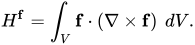
Generally, the helicity of a smooth vector field confined to a volume is a measure of the extent to which field lines wrap and coil around one another. It is defined as the volume integral over of the scalar product of and its curl, :


Hub AI
Magnetic helicity AI simulator
(@Magnetic helicity_simulator)
Magnetic helicity
In plasma physics, magnetic helicity is a measure of the linkage, twist, and writhe of a magnetic field.
Magnetic helicity is used to analyze systems with very low resistivity, including many astrophysical environments. When resistivity is low, magnetic helicity is approximately conserved over long timescales. Magnetic helicity dynamics are important in studies of solar flares and coronal mass ejections. It is relevant in the dynamics of the solar wind. Its approximate conservation is significant in dynamo processes. It also plays a role in fusion research, including reversed field pinch experiments.
When a magnetic field contains magnetic helicity, it can drive the formation of large-scale structures from small-scale ones. This process is referred to as inverse transfer in Fourier space. In three dimensions, magnetic helicity supports growth toward larger scales. In contrast, many three-dimensional flows in ordinary fluid mechanics are turbulent and exhibit a direct cascade in which large-scale vortices break up into smaller ones that dissipate through viscous effects. By a parallel but inverted process, small helical magnetic structures with nonzero magnetic helicity combine to form large-scale magnetic fields. This behavior is observed in the dynamics of the heliospheric current sheet, a large magnetic structure in the Solar System.
The concept of helicity emerged in the mid-20th century within fluid dynamics, where British fluid dynamicist H. K. Moffatt connected the knottedness of vortex lines to a conserved integral he termed helicity. In magnetohydrodynamics, Dutch-American astrophysicist Lodewijk Woltjer proved that magnetic helicity is an ideal invariant and characterized minimum energy states at fixed helicity. German-American geophysicist Walter M. Elsasser's dynamo work provided an early theoretical foundation for such invariants in cosmic magnetism.
During the 1970s and 1980s, the concept was further developed through advances in turbulence theory, laboratory plasma experiments, and topology. Uriel Frisch and collaborators predicted an inverse transfer of magnetic helicity toward larger scales, which was later confirmed numerically and interpreted as a pathway to self-organization in magnetized turbulence. American plasma physicist J. B. Taylor introduced relaxation theory for confined plasmas, arguing that low resistivity allows rapid relaxation to a force-free state that preserves helicity. He emphasized that during relaxation "only total magnetic helicity survives." On the topological front, American mathematician Mitchell A. Berger and American astrophysicist George B. Field introduced relative magnetic helicity to extend the invariant to volumes with magnetic flux crossing their boundaries. American plasma physicists John M. Finn and Thomas M. Antonsen Jr. provided an equivalent gauge-invariant expression, describing a "general gauge invariant definition."
From the 1990s onward, magnetic helicity became an important observational and diagnostic tool in solar physics and space physics. German solar physicist Norbert Seehafer reported that current helicity in active regions is "predominantly negative in the northern" and "positive in the southern hemisphere," establishing an empirical hemispheric rule that motivated extensive follow-up research. American solar physicists Alexei A. Pevtsov, Richard C. Canfield, and Thomas R. Metcalf mapped helicity patterns in active regions and demonstrated its latitudinal variation, helping to connect photospheric measurements to coronal dynamics and ejections. Analyses of the solar wind and heliosphere used helicity to interpret large-scale magnetic structure and transport.
Scientists have debated how best to define and measure helicity in realistic, open systems and how to interpret local proxies. Relative magnetic helicity is now the standard approach for volumes with flux crossing the boundary, while current helicity and other proxies are used when full three-dimensional measurements are unavailable. Ongoing discussions address gauge issues and whether a meaningful local helicity density can be defined in weakly inhomogeneous turbulence, leading to proposed gauge-invariant local measures and improved numerical diagnostics. In dynamo theory, magnetic helicity conservation constrains the growth of large-scale fields. Research on helicity fluxes and open boundaries suggests that such fluxes can relax these constraints, a perspective developed in astrophysical dynamo modeling.
Generally, the helicity of a smooth vector field confined to a volume is a measure of the extent to which field lines wrap and coil around one another. It is defined as the volume integral over of the scalar product of and its curl, :