
Recent from talks
Mahamuni Buddha Temple
Knowledge base stats:
Talk channels stats:
Members stats:
Mahamuni Buddha Temple
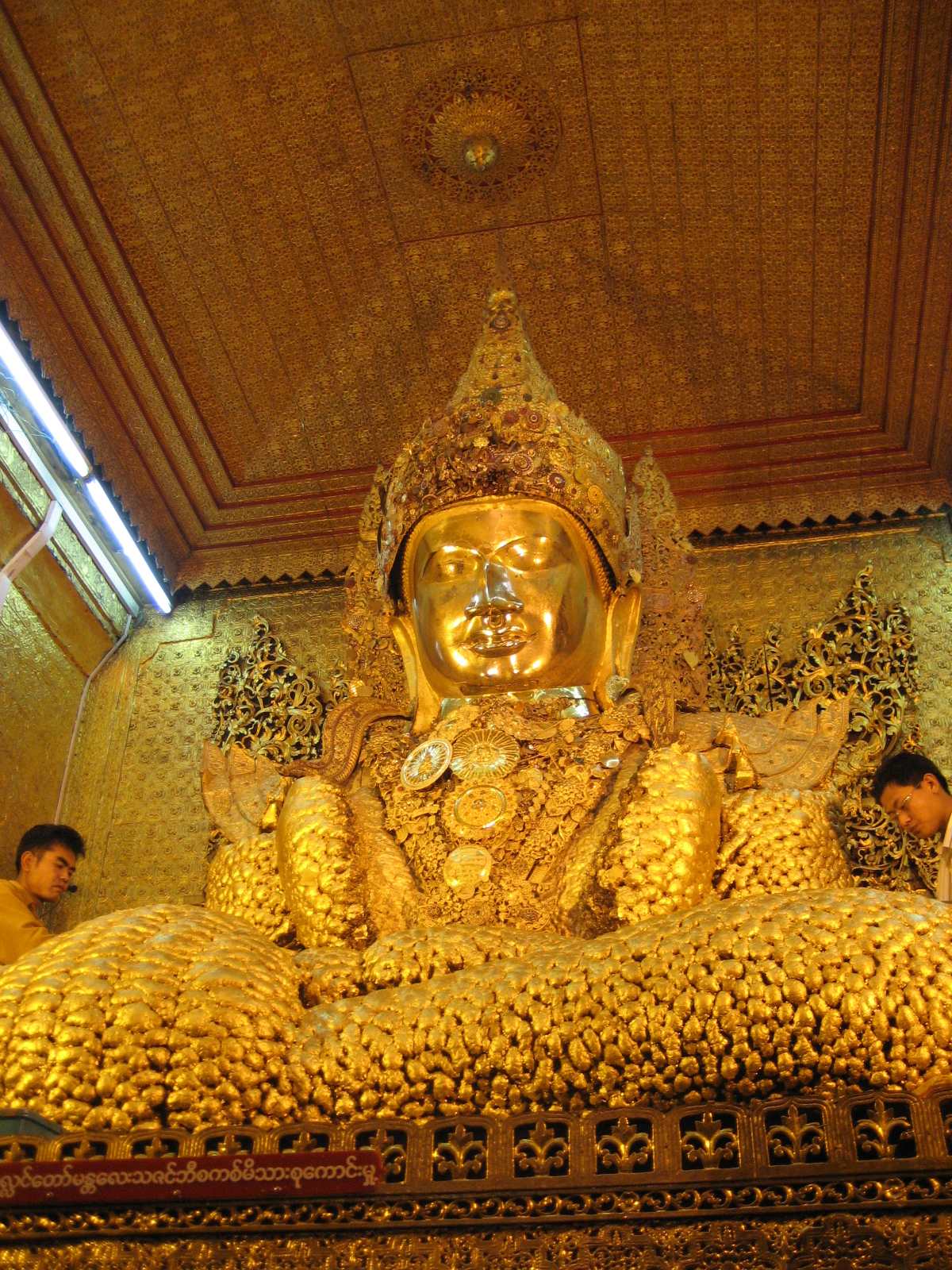
The Mahamuni Buddha Temple (Burmese: မဟာမုနိရှင်တော်မြတ်ကြီး, Burmese pronunciation: [məhà mṵnḭ pʰəjádʑí]) is a Buddhist temple and major pilgrimage site, located southwest of Mandalay, Myanmar (Burma). The Mahamuni Image (lit. 'The Great Sage') is enshrined in this temple, and originally came from Arakan. It is highly venerated in Burma and central to many people's lives, as it is seen as a representation of the Buddha's own life essence.
Ancient tradition refers to only five likenesses of the Buddha made during his lifetime; two were in India, two in paradise, and the fifth is the Mahamuni Image in Myanmar. Legend holds that the Buddha himself visited the Dhanyawadi city of Arakan in 554 BC. King Sanda Thuriya requested that an image be cast of him. Once complete, the Buddha breathed upon it, and thereafter the image took on his exact likeness.
According to legend, the Gautama Buddha visited Dhanyawadi, the capital city of Arakan during his travels on a missionary mission to spread Buddhism. During the 26th anniversary of King Candrasurya at the time, the Buddha accompanied by Shin Ananda and 500 disciples landed at Salagiri mountain peak near Khaukrah town. The King of Arakan, along with his Chief Queen Candra Mala (with her retinue of 1,600 ladies-in-waiting), and an entourage of ministers, generals and officials, paid homage to the Buddha. They were deeply moved by his teachings and upon his departure to Thawuthi (Sravasti), the King insisted that he leave his image for people to worship. For this purpose, the Buddha then sat under a Bodhi tree for a week of meditation. During this time Sakka (in Pāli, the ruler of the Tavatimsa, in Sanskrit called Trāyastriṃśa) one of the heavens in Buddhist cosmology, supported by his assistant Vissakamma (or Vishvakarman), moulded a lifelike image of the Buddha using ornaments donated by the king and his people. It is also said that Sakka and Vissakamma created a separate pavilion for the Buddha to live and enjoy during these seven days. After looking at his own lifelike image, believed at the time to have been his only true-likeness, Buddha was pleased and "imbued the image with his spiritual essence", or "enlivened and consecrated" the image, naming it "Candasara". He also stated that the image would last for five thousand years as his representative.
Historian Juliane Schober has very succinctly explained this legend and the cult worship that has evolved around the "living" double image of Mahamuni Buddha:
The rich and complex mythology associated with this image includes episodes that parallel other stories about the Buddha...The rituals and myths of Mahamuni thus accomplish two aims simultaneously: they place local contexts and actors within a universal Buddhist cosmology, and they locate a continuing biography of the Buddha in the Buddhist politics of Arakan and Upper Burma. Theravada politics characteristically extended the biographical mode of recreating the Buddha's presence and associated with it the power of kings and other patrons of this image. The veneration of this Buddha image is thus informed by local conceptions of religious patronage in sociopolitical domains.
Another legend narrated in the Arakanese chronicle relates to the nine phenomena that occurred when the image was consecrated in the temple and continued to occur after the Buddha had departed. These nine phenomena were: holy water used for washing the image would not overflow the collecting vessels; the water from the tank that was used for washing the Buddha's head would retain its quality throughout the year; six coloured rays appeared when the devotees worshipped the image in the evenings; the rays faded in the presence of non-believers; the space in the temple would automatically accommodate any number of devotees; the leaves of trees would tilt in the direction of the Buddha image; birds would not fly over the temple; and the stone guardians at the entrance would sense the presence of evil doers and prevent them from entering the temple.
In the ancient history of Arakan, King Anawratha of Pagan (r. 1044–1077) attempted to move the image to Bagan, without success. In 1784, the Burmese under the military leadership of Crown Prince Thado Minsaw of Konbaung dynasty conquered the Kingdom of Mrauk U. The religious relics of the kingdom, including the Mahamuni Buddha image, were confiscated and installed in the Mahamuni temple or pagoda at Amarapura. Amarapura, located within modern-day Mandalay District, had recently become the new royal capital just two years prior. As the Mahamuni image was too large to transport as a whole, it was cut into sections and later reassembled and housed in the new temple. Mandalay became the capital under King Mindon (r. 1853–1878). It was also the capital under his son Thibaw (r. 1878–1885) of the Konbaung Dynasty (1752–1885). When the British annexed Upper Burma in 1885 to prevent the French from dominating it, monarchic rule ended. However, veneration of the Mahamuni image has continued, and is visited and worshipped by many pilgrims, mainly Rakhine, Mon and Burmans peoples.
Several old bronze statues that line the courtyard of the temple have a long history as war loot. They were originally Khmer statues, found at Angkor Wat in Cambodia, and were taken to Ayutthaya in 1431 by the Siamese. In 1564, the Burmese king Bayinnaung conquered Ayutthaya and took thirty such statues to Bago. In 1599, King Razagri of Mrauk U invaded Bago and brought the statues to Mrauk U. Finally, Thado Minsaw took them to Amarapura in 1785. According to local belief, many more of these statues were brought from Arakan. However, King Thibaw melted many of them to cast cannons for fortification of his palace. Of the thirty statues Bayinnaung brought from Siam, only six remain today, and are displayed in the temple complex.
Hub AI
Mahamuni Buddha Temple AI simulator
(@Mahamuni Buddha Temple_simulator)
Mahamuni Buddha Temple
The Mahamuni Buddha Temple (Burmese: မဟာမုနိရှင်တော်မြတ်ကြီး, Burmese pronunciation: [məhà mṵnḭ pʰəjádʑí]) is a Buddhist temple and major pilgrimage site, located southwest of Mandalay, Myanmar (Burma). The Mahamuni Image (lit. 'The Great Sage') is enshrined in this temple, and originally came from Arakan. It is highly venerated in Burma and central to many people's lives, as it is seen as a representation of the Buddha's own life essence.
Ancient tradition refers to only five likenesses of the Buddha made during his lifetime; two were in India, two in paradise, and the fifth is the Mahamuni Image in Myanmar. Legend holds that the Buddha himself visited the Dhanyawadi city of Arakan in 554 BC. King Sanda Thuriya requested that an image be cast of him. Once complete, the Buddha breathed upon it, and thereafter the image took on his exact likeness.
According to legend, the Gautama Buddha visited Dhanyawadi, the capital city of Arakan during his travels on a missionary mission to spread Buddhism. During the 26th anniversary of King Candrasurya at the time, the Buddha accompanied by Shin Ananda and 500 disciples landed at Salagiri mountain peak near Khaukrah town. The King of Arakan, along with his Chief Queen Candra Mala (with her retinue of 1,600 ladies-in-waiting), and an entourage of ministers, generals and officials, paid homage to the Buddha. They were deeply moved by his teachings and upon his departure to Thawuthi (Sravasti), the King insisted that he leave his image for people to worship. For this purpose, the Buddha then sat under a Bodhi tree for a week of meditation. During this time Sakka (in Pāli, the ruler of the Tavatimsa, in Sanskrit called Trāyastriṃśa) one of the heavens in Buddhist cosmology, supported by his assistant Vissakamma (or Vishvakarman), moulded a lifelike image of the Buddha using ornaments donated by the king and his people. It is also said that Sakka and Vissakamma created a separate pavilion for the Buddha to live and enjoy during these seven days. After looking at his own lifelike image, believed at the time to have been his only true-likeness, Buddha was pleased and "imbued the image with his spiritual essence", or "enlivened and consecrated" the image, naming it "Candasara". He also stated that the image would last for five thousand years as his representative.
Historian Juliane Schober has very succinctly explained this legend and the cult worship that has evolved around the "living" double image of Mahamuni Buddha:
The rich and complex mythology associated with this image includes episodes that parallel other stories about the Buddha...The rituals and myths of Mahamuni thus accomplish two aims simultaneously: they place local contexts and actors within a universal Buddhist cosmology, and they locate a continuing biography of the Buddha in the Buddhist politics of Arakan and Upper Burma. Theravada politics characteristically extended the biographical mode of recreating the Buddha's presence and associated with it the power of kings and other patrons of this image. The veneration of this Buddha image is thus informed by local conceptions of religious patronage in sociopolitical domains.
Another legend narrated in the Arakanese chronicle relates to the nine phenomena that occurred when the image was consecrated in the temple and continued to occur after the Buddha had departed. These nine phenomena were: holy water used for washing the image would not overflow the collecting vessels; the water from the tank that was used for washing the Buddha's head would retain its quality throughout the year; six coloured rays appeared when the devotees worshipped the image in the evenings; the rays faded in the presence of non-believers; the space in the temple would automatically accommodate any number of devotees; the leaves of trees would tilt in the direction of the Buddha image; birds would not fly over the temple; and the stone guardians at the entrance would sense the presence of evil doers and prevent them from entering the temple.
In the ancient history of Arakan, King Anawratha of Pagan (r. 1044–1077) attempted to move the image to Bagan, without success. In 1784, the Burmese under the military leadership of Crown Prince Thado Minsaw of Konbaung dynasty conquered the Kingdom of Mrauk U. The religious relics of the kingdom, including the Mahamuni Buddha image, were confiscated and installed in the Mahamuni temple or pagoda at Amarapura. Amarapura, located within modern-day Mandalay District, had recently become the new royal capital just two years prior. As the Mahamuni image was too large to transport as a whole, it was cut into sections and later reassembled and housed in the new temple. Mandalay became the capital under King Mindon (r. 1853–1878). It was also the capital under his son Thibaw (r. 1878–1885) of the Konbaung Dynasty (1752–1885). When the British annexed Upper Burma in 1885 to prevent the French from dominating it, monarchic rule ended. However, veneration of the Mahamuni image has continued, and is visited and worshipped by many pilgrims, mainly Rakhine, Mon and Burmans peoples.
Several old bronze statues that line the courtyard of the temple have a long history as war loot. They were originally Khmer statues, found at Angkor Wat in Cambodia, and were taken to Ayutthaya in 1431 by the Siamese. In 1564, the Burmese king Bayinnaung conquered Ayutthaya and took thirty such statues to Bago. In 1599, King Razagri of Mrauk U invaded Bago and brought the statues to Mrauk U. Finally, Thado Minsaw took them to Amarapura in 1785. According to local belief, many more of these statues were brought from Arakan. However, King Thibaw melted many of them to cast cannons for fortification of his palace. Of the thirty statues Bayinnaung brought from Siam, only six remain today, and are displayed in the temple complex.
Recent media