
Recent from talks
Man-at-arms
Knowledge base stats:
Talk channels stats:
Members stats:
Man-at-arms
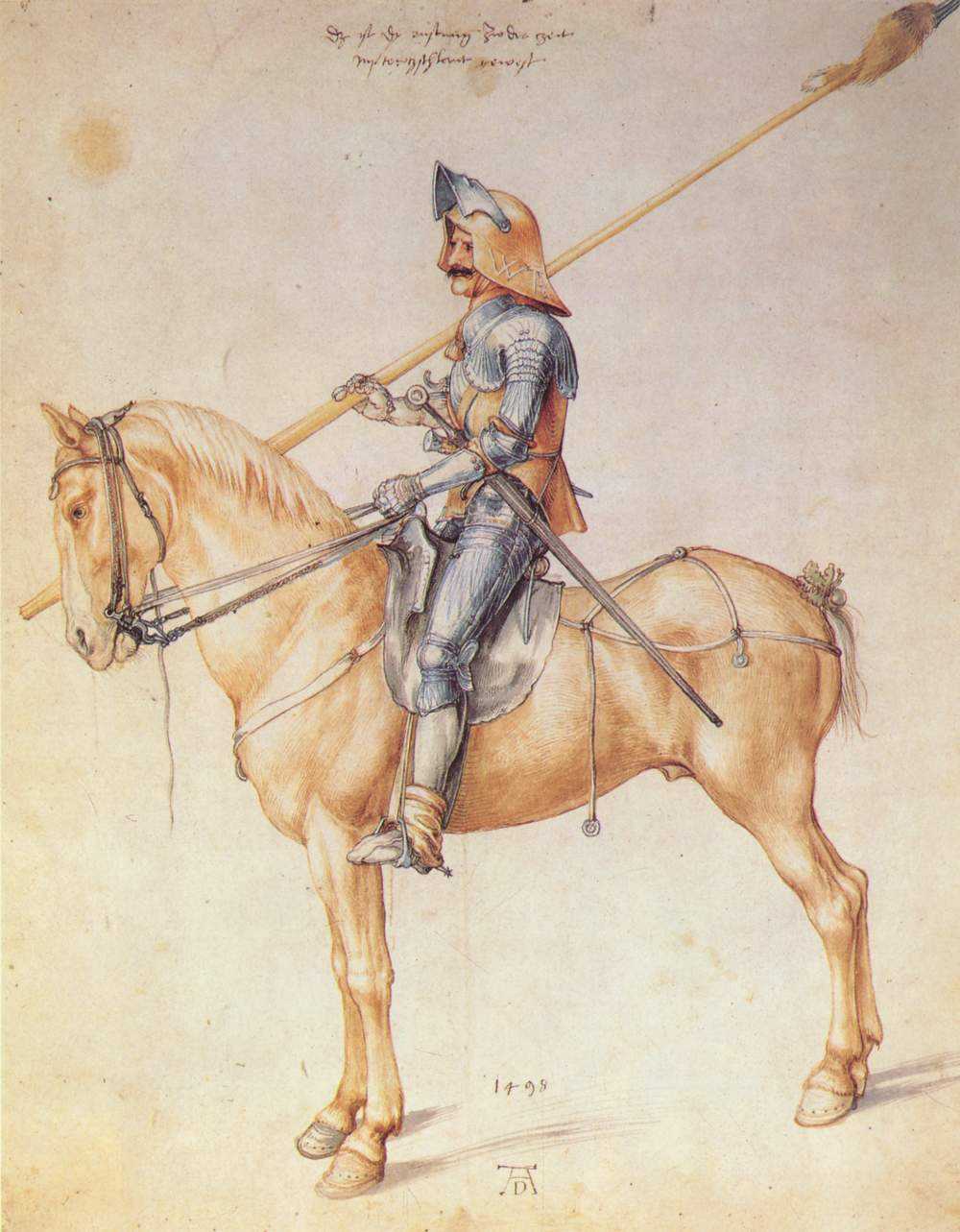
A man-at-arms was a soldier of the High Medieval to Renaissance periods who was typically well-versed in the use of arms and served as a fully-armoured heavy cavalryman. A man-at-arms could be a knight, or nobleman, a member of a knight's or nobleman's retinue, or a mercenary in a company serving under a captain. Such men could serve for pay or through a feudal obligation. The terms knight and man-at-arms are often used interchangeably, but while all knights equipped for war were men-at-arms, not all men-at-arms were knights.
Though in English the term man-at-arms is a fairly straightforward rendering of the French homme d'armes, in the Middle Ages, there were numerous terms for this type of soldier, referring to the type of arms he would be expected to provide: In France, he might be known as a lance or glaive, while in Germany, Spieß, Helm or Gleve, and in various places, a bascinet. In Italy, the term barbuta was used, and in England from the late 14th century, men-at-arms were known as lances or spears.
In the Early Medieval period, any well-equipped horseman could be described as a "knight", or in Latin, miles. In the course of the 12th century knighthood became a social rank with a distinction being made between milites gregarii (non-noble cavalrymen) and milites nobiles (true knights). As a fully armoured cavalryman could be of a lesser social status than a knight, an alternative term describing this type of soldier came into use which was, in French, homme d'armes or gent d'armes, and in English man-at-arms. This evolution differed in detail and timeline across Europe but by 1300, there was a clear distinction between the military function of the man-at-arms and the social rank of knighthood. The term man-at-arms thus primarily denoted a military function, rather than a social rank.
The military function that a man-at-arms performed was serving as a fully-armoured heavy cavalryman; though he could, and in the 14th and 15th centuries often did, also fight on foot. In the course of the 16th century, the man-at-arms was gradually replaced by other cavalry types, the demi-lancer and the cuirassier, characterised by less-extensive armour coverage and the use of weapons other than the heavy lance.
Throughout the medieval period and into the Renaissance the armour of the man-at-arms became progressively more effective and expensive. Throughout the 14th century, the armour worn by a man-at-arms was a composite of materials. Over a quilted gambeson, mail armour covered the body, limbs and head. Increasingly during the century, the mail was supplemented by plate armour on the body and limbs. In the 15th century, full plate armour was developed, which reduced the mail component to a few points of flexible reinforcement.
From the 14th to 16th century, the primary weapon of the man at arms on horseback was the lance. The lance of the 14th century was essentially a simple spear, 12 ft (3.7 m) in length, usually of ash. In response to the development of improved armour, however, heavier lances weighing up to 18 kg (40 lb) were developed, combined with a new method of using them in conjunction with a lance rest (arrêt) fixed to the breastplate. This combination of heavy lance and arrêt enabled the mounted man-at-arms to enjoy a new effectiveness on the battlefields of the later 15th and 16th centuries. Not all men-at-arms in the 15th century carried the heavy lance. A lighter weapon called a demi-lance evolved and this gave its name to a new class of a lighter-equipped man-at-arms, the demi-lancer, towards the end of the 15th century.
When fighting on foot, men-at-arms initially modified their ordinary cavalry weapons. English men-at-arms in Italy in the 1360s are recorded as advancing in close order with two men holding a cavalry lance. On other occasions, such as at the Battle of Agincourt, men-at-arms cut down their lances to a more manageable size of 5 ft (1.5 m). In the 15th century, the increased protection of plate armour led to the development of a specialist foot combat weapon, the two-handed poleaxe.
The horse was an essential part of a man-at-arm's equipment. The type of horse, however, varied according to wealth and status. Andrew Ayton in an in-depth study of English warhorses of the 13th and 14th centuries has shown that three types predominate: the destrier, the courser and an animal simply known as a "horse" (L:equus Med Fr : chival). Destriers were both rare and expensive, making up 5% of men-at-arms horses. Ayton also calculated the value of the average man-at-arm's horse in thirteen campaigns between 1282 and 1364, showing it varied between £7.6 and £16.4. In only two campaigns in the mid-14th century did the majority of horses cost more than £10. The horse was, therefore, a major item of expenditure in the equipment of a man-at-arms. It has been calculated that a French gendarme's horse in the mid-15th century cost the equivalent of six months' wages. The cost of horses meant that the professional soldier might not wish to risk his expensive asset in combat. A system evolved in the 13th century for employers to compensate for horses lost in action. In England this was called by the Latin name restauro equorum and similar systems were in use in France and Italy. In order to secure this insurance scheme, the man-at-arms had the value of his horse assessed and details of its appearance recorded. The assessment system also allowed employers to insist on a minimum value (and hence quality) of horse be presented at muster. In 14th-century England, the minimum value appears in most cases to be 100 shillings (£5).
Hub AI
Man-at-arms AI simulator
(@Man-at-arms_simulator)
Man-at-arms
A man-at-arms was a soldier of the High Medieval to Renaissance periods who was typically well-versed in the use of arms and served as a fully-armoured heavy cavalryman. A man-at-arms could be a knight, or nobleman, a member of a knight's or nobleman's retinue, or a mercenary in a company serving under a captain. Such men could serve for pay or through a feudal obligation. The terms knight and man-at-arms are often used interchangeably, but while all knights equipped for war were men-at-arms, not all men-at-arms were knights.
Though in English the term man-at-arms is a fairly straightforward rendering of the French homme d'armes, in the Middle Ages, there were numerous terms for this type of soldier, referring to the type of arms he would be expected to provide: In France, he might be known as a lance or glaive, while in Germany, Spieß, Helm or Gleve, and in various places, a bascinet. In Italy, the term barbuta was used, and in England from the late 14th century, men-at-arms were known as lances or spears.
In the Early Medieval period, any well-equipped horseman could be described as a "knight", or in Latin, miles. In the course of the 12th century knighthood became a social rank with a distinction being made between milites gregarii (non-noble cavalrymen) and milites nobiles (true knights). As a fully armoured cavalryman could be of a lesser social status than a knight, an alternative term describing this type of soldier came into use which was, in French, homme d'armes or gent d'armes, and in English man-at-arms. This evolution differed in detail and timeline across Europe but by 1300, there was a clear distinction between the military function of the man-at-arms and the social rank of knighthood. The term man-at-arms thus primarily denoted a military function, rather than a social rank.
The military function that a man-at-arms performed was serving as a fully-armoured heavy cavalryman; though he could, and in the 14th and 15th centuries often did, also fight on foot. In the course of the 16th century, the man-at-arms was gradually replaced by other cavalry types, the demi-lancer and the cuirassier, characterised by less-extensive armour coverage and the use of weapons other than the heavy lance.
Throughout the medieval period and into the Renaissance the armour of the man-at-arms became progressively more effective and expensive. Throughout the 14th century, the armour worn by a man-at-arms was a composite of materials. Over a quilted gambeson, mail armour covered the body, limbs and head. Increasingly during the century, the mail was supplemented by plate armour on the body and limbs. In the 15th century, full plate armour was developed, which reduced the mail component to a few points of flexible reinforcement.
From the 14th to 16th century, the primary weapon of the man at arms on horseback was the lance. The lance of the 14th century was essentially a simple spear, 12 ft (3.7 m) in length, usually of ash. In response to the development of improved armour, however, heavier lances weighing up to 18 kg (40 lb) were developed, combined with a new method of using them in conjunction with a lance rest (arrêt) fixed to the breastplate. This combination of heavy lance and arrêt enabled the mounted man-at-arms to enjoy a new effectiveness on the battlefields of the later 15th and 16th centuries. Not all men-at-arms in the 15th century carried the heavy lance. A lighter weapon called a demi-lance evolved and this gave its name to a new class of a lighter-equipped man-at-arms, the demi-lancer, towards the end of the 15th century.
When fighting on foot, men-at-arms initially modified their ordinary cavalry weapons. English men-at-arms in Italy in the 1360s are recorded as advancing in close order with two men holding a cavalry lance. On other occasions, such as at the Battle of Agincourt, men-at-arms cut down their lances to a more manageable size of 5 ft (1.5 m). In the 15th century, the increased protection of plate armour led to the development of a specialist foot combat weapon, the two-handed poleaxe.
The horse was an essential part of a man-at-arm's equipment. The type of horse, however, varied according to wealth and status. Andrew Ayton in an in-depth study of English warhorses of the 13th and 14th centuries has shown that three types predominate: the destrier, the courser and an animal simply known as a "horse" (L:equus Med Fr : chival). Destriers were both rare and expensive, making up 5% of men-at-arms horses. Ayton also calculated the value of the average man-at-arm's horse in thirteen campaigns between 1282 and 1364, showing it varied between £7.6 and £16.4. In only two campaigns in the mid-14th century did the majority of horses cost more than £10. The horse was, therefore, a major item of expenditure in the equipment of a man-at-arms. It has been calculated that a French gendarme's horse in the mid-15th century cost the equivalent of six months' wages. The cost of horses meant that the professional soldier might not wish to risk his expensive asset in combat. A system evolved in the 13th century for employers to compensate for horses lost in action. In England this was called by the Latin name restauro equorum and similar systems were in use in France and Italy. In order to secure this insurance scheme, the man-at-arms had the value of his horse assessed and details of its appearance recorded. The assessment system also allowed employers to insist on a minimum value (and hence quality) of horse be presented at muster. In 14th-century England, the minimum value appears in most cases to be 100 shillings (£5).
Recent media