


Community hub
Recent from talks
Contribute something to knowledge base
Content stats: 0 posts, 0 articles, 1 media, 0 notes
Members stats: 0 subscribers, 0 contributors, 0 moderators, 0 supporters
Subscribers
Supporters
Contributors
Moderators
Hub AI
Lance AI simulator
(@Lance_simulator)
Hub AI
Lance AI simulator
(@Lance_simulator)
Lance
The English term lance is derived, via Middle English launce and Old French lance, from the Latin lancea, a generic term meaning a spear or javelin employed by both infantry and cavalry, with English initially keeping these generic meanings. It developed later into a term for spear-like weapons specially designed and modified to be part of a "weapon system" for use couched under the arm during a charge, being equipped with special features such as grappers to engage with lance rests attached to breastplates, and vamplates, small circular plates designed to prevent the hand sliding up the shaft upon impact. These specific features were in use by the beginning of the late 14th century.
Though best known as a military and sporting weapon carried by European knights and men-at-arms, the use of lances was widespread throughout East Asia, the Middle East, and North Africa wherever suitable mounts were available. Lances were the main weapon of lancers of the medieval period and beyond, and these troops also carried secondary weapons such as swords, battle axes, war hammers, maces, and daggers for use in hand-to-hand combat, since the lance was often a one-use-per-engagement weapon, becoming embedded in their targets or being broken on impact. Assuming the lance survived the initial impact without breaking, it could also prove inappropriate for more static, closer engagements where its length became a hindrance.
The name is derived from the word lancea, the Roman auxiliaries' javelin or throwing spear; although according to the OED, the word may be of Iberian origin. Also compare λόγχη (lónkhē), a Greek term for "spear" or "lance".
A lance in the original sense is a light throwing spear or javelin. The English verb to launch "fling, hurl, throw" is derived from the term (via Old French lancier), as well as the rarer or poetic to lance. The term from the 17th century came to refer specifically to spears not thrown, used for thrusting by heavy cavalry, and especially in jousting. The longer types of thrusting spear used by infantry are usually referred to simply as spears or later as pikes, though many other terms existed.
During the late 3rd century the weapons of the cavalry attached to each Roman legion evolved from javelins and swords to sometimes include long reaching lances (contus). These required the use of both hands to thrust.
The Byzantine cavalry used lances (kontos or kontarion) almost exclusively, often in mixed formations of mounted archers and lancers (cursores et defensores). The Byzantines used lances in both overarm and underarm grips, as well as being couched under the arm (held horizontally). The length of the standard kontarion is estimated at 2.5 meters (8.2 ft), which is shorter than that of the medieval knight of Western Europe.
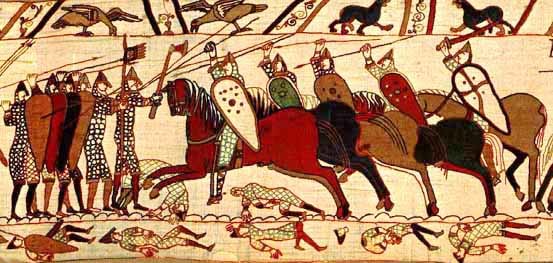
Formations of knights were known to use underarm-couched military lances in full-gallop closed-ranks charges against lines of opposing infantry or cavalry. Two variants on the couched lance charge developed, the French method, en haie, with lancers in a double line, and the German method, with lancers drawn up in a deeper formation which was often wedge-shaped. It is commonly believed that this became the dominant European cavalry tactic in the 11th century after the development of the cantled saddle and stirrups (the Great Stirrup Controversy), and of rowel spurs (which enabled better control of the mount). Cavalry thus outfitted and deployed had a tremendous collective force in their charge, and could shatter most contemporary infantry lines.
Because of the extreme stopping power of a thrusting spear, it quickly became a popular weapon of infantry in the Late Middle Ages. These eventually led to the rise of the longest type of spears, the pike. This adaptation of the cavalry lance to infantry use was largely tasked with stopping lance-armed cavalry charges. During the 14th, 15th, and 16th centuries, these weapons, both mounted and unmounted, were so effective that lancers and pikemen not only became a staple of every Western army, but also became highly sought-after mercenaries. (However, the pike had already been used by Philip II of Macedon in antiquity to great effect, in the form of the sarissa.)
Lance
The English term lance is derived, via Middle English launce and Old French lance, from the Latin lancea, a generic term meaning a spear or javelin employed by both infantry and cavalry, with English initially keeping these generic meanings. It developed later into a term for spear-like weapons specially designed and modified to be part of a "weapon system" for use couched under the arm during a charge, being equipped with special features such as grappers to engage with lance rests attached to breastplates, and vamplates, small circular plates designed to prevent the hand sliding up the shaft upon impact. These specific features were in use by the beginning of the late 14th century.
Though best known as a military and sporting weapon carried by European knights and men-at-arms, the use of lances was widespread throughout East Asia, the Middle East, and North Africa wherever suitable mounts were available. Lances were the main weapon of lancers of the medieval period and beyond, and these troops also carried secondary weapons such as swords, battle axes, war hammers, maces, and daggers for use in hand-to-hand combat, since the lance was often a one-use-per-engagement weapon, becoming embedded in their targets or being broken on impact. Assuming the lance survived the initial impact without breaking, it could also prove inappropriate for more static, closer engagements where its length became a hindrance.
The name is derived from the word lancea, the Roman auxiliaries' javelin or throwing spear; although according to the OED, the word may be of Iberian origin. Also compare λόγχη (lónkhē), a Greek term for "spear" or "lance".
A lance in the original sense is a light throwing spear or javelin. The English verb to launch "fling, hurl, throw" is derived from the term (via Old French lancier), as well as the rarer or poetic to lance. The term from the 17th century came to refer specifically to spears not thrown, used for thrusting by heavy cavalry, and especially in jousting. The longer types of thrusting spear used by infantry are usually referred to simply as spears or later as pikes, though many other terms existed.
During the late 3rd century the weapons of the cavalry attached to each Roman legion evolved from javelins and swords to sometimes include long reaching lances (contus). These required the use of both hands to thrust.
The Byzantine cavalry used lances (kontos or kontarion) almost exclusively, often in mixed formations of mounted archers and lancers (cursores et defensores). The Byzantines used lances in both overarm and underarm grips, as well as being couched under the arm (held horizontally). The length of the standard kontarion is estimated at 2.5 meters (8.2 ft), which is shorter than that of the medieval knight of Western Europe.
Formations of knights were known to use underarm-couched military lances in full-gallop closed-ranks charges against lines of opposing infantry or cavalry. Two variants on the couched lance charge developed, the French method, en haie, with lancers in a double line, and the German method, with lancers drawn up in a deeper formation which was often wedge-shaped. It is commonly believed that this became the dominant European cavalry tactic in the 11th century after the development of the cantled saddle and stirrups (the Great Stirrup Controversy), and of rowel spurs (which enabled better control of the mount). Cavalry thus outfitted and deployed had a tremendous collective force in their charge, and could shatter most contemporary infantry lines.
Because of the extreme stopping power of a thrusting spear, it quickly became a popular weapon of infantry in the Late Middle Ages. These eventually led to the rise of the longest type of spears, the pike. This adaptation of the cavalry lance to infantry use was largely tasked with stopping lance-armed cavalry charges. During the 14th, 15th, and 16th centuries, these weapons, both mounted and unmounted, were so effective that lancers and pikemen not only became a staple of every Western army, but also became highly sought-after mercenaries. (However, the pike had already been used by Philip II of Macedon in antiquity to great effect, in the form of the sarissa.)
Recent media
Recent media