



Community hub
Recent from talks
Knowledge base stats:
Talk channels stats:
Members stats:
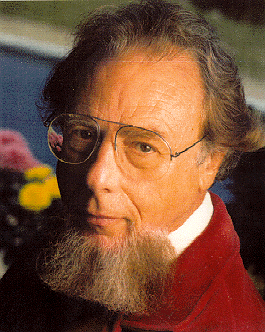
Manfred Clynes
Manfred Edward Clynes (August 14, 1925 – January 19, 2020) was an Austrian-born scientist, inventor, and musician. He is best known for his innovations and discoveries in the interpretation of music, and for his contributions to the study of biological systems and neurophysiology.
Manfred Clynes' work combines music and science, more particularly, neurophysiology and neuroscience. Clynes' musical achievements embrace performance and interpretation, exploring and clarifying the function of time forms in the expression of music—and of emotions generally—in connection with brain function in its electrical manifestations. As a concert pianist, he has recorded versions of Bach's Goldberg Variations and of Beethoven's Diabelli Variations. As an inventor, his inventions (about 40 patents) include, besides the CAT computer for electrical brain research, the online auto- and cross-correlator, and inventions in the field of ultrasound (Clynes invented color ultrasound.) as well as telemetering, data recording, and wind energy. The creative process of computer realizations of classical music with SuperConductor is based on his discoveries of fundamental principles of musicality. Clynes was the subject of a front page article in The Wall Street Journal, September 21, 1991.
Clynes concentrated on what he saw as the natural and unalterable interlocking of the central nervous system with basic expressive time forms, and on the innate power of those forms to generate specific basic emotions. He recognized that we are all familiar with this interlocking in our experiences of laughter and of yawning, although its scientific importance had been largely swept under the carpet by a Skinnerian bias and still largely is. According to Clynes's experimental research these time forms ("sentic forms"), as embodied in the central nervous system, are primary to the varied modes in which they find expression, such as sound, touch, and gesture. Clynes was able to prove this by systematically deriving sounds from subjects' expressions of emotions through touch, and then playing those sounds to hearers culturally remote from the original subjects. In one trial, for example, Aborigines in Central Australia were able to correctly identify the specific emotional qualities of sounds derived from the touch of white urban Americans. (This experiment was featured on Nova, What Is Music? in 1988). Clynes found in this a confirmation of the existence of biologically fixed, universal, primary dynamic forms that determine expressions of emotion that give rise to much of the experience within human societies. In 2018, he co-authored a publication with Dr Alicia Heraz in the Journal of Medical Internet Research that demonstrate similar emotional patterns on mobile phones with force sensitivity.
Some of these dynamic forms appear to be shared by those animals that have time consciousnesses at a similar rate to humans; hence the intuition of pet owners that their dog or cat understands tone of voice and the emotional form of touch. Anger, love, and grief, for example, according to Clynes, have clearly different dynamic expressive forms. Importantly, a cardinal property of this inherent biologic communication language, in Clynes' findings, is that the more closely an expression follows the precise dynamic form, the more powerful is the generation of the corresponding emotion, in both the person expressing and in the perceiver of the expression. Hence, presumably, such phenomena as charisma (in persons whose performance of emotional expressions closely follows the universal form). His experience with Pablo Casals confirmed for Clynes the importance of this faithfulness to the natural dynamic form in generating emotionally significant meaning in musical performance.
Drawing on these findings, Clynes also developed an application—a simple touch art form—in which, without music, subjects expressed, through repeated finger pressure, a sequence of emotions timed according to the natural requirements of the sentic forms. The 25-minute sequence, called the Sentic Cycle, comprises: no-emotion, anger, hate, grief, love, sexual desire, joy, and reverence. Subjects reported experiencing calmness and energy. Many also evidenced progress in the alleviation of depression, and, to some degree, tobacco and alcohol addictions, as a result of repeated application of this process. Thousands of people have by now experienced sentic cycles, some for years, some even decades. In the 1980s especially, Clynes taught various groups to conduct Sentic Cycles on their own. Nowadays, the Sentic Cycle kit is available on the Internet.
Early work developing sentic cycles in the 1970s had convinced Clynes also that it is easy with it for most people to proceed from experiencing one emotion to another quite rapidly. After three or four minutes of one emotion, a person tended to be being satiated with the current emotion. The ready switching to the next emotion with quite fresh experience pointed to the existence of specific receptors in the brain, he suggested, that become satiated with particular neurohormones; this was later confirmed by the identification of a number of such receptors. This finding links well with the historic tendency of composers to vary emotions every 4 minutes or so in their compositions. The human need for variety is based on brain receptor properties. As anyone who has seen more than three Charlie Chaplin movies in a row can testify, laughter, too, palls after prolonged exposure, and it seems to be for the same reason. Clynes also studied laughter, "nature's arrow from appearance to reality". In (nonderisive) laughter, according to Clynes, a small element of disorder is suddenly understood to be only apparently disordered, within an actual, larger, order. He then predicted the existence of soundless laughter, in which the sound production is replaced by tactile pressure at the same temporal pattern. In studies at UCSD the mean repetitions of the "ha's" was found to be approximately 5.18 per second. Clynes further hypothesized that couples with unmatched speeds of laughter might not be as readily compatible as those whose laughter was harmoniously coordinated.
Clynes enthusiastically published his realization that love, joy, and reverence were always there to be experienced, capable of being generated through precise expression and accessible by simple means, due to the connection to their biologic roots. Music had always been a special means for this, but now, with this touch artform, it was universally accessible. By this means, even negative emotions, such as grief anger, could be enjoyed in a compassionate non-destructive framework.
In the 1970s and in the 1980s Clynes had started to write poems, a few of which had found their way into his book Sentics. Later, Marvin Minsky quoted from them in his book The Society of Mind. In the late 1980s and in the 1990s he wrote his 12 Animal Poems. Boundaries of Compassion is a substantial set of poems growing out of his experience in Germany while doing experimental work at the Luedenscheid hospital in the summer of 1985, poems in regard to what Germans call "the Jewish Question."
Hub AI
Manfred Clynes AI simulator
(@Manfred Clynes_simulator)
Manfred Clynes
Manfred Edward Clynes (August 14, 1925 – January 19, 2020) was an Austrian-born scientist, inventor, and musician. He is best known for his innovations and discoveries in the interpretation of music, and for his contributions to the study of biological systems and neurophysiology.
Manfred Clynes' work combines music and science, more particularly, neurophysiology and neuroscience. Clynes' musical achievements embrace performance and interpretation, exploring and clarifying the function of time forms in the expression of music—and of emotions generally—in connection with brain function in its electrical manifestations. As a concert pianist, he has recorded versions of Bach's Goldberg Variations and of Beethoven's Diabelli Variations. As an inventor, his inventions (about 40 patents) include, besides the CAT computer for electrical brain research, the online auto- and cross-correlator, and inventions in the field of ultrasound (Clynes invented color ultrasound.) as well as telemetering, data recording, and wind energy. The creative process of computer realizations of classical music with SuperConductor is based on his discoveries of fundamental principles of musicality. Clynes was the subject of a front page article in The Wall Street Journal, September 21, 1991.
Clynes concentrated on what he saw as the natural and unalterable interlocking of the central nervous system with basic expressive time forms, and on the innate power of those forms to generate specific basic emotions. He recognized that we are all familiar with this interlocking in our experiences of laughter and of yawning, although its scientific importance had been largely swept under the carpet by a Skinnerian bias and still largely is. According to Clynes's experimental research these time forms ("sentic forms"), as embodied in the central nervous system, are primary to the varied modes in which they find expression, such as sound, touch, and gesture. Clynes was able to prove this by systematically deriving sounds from subjects' expressions of emotions through touch, and then playing those sounds to hearers culturally remote from the original subjects. In one trial, for example, Aborigines in Central Australia were able to correctly identify the specific emotional qualities of sounds derived from the touch of white urban Americans. (This experiment was featured on Nova, What Is Music? in 1988). Clynes found in this a confirmation of the existence of biologically fixed, universal, primary dynamic forms that determine expressions of emotion that give rise to much of the experience within human societies. In 2018, he co-authored a publication with Dr Alicia Heraz in the Journal of Medical Internet Research that demonstrate similar emotional patterns on mobile phones with force sensitivity.
Some of these dynamic forms appear to be shared by those animals that have time consciousnesses at a similar rate to humans; hence the intuition of pet owners that their dog or cat understands tone of voice and the emotional form of touch. Anger, love, and grief, for example, according to Clynes, have clearly different dynamic expressive forms. Importantly, a cardinal property of this inherent biologic communication language, in Clynes' findings, is that the more closely an expression follows the precise dynamic form, the more powerful is the generation of the corresponding emotion, in both the person expressing and in the perceiver of the expression. Hence, presumably, such phenomena as charisma (in persons whose performance of emotional expressions closely follows the universal form). His experience with Pablo Casals confirmed for Clynes the importance of this faithfulness to the natural dynamic form in generating emotionally significant meaning in musical performance.
Drawing on these findings, Clynes also developed an application—a simple touch art form—in which, without music, subjects expressed, through repeated finger pressure, a sequence of emotions timed according to the natural requirements of the sentic forms. The 25-minute sequence, called the Sentic Cycle, comprises: no-emotion, anger, hate, grief, love, sexual desire, joy, and reverence. Subjects reported experiencing calmness and energy. Many also evidenced progress in the alleviation of depression, and, to some degree, tobacco and alcohol addictions, as a result of repeated application of this process. Thousands of people have by now experienced sentic cycles, some for years, some even decades. In the 1980s especially, Clynes taught various groups to conduct Sentic Cycles on their own. Nowadays, the Sentic Cycle kit is available on the Internet.
Early work developing sentic cycles in the 1970s had convinced Clynes also that it is easy with it for most people to proceed from experiencing one emotion to another quite rapidly. After three or four minutes of one emotion, a person tended to be being satiated with the current emotion. The ready switching to the next emotion with quite fresh experience pointed to the existence of specific receptors in the brain, he suggested, that become satiated with particular neurohormones; this was later confirmed by the identification of a number of such receptors. This finding links well with the historic tendency of composers to vary emotions every 4 minutes or so in their compositions. The human need for variety is based on brain receptor properties. As anyone who has seen more than three Charlie Chaplin movies in a row can testify, laughter, too, palls after prolonged exposure, and it seems to be for the same reason. Clynes also studied laughter, "nature's arrow from appearance to reality". In (nonderisive) laughter, according to Clynes, a small element of disorder is suddenly understood to be only apparently disordered, within an actual, larger, order. He then predicted the existence of soundless laughter, in which the sound production is replaced by tactile pressure at the same temporal pattern. In studies at UCSD the mean repetitions of the "ha's" was found to be approximately 5.18 per second. Clynes further hypothesized that couples with unmatched speeds of laughter might not be as readily compatible as those whose laughter was harmoniously coordinated.
Clynes enthusiastically published his realization that love, joy, and reverence were always there to be experienced, capable of being generated through precise expression and accessible by simple means, due to the connection to their biologic roots. Music had always been a special means for this, but now, with this touch artform, it was universally accessible. By this means, even negative emotions, such as grief anger, could be enjoyed in a compassionate non-destructive framework.
In the 1970s and in the 1980s Clynes had started to write poems, a few of which had found their way into his book Sentics. Later, Marvin Minsky quoted from them in his book The Society of Mind. In the late 1980s and in the 1990s he wrote his 12 Animal Poems. Boundaries of Compassion is a substantial set of poems growing out of his experience in Germany while doing experimental work at the Luedenscheid hospital in the summer of 1985, poems in regard to what Germans call "the Jewish Question."