



Community hub
Recent from talks
Knowledge base stats:
Talk channels stats:
Members stats:
Manstein plan
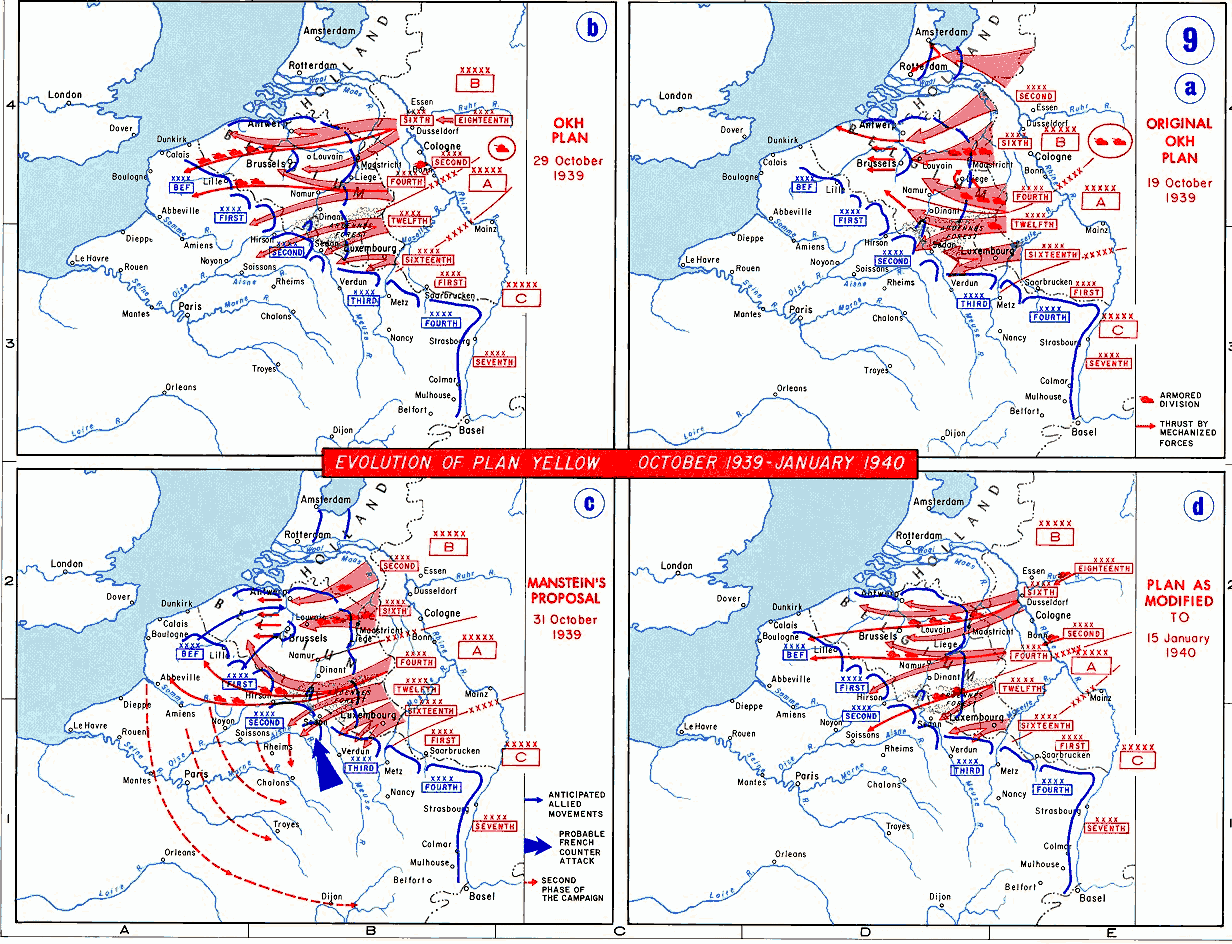
The Manstein plan or Case Yellow (German: Fall Gelb; also known after the war as Unternehmen Sichelschnitt a transliteration of the English Operation Sickle Cut), was the war plan of the German armed forces (Wehrmacht) for the Battle of France in 1940. The original invasion plan was an awkward compromise devised by General Franz Halder, the chief of staff of Oberkommando des Heeres (OKH, Army High Command) that satisfied no one. Documents with details of the plan fell into Belgian hands during the Mechelen incident on 10 January 1940 and the plan was revised several times, each giving more emphasis to an attack by Army Group A through the Ardennes, which progressively reduced the offensive by Army Group B through the Low Countries to a diversion.
In the final version of the plan, the main effort of the German invasion was made against the Ardennes, the weakest part of the Allied line, where the defence was left to second-rate French divisions in the Second Army and the Ninth Army, on the assumption that the difficulty of moving masses of men and equipment would give the French plenty of time to send reinforcements if the area was attacked. The Seventh Army, which had been the most powerful part of the French strategic reserve, had been committed to a rush through Belgium to join with the Dutch Army to the north, in the Breda variant of Plan D, the Allied deployment plan.
The Manstein plan has often been called Operation Sichelschnitt, a transliteration of "sickle cut", a catchy expression used after the events by Winston Churchill. After the war, German generals adopted the term, which led to a misunderstanding that this was the official name of the plan or at least of the attack by Army Group A. The German name was Aufmarschanweisung Nr. 4, Fall Gelb (Campaign Instruction No. 4, Case Yellow) issued on 24 February 1940 and the manoeuvre through the Ardennes had no name.
The Manstein plan was a counterpart to the French Dyle plan for the Battle of France. Lieutenant General Erich von Manstein dissented from the 1939 versions of Fall Gelb (Case Yellow), a plan for an invasion of France and the Low Countries, devised by Franz Halder. The original Aufmarschanweisung N°1, Fall Gelb (Campaign Instruction No 1, Case Yellow), was a plan to push the Allied forces back through central Belgium to the Somme river in northern France, with similarities to the 1914 campaign of the First World War. On 10 January 1940, a German aircraft carrying documents with parts of the plan for Fall Gelb crashed in Belgium (the Mechelen Incident) prompting another review of the invasion plan. Halder revised Fall Gelb to an extent in Aufmarschanweisung N°3, Fall Gelb and Manstein was able to convince Hitler in a meeting on 17 February, that the Wehrmacht should attack through the Ardennes, followed by an advance to the coast.
Manstein, chief of staff of Army Group A, had originally formulated his plan in October 1939 in Koblenz on the instigation of his commander, General Gerd von Rundstedt, who rejected Halder's plan, partly through professional rivalry and part because it could not inflict a decisive victory over France. Manstein first thought to follow annihilation theory (Vernichtungsgedanke), envisaging a swing from Sedan to the north, rapidly to destroy the Allied armies in a cauldron battle (Kesselschlacht). When discussing his intentions with Generalleutnant (Lieutenant-General) Heinz Guderian, the commander of the XIX Panzer Corps, Guderian proposed to avoid the main body of the Allied armies and swiftly advance with the armoured divisions to the English Channel, taking the Allies by surprise and cutting their supply routes from the south. Manstein had many reservations about the proposal, fearing the long open flank to the south that would be created by such a bold advance. Guderian managed to convince him that the danger of a French counter-offensive from the south could be averted by a simultaneous secondary spoiling offensive southwards, in the general direction of Reims.
When Manstein first presented his ideas to OKH, he did not mention Guderian and made the attack to the north the main effort, with a few armoured divisions protecting the left flank of the manoeuvre. The changes were included because the original conception was too bold to be acceptable to many generals, who also considered Guderian too radical; Halder and Walther von Brauchitsch rejected the Manstein concept. Reformulating it in a more radical sense did not help. Manstein and Halder were rivals; in 1938 Manstein had been the successor of the chief of staff Ludwig Beck but had been ousted when the latter was disgraced over the Blomberg–Fritsch affair. On 1 September 1938, Halder rather than Manstein had replaced Beck. In late January, Halder got rid of Manstein by having him promoted to the command of XXXVIII Corps in east Germany.
In late January, Lieutenant-Colonel Günther Blumentritt and Major Henning von Tresckow, on Manstein's staff, contacted Lieutenant-Colonel Rudolf Schmundt (an old acquaintance of Tresckow) the army attaché of Adolf Hitler, when he was visiting Koblenz, who informed Hitler of the affair on 2 February. Having found the Halder plan unsatisfactory from the start, Hitler ordered a change of strategy on 13 February in accordance with Manstein's thinking, after having heard only a rough outline. Manstein was invited to the Reich Chancellery in Berlin to meet Hitler on 17 February, in the presence of Alfred Jodl and Erwin Rommel. Though Hitler felt an immediate antipathy against Manstein for being arrogant and aloof, he listened silently to his exposition and was impressed by Manstein's thinking. Hitler remarked after Manstein had left, "Certainly an exceptionally clever fellow, with great operational gifts, but I don't trust him".
Manstein took no more part in the planning and returned to eastern Germany. Halder had to revise the plan again, which became Aufmarschanweisung N°4, Fall Gelb. The new plan conformed to Manstein's thinking in that Army Group A would provide the main thrust of the invasion through the Ardennes in southern Belgium. After crossing the Meuse River between Namur and Sedan, Army Group A would turn north-west towards Amiens, as Army Group B executed a feint attack in the north, to lure the Allied armies forward into Belgium and pin them down.
Hub AI
Manstein plan AI simulator
(@Manstein plan_simulator)
Manstein plan
The Manstein plan or Case Yellow (German: Fall Gelb; also known after the war as Unternehmen Sichelschnitt a transliteration of the English Operation Sickle Cut), was the war plan of the German armed forces (Wehrmacht) for the Battle of France in 1940. The original invasion plan was an awkward compromise devised by General Franz Halder, the chief of staff of Oberkommando des Heeres (OKH, Army High Command) that satisfied no one. Documents with details of the plan fell into Belgian hands during the Mechelen incident on 10 January 1940 and the plan was revised several times, each giving more emphasis to an attack by Army Group A through the Ardennes, which progressively reduced the offensive by Army Group B through the Low Countries to a diversion.
In the final version of the plan, the main effort of the German invasion was made against the Ardennes, the weakest part of the Allied line, where the defence was left to second-rate French divisions in the Second Army and the Ninth Army, on the assumption that the difficulty of moving masses of men and equipment would give the French plenty of time to send reinforcements if the area was attacked. The Seventh Army, which had been the most powerful part of the French strategic reserve, had been committed to a rush through Belgium to join with the Dutch Army to the north, in the Breda variant of Plan D, the Allied deployment plan.
The Manstein plan has often been called Operation Sichelschnitt, a transliteration of "sickle cut", a catchy expression used after the events by Winston Churchill. After the war, German generals adopted the term, which led to a misunderstanding that this was the official name of the plan or at least of the attack by Army Group A. The German name was Aufmarschanweisung Nr. 4, Fall Gelb (Campaign Instruction No. 4, Case Yellow) issued on 24 February 1940 and the manoeuvre through the Ardennes had no name.
The Manstein plan was a counterpart to the French Dyle plan for the Battle of France. Lieutenant General Erich von Manstein dissented from the 1939 versions of Fall Gelb (Case Yellow), a plan for an invasion of France and the Low Countries, devised by Franz Halder. The original Aufmarschanweisung N°1, Fall Gelb (Campaign Instruction No 1, Case Yellow), was a plan to push the Allied forces back through central Belgium to the Somme river in northern France, with similarities to the 1914 campaign of the First World War. On 10 January 1940, a German aircraft carrying documents with parts of the plan for Fall Gelb crashed in Belgium (the Mechelen Incident) prompting another review of the invasion plan. Halder revised Fall Gelb to an extent in Aufmarschanweisung N°3, Fall Gelb and Manstein was able to convince Hitler in a meeting on 17 February, that the Wehrmacht should attack through the Ardennes, followed by an advance to the coast.
Manstein, chief of staff of Army Group A, had originally formulated his plan in October 1939 in Koblenz on the instigation of his commander, General Gerd von Rundstedt, who rejected Halder's plan, partly through professional rivalry and part because it could not inflict a decisive victory over France. Manstein first thought to follow annihilation theory (Vernichtungsgedanke), envisaging a swing from Sedan to the north, rapidly to destroy the Allied armies in a cauldron battle (Kesselschlacht). When discussing his intentions with Generalleutnant (Lieutenant-General) Heinz Guderian, the commander of the XIX Panzer Corps, Guderian proposed to avoid the main body of the Allied armies and swiftly advance with the armoured divisions to the English Channel, taking the Allies by surprise and cutting their supply routes from the south. Manstein had many reservations about the proposal, fearing the long open flank to the south that would be created by such a bold advance. Guderian managed to convince him that the danger of a French counter-offensive from the south could be averted by a simultaneous secondary spoiling offensive southwards, in the general direction of Reims.
When Manstein first presented his ideas to OKH, he did not mention Guderian and made the attack to the north the main effort, with a few armoured divisions protecting the left flank of the manoeuvre. The changes were included because the original conception was too bold to be acceptable to many generals, who also considered Guderian too radical; Halder and Walther von Brauchitsch rejected the Manstein concept. Reformulating it in a more radical sense did not help. Manstein and Halder were rivals; in 1938 Manstein had been the successor of the chief of staff Ludwig Beck but had been ousted when the latter was disgraced over the Blomberg–Fritsch affair. On 1 September 1938, Halder rather than Manstein had replaced Beck. In late January, Halder got rid of Manstein by having him promoted to the command of XXXVIII Corps in east Germany.
In late January, Lieutenant-Colonel Günther Blumentritt and Major Henning von Tresckow, on Manstein's staff, contacted Lieutenant-Colonel Rudolf Schmundt (an old acquaintance of Tresckow) the army attaché of Adolf Hitler, when he was visiting Koblenz, who informed Hitler of the affair on 2 February. Having found the Halder plan unsatisfactory from the start, Hitler ordered a change of strategy on 13 February in accordance with Manstein's thinking, after having heard only a rough outline. Manstein was invited to the Reich Chancellery in Berlin to meet Hitler on 17 February, in the presence of Alfred Jodl and Erwin Rommel. Though Hitler felt an immediate antipathy against Manstein for being arrogant and aloof, he listened silently to his exposition and was impressed by Manstein's thinking. Hitler remarked after Manstein had left, "Certainly an exceptionally clever fellow, with great operational gifts, but I don't trust him".
Manstein took no more part in the planning and returned to eastern Germany. Halder had to revise the plan again, which became Aufmarschanweisung N°4, Fall Gelb. The new plan conformed to Manstein's thinking in that Army Group A would provide the main thrust of the invasion through the Ardennes in southern Belgium. After crossing the Meuse River between Namur and Sedan, Army Group A would turn north-west towards Amiens, as Army Group B executed a feint attack in the north, to lure the Allied armies forward into Belgium and pin them down.