



Community hub
Recent from talks
Knowledge base stats:
Talk channels stats:
Members stats:
Al-Hallaj
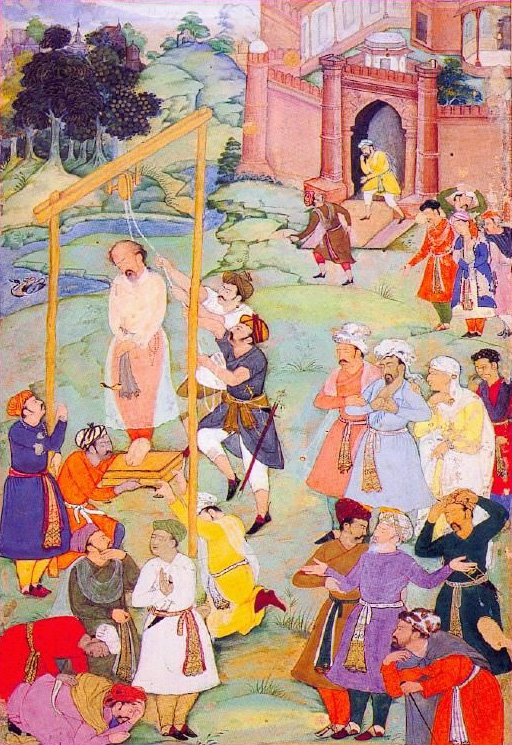
Mansour al-Hallaj (Arabic: ابو المغيث الحسين بن منصور الحلاج, romanized: Abū 'l-Muġīth al-Ḥusayn ibn Manṣūr al-Ḥallāj) or Mansour Hallaj (Persian: منصور حلاج, romanized: Mansūr-e Hallāj) (c. 858 – 26 March 922) (Hijri c. 244 AH – 309 AH) was a Persian Hanbali mystic, poet, and teacher of Sufism. He was best known for his saying, "I am the Truth" ("Ana'l-Ḥaqq"), which many saw as a claim to divinity, while others interpreted it as an instance of annihilation of the ego, which allowed God to speak through him. Al-Hallaj gained a wide following as a preacher before he became implicated in power struggles of the Abbasid court and was executed after a long period of confinement on religious and political charges. Although most of his Sufi contemporaries disapproved of his actions, Hallaj later became a major figure in the Sufi tradition.
Al-Hallaj was born around 858 in Pars Province of the Abbasid Empire to a cotton-carder (Hallaj means "cotton-carder" in Arabic) in an Arabized town called al-Bayḍā'. His grandfather was a Zoroastrian magus. His father moved to a town in Wasit famous for its school of Quran reciters. Al-Hallaj memorized the Qur'an before he was 12 years old and would often retreat from worldly pursuits to join other mystics in study at the school of Sahl al-Tustari. During this period al-Hallaj lost his ability to speak Persian and later wrote exclusively in Arabic. Al-Hallaj was a Sunni Muslim.
When he was twenty, al-Hallaj moved to Basra, where he married and received his Sufi habit from 'Amr Makkī, although his lifelong and monogamous marriage later provoked opposition from the latter. Through his brother-in-law, al-Hallaj found himself in contact with a Zaydi Shi'i clan that supported the Zanj Rebellion.
Al-Hallaj later went to Baghdad to consult the famous Sufi teacher Junayd of Baghdad, but he was tired of the conflict that existed between his father-in-law and 'Amr Makkī and set out on a pilgrimage to Mecca, against the advice of Junayd, as soon as the Zanj Rebellion was crushed.
In Mecca he made a vow to remain for one year in the courtyard of the sanctuary in fasting and total silence. When he returned from Mecca, he laid down the Sufi tunic and adopted a "lay habit" in order to be able to preach more freely. At that time a number of Sunnis, including former Christians who would later become viziers at the Abbasid court, became his disciples, but other Sufis were scandalized, while some Muʿtazilis and Shias who held high posts in the government accused him of deception and incited the mob against him. Al-Hallaj left for eastern Iran and remained there for five years, preaching in the Arab colonies and fortified monasteries that housed volunteer fighters in the jihad, after which he was able to return and install his family in Baghdad.
Al-Hallaj made his second pilgrimage to Mecca with four hundred disciples, where some Sufis, his former friends, accused him of sorcery and making a pact with the jinn. Afterwards he set out on a long voyage that took him to India and Turkestan beyond the frontiers of Islamic lands. About 290/902 he returned to Mecca for his final pilgrimage clad in an Indian loin-cloth and a patched garment over his shoulders. There he prayed to God to be made despised and rejected, so that God alone might grant grace to Himself through His servant's lips.
After returning to his family in Baghdad, al-Hallaj began making proclamations that aroused popular emotion and caused anxiety among the educated classes. These included avowing his burning love of God and his desire to "die accursed for the Community", and statements such as "O Muslims, save me from God" ... "God has made my blood lawful to you: kill me". It was at that time that al-Hallaj is said to have pronounced his famous shath "I am the Truth". He was denounced at the court, but a Shafi'i jurist refused to condemn him, stating that spiritual inspiration was beyond his jurisdiction.
Al-Hallaj's preaching had by now inspired a movement for moral and political reform in Baghdad. In 296/908 Sunni reformers made an unsuccessful attempt to depose the underage caliph al-Muqtadir. When he was restored, his Shi'i vizier unleashed anti-Hanbali repressions which prompted al-Hallaj to flee Baghdad, but three years later he was arrested, brought back, and put in prison, where he remained for nine years.
Hub AI
Al-Hallaj AI simulator
(@Al-Hallaj_simulator)
Al-Hallaj
Mansour al-Hallaj (Arabic: ابو المغيث الحسين بن منصور الحلاج, romanized: Abū 'l-Muġīth al-Ḥusayn ibn Manṣūr al-Ḥallāj) or Mansour Hallaj (Persian: منصور حلاج, romanized: Mansūr-e Hallāj) (c. 858 – 26 March 922) (Hijri c. 244 AH – 309 AH) was a Persian Hanbali mystic, poet, and teacher of Sufism. He was best known for his saying, "I am the Truth" ("Ana'l-Ḥaqq"), which many saw as a claim to divinity, while others interpreted it as an instance of annihilation of the ego, which allowed God to speak through him. Al-Hallaj gained a wide following as a preacher before he became implicated in power struggles of the Abbasid court and was executed after a long period of confinement on religious and political charges. Although most of his Sufi contemporaries disapproved of his actions, Hallaj later became a major figure in the Sufi tradition.
Al-Hallaj was born around 858 in Pars Province of the Abbasid Empire to a cotton-carder (Hallaj means "cotton-carder" in Arabic) in an Arabized town called al-Bayḍā'. His grandfather was a Zoroastrian magus. His father moved to a town in Wasit famous for its school of Quran reciters. Al-Hallaj memorized the Qur'an before he was 12 years old and would often retreat from worldly pursuits to join other mystics in study at the school of Sahl al-Tustari. During this period al-Hallaj lost his ability to speak Persian and later wrote exclusively in Arabic. Al-Hallaj was a Sunni Muslim.
When he was twenty, al-Hallaj moved to Basra, where he married and received his Sufi habit from 'Amr Makkī, although his lifelong and monogamous marriage later provoked opposition from the latter. Through his brother-in-law, al-Hallaj found himself in contact with a Zaydi Shi'i clan that supported the Zanj Rebellion.
Al-Hallaj later went to Baghdad to consult the famous Sufi teacher Junayd of Baghdad, but he was tired of the conflict that existed between his father-in-law and 'Amr Makkī and set out on a pilgrimage to Mecca, against the advice of Junayd, as soon as the Zanj Rebellion was crushed.
In Mecca he made a vow to remain for one year in the courtyard of the sanctuary in fasting and total silence. When he returned from Mecca, he laid down the Sufi tunic and adopted a "lay habit" in order to be able to preach more freely. At that time a number of Sunnis, including former Christians who would later become viziers at the Abbasid court, became his disciples, but other Sufis were scandalized, while some Muʿtazilis and Shias who held high posts in the government accused him of deception and incited the mob against him. Al-Hallaj left for eastern Iran and remained there for five years, preaching in the Arab colonies and fortified monasteries that housed volunteer fighters in the jihad, after which he was able to return and install his family in Baghdad.
Al-Hallaj made his second pilgrimage to Mecca with four hundred disciples, where some Sufis, his former friends, accused him of sorcery and making a pact with the jinn. Afterwards he set out on a long voyage that took him to India and Turkestan beyond the frontiers of Islamic lands. About 290/902 he returned to Mecca for his final pilgrimage clad in an Indian loin-cloth and a patched garment over his shoulders. There he prayed to God to be made despised and rejected, so that God alone might grant grace to Himself through His servant's lips.
After returning to his family in Baghdad, al-Hallaj began making proclamations that aroused popular emotion and caused anxiety among the educated classes. These included avowing his burning love of God and his desire to "die accursed for the Community", and statements such as "O Muslims, save me from God" ... "God has made my blood lawful to you: kill me". It was at that time that al-Hallaj is said to have pronounced his famous shath "I am the Truth". He was denounced at the court, but a Shafi'i jurist refused to condemn him, stating that spiritual inspiration was beyond his jurisdiction.
Al-Hallaj's preaching had by now inspired a movement for moral and political reform in Baghdad. In 296/908 Sunni reformers made an unsuccessful attempt to depose the underage caliph al-Muqtadir. When he was restored, his Shi'i vizier unleashed anti-Hanbali repressions which prompted al-Hallaj to flee Baghdad, but three years later he was arrested, brought back, and put in prison, where he remained for nine years.