



Community hub
Recent from talks
Knowledge base stats:
Talk channels stats:
Members stats:
Manta ray
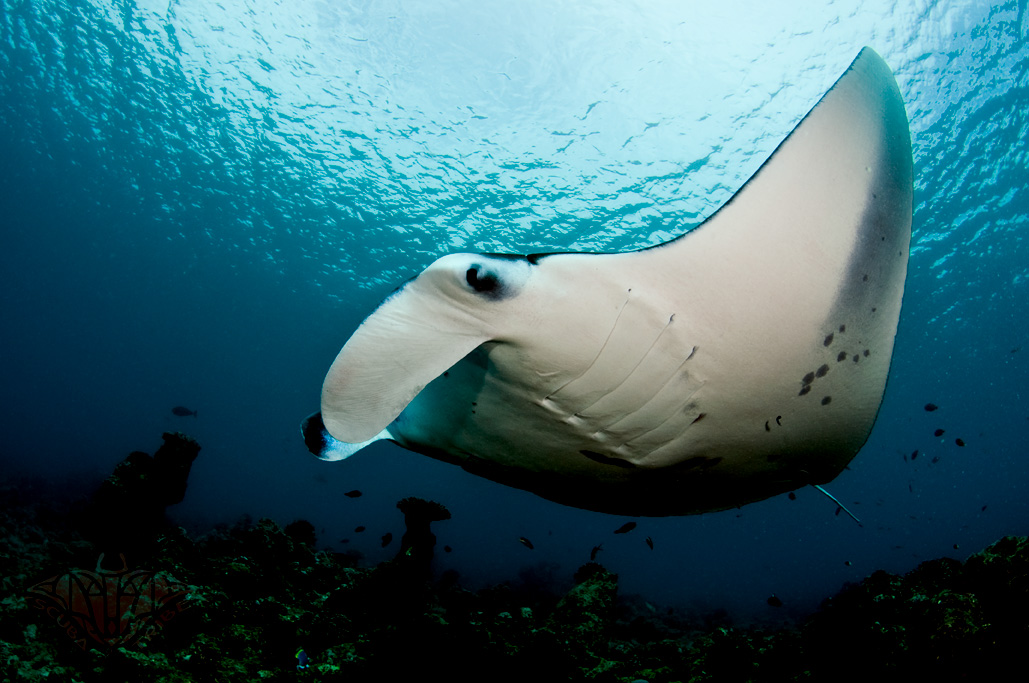
Manta rays are large rays belonging to the genus Mobula (formerly its own genus Manta). Three species are known: M. birostris, the largest at 7 m (23 ft) in width, M. yarae, which reaches 6 m (20 ft), and M. alfredi, the smallest at 5.5 m (18 ft). All three have triangular pectoral fins, horn-shaped cephalic fins and large, forward-facing mouths. They are classified among the Myliobatiformes (stingrays and relatives) and are placed in the family Myliobatidae (eagle rays). They have one of the highest brain-to-body ratio of all fish, and can pass the mirror test.
Mantas are found in warm temperate, subtropical and tropical waters. All three species are pelagic; M. birostris and M. yarae migrate across open oceans, singly or in groups, while M. alfredi tends to be resident and coastal. They are filter feeders and eat large quantities of zooplankton, which they gather with their open mouths as they swim. However, research suggests that the majority of their diet comes from mesopelagic sources. Gestation lasts over a year and mantas give birth to live pups. Mantas may visit cleaning stations for the removal of parasites. Like whales, they breach for unknown reasons.
M. birostris and M. alfredi are both listed as vulnerable by the International Union for Conservation of Nature. Anthropogenic threats include pollution, entanglement in fishing nets, and direct harvesting of their gill rakers for use in Chinese medicine. Manta rays are particularly valued for their gill plates, which are traded internationally. Their slow reproductive rate exacerbates these threats. They are protected in international waters by the Convention on Migratory Species of Wild Animals, but are more vulnerable closer to shore. Areas where mantas congregate are popular with tourists. Only a few public aquariums are large enough to house them.
The name "manta" is Portuguese and Spanish for mantle (cloak or blanket), a type of blanket-shaped trap traditionally used to catch rays. Mantas are known as "devilfish" because of their horn-shaped cephalic fins, which are imagined to give them an "evil" appearance.
Manta rays are members of the order Myliobatiformes which consists of stingrays and their relatives. The genus Manta is part of the eagle ray family Myliobatidae, where it is grouped in the subfamily Mobulinae along with the smaller Mobula devil rays. In 2018, an analysis of DNA, and to a lesser degree, morphology, found that Mobula was paraphyletic with respect to the manta rays; that is, some members of genus Mobula are closer related to the members of the genus Manta than they are to fellow Mobula, and the researchers recommended treating Manta as a junior synonym of Mobula.
Mantas evolved from bottom-dwelling stingrays, eventually developing more wing-like pectoral fins. M. birostris still has a vestigial remnant of a sting barb in the form of a caudal spine. The mouths of most rays lie on the underside of the head, while in mantas, they are right at the front. The edges of the jaws line up while in devil rays, the lower jaw shifts back when the mouth closes. Manta rays and devil rays are the only ray species that have evolved into filter feeders. Manta rays have dorsal slit-like spiracles, traits which they share with the devil fish and Chilean devil ray.
The scientific naming of mantas has had a convoluted history, during which several names were used for both the genus (Ceratoptera, Brachioptilon, Daemomanta, and Diabolicthys) and species (such as vampyrus, americana, johnii, and hamiltoni). All were eventually treated as synonyms of the single species Manta birostris. The genus name Manta was first published in 1829 by Dr Edward Nathaniel Bancroft of Jamaica. The specific name birostris is ascribed to Johann Julius Walbaum (1792) by some authorities and to Johann August Donndorff (1798) by others. The specific name alfredi was first used by Australian zoologist Gerard Krefft, who named the manta after Prince Alfred.
A 2009 study analyzed the differences in morphology, including color, meristic variation, spine, dermal denticles (tooth-like scales), and teeth of different populations. Two distinct species emerged: the smaller M. alfredi found in the Indo-Pacific and tropical East Atlantic, and the larger M. birostris found throughout tropical, subtropical and warm temperate oceans. The former is more coastal, while the latter is more ocean-going and migratory. A 2010 study on mantas around Japan confirmed the morphological and genetic differences between M. birostris and M. alfredi.
Hub AI
Manta ray AI simulator
(@Manta ray_simulator)
Manta ray
Manta rays are large rays belonging to the genus Mobula (formerly its own genus Manta). Three species are known: M. birostris, the largest at 7 m (23 ft) in width, M. yarae, which reaches 6 m (20 ft), and M. alfredi, the smallest at 5.5 m (18 ft). All three have triangular pectoral fins, horn-shaped cephalic fins and large, forward-facing mouths. They are classified among the Myliobatiformes (stingrays and relatives) and are placed in the family Myliobatidae (eagle rays). They have one of the highest brain-to-body ratio of all fish, and can pass the mirror test.
Mantas are found in warm temperate, subtropical and tropical waters. All three species are pelagic; M. birostris and M. yarae migrate across open oceans, singly or in groups, while M. alfredi tends to be resident and coastal. They are filter feeders and eat large quantities of zooplankton, which they gather with their open mouths as they swim. However, research suggests that the majority of their diet comes from mesopelagic sources. Gestation lasts over a year and mantas give birth to live pups. Mantas may visit cleaning stations for the removal of parasites. Like whales, they breach for unknown reasons.
M. birostris and M. alfredi are both listed as vulnerable by the International Union for Conservation of Nature. Anthropogenic threats include pollution, entanglement in fishing nets, and direct harvesting of their gill rakers for use in Chinese medicine. Manta rays are particularly valued for their gill plates, which are traded internationally. Their slow reproductive rate exacerbates these threats. They are protected in international waters by the Convention on Migratory Species of Wild Animals, but are more vulnerable closer to shore. Areas where mantas congregate are popular with tourists. Only a few public aquariums are large enough to house them.
The name "manta" is Portuguese and Spanish for mantle (cloak or blanket), a type of blanket-shaped trap traditionally used to catch rays. Mantas are known as "devilfish" because of their horn-shaped cephalic fins, which are imagined to give them an "evil" appearance.
Manta rays are members of the order Myliobatiformes which consists of stingrays and their relatives. The genus Manta is part of the eagle ray family Myliobatidae, where it is grouped in the subfamily Mobulinae along with the smaller Mobula devil rays. In 2018, an analysis of DNA, and to a lesser degree, morphology, found that Mobula was paraphyletic with respect to the manta rays; that is, some members of genus Mobula are closer related to the members of the genus Manta than they are to fellow Mobula, and the researchers recommended treating Manta as a junior synonym of Mobula.
Mantas evolved from bottom-dwelling stingrays, eventually developing more wing-like pectoral fins. M. birostris still has a vestigial remnant of a sting barb in the form of a caudal spine. The mouths of most rays lie on the underside of the head, while in mantas, they are right at the front. The edges of the jaws line up while in devil rays, the lower jaw shifts back when the mouth closes. Manta rays and devil rays are the only ray species that have evolved into filter feeders. Manta rays have dorsal slit-like spiracles, traits which they share with the devil fish and Chilean devil ray.
The scientific naming of mantas has had a convoluted history, during which several names were used for both the genus (Ceratoptera, Brachioptilon, Daemomanta, and Diabolicthys) and species (such as vampyrus, americana, johnii, and hamiltoni). All were eventually treated as synonyms of the single species Manta birostris. The genus name Manta was first published in 1829 by Dr Edward Nathaniel Bancroft of Jamaica. The specific name birostris is ascribed to Johann Julius Walbaum (1792) by some authorities and to Johann August Donndorff (1798) by others. The specific name alfredi was first used by Australian zoologist Gerard Krefft, who named the manta after Prince Alfred.
A 2009 study analyzed the differences in morphology, including color, meristic variation, spine, dermal denticles (tooth-like scales), and teeth of different populations. Two distinct species emerged: the smaller M. alfredi found in the Indo-Pacific and tropical East Atlantic, and the larger M. birostris found throughout tropical, subtropical and warm temperate oceans. The former is more coastal, while the latter is more ocean-going and migratory. A 2010 study on mantas around Japan confirmed the morphological and genetic differences between M. birostris and M. alfredi.