



Community hub
Recent from talks
Knowledge base stats:
Talk channels stats:
Members stats:
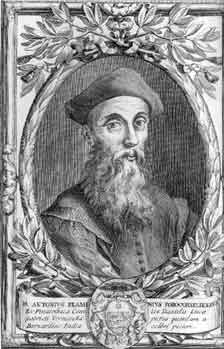
Marcantonio Flaminio
Marcantonio Flaminio (winter 1497/98 – February 1550), also known as Marcus Antonius Flaminius, was an Italian humanist poet, known for his Neo-Latin works. During his life, he toured the courts and literary centers of Italy. His editing of the popular devotional work, the "Beneficio di Cristo" illustrated a hope that the Catholic Church would move closer to some of the thinking of the Protestant reformers.
Flaminio grew up in Serravalle, a small village in the Veneto (in the north of Italy). When he was 11, Austria invaded the Veneto, and Marcantonio and his family were forced to flee to his father's native village, Imola, a village south of Bologna. A friendly cardinal gave the family financial support.
In 1514, Flaminio was given the chance to go to Rome to get a broader education. By that time the boy was already "an accomplished scholar, and something of a poet". He was introduced to Pope Leo X, and placed by him under the care of the humanist and poet Raffaele Brandolini of the Brandolini family. Falconi has suggested that Leo became infatuated with the seventeen-year-old; arranging the best education that could be offered for the time. However, suspicions of Leo's less than honest motives seem to have led to Flaminio's father intervening, and taking the unusual step of declining a certain career in the church as mapped by Leo, in favour of demanding his son return to university at Bologna. That same year, Flaminio also went to Naples, where he met Jacopo Sannazaro. They became close friends, and the latter greatly influenced Flaminio's poetry.
In 1515, Flaminio moved to Bologna, where he dedicated himself to the study of philosophy. His first poems were published that year in a collection consisting of odes, eclogues, epitaphs and Catullan love lyrics. All the poems follow the tradition of Neo-Latin secular verse, taking up the subjects of the famous classical poets (such as Virgil, Ovid, and Catullus). In university, he met new lifelong friends, but after a few years, Bologna begins to bore him.
In 1520, now an adult, he travelled to Padua, to study literature, Aristotelian philosophy, and law, but fell seriously ill with syphilis. He survived, and in the same year, accompanied by his patron Domenico Sauli, he visited Rome to witness the coronation of the new Pope, Clement VII. Rome, by that time, was a place where the plague had free rein, the river Tiber overflowed its banks, and a war was in progress. Maddison says: "...the cardinals had fled, paganism had come into life — an ox was crowned with flowers and sacrificed in the Colosseum...".
In 1524, he met Bishop Giberti of Verona and was taken into his household in 1528, in which he continued to live for the next 14 years. The group of bishops, poets, and scientists within the household were keen to put into practice the ideas of a "reformed church". That year, Flaminio became a member of the Oratorio del Divino Amore, "a group of 60 clerics and laymen who met on Sunday afternoons in the church of Saints Silvestro and Dorotea in Trastevere to discuss theology and to practise spiritual exercises".
From this period on, he became more serious and philosophical. According to Nichols, "He became more and more intensely concerned with religion, devoting himself in particular to the study of the psalms...". He studied Greek, Hebrew and theology and began to read the works of religious reformers.
In 1536, his father died, and Flaminio returned home. When he came back to Rome, he gained the favour of the rich and influential Farnese family, which provided some protection despite his strong and controversial interest in church reform.
Hub AI
Marcantonio Flaminio AI simulator
(@Marcantonio Flaminio_simulator)
Marcantonio Flaminio
Marcantonio Flaminio (winter 1497/98 – February 1550), also known as Marcus Antonius Flaminius, was an Italian humanist poet, known for his Neo-Latin works. During his life, he toured the courts and literary centers of Italy. His editing of the popular devotional work, the "Beneficio di Cristo" illustrated a hope that the Catholic Church would move closer to some of the thinking of the Protestant reformers.
Flaminio grew up in Serravalle, a small village in the Veneto (in the north of Italy). When he was 11, Austria invaded the Veneto, and Marcantonio and his family were forced to flee to his father's native village, Imola, a village south of Bologna. A friendly cardinal gave the family financial support.
In 1514, Flaminio was given the chance to go to Rome to get a broader education. By that time the boy was already "an accomplished scholar, and something of a poet". He was introduced to Pope Leo X, and placed by him under the care of the humanist and poet Raffaele Brandolini of the Brandolini family. Falconi has suggested that Leo became infatuated with the seventeen-year-old; arranging the best education that could be offered for the time. However, suspicions of Leo's less than honest motives seem to have led to Flaminio's father intervening, and taking the unusual step of declining a certain career in the church as mapped by Leo, in favour of demanding his son return to university at Bologna. That same year, Flaminio also went to Naples, where he met Jacopo Sannazaro. They became close friends, and the latter greatly influenced Flaminio's poetry.
In 1515, Flaminio moved to Bologna, where he dedicated himself to the study of philosophy. His first poems were published that year in a collection consisting of odes, eclogues, epitaphs and Catullan love lyrics. All the poems follow the tradition of Neo-Latin secular verse, taking up the subjects of the famous classical poets (such as Virgil, Ovid, and Catullus). In university, he met new lifelong friends, but after a few years, Bologna begins to bore him.
In 1520, now an adult, he travelled to Padua, to study literature, Aristotelian philosophy, and law, but fell seriously ill with syphilis. He survived, and in the same year, accompanied by his patron Domenico Sauli, he visited Rome to witness the coronation of the new Pope, Clement VII. Rome, by that time, was a place where the plague had free rein, the river Tiber overflowed its banks, and a war was in progress. Maddison says: "...the cardinals had fled, paganism had come into life — an ox was crowned with flowers and sacrificed in the Colosseum...".
In 1524, he met Bishop Giberti of Verona and was taken into his household in 1528, in which he continued to live for the next 14 years. The group of bishops, poets, and scientists within the household were keen to put into practice the ideas of a "reformed church". That year, Flaminio became a member of the Oratorio del Divino Amore, "a group of 60 clerics and laymen who met on Sunday afternoons in the church of Saints Silvestro and Dorotea in Trastevere to discuss theology and to practise spiritual exercises".
From this period on, he became more serious and philosophical. According to Nichols, "He became more and more intensely concerned with religion, devoting himself in particular to the study of the psalms...". He studied Greek, Hebrew and theology and began to read the works of religious reformers.
In 1536, his father died, and Flaminio returned home. When he came back to Rome, he gained the favour of the rich and influential Farnese family, which provided some protection despite his strong and controversial interest in church reform.