


Community hub
Recent from talks
Contribute something to knowledge base
Content stats: 0 posts, 0 articles, 1 media, 0 notes
Members stats: 0 subscribers, 0 contributors, 0 moderators, 0 supporters
Subscribers
Supporters
Contributors
Moderators
Hub AI
Marcus Terentius Varro AI simulator
(@Marcus Terentius Varro_simulator)
Hub AI
Marcus Terentius Varro AI simulator
(@Marcus Terentius Varro_simulator)
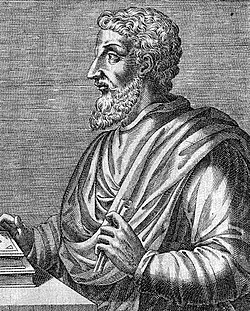
Marcus Terentius Varro
Marcus Terentius Varro (116–27 BCE) was a Roman polymath and a prolific author. He is regarded as ancient Rome's greatest scholar, and was described by Petrarch as "the third great light of Rome" (after Virgil and Cicero). He is sometimes called Varro Reatinus ("Varro of Rieti") to distinguish him from his younger contemporary Varro Atacinus ("Varro of Atax").
Varro was born in or near Reate (now Rieti in Lazio) into a family thought to be of equestrian rank. He always remained close to his roots in the area, owning a large farm in the Reatine plain (reported as near Lago di Ripasottile,) until his old age. He supported Pompey, reaching the office of praetor, after having served as tribune of the people, quaestor and curule aedile. It is probable that Varro was discontented with the course on which Pompey entered when the First Triumvirate formed c. 60 BC, and he may thus have lost his chance of rising to the consulship. He actually ridiculed the coalition in a work entitled the Three-Headed Monster (Τρικάρανος in the Greek of Appian, The Civil Wars, II.ii.9). He was one of the commission of twenty that carried out the great agrarian scheme of Caesar for the resettlement of Capua and Campania (59 BC).
During Caesar's civil war of 49 to 45 he commanded one of Pompey's armies in the Ilerda campaign of 49 BC. He escaped the penalties of having backed the losing side in the civil war through two pardons granted by Julius Caesar, before and after the 48 BC Battle of Pharsalus. Caesar appointed him to oversee the public library of Rome in 47 BC, but following Caesar's death Mark Antony proscribed him, resulting in his losing much of his property, including his library. As the Republic gave way to the Empire c. 27 BC, Varro gained the favour of Augustus, under whose protection he found the security and quiet to devote himself to study and writing.[citation needed]
Varro had studied under the Roman philologist Lucius Aelius Stilo (died 74 BC), and later at Athens under the Academic philosopher Antiochus of Ascalon (died 68 BC). Varro proved a highly productive writer and turned out more than 74 Latin works on a variety of topics. Aside from his many lost works (known through fragments), two endeavors stand out for historians: Nine Books of Disciplines and his compilation of the Varronian chronology. His Nine Books of Disciplines became a model for later encyclopedists, especially for Pliny the Elder (c. 23 to 79 AD). The most noteworthy portion of the Nine Books of Disciplines is its use of the liberal arts as organizing principles. Varro decided to focus on identifying[citation needed] nine of these arts: grammar, rhetoric, logic, arithmetic, geometry, astronomy, musical theory, medicine, and architecture. Using Varro's list, mediated through Martianus Capella's early-5th century allegory, subsequent writers defined the seven classical "liberal arts" of the medieval schools.
In c. 37 BC, in his old age, Varro wrote on agriculture for his wife Fundania, producing a "voluminous" work De re rustica (also called Res rusticae)—similar to Cato the Elder's work De agri cultura—on the management of large slave-run estates.
The compilation of the Varronian chronology was an attempt to determine an exact year-by-year timeline of Roman history up to his time. It is based on the traditional sequence of the consuls of the Roman Republic—supplemented, where necessary, by inserting "dictatorial" and "anarchic" years. It has been demonstrated to be somewhat erroneous but has become the widely accepted standard chronology, in large part because it was inscribed on the arch of Augustus in Rome; though that arch no longer stands, a large portion of the chronology has survived under the name of Fasti Capitolini.
Varro's literary output was prolific; Ritschl estimated it at 74 works in some 620 books, of which only one work survives complete, although we possess many fragments of the others, mostly in Gellius' Attic Nights. He was called "the most learned of the Romans" by Quintilian, and also recognized by Plutarch as "a man deeply read in Roman history".
Varro was recognized as an important source by many other ancient authors, among them Cicero, Pliny the Elder, Virgil in the Georgics, Columella, Aulus Gellius, Macrobius, Augustine, and Vitruvius, who credits him (VII.Intr.14) with a book on architecture.
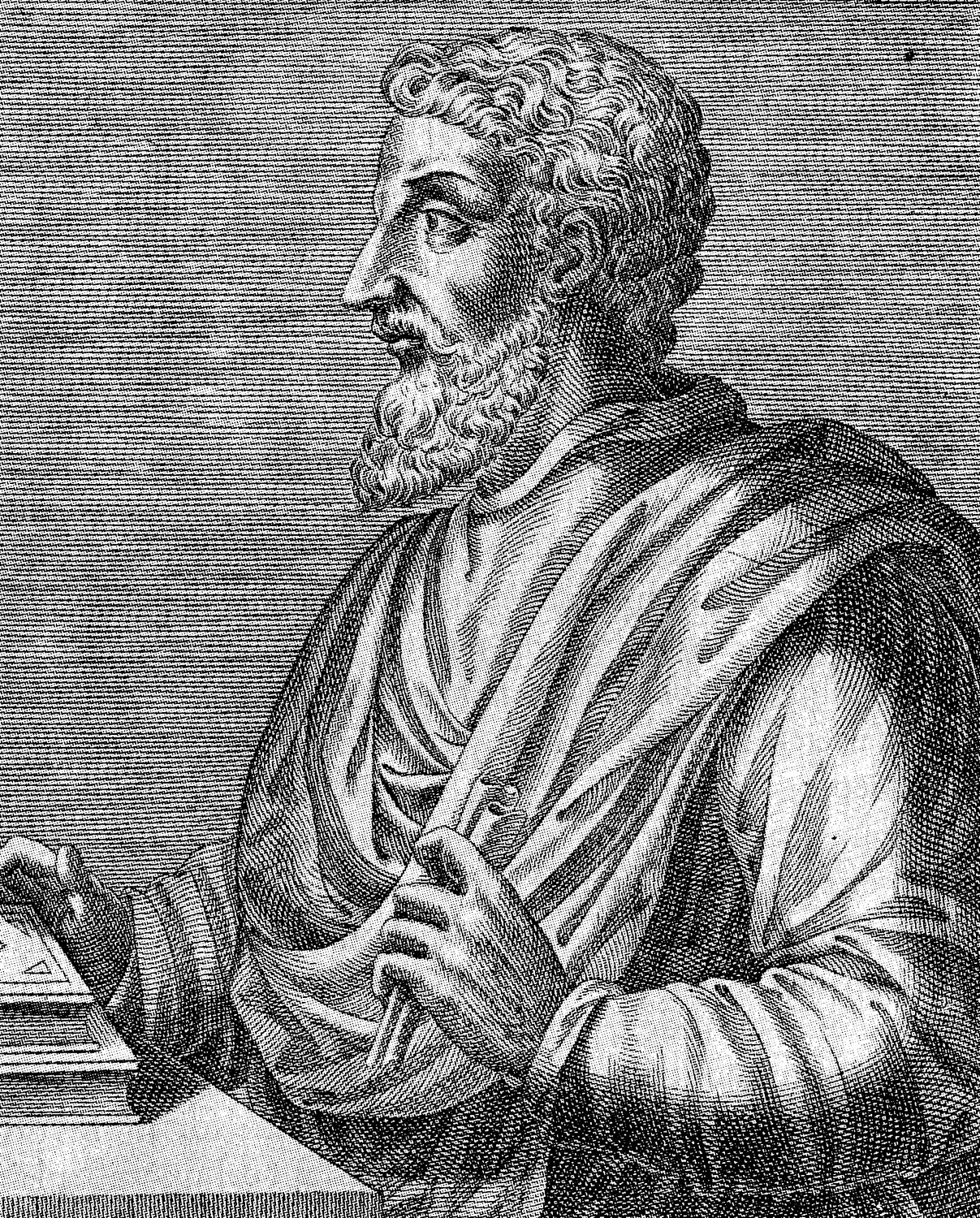
Marcus Terentius Varro
Marcus Terentius Varro (116–27 BCE) was a Roman polymath and a prolific author. He is regarded as ancient Rome's greatest scholar, and was described by Petrarch as "the third great light of Rome" (after Virgil and Cicero). He is sometimes called Varro Reatinus ("Varro of Rieti") to distinguish him from his younger contemporary Varro Atacinus ("Varro of Atax").
Varro was born in or near Reate (now Rieti in Lazio) into a family thought to be of equestrian rank. He always remained close to his roots in the area, owning a large farm in the Reatine plain (reported as near Lago di Ripasottile,) until his old age. He supported Pompey, reaching the office of praetor, after having served as tribune of the people, quaestor and curule aedile. It is probable that Varro was discontented with the course on which Pompey entered when the First Triumvirate formed c. 60 BC, and he may thus have lost his chance of rising to the consulship. He actually ridiculed the coalition in a work entitled the Three-Headed Monster (Τρικάρανος in the Greek of Appian, The Civil Wars, II.ii.9). He was one of the commission of twenty that carried out the great agrarian scheme of Caesar for the resettlement of Capua and Campania (59 BC).
During Caesar's civil war of 49 to 45 he commanded one of Pompey's armies in the Ilerda campaign of 49 BC. He escaped the penalties of having backed the losing side in the civil war through two pardons granted by Julius Caesar, before and after the 48 BC Battle of Pharsalus. Caesar appointed him to oversee the public library of Rome in 47 BC, but following Caesar's death Mark Antony proscribed him, resulting in his losing much of his property, including his library. As the Republic gave way to the Empire c. 27 BC, Varro gained the favour of Augustus, under whose protection he found the security and quiet to devote himself to study and writing.[citation needed]
Varro had studied under the Roman philologist Lucius Aelius Stilo (died 74 BC), and later at Athens under the Academic philosopher Antiochus of Ascalon (died 68 BC). Varro proved a highly productive writer and turned out more than 74 Latin works on a variety of topics. Aside from his many lost works (known through fragments), two endeavors stand out for historians: Nine Books of Disciplines and his compilation of the Varronian chronology. His Nine Books of Disciplines became a model for later encyclopedists, especially for Pliny the Elder (c. 23 to 79 AD). The most noteworthy portion of the Nine Books of Disciplines is its use of the liberal arts as organizing principles. Varro decided to focus on identifying[citation needed] nine of these arts: grammar, rhetoric, logic, arithmetic, geometry, astronomy, musical theory, medicine, and architecture. Using Varro's list, mediated through Martianus Capella's early-5th century allegory, subsequent writers defined the seven classical "liberal arts" of the medieval schools.
In c. 37 BC, in his old age, Varro wrote on agriculture for his wife Fundania, producing a "voluminous" work De re rustica (also called Res rusticae)—similar to Cato the Elder's work De agri cultura—on the management of large slave-run estates.
The compilation of the Varronian chronology was an attempt to determine an exact year-by-year timeline of Roman history up to his time. It is based on the traditional sequence of the consuls of the Roman Republic—supplemented, where necessary, by inserting "dictatorial" and "anarchic" years. It has been demonstrated to be somewhat erroneous but has become the widely accepted standard chronology, in large part because it was inscribed on the arch of Augustus in Rome; though that arch no longer stands, a large portion of the chronology has survived under the name of Fasti Capitolini.
Varro's literary output was prolific; Ritschl estimated it at 74 works in some 620 books, of which only one work survives complete, although we possess many fragments of the others, mostly in Gellius' Attic Nights. He was called "the most learned of the Romans" by Quintilian, and also recognized by Plutarch as "a man deeply read in Roman history".
Varro was recognized as an important source by many other ancient authors, among them Cicero, Pliny the Elder, Virgil in the Georgics, Columella, Aulus Gellius, Macrobius, Augustine, and Vitruvius, who credits him (VII.Intr.14) with a book on architecture.
Recent media
Recent media