Hubbry Logo
ColumellaColumellaMain
Open search
Columella
Community hub
Columella
logo
8 pages, 0 posts
0 subscribers
Be the first to start a discussion here.
Contribute something
Columella
Columella
from Wikipedia

Statue of Columella, holding a sickle and an ox-yoke, in the Plaza de las Flores, Cádiz

Key Information

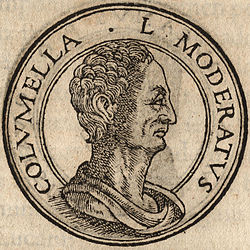
Lucius Junius Moderatus Columella (/ˌkɒljəˈmɛlə/, Arabic: Yunius[1]: 12 ) was a Roman writer on agriculture in the Roman Empire.[2]

His De re rustica in twelve volumes has been completely preserved and forms an important source on Roman agriculture and cuisine, together with the works of Cato the Elder and Marcus Terentius Varro, both of which he occasionally cites. A smaller book on trees, De arboribus, is usually attributed to him.

In 1794 the Spanish botanists José Antonio Pavón Jiménez and Hipólito Ruiz López named a genus of Peruvian asterid Columellia in his honour.[3]

Life

[edit]

Little is known of Columella's life. He was probably born in Gades, Hispania Baetica (modern Cádiz), possibly to Roman parents. After a career in the army (he was tribune in Syria in 35 AD), he turned to farming his estates at Ardea, Carseoli, and Alba in Latium.[4]

Works

[edit]

De re rustica

[edit]

In ancient times, Columella's work "appears to have been but little read", cited only by Pliny the Elder, Servius, Cassiodorus, and Isidorus, and having fallen "into almost complete neglect" after Palladius published an abridgement of it.[5]: 383 

This book is presented as advice to a certain Publius Silvinus. Previously known only in fragments, the complete book was among those discovered in monastery libraries in Switzerland and France by Poggio Bracciolini and his assistant Bartolomeo di Montepulciano during the Council of Constance, between 1414 and 1418.[6]

Structure of De re rustica ("On Agriculture"):

Book 10 is written entirely in dactylic hexameter verse, in imitation of, or homage to, Virgil. It may initially have been intended to be the concluding volume, books 11 and 12 being perhaps an addition to the original scheme.[7]

A complete, but anonymous, translation into English was published by Andrew Millar in 1745.[8] Excerpts had previously been translated by Richard Bradley.[9]

De arboribus

[edit]
De re rustica, 1564

The short work De arboribus, "On Trees", is in manuscripts and early editions of Columella considered as book 3 of De re rustica.[10] However, it is clear from the opening sentences that it is part of a separate and possibly earlier work. As the anonymous translator of the Millar edition notes, in De arboribus there is no mention of the Publius Silvinus to whom the De re rustica is addressed.[8]: 571  A recent critical edition of the Latin text of the De re rustica includes it, but as incerti auctoris, by an unknown hand.[11] Cassiodorus mentions sixteen books of Columella, which has led to the suggestion that De arboribus formed part of a work in four volumes.[10]

Sources

[edit]

In addition to Cato the Elder and Varro, Columella used many sources that are no longer extant and for which he is one of the few references. These include works by Aulus Cornelius Celsus, the Carthaginian writer Mago, Tremellius Scrofa, and many Greek sources. His uncle Marcus Columella, "a clever man and an exceptional farmer" (VII.2.30), had conducted experiments in sheep breeding, crossing colourful wild rams, introduced from Africa for gladiatorial games, with domestic sheep,[12] and may have influenced his nephew's interests. Columella owned farms in Italy; he refers specifically to estates at Ardea, Carseoli, and Alba,[13] and speaks repeatedly of his own practical experience in agriculture.

Editions

[edit]

The earliest editions of Columella group his works with those on agriculture of Cato the Elder, Varro and Palladius. Some modern library catalogues follow Brunet in listing these under "Rei rusticae scriptores" or "Scriptores rei rusticae".[14]

  • Iunii Moderati Columellae hortulus [Rome: Printer of Silius Italicus, c. 1471] (book X only)
  • Georgius Merula, Franciscus Colucia (eds.) De re rustica Opera et impensa Nicolai Ienson: Venetiis, 1472.
  • Lucii Iunii Moderati Columellae de Cultu hortorum Liber .xi. quem .Pub. Virgilius .M. i[n] Georgicis Posteris edendum dimisit. [Padova]: D[ominicus] S[iliprandus], [ca. 1480]
  • Opera Agricolationum: Columellæ: Varronis: Catonisque: nec non Palladii: cū excriptionibus .D. Philippi Beroaldi: & commentariis quæ in aliis impressionibus non extāt. Impensis Benedicti hectoris: Bonon., xiii. calen. octob. [19 Sept.], 1494
  • Beroaldo, Filippo "il vecchio" Oratio de felicitate habita in enarratione Georgicon Virgilii et Columellae Bononiae: per Ioannemantonium De Benedictis, 1507
  • Lucii Junii moderati Columell[ae] de cultu hortorum carme[n] : Necno[n] [et] Palladius de arboru[m] insitione una cu[m] Nicolai Barptholomaei Lochensis hortulo. Parisiis: Venundantur parisiis in aedibus Radulphi Laliseau [printed by Jean Marchant], [1512] (poetry sections only)
  • Columella, Lucius Iunius Moderatus Columella De cultu ortorum. Interprete Pio Bononiensi. Impressum Bononiae: a Hieronymo de Benedictis bibliopola et calcographo, 1520 mense Augusto
  • Libri De Re Rustica...Additis Nuper Commentariis Iunii Pompo. Fortunati in Librum De Cultu Hortorum, Cum Adnotationibus Philippi Beroaldi... Florence: Filippo Giunta, 1521
  • De re rustica libri XII. Euisdem de Arboris liber, separatus ab aliis. Lyon, Sébastien Gryphe, 1541
  • Columella, Lucius Iunius Moderatus De l'agricoltura libri XII. / Lutio Giunio Moderato Columella. Trattato de gli alberi, tradotto nuouamente di latino in lingua italiana per Pietro Lauro Modonese In Venetia: [Michele Tramezzino il vecchio], 1544
  • Les Douze livres des choses rustiques. Traduicts de Latin en François, par feu maistre Claude Cotereau Chanoine de Paris. La traduction duquel ha esté soingneusement reveue & en la plupart corrigée, & illustrée de doctes annotations par maistre Jean Thierry de Beauvoisis Paris: Jacques Kerver, 1551, 1555
  • Columella, Lucius Junius Moderatus Les douze liures ... des choses rustiques, tr. par C. Cotereau. La tr. corrigée & illustrée de doctes annotations par J. Thiery de Beauoisis Paris, 1555
  • Columella, Lucius Iunius Moderatus Lutio Giunio Moderato Columella De l'agricoltura libri XII. Trattato de gli alberi del medesimo, tradotto nuouamente di latino in lingua italiana per Pietro Lauro modonese. In Venetia: per Geronimo Caualcalouo, 1559
  • Orsini, Fulvio Notae ad M. Catonem, M. Varronem, L. Columellam de re rustica. Ad kalend. rusticum Farnesianum & veteres inscriptiones Fratrum Arvalium. Iunius Philargyrius in Bucolica & Georgica Virgilij. Notae ad Servium in Bucol. Georg. & Aeneid. Virg. Velius Longus de orthographia : ex bibliotheca Fulvi Ursini Romae: in aedib. S.P.Q.R. apud Georgium Ferrarium, 1587[15]
  • Bradley, Richard A Survey of the Ancient Husbandry and Gardening collected from Cato, Varro, Columella, Virgil, and others, the most eminent writers among the Greeks & Romans: wherein many of the most difficult passages in those authors are explain'd ... Adorn'd with cuts, etc. London: B. Motte, 1725
  • Gesner, Johann Matthias (ed.) Scriptores Rei Rusticae veteres Latini Cato, Varro, Columella, Palladius, quibus nunc accedit Vegetius de Mulo-Medicina et Gargilii Martialis fragmentum (Ausoni Popinæ De instrumento fundi liber. J. B. Morgagni epist. IV.) cum editionibus prope omnibus et MSS. pluribus collati: adjectae notae virorum clariss, integræ ... et lexicon Rei Rusticae curante Io. Matthia Gesnero Lipsiae: sumtibus Caspari Fritsch, 1735 (full text)
  • Lucius Junius Moderatus Columella (trans. Anon.) L. Junius Moderatus Columella of Husbandry, in Twelve Books: and his book, concerning Trees. Translated into English, with illustrations from Pliny, Cato, Varro, Palladius and other ancient and modern authors London: A. Millar, 1745

References

[edit]

Further reading

[edit]
[edit]
Revisions and contributorsEdit on WikipediaRead on Wikipedia
from Grokipedia
Junius Moderatus Columella (c. 4 – c. 70 AD) was a prominent Roman author and agriculturist from , renowned for his extensive writings on farming and rural estate management during the early . Born in the province of , he served as a in the , traveling to regions including and Asia Minor before retiring to manage agricultural estates in . Living through the reigns of emperors , , , and , Columella drew on his practical experience and classical influences to produce works that emphasized sustainable farming, , and the ethical role of landowners in . His most significant contribution is the De re rustica (On Agriculture), a 12-book completed around 65 AD, supplemented by a 10th book in verse on gardening. This encyclopedic work covers a wide array of topics, including soil preparation, , , , and villa management, while advocating for the of rural labor and the integration of with practical . Columella also authored De arboribus (On Trees), a now-lost text referenced in De re rustica that focused on . As one of the few surviving comprehensive Roman agricultural manuals—building on earlier authors like Cato and Varro—his writings provide invaluable insights into 1st-century Roman economy, technology, and agrarian society, influencing later European farming traditions.

Biography

Early Life and Origins

Lucius Junius Moderatus Columella was born around the beginning of the AD in Gades, a prosperous Roman in the province of (modern , ), to a family of Roman settlers deeply embedded in the region's social and economic fabric. His full name included the "Moderatus," signifying moderation—a potentially tied to philosophical influences, such as the contemporary Pythagorean thinker Moderatus of Gades, who may have been a relative and emphasized in his teachings. This provincial upbringing in Baetica, a hub of Roman imperial administration and trade, shaped his early worldview amid a landscape of fertile valleys and coastal ports. Columella hailed from a prominent equestrian family, a status confirmed by a surviving inscription (CIL IX 235) that records him as Iunius, son of , of the tribe, Moderatus Columella, serving as a —positions typically held by the class. His family maintained significant estates in Baetica, where his uncle, Marcus Columella, was a respected on farming practices, providing a direct link to the province's agrarian heritage. This equestrian background afforded Columella access to networks of Roman elites, blending provincial roots with imperial opportunities. During his formative years, Columella spent considerable time on his family's Baetican estates, immersing himself in the practicalities of amid Hispania's . The region was renowned for its intensive cultivation of olives and vines, key exports that drove the local economy through production and , techniques honed over generations by Roman proprietors. His , possibly encompassing alongside hands-on farming knowledge, was influenced by these familial traditions and the intellectual currents of southern , preparing him for a life bridging provincial customs and Roman service.

Military and Public Service

Columella, born into an equestrian family from Gades in , was eligible for military and administrative roles typical of his social class. An inscription discovered at Tarentum records his service as a (tribunus militum) in , a legion stationed in during the reign of , likely around 35 AD; this position involved commanding cohorts, training recruits, and performing administrative duties within the provincial legionary structure. (CIL IX 235) The role placed him under imperial oversight in the Eastern provinces, where equestrian tribunes often assisted legates in maintaining order and for the Roman presence in . During his time in the East, Columella engaged with provincial governance, overseeing aspects of local and supply chains essential to operations, which exposed him to diverse economic practices in the region. His writings reflect familiarity with Eastern agricultural techniques, such as the timing of in well-irrigated fields of and during June and July, harvested in autumn, indicating direct observation or interaction with these methods that later informed his ideas on efficient operations. He also references the minimal labor required for crops in and from to , suggesting broader exposure to Valley practices that contrasted with Italian farming and influenced his emphasis on labor optimization. Columella's equestrian background facilitated these opportunities, but there is no record of advancement to senatorial ranks or further public offices, limiting his career to typical equestrian military and administrative functions.

Later Life and Estates

After his military service as a tribune in Syria around 35 AD, Columella retired to Italy and focused on managing his rural estates in Latium, settling on properties near Ardea, Carseoli, and Alba Longa between approximately 40 and 50 AD. These farms served as the basis for his hands-on agricultural pursuits, where he emphasized the importance of the owner's direct oversight to ensure efficiency and productivity. Columella's practical involvement extended to experimenting with crop rotations to maintain , organizing slave labor through structured hierarchies and incentives to maximize output, and designing villa that integrated living quarters with operations for seamless management, as outlined in the prefaces to his treatises. His military background briefly informed these efforts, particularly in enforcing discipline among estate workers akin to order. Little is known of Columella's family life. He likely died around 70 AD on one of his Italian estates.

Major Works

De Re Rustica

De Re Rustica is Columella's comprehensive treatise on , composed around 60-65 AD during the Neronian period. The work spans twelve books, systematically addressing the selection and management of rural estates, cultivation of s, , , , and the oversight of operations. Book 1 focuses on choosing a suitable site, ensuring , constructing buildings, and assembling staff, while Book 2 details plowing techniques, fertilization methods, and care, particularly for grains. Books 3 through 5 cover the cultivation, grafting, and pruning of vines, fruit trees, and olives, emphasizing as a profitable endeavor. Books 6 and 7 discuss the breeding and care of large like oxen and horses, as well as smaller animals including sheep, , pigs, and dogs. Book 8 addresses rearing and management, and Book 9 provides guidance on and production. Books 11 and 12 shift to the duties of estate overseers, including seasonal calendars for tasks and instructions for the overseer's wife on household management, wine production, , and preservation. A distinctive stylistic feature is the use of verse in Book 10, which treats in , deliberately emulating and supplementing Virgil's to poeticize practical horticultural advice on planting vegetables, herbs, and flowers. This poetic interlude, comprising about 400 lines, contrasts with the prose of the surrounding books and serves as a literary homage while conveying actionable instructions on garden layout and maintenance. Book 12 also incorporates hexameter verse for portions on the vilica's responsibilities, blending didactic poetry with prose to enhance the treatise's appeal. Columella draws foundational inspiration from earlier Roman agricultural writers like Cato and Varro, adapting their principles to his era's conditions. The offers practical recommendations on tools, fertilizers, and slave to optimize efficiency, underscoring the importance of profitability through diversified operations and sustainable practices like soil rotation and . Seasonal calendars in Book 11 outline tasks by month to align labor with natural cycles, promoting long-term estate viability. Prefaces to individual books reveal personal insights, such as Columella's admiration for his Marcus, an innovative whose experimental vineyards in Baetica informed the author's views on grape cultivation. These introductions also critique urban luxury and moral decline, contrasting the virtuous rural life with city to advocate as a path to ethical and economic fulfillment.

De Arboribus

De Arboribus is a concise attributed to Columella, though its authenticity has been disputed by some scholars, focusing exclusively on the cultivation of and trees through detailed guidance on planting, , and techniques. Comprising 30 chapters, the work systematically addresses arboreal agriculture, likely intended as part of an earlier and shorter version of his larger De Re Rustica, though its standalone nature suggests an independent composition. Written around 50–60 AD, it lacks the dedication to Publius Silvinus found in prefaces to parts of De Re Rustica, further supporting its separate origin and possible earlier drafting before the main corpus was finalized. The emphasizes key including vines, , figs, and apples, providing practical instructions tailored to Roman estate management. For vines, Columella describes establishing nurseries by selecting high-quality seeds in late winter, planting in prepared beds, and propagating through cuttings or layering to ensure vigorous growth. cultivation receives extensive coverage, with advice on site selection in well-drained , deep planting to promote stability, and annual to maintain productivity. Similar methods apply to figs and apples, stressing optimal spacing—such as 40 feet between trees—to allow penetration and airflow, alongside enrichment via manuring and trenching for nutrient absorption. Propagation techniques form a core element, with Columella outlining methods like root division for certain trees and innovative approaches to hybridize varieties. He introduces layered grafting, where branches are bent and partially buried to root while still attached, and a novel use of the "Gallic " for precise insertion of scions into stocks, enabling multi-varietal outcomes such as grapes yielding different colors from one . is detailed seasonally, recommending sharp tools to remove deadwood post-harvest and retain two buds per for fruiting, while relies on natural remedies like sprinkling against ants or solutions for mice and insects. These innovations, including enhanced soil preparation through deep furrows filled with , underscore Columella's emphasis on empirical improvements for yields. The work's specialized focus on tree care complements the broader viticulture discussions in De Re Rustica by offering supplementary, in-depth strategies for propagation and maintenance without overlapping into general farm operations.

Sources and Composition

Influences and Citations

Columella's agricultural treatise De Re Rustica synthesizes a rich array of Roman precedents, beginning with Marcus Porcius Cato the Elder's De Agri Cultura (c. 160 BC), which supplied foundational principles on farm management, crop cultivation, and rural economy. Cato's work, the earliest surviving Latin text on agriculture, emphasized practical Roman traditions like soil preparation and slave labor organization, forming the bedrock for Columella's discussions of villa-based farming. Marcus Terentius Varro's Rerum Rusticarum (37 BC), in turn, profoundly shaped Columella's treatment of livestock husbandry, including breeding techniques for cattle, sheep, and bees, where Varro's emphasis on regional adaptations and economic profitability is echoed and expanded. Complementing these published authorities, Columella frequently drew from the unpublished notebooks and practical insights of his uncle, Marcus Columella, a respected Betic landowner whose experiential knowledge on viticulture and estate management informed sections on grape cultivation and soil fertility in southern Spain. Greek and Punic traditions enriched Columella's synthesis, particularly through the 28-volume agricultural encyclopedia of Mago the Carthaginian (), which the commissioned for translation into Latin around 146 BC, with contributions from Decimus Junius Silanus among others; Columella accessed this via epitomes like Diophanes' Greek summary, integrating Punic methods for and care suited to Mediterranean climates. Botanical knowledge from Theophrastus' Enquiry into Plants (c. 300 BC) influenced Columella's detailed accounts of and , bridging Hellenistic science with Roman practice, while other Greek agronomists such as and provided conceptual frameworks for estate oversight and . Columella incorporated medical perspectives from ' De Medicina (c. 25 AD), applying its principles on and remedies to animal health, such as treatments for ailments like lameness or digestive disorders, thereby extending human medical knowledge to veterinary care in his chapters on herd maintenance. Parallels appear in Gaius Plinius Secundus' Naturalis Historia (c. 77 AD), where both authors overlap in descriptions of natural resources, crop varieties, and environmental factors affecting agriculture, reflecting shared reliance on empirical observation of Roman landscapes. Throughout De Re Rustica, Columella demonstrated a critical approach by evaluating and updating predecessors' advice, discarding obsolete techniques from Cato and Varro—such as rudimentary drainage—while incorporating 1st-century AD innovations like enhanced via water wheels and conduit systems to boost yields on arid estates. He validated these sources through personal experiments conducted on his own properties in and .

Manuscript History and Editions

Columella's De Re Rustica survived the transition from antiquity through a limited number of medieval manuscripts preserved primarily in monastic libraries, with the oldest extant copies dating to the ninth century and deriving from archetypes no earlier than the fifth or sixth century CE. The text's transmission involved two main branches: the S family (exemplified by the ninth-century Codex Sangallensis 737) and the A family (including the tenth-century Codex Ambrosianus), both stemming from a common lost archetype, as reconstructed in Heinrich Sobel's 1912 stemma codicum. Evidence of early circulation appears in citations by Pliny the Elder in the first century CE, indicating the work's initial dissemination before its near-disappearance in late antiquity. The De Arboribus, a shorter likely representing an earlier version of Columella's arboreal material, survives only fragmentarily and was incorporated into De Re Rustica as in most medieval manuscripts, reflecting scribal efforts to compile his corpus cohesively. Humanist scholars rediscovered these monastic manuscripts in the early fifteenth century, facilitating the work's revival during the ; for instance, the beautifully illuminated manuscript (Biblioteca Medicea Laurenziana, Plut. 38.30) from around 1470 exemplifies this period's renewed interest. The first printed edition appeared in around 1470–1471 by Conrad Sweynheym and Arnold Pannartz, initially covering Book 10 in a partial release, followed by the full edited by George Merula in in 1472 under Nicolas Jenson. Subsequent incunabula often bundled Columella with Cato, Varro, and Palladius, such as the 1482 collective edition. Key critical editions include Johann Albert Fabricius and Johann Friedrich Gessner's 1735 text, which incorporated extensive commentary. The bilingual edition, translated and edited by E.S. Forster (Volumes I–II, 1941) and Edward H. Heffner (Volume III, 1955), provided a drawing on Vilhelm Lundström's collations of Books I–II, VI–XII, and De Arboribus. The most recent authoritative text is R.H. Rodgers' Oxford Classical Texts edition (2010), which reviews the full manuscript tradition and includes De Arboribus as an appendix, superseding earlier partial efforts like Lundström's 1898–1922 series. Eighteenth- and nineteenth-century translations broadened access: the 1745 English version, rendered anonymously with annotations from classical sources, marked an early modern effort to adapt Columella for agricultural readers. French translations appeared in Rozier's 1781–1804 edition, while German versions, such as Karl Gottlob von Anton’s 1802 rendering, integrated the text into Enlightenment agrarian discourse.

Legacy

Influence in Classical Antiquity

Columella's De Re Rustica exerted a notable influence on contemporary and near-contemporary Roman authors, particularly in the realm of practical and . , in his completed around 77 AD, frequently cited Columella for details on farming techniques, plant cultivation, and environmental observations, often adapting or critiquing his methods to fit broader encyclopedic discussions. For instance, in Book 18, Pliny references Columella's predictions on and yields based on patterns. These citations underscore Columella's authority as a source for empirical agricultural knowledge, with Pliny integrating his techniques into sections on and , thereby disseminating them to a wider audience amid the empire's expanding interest in systematic . By the AD, Columella's work had become a foundational text for later agronomists, most evidently in the writings of Palladius, whose Opus Agriculturae (c. 400 AD) excerpted and expanded upon Columella's seasonal farming advice across its 14 books. Palladius structured his treatise around monthly calendars of agricultural tasks, directly borrowing from Columella's detailed prescriptions for , soil preparation, and , while adapting them for provincial contexts. This reliance is apparent in textual parallels, such as Palladius's elaboration on Columella's vineyard management and livestock care, which Palladius refines for smaller estates but preserves the core methodologies. Columella played a key role in codifying Roman agronomic practices during a period of empire-wide estate expansion, influencing the management of large-scale villae rusticae in Italy and the provinces through his emphasis on intensive, slave-based operations and diversified production. His prescriptions for villa layouts—integrating residential, productive, and storage zones—aligned with the economic imperatives of absentee landowners, promoting profitability via specialized crops, viticulture, and animal rearing to support urban markets. This framework contributed to standardized estate economies, as seen in the proliferation of villas designed for high-yield agriculture across Gaul, Hispania, and North Africa. Direct evidence of Columella's widespread adoption remains limited, with few explicit attestations in non-agronomic texts from the 1st to 5th centuries AD, suggesting his influence was primarily among elite landowners and specialists rather than general dissemination. However, archaeological findings from Roman villas, such as those at Settefinestre in , reveal layouts and facilities— including centralized floors, wine presses, and partitioned worker quarters—that closely match Columella's descriptions of efficient estate organization, implying indirect uptake in provincial .

Rediscovery and Renaissance Impact

Columella's De Re Rustica survived the early Middle Ages primarily through Carolingian-era copies preserved in monastic libraries across , including examples from the such as the Sangermanensis , though the text fell into relative obscurity as full versions were rarely circulated beyond excerpts and adaptations in later works such as the 4th-century Opus Agriculturae of Palladius. This dormancy persisted until the early , when the humanist scholar rediscovered a key during his searches in monastic collections around 1417, in monastic libraries in and , sparking renewed interest among Italian scholars. The rediscovery fueled a printing boom that amplified Columella's reach; the first complete edition of De Re Rustica appeared in in 1472 as part of the Scriptores rei rusticae, edited by Georgius Merula and printed by Nicolas Jenson, which inspired Italian humanists connected to Petrarch's legacy, including Poggio himself, to integrate classical agricultural knowledge into their studies of antiquity. This edition's dissemination encouraged a revival of Roman villa-based farming models, emphasizing systematic estate and labor organization as ideals for contemporary landowners amid the era's economic expansions. In 16th-century , agronomist Olivier de Serres drew directly on Columella in his influential Théâtre d'Agriculture et Mesnage des Champs (1600), adapting the Roman author's villa prototypes to promote diversified European estates with integrated crop rotations, , and improvement techniques suited to post-medieval . De Serres cited Columella's prescriptions for field layouts and to advocate for efficient, self-sustaining farms, influencing reforms that boosted in regions like the . Columella's detailed guidance on , particularly in Book 10, permeated herbals and agronomic treatises, where his advocacy for techniques—such as vines and fruit trees for hybrid vigor—and to mitigate risks like pests and weather variability was incorporated into works promoting botanical experimentation during agricultural innovations. These elements supported broader reforms, including the expansion of orchards and market gardens, as seen in Italian and French texts that blended classical methods with emerging scientific observation.

Modern Relevance and Scholarship

Excavations of Roman villas in the 20th and 21st centuries, particularly at Settefinestre in , , have corroborated Columella's descriptions of estate layouts, including centralized production facilities and worker , as well as tools like presses and storage amphorae used in and olive oil processing. These findings from the onward, led by archaeologists such as Andrea Carandini, demonstrate how Columella's idealized villa organization reflected practical imperial-era operations, with the site's expansive 250-hectare estate mirroring his recommendations for diversified crop zones and slave labor management. Columella's works highlight themes, such as through , fallowing, and manure application, which align with 21st-century eco-farming principles aimed at preventing and maintaining . Recent studies have applied his methods to evaluate profitability in modern contexts, showing how balanced land use could enhance yields while reducing . These interpretations underscore Columella's relevance to amid climate challenges, with his advice on integrating for informing regenerative practices today. Scholarly debates continue on the authenticity of De Arboribus, with many experts questioning its attribution to Columella due to stylistic inconsistencies and vocabulary differences from De Re Rustica, viewing it instead as a later compilation or pseudepigraphon. Discussions also address gender roles in Columella's depictions of slave labor, where female slaves are assigned lighter field tasks or wool-working to prioritize reproduction, reflecting Roman patriarchal norms that valued their demographic contributions to estate workforces over equal productivity. Comparisons with climate-adapted ancient practices, such as Columella's recommendations for selecting drought-resistant vines for hilly terrains, have gained traction in modern scholarship, linking his terroir-specific strategies to contemporary viticulture resilience against warming trends. Since the 2010s, open-access digital editions and translations of Columella's texts, such as those hosted by the University of Chicago's Penelope project, have facilitated global scholarly access and interdisciplinary analysis. These resources, including the 2010 Oxford Classical Texts edition integrated into online platforms, have enabled studies on applying Columella's economic models—emphasizing diversified income from crops and —to promote .

References

Add your contribution
Related Hubs
Contribute something
User Avatar
No comments yet.