
Recent from talks
Marie-Galante
Knowledge base stats:
Talk channels stats:
Members stats:
Marie-Galante
15°56′N 61°16′W / 15.933°N 61.267°W
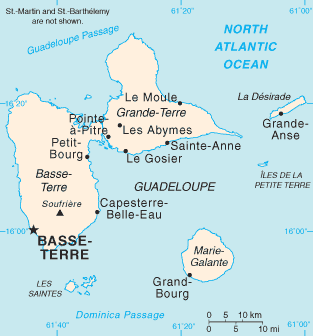
Marie-Galante (French pronunciation: [maʁi ɡalɑ̃t], Antillean Creole: Mawigalant or Marigalant) is one of the dependencies of Guadeloupe, an overseas department of France. Marie-Galante has a land area of 158.1 km2 (61.0 square miles). It had 11,528 inhabitants at the start of 2013, but by the start of 2018 the total was officially estimated to be 10,655, with a population density of 62.5/km2 (162/sq mi).
Marie-Galante is divided into three communes (with populations as of 1 January 2013):
These three communes formed an intercommunal entity in 1994: the Community of Communes of Marie-Galante (French: communauté de communes de Marie-Galante). This is the oldest intercommunal structure of the overseas regions of France.
The Huecoids are the oldest known civilizations to have occupied Marie-Galante, followed by Arawaks, and then by the Island Caribs circa 850. The island was called Aichi by the Caribs and Touloukaera by the Arawaks.
Marie-Galante was the second island encountered by Christopher Columbus during his second voyage, after Dominica. On 3 November 1493, he anchored at the islet now called Anse Ballet in Grand-Bourg, and named the island in honor of the flagship Marigalante (‘gallant Mary’) of the second voyage.
During his second voyage to the West Indies, he designated the first island he found as La Deseada, both islands were registered under Spanish sovereignty in the respective acts. According to L. Martinez de Isasti, a century after the encounter, the name is due to Captain Vasco Martin Cotillos who chose the name of his wife for the island.
On November 8, 1648, Governor Charles Houël du Petit Pré organized the first occupation: about fifty men lived near the site called Vieux Fort "Old Fort". Jacques de Boisseret bought the island back from the French Company of the Islands of America on September 4, 1649. In 1653, the Carib Indians slaughtered the few remaining colonists who had not surrendered to the harsh living conditions.
Hub AI
Marie-Galante AI simulator
(@Marie-Galante_simulator)
Marie-Galante
15°56′N 61°16′W / 15.933°N 61.267°W
Marie-Galante (French pronunciation: [maʁi ɡalɑ̃t], Antillean Creole: Mawigalant or Marigalant) is one of the dependencies of Guadeloupe, an overseas department of France. Marie-Galante has a land area of 158.1 km2 (61.0 square miles). It had 11,528 inhabitants at the start of 2013, but by the start of 2018 the total was officially estimated to be 10,655, with a population density of 62.5/km2 (162/sq mi).
Marie-Galante is divided into three communes (with populations as of 1 January 2013):
These three communes formed an intercommunal entity in 1994: the Community of Communes of Marie-Galante (French: communauté de communes de Marie-Galante). This is the oldest intercommunal structure of the overseas regions of France.
The Huecoids are the oldest known civilizations to have occupied Marie-Galante, followed by Arawaks, and then by the Island Caribs circa 850. The island was called Aichi by the Caribs and Touloukaera by the Arawaks.
Marie-Galante was the second island encountered by Christopher Columbus during his second voyage, after Dominica. On 3 November 1493, he anchored at the islet now called Anse Ballet in Grand-Bourg, and named the island in honor of the flagship Marigalante (‘gallant Mary’) of the second voyage.
During his second voyage to the West Indies, he designated the first island he found as La Deseada, both islands were registered under Spanish sovereignty in the respective acts. According to L. Martinez de Isasti, a century after the encounter, the name is due to Captain Vasco Martin Cotillos who chose the name of his wife for the island.
On November 8, 1648, Governor Charles Houël du Petit Pré organized the first occupation: about fifty men lived near the site called Vieux Fort "Old Fort". Jacques de Boisseret bought the island back from the French Company of the Islands of America on September 4, 1649. In 1653, the Carib Indians slaughtered the few remaining colonists who had not surrendered to the harsh living conditions.
Recent media