Hubbry Logo
Marie AntoinetteMarie AntoinetteMain
Open search
Marie Antoinette
Community hub
Marie Antoinette
logo
40 pages, 0 posts
0 subscribers
Be the first to start a discussion here.
Marie Antoinette
Marie Antoinette
from Wikipedia

Marie Antoinette (/ˌæntwəˈnɛt, ˌɒ̃t-/;[1] French: [maʁi ɑ̃twanɛt] ; Maria Antonia Josefa Johanna; 2 November 1755 – 16 October 1793) was the last queen of France before the fall of the monarchy during the French Revolution. She was the wife of King Louis XVI.

Key Information

Born an archduchess of Austria, she was the penultimate child and youngest daughter of Empress Maria Theresa and Emperor Francis I of the Holy Roman Empire. She married Louis Auguste, Dauphin of France, in May 1770 at age 14, becoming the Dauphine of France. On 10 May 1774, her husband ascended the throne as king, and she became queen.

As queen, Marie Antoinette became increasingly a target of criticism by opponents of the domestic and foreign policies of Louis XVI and those opposed to the monarchy in general. The French libelles accused her of being profligate,[2] promiscuous, having illegitimate children, and harboring sympathies for France's perceived enemies, including her native Austria. She was falsely accused of defrauding the Crown's jewelers in the Affair of the Diamond Necklace, but the accusations damaged her reputation further. During the French Revolution, she became known as Madame Déficit because the country's financial crisis was blamed on her lavish spending and her opposition to social and financial reforms proposed by Anne Robert Jacques Turgot and Jacques Necker.

Several events were linked to Marie Antoinette during the Revolution after the government placed the royal family under house arrest in the Tuileries Palace in October 1789. The June 1791 attempted flight to Varennes and her role in the War of the First Coalition were immensely damaging to her image among French citizens. On 10 August 1792, the attack on the Tuileries forced the royal family to take refuge at the Legislative Assembly, and they were imprisoned in the Temple Prison on 13 August 1792. On 21 September 1792, France was declared a republic and the monarchy was abolished. Louis XVI was executed by guillotine on 21 January 1793. Marie Antoinette's trial began on 14 October 1793; two days later, she was convicted by the Revolutionary Tribunal of high treason and executed by guillotine on 16 October 1793 at the Place de la Révolution.

Early life (1755–1770)

[edit]
Archduchess Maria Antonia depicted at seven years of age, in a 1762 watercolour portrait by Jean-Étienne Liotard

Maria Antonia Josepha Johanna was born on 2 November 1755 at the Hofburg Palace in Vienna, Archduchy of Austria.[3] She was the youngest daughter and 15th child of Empress Maria Theresa, ruler of the Habsburg monarchy, and her husband Francis I, Holy Roman Emperor.[4] Maria Theresa gave birth to all of her previous children without any problems. During the birth of her last daughter serious complications arose, and doctors feared for the life of the mother. Her godparents were Joseph I and Mariana Victoria, king and queen of Portugal; Archduke Joseph and Archduchess Maria Anna acted as proxies for their newborn sister.[5][6]

Maria Antonia was born on All Souls' Day, a Catholic day of mourning, and during her childhood her birthday was instead celebrated the day before, on All Saints' Day, due to the connotations of the date. Shortly after her birth she was placed under the care of the governess of the imperial children, Countess von Brandeis.[7] Maria Antonia was raised together with her sister, Maria Carolina of Austria, who was three years older and with whom she had a lifelong close relationship.[8] Maria Antonia had a difficult but ultimately loving relationship with her mother,[9] who referred to her as "the little Madame Antoine".

Maria Antonia spent her formative years between the Hofburg Palace and Schönbrunn, the imperial summer residence in Vienna,[6] where on 13 October 1762, when she was seven, she met Wolfgang Amadeus Mozart, two months her junior and a child prodigy.[10][6][7][11] Despite the private tutoring she received, the results of her schooling were less than satisfactory.[12] At age 10 she could not write correctly in German or in any language commonly used at court, such as French or Italian,[6] and conversations with her were stilted.[13][6] Under the teaching of Christoph Willibald Gluck, Maria Antonia developed into a good musician. She learned to play the harp,[12] the harpsichord and the flute. She sang during the family's evening gatherings, as she was known to have had a beautiful voice.[14] She also excelled at dancing, had "exquisite" poise, and loved dolls.[15]

Maria Antonia by Martin van Meytens, c. 1767–1768

The death of her older sister Maria Josepha from smallpox during the epidemic in Vienna in October 1767 made an everlasting impression on the young Maria Antonia.[16] In her later life she recalled the ailing Maria Josepha taking her in her arms. She told her that she would not be traveling to Naples to marry King Ferdinand IV of Naples, to whom she was betrothed, but for the family vault.[16]

In 1768, Mathieu-Jacques de Vermond was dispatched by Louis XV to tutor Maria Antonia. De Vermond found her to be unsatisfactorily educated and lacking in important writing skills. Nonetheless, he also complimented her, stating "her character, her heart, are excellent". He found her "more intelligent than has been generally supposed," but since "she is rather lazy and extremely frivolous, she is hard to teach".[17]

Under the recommendation of Étienne François de Choiseul, Duke of Choiseul, a strong supporter of her prospective marriage, she received a makeover to bring her more in line with the fashion of French royalty. This included the straightening of her teeth by a French dentist, the diversification of her wardrobe, and hairstyles reminiscent of Madame de Pompadour.[18] She was also instructed by Jean-Georges Noverre who taught her to walk in the gliding fashion characteristic of the court of Versailles.[19]

Dauphine of France (1770–1774)

[edit]
Archduchess Maria Antonia depicted at age 13 in a 1769 portrait by Joseph Ducreux, which was sent to the Palace of Versailles in May 1769[20]
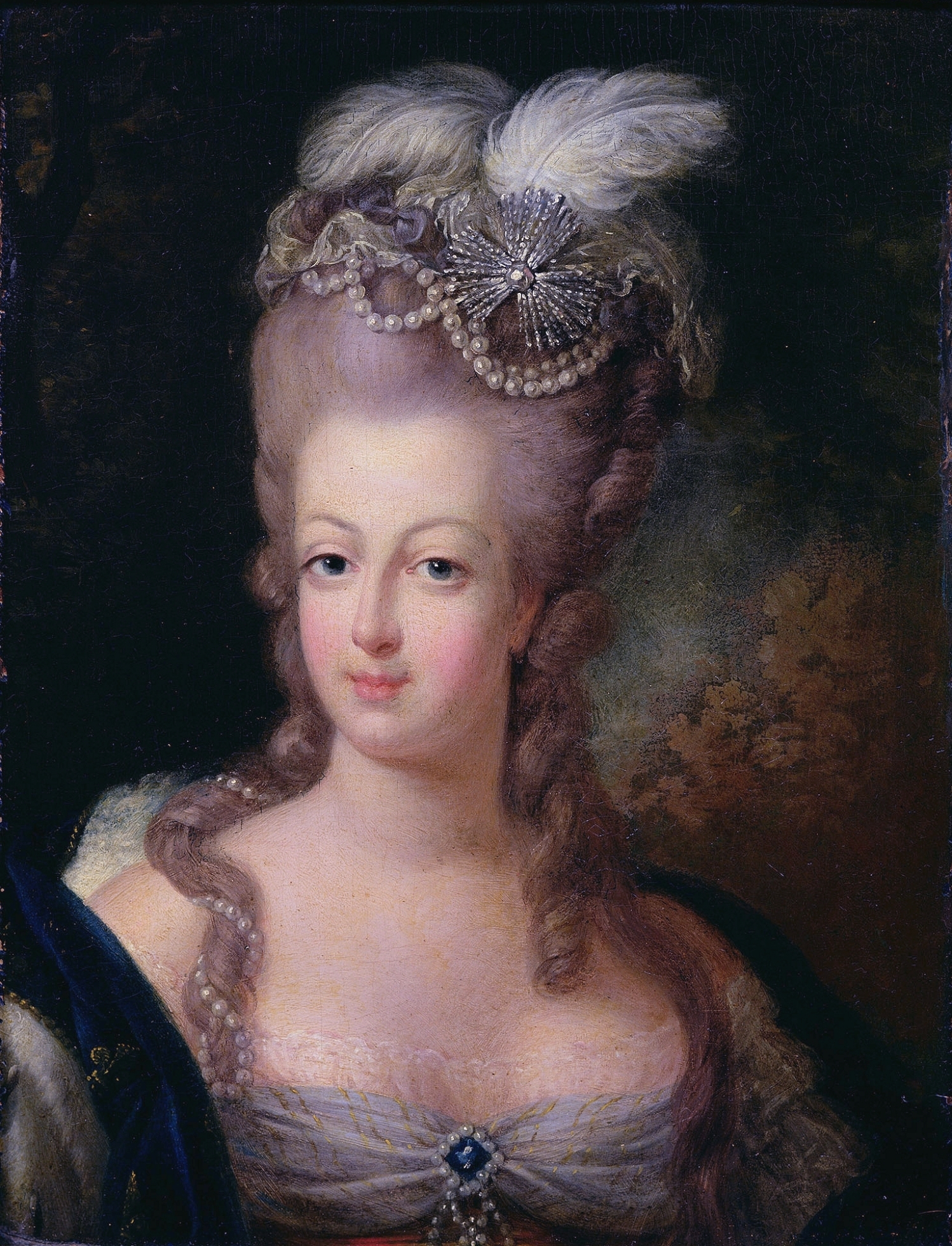
Queen Marie Antoinette of France, at age 16 depicted in a pastel portrait drawn in Versailles by Joseph Kranzinger and sent to her mother, Empress Maria Theresa, in Austria
Coat of arms of Marie Antoinette as Dauphine of France

Following the Seven Years' War and the Diplomatic Revolution of 1756, Maria Theresa decided to end hostilities with her longtime enemy, King Louis XV of France. Their common desire to destroy the ambitions of Prussia and Great Britain, and to secure a definitive peace between their respective countries led them to seal their alliance with a marriage: on 7 February 1770, Louis XV formally requested the hand of Maria Antonia for his eldest surviving grandson and heir, Louis Auguste, Duke of Berry and Dauphin of France.[6]

Maria Antonia formally renounced her rights to Habsburg domains, and on 19 April 1770 she was married by proxy with Louis Auguste at the Augustinian Church, Vienna, with her brother Archduke Ferdinand standing in for the dauphin.[21][22][6] On 14 May 1770 she met her husband at the edge of the forest of Compiègne. Upon her arrival in France, she adopted the French version of her name: Marie Antoinette. A ceremonial wedding took place on 16 May 1770 in the Palace of Versailles, and after the festivities the day ended with the ritual bedding.[23][24] The couple's longtime failure to consummate the marriage plagued the reputations of the royal couple for the next seven years.[25]

The initial reaction to the marriage was mixed. On the one hand, the dauphine was beautiful, personable and well-liked by the common people. Her first official appearance in Paris on 8 June 1773 was a resounding success. On the other hand, those opposed to the alliance with Austria had a difficult relationship with Marie Antoinette, as did others who disliked her for more personal or petty reasons.[26]

Madame du Barry proved a troublesome foe to the new dauphine. She was Louis XV's mistress and had considerable political influence over him. In 1770 she was instrumental in ousting Choiseul, who had helped orchestrate the Franco-Austrian Alliance and Marie Antoinette's marriage,[27] and in exiling his sister, the Duchess of Gramont, one of Marie Antoinette's ladies-in-waiting. Marie Antoinette was persuaded by her husband's aunts to refuse to acknowledge du Barry, which some saw as a political blunder that jeopardized Austria's interests at the French court. Maria Theresa and the Austrian ambassador to France, Comte de Mercy-Argenteau (who sent the empress secret reports on Marie Antoinette's behaviour) pressured Marie Antoinette to speak to du Barry, which she grudgingly agreed to do on New Year's Day 1772.[28] She merely commented to her, "There are a lot of people at Versailles today", but it was enough for du Barry, who was satisfied with this recognition, and the crisis passed.[29]

Two days after the death of Louis XV in 1774, Louis XVI exiled du Barry to the Abbaye du Pont-aux-Dames in Meaux, pleasing both Marie Antoinette and his aunts.[30][31][32][33][34] Two and a half years later, at the end of October 1776, du Barry's exile ended and she was allowed to return to her beloved château at Louveciennes, but she was never permitted to return to Versailles.[35]

Queen of France and Navarre (1774–1792)

[edit]
Marie Antoinette by Joseph Hickel c. 1773

Early years (1774–1778)

[edit]

On 10 May 1774, upon the death of Louis XV, the dauphin ascended the throne as King Louis XVI of France and Navarre with Marie Antoinette as his queen consort. At the outset, the new queen had limited political influence with her husband, who, with the support of his two most important ministers, Chief Minister Maurepas and Foreign Minister Vergennes, blocked several of her candidates from assuming important positions, including Choiseul.[36] The queen did play a decisive role in the disgrace and exile of the most powerful of Louis XV's ministers, the Duc d'Aiguillon.[37]

On 24 May 1774, two weeks after the death of Louis XV, the king gave his wife the Petit Trianon, a small château on the grounds of Versailles that had been built by Louis XV for Madame de Pompadour. Louis XVI allowed Marie Antoinette to renovate it to suit her own tastes; soon rumours circulated that she had plastered the walls with gold and diamonds.[38]

Queen Marie Antoinette wearing court grand habit by Jean-Baptiste André Gautier-Dagoty, c. 1775

The queen spent heavily on fashion, luxuries, and gambling, though the country was facing a grave financial crisis and the population was suffering. Rose Bertin created dresses for her, hairstyles such as poufs, up to three feet (90 cm) high, and the panachea spray of feather plumes. She and her court also adopted the English fashion of dresses made of indienne (a material banned in France from 1686 until 1759 to protect local French woolen and silk industries), percale and muslin.[39][40] As a result of all these fashion activities, Marie Antoinette presided over one of the most important and fashionable courts in history, and she was dominant over all of the other ladies of the court; as for her bearing and appearance the queen was very majestic and charismatic despite gaining much weight over the years with her many pregnancies.

The Flour War of 1775—a series of riots caused by the high prices of flour and bread—damaged her reputation among the general public. Eventually, Marie Antoinette's reputation was no better than that of previous kings. Many French people were beginning to blame her for the degrading economic situation, suggesting the country's inability to pay off its debt was the result of her wasting the crown's money.[41] In her correspondence, Maria Theresa expressed concern over her daughter's spending habits, citing the civil unrest it was beginning to cause.[42]

Coat of arms of Marie Antionette as Queen consort

As early as 1774, Marie Antoinette had begun to befriend some of her male admirers, such as the Baron de Besenval, the Duc de Coigny, and Count Valentin Esterházy,[43][44] and also formed deep friendships with various ladies at court. Most noted was Marie-Louise, Princesse de Lamballe, related to the royal family through her marriage into the Penthièvre family. On 19 September 1774, she appointed her superintendent of her household,[45][46] an appointment she soon transferred to her new favourite, the Duchess of Polignac. In 1774, she took under her the patronage of her former music teacher, the German opera composer Christoph Willibald Gluck, who remained in France until 1779.[47][48]

Motherhood, changes at court and intervention in politics (1778–1781)

[edit]

Amidst the atmosphere of a wave of libelles, the Holy Roman Emperor Joseph II came to France incognito, using the name Comte de Falkenstein, for a six-week visit during which he toured Paris extensively and was a guest at Versailles. He visited the king and queen (his sister) on 18 April 1777 at the Château de la Muette and spoke frankly to Louis, curious as to why the royal marriage had not been consummated, arriving at the conclusion that no obstacle to the couple's conjugal relations existed save the queen's lack of interest and the king's unwillingness to exert himself.[49]

In a letter to his brother Leopold, Grand Duke of Tuscany, Joseph II described them as "a couple of complete blunderers."[50] He disclosed to Leopold that the inexperienced Louis had confided in him the course of action he had been undertaking in their marital bed; saying Louis "introduces the member," but then "stays there without moving for about two minutes," withdraws without having completed the act and "bids goodnight."[51] Suggestions that Louis suffered from phimosis, which was relieved by circumcision, have been discredited.[52] Nevertheless, following Joseph's intervention, the marriage was finally consummated in August 1777.[53] Eight months later, in April 1778, it was suspected that the queen was pregnant, which was officially announced on 16 May.[54] Marie Antoinette's daughter, Marie-Thérèse Charlotte, Madame Royale, was born at Versailles on 19 December 1778.[9][55][56] The child's paternity was contested in the libelles, as were all her children's.[57][58]

In the middle of the queen's pregnancy, two events occurred which had a profound effect on her later life: the return of her friend, the Swedish diplomat Count Axel von Fersen the Younger[59] to Versailles for two years, and her brother's claim to the throne of Bavaria, contested by Saxony and Prussia.[60] Marie Antoinette pleaded with her husband for the French to intercede on behalf of Austria. The Peace of Teschen, signed on 13 May 1779, ended the brief conflict, with the queen imposing French mediation at her mother's insistence and Austria gaining the Innviertel territory of at least 100,000 inhabitants—a strong retreat from the early French position which was hostile towards Austria. This gave the impression, partially justified, that the queen had sided with Austria against France.[61][62]

Meanwhile, the queen began to institute changes in court customs. Some of them met with the disapproval of the older generation, such as the abandonment of heavy makeup and the popular wide-hooped panniers.[63] The new fashion called for a simpler feminine look, typified first by the rustic robe à la polonaise style and later by the gaulle, a layered muslin dress Marie Antoinette wore in a 1783 Vigée-Le Brun portrait.[64] In 1780 she began to participate in amateur plays and musicals in the Théâtre de la Reine built for her by Richard Mique.[65]

Marie Antoinette with a Rose, a 1783 portrait of Marie Antoinette that was criticised for showing what was described as improper and informal attire for a queen. In response to the criticism, it was repainted with the queen in a blue silk dress.[66]

Repayment of the French debt remained a difficult problem, further exacerbated by Vergennes and also by Marie Antoinette prodding[67] Louis to involve France in the American Revolutionary War. The primary motive for the queen's involvement in political affairs in this period may arguably have had more to do with court factionalism than any true interest on her part in politics,[68] but she played an important role in aiding the American Revolution by securing Austrian and Russian support for France, which resulted in the establishment of the First League of Armed Neutrality that stopped Britain's attack, and by weighing in decisively for the nomination of Philippe Henri, Marquis de Ségur, as Minister of War and Charles Eugène Gabriel de La Croix as Secretary of the Navy in 1780, who helped George Washington defeat the British in the American Revolutionary War, which ended in 1783.[69]

Marie Antoinette's second pregnancy ended in a miscarriage early in July 1779, as confirmed by letters between the queen and her mother, although some historians believed that she may have experienced bleeding related to an irregular menstrual cycle, which she mistook for a lost pregnancy.[70] Her third pregnancy was affirmed in March 1781, and on 22 October she gave birth to Louis Joseph Xavier François, Dauphin of France.[71]

Marie Antoinette depicted with her children, on the left the Dauphin, on the right Madame Royale, overlooked by a bust of Louis XVI, 1786, by Charles Le Clercq

Empress Maria Theresa died on 29 November 1780 in Vienna. Marie Antoinette feared that the death of her mother would jeopardise the Franco-Austrian alliance, as well as ultimately herself, but Joseph II wrote to her that he had no intention of breaking the alliance.[72] A second visit from Joseph II, which took place in July 1781 to reaffirm the Franco-Austrian alliance and also to see his sister, was tainted by false rumours[73] that Marie Antoinette was sending money to him from the French treasury.[74][75]

Declining popularity (1782–1785)

[edit]

Despite the general celebration over the birth of an heir, Marie Antoinette's political influence was perceived to greatly benefit Austria.[76] During the Kettle War in which Joseph II attempted to open the Scheldt river for naval passage, Marie Antoinette succeeded in obliging Vergennes to pay huge financial compensation to Austria. The queen was able to obtain her brother's support against Great Britain in the American Revolution, and she neutralized French hostility to his alliance with Russia.[77][78]

In 1782, after the governess of the royal children, the Princesse de Guéméné, went bankrupt and resigned, Marie Antoinette appointed her favourite, the Duchess of Polignac, to the position.[79] This decision met with disapproval from the court as the duchess was considered to be of too modest origins to occupy such an exalted position. In contrast, both the king and the queen trusted Madame de Polignac completely, gave her a 13-room apartment in Versailles and paid her well.[80] The entire Polignac family benefited greatly from royal favour in titles and positions, but its sudden wealth and lavish lifestyle outraged most aristocratic families, who resented the Polignacs' dominance at court and also fueled the increasing popular disapproval of Marie Antoinette, mostly in Paris.[81] Mercy-Argenteau wrote to the empress: "It is almost unexampled that in so short a time, the royal favour should have brought such overwhelming advantages to a family".[82]

In June 1783, Marie Antoinette's pregnancy was announced, but on the night of 1–2 November, her 28th birthday, she suffered a miscarriage.[83] In 1783 the queen played a decisive role in the nomination of Charles Alexandre de Calonne, a close friend of the Polignacs, as Controller-General of Finances, and of the Baron de Breteuil as the Minister of the Royal Household, making him perhaps the strongest and most conservative minister of the reign.[84] The result of these two nominations was that Marie Antoinette's influence became paramount in government, and the new ministers rejected any major change to the structure of the old regime. More than that, the decree by de Ségur, the minister of war, requiring four quarters of nobility as a condition for the appointment of officers, mainly served the interest of older noble families including poorer provincial ones, who were widely seen as a reactionary interest group by ambitious members of the middle and professional classes, by some more recent nobility, and even by the Parisian populace and press. The measure also blocked the access of 'commoners', mainly sons of members of the professional classes, and of more recently elevated nobility to important positions in the armed forces. As such, the decree became an important grievance for social classes that had been habitually supportive of the monarchy and established order, and which went on to supply the bulk of the early leadership of the French Revolution.[85][86]

Count Axel von Fersen, after his return from America in June 1783, was accepted into the queen's private society. There were claims that the two were romantically involved,[87] but since most of their correspondence has been lost, destroyed, or redacted, for many years there was no conclusive evidence.[88] Starting in 2016, scientists at the Centre for Research and Restoration of Museums of France uncovered some of the redacted text of the queen's letters to Fersen.[89] The revealed texts do not mention a physical relationship but do confirm a very strong emotional relationship.[90]

Around this time, pamphlets describing farcical sexual deviance including the queen and her friends in the court were growing in popularity around the country. The Portefeuille d'un talon rouge was one of the earliest, including the queen and a variety of other nobles in a political statement decrying the immoral practices of the court. As time went on, these came to focus more on the queen. They described amorous encounters with a wide range of figures, from the Duchess of Polignac to Louis XV. As these attacks increased, they were connected with the public's dislike of her association with the rival nation of Austria. It was publicly suggested that her supposed behaviour was learned at the Austrian court, particularly lesbianism, which was known as the "German vice".[91]

In 1783, the queen was busy with the creation of her "hamlet", a rustic retreat built by her favoured architect Richard Mique, according to the designs of the painter Hubert Robert.[92] Its creation caused another uproar when its cost became widely known.[93][94] However, the hamlet was not an eccentricity of Marie Antoinette's. It was en vogue at the time for nobles to have recreations of small villages on their properties. In fact, the design was copied from that of Louis Joseph, Prince of Condé. It was also significantly smaller and less intricate than many other nobles'.[95] Around this time she accumulated a library of 5,000 books. Those on music, often dedicated to her, were the most read, though she also liked to read history.[96][97] She sponsored the arts, in particular music. Marie Antoinette preferred to hold her musicales in the salon of her Petit appartement de la reine in the Palace of Versailles or in the Théâtre de la Reine. She limited the audience to her intimate circle and a few musicians, among them the Chevalier de Saint-Georges. "Admitted to perform music with the Queen,"[98] Saint-Georges probably played his violin sonatas for two instruments, with Her Majesty playing the fortepiano. She also supported some scientific endeavours, encouraging and witnessing the first launch of a Montgolfière hot air balloon; this extraordinary feat which represented a turning point in human civilization was done by Jean-François Pilâtre de Rozier.[99]

On 27 April 1784, Pierre Beaumarchais's play The Marriage of Figaro premiered in Paris. Initially banned by the king because of its negative portrayal of the nobility, the play was finally allowed to be publicly performed because of the queen's support and its overwhelming popularity at court, where secret readings of it had been given by Marie Antoinette. The play was a disaster for the image of the monarchy and aristocracy. It inspired Mozart's The Marriage of Figaro, which premiered in Vienna on 1 May 1786.[100]

1784 portrait of Marie Antoinette with her two eldest children, Marie-Thérèse Charlotte and the Dauphin Louis Joseph, in the garden of Petit Trianon, by Adolf Ulrik Wertmüller

On 24 October 1784, putting the Baron de Breteuil in charge of its acquisition, Louis XVI bought the Château de Saint-Cloud from Louis Philippe I, Duke of Orléans in the name of his wife, which she wanted because of their expanding family. She wanted to be able to own her own property, one that was actually hers, to then have the authority to bequeath it to "whichever of my children I wish,"[101] choosing the child she thought could use it rather than it going through patriarchal inheritance laws or whims. It was proposed that the cost could be covered by other sales, such as that of the château Trompette in Bordeaux.[102] This was unpopular, particularly with those factions of the nobility who disliked the queen but also with a growing percentage of the population who disapproved of a queen of France independently owning a private residence. The purchase of Saint-Cloud thus damaged the public's image of the queen even further. The château's high price, almost 6 million livres, plus the substantial extra cost of redecorating, ensured that much less money was going towards repaying France's substantial debt.[103][104]

On 27 March 1785, Marie Antoinette gave birth to a second son, Louis Charles, who bore the title of Duke of Normandy.[105] The fact that the birth occurred exactly nine months after Fersen's return did not escape the attention of many, leading to doubt as to the parentage of the child and to a noticeable decline of the queen's reputation in public opinion.[106] The majority of Marie Antoinette's and Louis Charles' biographers believe that he was the biological son of Louis XVI, including Stefan Zweig and Antonia Fraser.[107][108][109][110][111][112][113][114] Fraser has noted that the birthdate matches up with a known conjugal visit from the king.[101] Courtiers at Versailles noted in their diaries that the date of conception corresponded with a period when the king and queen had spent much time together, but these details were ignored amid attacks on the queen's character.[115] These suspicions of illegitimacy further turned popular opinion sharply against the queen, and the image of a licentious, spendthrift, empty-headed foreign queen was quickly taking root in the French psyche.[116]

A second daughter, her last child, Marie Sophie Hélène Béatrix, Madame Sophie, was born on 9 July 1786 and lived only eleven months until 19 June 1787. She was named after the king's aunt, Princess Sophie of France.[117]

Prelude to the Revolution: scandals and the failure of reforms (1786–1789)

[edit]

Affair of the Diamond Necklace

[edit]
A reconstruction of the diamond necklace in the Château de Breteuil, in France

Marie Antoinette began to abandon her more carefree activities to become increasingly involved in politics in her role as queen of France.[118] By publicly showing her attention to the education and care of her children, the queen sought to improve the dissolute image she had acquired in 1785 from the "Affair of the Diamond Necklace", in which public opinion had falsely accused her of criminal participation in defrauding jewelers of the price of an expensive diamond necklace they had originally created for Madame du Barry.

The main actors in the scandal were Cardinal de Rohan, Prince de Rohan-Guéméné, and Jeanne de Valois-Saint-Rémy, Comtesse de la Motte. Marie Antoinette had profoundly disliked Rohan since the time he had been the French ambassador to Vienna when she was a child. Despite his high clerical position at the Court, she never addressed a word to him. Others involved were Nicole Lequay, alias Baronne d'Oliva, a prostitute who happened to look like Marie Antoinette; Rétaux de Villette, a forger; Alessandro Cagliostro, an Italian adventurer; and the Count de La Motte, Jeanne de Valois' husband. Madame de La Motte tricked Rohan into buying the necklace as a gift to Marie Antoinette, for him to gain the queen's favour.

When the affair was discovered, those involved were arrested, tried, convicted, and either imprisoned or exiled—except Count de La Motte and Rétaux de Villette, who both managed to flee. Madame de La Motte was sentenced for life to confinement in the Pitié-Salpêtrière Hospital, which also served as a prison for women. Judged by the Parlement of Paris, Rohan was found not guilty and allowed to leave the Bastille. Marie Antoinette, who had insisted on the arrest of the cardinal, was dealt a heavy personal blow, as was the monarchy, and despite the fact that the guilty parties were tried and convicted, the affair proved to be extremely damaging to her reputation, which never recovered from it.[citation needed]

Failure of political and financial reforms

[edit]

Suffering from an acute case of depression, the king began to seek the advice of his wife. In her new role and with increasing political power, the queen tried to improve the awkward situation brewing between the Parlement and the king.[119] This change of the queen's position signaled the end of the Polignacs' influence and their impact on the finances of the Crown.

Continuing deterioration of the financial situation despite cutbacks to the royal retinue and court expenses ultimately forced the king, the queen and the Controller-General of Finances Charles Alexandre de Calonne—at the urging of Vergennes—to call a session of the Assembly of Notables after a hiatus of 160 years. The Assembly was held for the purpose of initiating necessary financial reforms, but the Assembly refused to cooperate. The first meeting took place on 22 February 1787, nine days after the death of Vergennes on 13 February. Marie Antoinette did not attend the meeting, and her absence resulted in accusations that the queen was trying to undermine its purpose.[120][121] The Assembly was a failure; it did not pass any reforms and instead fell into a pattern of defying the king. On the urging of the queen, Louis dismissed Calonne on 8 April.[119]

On 1 May Étienne Charles de Loménie de Brienne, Archbishop of Toulouse and one of the queen's political allies, was appointed by the king at her urging to replace Calonne, first as controller-general of finances and then as chief minister. He began to institute more cutbacks at court while trying to restore the royal absolute power weakened by the Parlement.[122] Brienne was unable to improve the financial situation, and since he was the queen's ally, this failure adversely affected her political position. The continued poor financial climate of the country resulted in the 25 May dissolution of the Assembly of Notables because of its inability to function, and the lack of solutions was blamed on the queen.[85]

France's financial problems were the result of a combination of factors: several expensive wars; a large royal family whose expenditures were paid for by the state; and an unwillingness on the part of most members of the privileged classes, aristocracy, and clergy, to help defray the costs of the government out of their own pockets by relinquishing some of their financial privileges. As a result of the public perception that she had single-handedly ruined the national finances, Marie Antoinette was given the nickname of "Madame Déficit" in the summer of 1787.[123] While the sole fault for the financial crisis did not lie with her, Marie Antoinette was the biggest obstacle to any major reform effort. She had played a decisive role in the disgrace of the reformer ministers of finance, Anne-Robert-Jacques Turgot (in 1776), and Jacques Necker (first dismissal in 1781). If the secret expenses of the queen were taken into account, court expenses were much higher than the official estimate of 7% of the state budget.[124]

This state portrait (Marie Antoinette and Her Children) of Marie Antoinette and her three surviving children, Marie Thérèse, Louis Charles (on her lap) and Louis Joseph holding up the drape of an empty bassinet signifying the recent death of Marie's fourth child Sophie was meant to improve her reputation by depicting her as a mother in simple, yet stately attire, by Élisabeth Vigée Le Brun, 1787.

The queen attempted to fight back with propaganda portraying her as a caring mother, most notably in the painting by Élisabeth Vigée Le Brun exhibited at the Royal Académie Salon de Paris in August 1787, showing her with her children.[125][126] Around the same time, Jeanne de Valois-Saint-Rémy escaped from prison and fled to London where she published damaging slander concerning her supposed amorous affair with the queen.[127]

The political situation in 1787 worsened when, at Marie Antoinette's urging, the Parlement of Paris was exiled to Troyes on 15 August. It further deteriorated when Louis tried to use a lit de justice on 11 November to impose legislation. The new Duke of Orléans publicly protested the king's actions and was subsequently exiled to his Château de Villers-Cotterêts.[128] The May Edicts issued on 8 May 1788 were also opposed by the public and parlement. On 8 August Louis announced his intention to bring back the Estates General, the traditional elected legislature of the country, which had not been convened since 1614.[129]

While from late 1787 up to his death in June 1789, Marie Antoinette's primary concern was the continued deterioration of the health of Louis Joseph, who suffered from tuberculosis,[130] she was directly involved in the exile of the Parlement, the May Edicts, and the announcement regarding the Estates General. She participated in the King Council, the first queen to do so in over 175 years (since Marie de' Medici had been named Chef du Conseil du Roi, between 1614 and 1617), and she was making the major decisions behind the scene and in the Royal Council.

Marie Antoinette was instrumental in the reinstatement of Necker as finance minister on 26 August 1788, a popular move, even though she herself was worried that it would go against her if Necker proved unsuccessful in reforming the country's finances. She accepted Necker's proposition to double the representation of the Third Estate (tiers état) in an attempt to check the power of the aristocracy.[131][132]

On the eve of the opening of the Estates General the queen attended the mass celebrating its return. As soon as it opened on 5 May 1789, the fracture between the democratic Third Estate (consisting of bourgeois and radical aristocrats) and the conservative nobility of the Second Estate widened, and Marie Antoinette knew that her rival, the Duke of Orléans, who had given money and bread to the people during the winter, would be acclaimed by the crowd, much to her detriment.[133]

The death of Louis Joseph on 4 June, which deeply affected his parents, was virtually ignored by the French people[134] who were instead preparing for the next meeting of the Estates General and hoping for a resolution to the bread crisis. As the Third Estate declared itself a National Assembly, and as people either spread or believed rumours that the queen wished to bathe in their blood, Marie Antoinette went into mourning for her eldest son.[135] Her role was decisive in urging the king to remain firm and not concede to popular demands for reforms. In addition, she showed her determination to use force to crush the forthcoming revolution.[136][137]

French Revolution before Varennes (1789–1791)

[edit]

The situation escalated on 20 June as the Third Estate, which had been joined by several members of the clergy and radical nobility, found the door to its appointed meeting place closed by order of the king.[138] It thus met at the tennis court in Versailles and took the Tennis Court Oath not to separate before it had given a constitution to the nation. On 11 July at Marie Antoinette's urging, Necker was dismissed and replaced by Breteuil, the queen's choice to crush the revolution with mercenary Swiss troops under the command of one of her favourites, Pierre Victor, Baron de Besenval de Brünstatt.[139][140] At the news, Paris was besieged by riots that culminated in the storming of the Bastille on 14 July.[141][142] On 15 July Gilbert du Motier, Marquis de Lafayette was named commander-in-chief of the newly formed National Guard.[143][144]

The Storming of the Bastille in Paris, and the arrest of its Governor Bernard-René de Launay, 14 July 1789

In the days following the storming of the Bastille, for fear of assassination and ordered by the king, the emigration of members of the high aristocracy began on 17 July with the departure of the Count of Artois, the Condés, cousins of the King,[145] and the unpopular Polignacs. Marie Antoinette, whose life was as much in danger, remained with the king, whose power was gradually being taken away by the National Constituent Assembly.[143][146][144]

The abolition of feudal privileges by the National Constituent Assembly on 4 August 1789 and the Declaration of the Rights of Man and of the Citizen (La Déclaration des Droits de l'Homme et du Citoyen), drafted by Lafayette with the help of Thomas Jefferson and adopted on 26 August, paved the way to a Constitutional Monarchy (4 September 1791 – 21 September 1792).[147][148] Despite these dramatic changes, life at the court continued, while the situation in Paris was becoming critical because of bread shortages in September. On 5 October a crowd from Paris descended upon Versailles and forced the royal family to move to the Tuileries Palace in Paris, where they lived under a form of house arrest under the watch of Lafayette's National Guard, while the Count of Provence and his wife were allowed to reside in the Petit Luxembourg, where they remained until they went into exile on 20 June 1791.[149]

Marie Antoinette continued to perform charitable functions and attend religious ceremonies, but she dedicated most of her time to her children.[150] She also played an important political, albeit not public, role between 1789 and 1791 when she had a complex set of relationships with several key actors of the early period of the French Revolution. One of the most important was Prime Minister of Finances Necker.[151] She blamed him for his support of the revolution and did not regret his resignation in 1790.[152][153]

Lafayette served as the warden of the royal family. Despite his dislike of the queen—he detested her as much as she detested him and at one time had even threatened to send her to a convent—he was persuaded by Mayor of Paris Jean Sylvain Bailly to work and collaborate with her, and allowed her to see Fersen a number of times. He even went as far as exiling the Duke of Orléans, who was accused by the queen of fomenting trouble. His relationship with the king was more cordial. As a liberal aristocrat, he did not want the fall of the monarchy but rather the establishment of a liberal one, similar to that of Great Britain, based on cooperation between the king and the people, as was to be defined in the Constitution of 1791. Despite her attempts to remain out of the public eye, Marie Antoinette was falsely accused in the libelles of having an affair with Lafayette.[154] Publication of such calumnies continued to the end, climaxing at her trial with an accusation of incest with her son. There is no evidence to support the accusations.

Mirabeau

[edit]

A significant achievement of Marie Antoinette in that period was the establishment of an alliance with Honoré Gabriel Riqueti, Comte de Mirabeau, the most important lawmaker in the assembly. Like Lafayette, Mirabeau was a liberal aristocrat. He had joined the Third Estate and was not against the monarchy but wanted to reconcile it with the revolution. He also wanted to be a minister and was not immune to corruption. On the advice of Mercy, Marie Antoinette opened secret negotiations with him and both agreed to meet privately at the Château de Saint-Cloud on 3 July 1790, where the royal family was allowed to spend the summer, free of the radical elements who watched their every move in Paris.[155] At the meeting, Mirabeau was much impressed by the queen and remarked in a letter to Auguste Marie Raymond d'Arenberg, Comte de la Marck, that she was the only person the king had by him: La Reine est le seul homme que le Roi ait auprès de Lui.[156] An agreement was reached turning Mirabeau into one of her political allies: Marie Antoinette promised to pay him 6000 livres per month and one million livres if he succeeded in his mission to restore the king's authority.[157]

The only time the royal couple returned to Paris in that period was on 14 July to attend the Fête de la Fédération, an official ceremony held at the Champ de Mars in commemoration of the fall of the Bastille one year earlier. At least 300,000 persons participated from all over France, including 18,000 National Guards, with Talleyrand, bishop of Autun, celebrating a mass at the autel de la Patrie ("altar of the fatherland"). The king was greeted at the event with loud cheers of "Long live the King!", especially when he took the oath to protect the nation and to enforce the laws voted by the Constitutional Assembly. There were even cheers for the queen, particularly when she presented Louis Joseph to the public.[158]

Mirabeau sincerely wanted to reconcile the queen with the people, and she was happy to see him restoring much of the king's powers, such as his authority over foreign policy and the right to declare war. Over the objections of Lafayette and his allies, the king was given a suspensive veto allowing him to veto any laws for a period of four years. With time, Mirabeau would support the queen, even more, going as far as to suggest that Louis XVI "adjourn" to Rouen or Compiègne.[159] This leverage with the Assembly ended with the death of Mirabeau in April 1791, despite the attempt of several moderate leaders of the revolution to contact the queen to establish some basis of cooperation with her.

Civil Constitution of the Clergy

[edit]

In March 1791 Pope Pius VI had condemned the Civil Constitution of the Clergy, reluctantly signed by Louis XVI, which reduced the number of bishops from 132 to 93, imposed the election of bishops and all members of the clergy by departmental or district assemblies of electors, and reduced the pope's authority over the Church. Religion played important roles in the lives of Marie Antoinette and Louis XVI, both raised in the Roman Catholic faith. The queen's political ideas and her belief in the absolute power of monarchs were based on France's long-established tradition of the divine right of kings.[160]

On 18 April, as the royal family prepared to leave for Saint-Cloud to attend Easter mass celebrated by a refractory priest, a crowd, soon joined by the National Guard (disobeying Lafayette's orders), prevented their departure from Paris, prompting Marie Antoinette to declare to Lafayette that she and her family were no longer free. This incident fortified her in her determination to leave Paris for personal and political reasons, not alone, but with her family. Even the king, who had been hesitant, accepted his wife's decision to flee with the help of foreign powers and counter-revolutionary forces.[161] Fersen and Breteuil, who represented her in the courts of Europe, were put in charge of the escape plan while Marie Antoinette continued her negotiations with some of the moderate leaders of the French Revolution.[162]

Flight, arrest at Varennes and return to Paris (21–25 June 1791)

[edit]
Arrest of the royal family at the house of the registrar of passports at Varennes on the night of 21–22 June 1791, by Thomas Falcon Marshall, 1854

There had been several plots designed to help the royal family escape, which the queen had rejected because she would not leave without the king, or which had ceased to be viable because of the king's indecision. Once Louis finally did commit to a plan, its poor execution was the cause of its failure. In an elaborate attempt known as the Flight to Varennes to reach the royalist stronghold of Montmédy, some members of the royal family were to pose as the servants of an imaginary "Madame de Korff", a wealthy Russian baroness, a role played by Louise-Élisabeth de Croÿ de Tourzel, governess of the royal children.

After many delays, the escape was ultimately attempted on 21 June 1791, but the entire family was arrested less than 24 hours later at Varennes and taken back to Paris within a week. The escape attempt destroyed much of the remaining support of the population for the king.[163][164] Upon learning of the capture of the royal family, the National Constituent Assembly sent three representatives—Antoine Barnave, Jérôme Pétion de Villeneuve and Charles César de Fay de La Tour-Maubourg—to Varennes to escort Marie Antoinette and her family back to Paris. On the way to the capital they were jeered and insulted by the people. During the trip Barnave, the representative of the moderate party in the Assembly, protected Marie Antoinette from the crowds, and even Pétion took pity on the royal family. Brought safely back to Paris, they were met with silence by the crowd. Thanks to Barnave, the royal couple was not brought to trial and was publicly exonerated of any crime in relation with the attempted escape.[165]

Marie Antoinette's first Lady of the Bedchamber, Jeanne-Louise-Henriette Campan, wrote about what happened to the queen's hair on the night of 21–22 June, "...in a single night, it had turned white as that of a seventy-year-old woman." (En une seule nuit ils étaient devenus blancs comme ceux d'une femme de soixante-dix ans.)[166]

Radicalization of the Revolution after Varennes (1791–1792)

[edit]
Marie-Antoinette, c. 1792. Unfinished portrait by Alexander Kucharsky, damaged with a pike by a revolutionary.

After their return from Varennes the queen, her family and entourage were held under tight surveillance by the National Guard in the Tuileries, where the royal couple was guarded night and day. Four guards accompanied the queen wherever she went, and her bedroom door had to be left open at night. Her health also began to deteriorate, thus further reducing her physical activities.[167][168]

On 17 July 1791, with the support of Barnave and his friends, Lafayette's Garde Nationale opened fire on the crowd that had assembled on the Champ de Mars to sign a petition demanding the deposition of the king. The estimated number of those killed varies between 12 and 50. Lafayette's reputation never recovered from the event and, on 8 October he resigned as commander of the National Guard. Their enmity continuing, Marie Antoinette played a decisive role in defeating him in his aims to become the mayor of Paris in November 1791.[169]

As her correspondence shows, while Barnave was taking great political risks in the belief that the queen was his political ally and had managed, despite her unpopularity, to secure a moderate majority ready to work with her, Marie Antoinette was not considered sincere in her cooperation with the moderate leaders of the French Revolution, which ultimately ended any chance to establish a moderate government.[170] Moreover, the view that the unpopular queen was controlling the king further degraded the royal couple's standing with the people, which the Jacobins successfully exploited after their return from Varennes to advance their radical agenda to abolish the monarchy.[171] This situation lasted until the spring of 1792.[172]

Marie Antoinette continued to hope that the military coalition of European kingdoms would succeed in crushing the revolution. She counted most on the support of her Austrian family. After the death of Joseph II in 1790, his successor and younger brother Leopold II[173] was willing to support her to a limited degree.[174] It was her hope that the threat of Austria's advancing military would deter further escalation of revolutionary violence. In a letter to her brother, penned in September 1791, Marie Antoinette expressed how she expected the revolution to react: "...it will be effected by the approach of the war and not by the war itself. The King, his powers restored, will be entrusted with negotiations with the foreign powers, and the princes will return, in the general tranquillity, to reassume their ranks at his court and in the nation."[175] In the same letter, she wrote that the fall of France's monarchy and the subsequent rise of revolutionary principles would be "destructive to all governments."

Upon Leopold's death in 1792, his son Francis, a conservative ruler, was ready to support the cause of the French royal couple more vigorously because he feared the consequences of the French Revolution and its ideas for the monarchies of Europe, particularly for Austria's influence in the continent.[citation needed] Barnave had advised the queen to call back Mercy-Argenteau, who had played such an important role in her life before the revolution, but Mercy-Argenteau had been appointed governor-general of the Austrian Netherlands and could not return to France. At the end of 1791, ignoring the danger she faced, the Princesse de Lamballe, who was in London, returned to the Tuileries. As for Fersen, despite the strong restrictions imposed on the queen, he was able to see her a final time in February 1792.[176]

Events leading to the abolition of the monarchy on 10 August 1792

[edit]

Leopold's and Francis II's strong action on behalf of Marie Antoinette led to France's declaration of war on Austria on 20 April 1792. This resulted in the queen being viewed as an enemy, although she was personally against Austrian claims to French territories on European soil. That summer, the situation was compounded by multiple defeats of the French Revolutionary Army by the Austrians, in part because Marie Antoinette passed on military secrets to them.[177] In addition, at the insistence of Marie Antoinette, Louis vetoed several measures that would have further restricted his power, earning the royal couple the nicknames "Monsieur Veto" and "Madame Veto",[177][178] nicknames then prominently featured in different contexts, including La Carmagnole.

Barnave remained the most important advisor and supporter of the queen, who was willing to work with him as long as he met her demands, which he did to a large extent. Barnave and the moderates comprised about 260 lawmakers in the new Legislative Assembly; the radicals numbered around 136, and the rest around 350. Initially, the majority was with Barnave, but the queen's policies led to the radicalization of the Assembly, and the moderates lost control of the legislative process. The moderate government collapsed in April 1792 to be replaced by a radical majority headed by the Girondins. The Assembly then passed a series of laws concerning the Church, the aristocracy and the formation of new National Guard units; all were vetoed by Louis XVI. While Barnave's faction had dropped to 120 members, the new Girondin majority controlled the legislative assembly with 330 members. The two strongest members of that government were Jean Marie Roland, who was minister of interior, and General Charles François Dumouriez, the minister of foreign affairs. Dumouriez sympathized with the royal couple and wanted to save them but was rebuffed by the queen.[179]

Marie Antoinette's actions in refusing to collaborate with the Girondins, in power between April and June 1792, led them to denounce the treason of the Austrian comity, a direct allusion to the Queen. After Madame Roland sent a letter to the king denouncing the queen's role in these matters, urged by the queen, Louis disbanded[citation needed] the government, thus losing his majority in the Assembly. Dumouriez resigned and refused a post in any new government. At this point, the tide against royal authority intensified in the population and political parties, while Marie Antoinette encouraged the king to veto the new laws voted by the Legislative Assembly in 1792.[180] In August 1791, the Declaration of Pillnitz threatened an invasion of France. This led in turn to a French declaration of war in April 1792, which led to the French Revolutionary Wars and to the events of August 1792, which ended the monarchy.[181]

Marie Antoinette with her children and her sister-in-law Madame Élisabeth, facing the mob that had broken into the Tuileries Palace on 20 June 1792: Musée de la Révolution française

On 20 June 1792, "a mob of terrifying aspect" broke into the Tuileries, made the king wear the bonnet rouge (red Phrygian cap) to show his loyalty to the revolution, insulted Marie Antoinette, accusing her of betraying France, and threatened her life. In consequence, the queen asked Fersen to urge the foreign powers to carry out their plans to invade France and to issue a manifesto in which they threatened to destroy Paris if anything happened to the royal family. The Brunswick Manifesto, issued on 25 July 1792, triggered the Insurrection of 10 August[182] when the approach of an armed mob on its way to the Tuileries Palace forced the royal family to seek refuge at the Legislative Assembly. Ninety minutes later, the palace was invaded by the mob, who massacred the Swiss Guards.[183] On 13 August the royal family was imprisoned in the tower of the Temple in the Marais under conditions considerably harsher than those of their previous confinement in the Tuileries.[184]

A week later, several of the royal family's attendants, among them the Princesse de Lamballe, were taken for interrogation by the Paris Commune. Transferred to La Force Prison, after a rapid judgment, de Lamballe was savagely killed on 3 September. Her head was affixed on a pike and paraded through the city to the Temple for the queen to see. Marie Antoinette was prevented from seeing it but fainted upon learning of it.[185]

On 21 September 1792, France was declared a republic, the monarchy was abolished and the National Convention became the governing body of the French First Republic. The royal family name was downgraded to the non-royal "Capets". Preparations began for the trial of the former king in a court of law.[186]

Louis XVI's trial and execution

[edit]

Charged with treason against the French Republic, Louis XVI was separated from his family and tried in December. He was found guilty by the Convention, led by the Jacobins who rejected the idea of keeping him as a hostage. On 15 January 1793, by a majority of six votes, he was condemned to death by guillotine and executed on 21 January 1793.[187]

Imprisonment

[edit]

The former queen, now called "Widow Capet", plunged into deep mourning. She still hoped her son Louis-Charles, whom the exiled Count of Provence, Louis XVI's brother, had recognized as Louis XVI's successor, would one day rule France. The royalists and the refractory clergy, including those preparing the insurrection in Vendée, supported Marie Antoinette and the return to the monarchy. Throughout her imprisonment and up to her execution, Marie Antoinette could count on the sympathy of conservative factions and social-religious groups which had turned against the revolution, and also on wealthy individuals ready to bribe republican officials to facilitate her escape.[188] These plots all failed. While imprisoned in the Tower of the Temple, Marie Antoinette, her children and Élisabeth were insulted, some of the guards going as far as blowing smoke in her face. Strict security measures were taken to assure that she was not able to communicate with the outside world. Despite these measures, several of her guards were open to bribery, and a line of communication was kept with the outside world.[189]

After Louis's execution, Marie Antoinette's fate became a central question of the National Convention. While some advocated her death, others proposed exchanging her for French prisoners of war or for a ransom from the Holy Roman Emperor. Thomas Paine advocated exile to America.[190] In April 1793, during the Reign of Terror, a Committee of Public Safety, dominated by Maximilien Robespierre, was formed, and men such as Jacques Hébert began to call for Marie Antoinette's trial. By the end of May, the Girondins had been chased from power.[191] Calls were also made to "retrain" the eight-year-old Louis XVII, to make him pliant to revolutionary ideas. To carry this out, Louis Charles was separated from his mother on 3 July after a struggle during which his mother fought in vain to retain her son, who was handed over to Antoine Simon, a cobbler and representative of the Paris Commune. Until her removal from the Temple, she spent hours trying to catch a glimpse of her son, who within weeks had been made to turn against her, accusing his mother of wrongdoing.[192]

Conciergerie

[edit]

At 1 a.m. on 1 August, she was transferred from the Temple to an isolated cell in the Conciergerie as 'Prisoner nº 280'. Leaving the Tower she bumped her head against the lintel of a door, which prompted one of her guards to ask her if she was hurt, to which she answered, "No! Nothing now can hurt me."[193] This was the most difficult period of her captivity. She was under constant surveillance with no privacy. The "Carnation Plot" (Le complot de l'œillet), an attempt to help her escape at the end of August, was foiled due to the inability to corrupt all the guards.[194] She was attended by Rosalie Lamorlière, who took care of her as much as she could.[195] At least once she received a visit by a Catholic priest.[196][197]

Trial and execution (14–16 October 1793)

[edit]
Marie Antoinette on her way to the guillotine. Pen and ink by Jacques-Louis David, 16 October 1793
Marie Antoinette's execution by guillotine on 16 October 1793: at left, Sanson, the executioner, showing Marie Antoinette's head to the people. Anonymous, 1793

Marie Antoinette was tried by the Revolutionary Tribunal on 14 October 1793. Some historians believe the outcome of the trial had been decided in advance by the Committee of Public Safety around the time the Carnation Plot was uncovered.[198] She and her lawyers were given less than one day to prepare her defense. Among the accusations, many previously published in the libelles, were: orchestrating orgies in Versailles, sending millions of livres of treasury money to Austria, planning the massacre of the National Guards in 1792,[199] declaring her son to be the new king of France, and incest—a charge made by her son Louis-Charles, pressured into doing so by the radical Jacques Hébert who controlled him.

This last accusation drew an emotional response from Marie Antoinette, who refused to respond to this charge, instead appealing to all mothers present in the room. Their reaction comforted her since these women were not otherwise sympathetic to her.[200] Upon being pressed further by a juror to address the accusations of incest, the queen replied, "If I did not respond, it was because it would be against nature for a mother to reply to such an accusation. On this I appeal to all mothers who may be here." When a juror, Joachim Vilate, told Robespierre of this over dinner, Robespierre broke his plate in anger, declaring "That imbecile Hébert!"[201]

Early on 16 October, Marie Antoinette was declared guilty of the three main charges against her: depletion of the national treasury, conspiracy against the internal and external security of the state, and high treason because of her intelligence activities in the interest of the enemy; the latter charge alone was enough to condemn her to death.[202] At worst, she and her lawyers had expected life imprisonment.[203] In the hours left to her, she composed a letter to her sister-in-law Madame Élisabeth, affirming her clear conscience, her Catholic faith, and her love and concern for her children. The letter did not reach Élisabeth.[204] Her will was part of the collection of papers of Robespierre found under his bed and was published by Edme-Bonaventure Courtois.[205][206]

Preparing for her execution, she had to change clothes in front of her guards. She wanted to wear a black dress but was forced to wear a plain white dress, white being the colour worn by widowed queens of France. Her hair was shorn, her hands bound painfully behind her back and she was put on a rope leash. Unlike her husband, who had been taken to his execution in a carriage (carrosse), she had to sit in an open cart (charrette) for the hour it took to convey her from the Conciergerie via the rue Saint-Honoré thoroughfare to reach the guillotine erected in the Place de la Révolution, the present-day Place de la Concorde.[207] She maintained her composure, despite the insults of the jeering crowd. A constitutional priest was assigned to hear her final confession. He sat by her in the cart, but she ignored him all the way to the scaffold as he had pledged his allegiance to the republic.[208]

Marie Antoinette was executed by beheading by guillotine at 12:15 pm on 16 October.[209][210] Her last words are recorded as, "Pardonnez-moi, monsieur. Je ne l'ai pas fait exprès" or "Pardon me, sir, I did not do it on purpose", after accidentally stepping on her executioner's shoe.[211] Marie Tussaud was employed to make a death mask of her head.[212] Her body was thrown into an unmarked grave in the Madeleine cemetery, located close by in rue d'Anjou. Because its capacity was exhausted, the cemetery was closed the following year, on 25 March 1794.[213]

Foreign response

[edit]

After her execution, Marie Antoinette became a symbol abroad and a controversial figure of the French Revolution. Some used her as a scapegoat to blame for the events of the revolution. Thomas Jefferson, writing in 1821, claimed that "Her inordinate gambling and dissipations, with those of the Count d'Artois, and others of her clique, had been a sensible item in the exhaustion of the treasury, which called into action the reforming hand of the nation; and her opposition to it, her inflexible perverseness, and dauntless spirit, led herself to the Guillotine," adding "I have ever believed that, had there been no Queen, there would have been no revolution."[214]

Marie Antoinette supported by Religion at the Chapelle expiatoire, the chapel constructed on the grounds where she was initially buried

In Edmund Burke's 1790 treatise Reflections on the Revolution in France, which was written during Marie Antoinette's imprisonment in Paris but prior to her execution, he laments "the age of chivalry is gone. That of sophisters, economists, and calculators has succeeded, and the glory of Europe is extinguished forever" and "Never, never more, shall we behold that generous loyalty to rank and sex."[215] After receiving the news, Maria Carolina, Queen of Naples and close sister to Marie Antoinette, spiraled into a state of mourning and an anger against the revolutionaries. She quickly suspended protections of reformers and intellectuals in Naples, allowed Neapolitan bishops wide latitude to halt the secularization of the country, and offered succor to the overflowing number of émigrés fleeing from revolutionary France, many of whom were granted pensions.[216]

Bourbon Restoration

[edit]

Both Marie Antoinette's and Louis XVI's bodies were exhumed on 18 January 1815, during the Bourbon Restoration, when the Count of Provence ascended the newly reestablished throne as Louis XVIII, King of France and of Navarre. Christian burial of the royal remains took place three days later, on 21 January, in the necropolis of French kings at the Basilica of Saint-Denis.[217]

Legacy

[edit]

For many revolutionary figures, Marie Antoinette was the symbol of what was wrong with the old regime in France. The onus of having caused the financial difficulties of the nation was placed on her shoulders by the revolutionary tribunal,[218] and under the new republican ideas of what it meant to be a member of a nation, her Austrian descent and continued correspondence with the competing nation made her a traitor.[219] The people of France saw her death as a necessary step toward completing the revolution. Furthermore, her execution was seen as a sign that the revolution had done its work.[220]

Marie Antoinette is known for her taste for fine things, and her commissions from famous craftsmen such as Jean Henri Riesener suggest more about her enduring legacy as a woman of taste and patronage. For instance, a writing table attributed to Riesener, now located at Waddesdon Manor, bears witness to Marie Antoinette's desire to escape the oppressive formality of court life, when she decided to move the table from the queen's boudoir, de la Meridienne, at Versailles to her humble interior, the Petit Trianon. Her favourite objects filled her small, private chateau and reveal aspects of Marie Antoinette's character that have been obscured by satirical political prints, such as those in Les Tableaux de la Révolution.[221] She owned several instruments;[222] in 1788 she bought a piano made by Sébastien Érard.[223]

A catalog of Marie Antoinette's personal library of 736 volumes was published by Paul Lacroix in 1863, using his pseudonym P. L. Jacob.[224] The listed books were from her library at the Petit Trianon, including many found in her boudoir, and mostly consist of novels and plays. A random selection of her books includes Histoire de Mademoiselle de Terville by Madeleine d'Arsant de Puisieux, Le Philosophe parvenu ou Lettres et pièces originales contenant les aventures d'Eugène Sans-Pair by Robert-Martin Lesuire, and Oeuvres mêlées... contenant des tragédies et différents ouvrages en vers et en prose by Madeleine-Angélique de Gomez. A larger and more official library belonging to Marie Antoinette was kept at the Tuileries Palace in Paris.[225]

Long after her death, Marie Antoinette remains a major historical figure linked with conservatism, the Catholic Church, wealth and fashion. She has been the subject of many books, films, and other media. Politically engaged authors have deemed her the quintessential representative of class conflict, western aristocracy and absolutism. Some of her contemporaries, such as Jefferson, attributed to her as a cause of the French Revolution.[226]

From September 20, 2025, to March 22, 2026, the Victoria and Albert Museum, London hosted an exhibition “Marie Antoinette: Style.”[227][228] The exhibition examined her interest in fashion and the decorative arts, as well as her influence on designers such as Dior, Chanel, and Vivienne Westwood.  It was accompanied by an exhibition catalog edited by Sarah Grant.  ISBN 978-1-838-51054-1

[edit]

The phrase "let them eat cake" is often conventionally attributed to Marie Antoinette, but there is no evidence that she uttered it, and it is now generally regarded as a journalistic cliché.[229] This phrase originally appeared in Book VI of the first part of Jean-Jacques Rousseau's autobiographical work Les Confessions, finished in 1767 and published in 1782: "Enfin Je me rappelai le pis-aller d'une grande Princesse à qui l'on disait que les paysans n'avaient pas de pain, et qui répondit: Qu'ils mangent de la brioche". ("Finally I recalled the stopgap solution of a great princess who was told that the peasants had no bread, and who responded: 'Let them eat brioche'.") Rousseau ascribes these words to a "great princess", but the purported writing date precedes Marie Antoinette's arrival in France. Some think that he invented it altogether.[230]

In the United States, expressions of gratitude to France for its help in the American Revolution included naming a city Marietta, Ohio, in 1788.[231] Her life has been the subject of many films, such as Marie Antoinette (1938) and Marie Antoinette (2006).[232][233] Antonia Fraser wrote a biography of Marie Antoinette called Marie Antoinette: The Journey.[234][235] In 2022, her story was dramatised by a Canal+ and BBC English-language television series.

Family tree

[edit]

Children

[edit]
Children of Marie Antoinette
Name Portrait Lifespan Age Notes
Marie-Thérèse Charlotte
Madame Royale
19 December 1778 –
19 October 1851
72 years and 10 months Married her cousin, Louis Antoine, Duke of Angoulême, the eldest son of the future Charles X of France.
Louis Joseph Xavier François
Dauphin de France
22 October 1781 –
4 June 1789
7 years, 7 months and 13 days Contracted tuberculosis and died in childhood on the very day the Estates General convened.
Louis XVII
(nominally) King of France and Navarre
27 March 1785 –
8 June 1795
10 years, 2 months and 12 days Died in childhood; no issue. He was never officially king, nor did he rule. His title was bestowed by his royalist supporters and acknowledged implicitly by his uncle's later adoption of the regnal name Louis XVIII rather than Louis XVII, upon the restoration of the Bourbon monarchy in 1814.
Marie Sophie Hélène Béatrix 9 July 1786 –
19 June 1787
11 months and 10 days Died in the Palace of Versailles at the age of 11 months after suffering several days of convulsions, possibly related to tuberculosis.[237]

In addition to her biological children, Marie Antoinette adopted four children: "Armand" Francois-Michel Gagné, a poor orphan adopted in 1776; Jean Amilcar, a Senegalese slave boy given to the queen as a present by Chevalier de Boufflers in 1787, but whom she instead freed, baptized, adopted and placed in a pension; Ernestine Lambriquet, daughter of two servants at the palace, who was raised as the playmate of her daughter Marie-Thérèse and whom she adopted after the death of her mother in 1788; and "Zoe" Jeanne Louise Victoire, who was adopted in 1790 along with her two older sisters when her parents, an usher and his wife in service of the king, had died.[238] Of these, only Armand, Ernestine, and Zoe actually lived with the royal family: Jean Amilcar, along with the elder siblings of Zoe and Armand who were also formally foster children of the royal couple, simply lived at the queen's expense until her imprisonment, which proved fatal for at least Amilcar, as he was evicted from the boarding school when the fee was no longer paid and reportedly starved to death on the street but in actuality was taken in by one of his teachers and passed a few years later of illness.[238][239] Armand and Zoe had a position which was more similar to that of Ernestine; Armand lived at court with the king and queen until he left them at the outbreak of the revolution because of his republican sympathies, and Zoe was chosen to be the playmate of the dauphin, just as Ernestine had once been selected as the playmate of Marie-Thérèse, and later sent away to her sisters in a convent boarding school before the Flight to Varennes in 1791.[238]

Notes

[edit]

References

[edit]

Further reading

[edit]
[edit]
Revisions and contributorsEdit on WikipediaRead on Wikipedia
from Grokipedia

Maria Antonia Josepha Johanna (2 November 1755 – 16 October 1793), known as Marie Antoinette after her marriage, was the Archduchess of Austria who became the last Queen consort of France from 1774 to 1792 as the wife of King Louis XVI. Born in Vienna as the fifteenth child of Holy Roman Emperor Francis I and Habsburg Empress Maria Theresa, she was selected for a diplomatic marriage to the dauphin Louis-Auguste to strengthen Franco-Austrian ties. The union occurred on 16 May 1770, when she was fourteen and he fifteen, marking her entry into the rigid etiquette of the French court at Versailles.
Upon Louis XVI's accession in 1774, Marie Antoinette assumed the role of queen amid a kingdom burdened by debt from prior wars and inefficient taxation, yet she rapidly became the target of pamphlets and caricatures decrying her as frivolous and foreign-influenced. Her early years featured for seven years, straining the marriage until the birth of four children, including the dauphin Louis-Joseph (who died young) and later Louis Charles, the titular . Accusations of extravagance, such as the fabricated "" remark—actually referenced earlier by in describing an unnamed princess—exemplified the propaganda that scapegoated her for broader economic woes unrelated to her personal habits. Events like the in 1785 further eroded her popularity, despite her innocence in the scandal orchestrated by fraudsters. As revolutionary fervor escalated, Marie Antoinette urged resistance to radical demands, contributing to the family's failed in 1791, after which they were imprisoned in the Temple. Deposed in 1792 following the storming of the Tuileries, she faced trial in 1793 on charges including treason and fabricated incest, defending herself with composure before her execution by on 16 October at the Place de la Révolution. Her steadfast demeanor in captivity and death transformed her into a symbol of monarchical martyrdom, with later scholarship debunking many calumnies to reveal a navigating political intrigue, personal tragedies, and systemic collapse rather than a primary cause of France's turmoil.

Origins and Early Life (1755–1770)

Birth and Habsburg Family Context

Maria Antonia Josepha Johanna was born on 2 November 1755 at the Hofburg Palace in Vienna, as the fifteenth of sixteen children born to Maria Theresa, sovereign of the Habsburg monarchy, and her consort Francis Stephen of Lorraine, who had been elected Holy Roman Emperor Francis I in 1745. The birth occurred amid the Habsburgs' ongoing efforts to consolidate power following the War of the Austrian Succession (1740–1748), during which Maria Theresa had defended her inheritance against challengers invoking Salic law traditions that barred female succession. Her parents' marriage in 1736 had established the House of Habsburg-Lorraine, blending the ancient Habsburg line—long dominant in Central Europe through strategic unions—with the Lorraine dynasty, thereby securing male heirs while preserving Maria Theresa's de facto authority as the monarchy's primary ruler. The Habsburg-Lorraine family was exceptionally large, with Maria Theresa bearing sixteen children between 1737 and 1756, of whom ten survived infancy, reflecting the era's high rates and the imperative for royal dynasties to produce numerous offspring for political alliances. Maria Antonia, the penultimate child, grew up in a household where siblings included future Joseph II (born 1741), who served as co-regent, and other archdukes and archduchesses strategically married to fortify Habsburg influence across Europe, embodying the adage "Tu, felix , nube" (Let others wage war; you, happy , marry). Francis I, though titular emperor, focused on financial enterprises like banking and mining ventures in , yielding profits that bolstered the family's resources, while Maria Theresa directed state policy, centralizing administration and reforming the military to counter threats from and the . This context of dynastic pragmatism and maternal governance shaped the environment into which Maria Antonia entered, positioning her from birth as a potential pawn in Habsburg diplomacy. Baptized the day after her birth in the Hofburg's Augustinian Church, Maria Antonia received a name honoring Saint Anthony of and reflecting Catholic Habsburg traditions of invoking saintly protection for royal progeny. Her early family life unfolded against the backdrop of the Seven Years' War (1756–1763), which began shortly after her birth and pitted the Habsburgs, allied with and , against Frederick the Great's , straining imperial finances and underscoring the interconnectedness of familial and geopolitical strategies. Within this sprawling brood, Maria Antonia's relative youth and the survival of older siblings diminished her immediate succession prospects, directing attention toward her utility in matrimonial diplomacy, a role that would later define her trajectory.

Upbringing and Education in Vienna


Maria Antonia Josepha Johanna, later known as Marie Antoinette, was born on November 2, 1755, at the Hofburg Palace in Vienna as the fifteenth child and eleventh daughter of Holy Roman Emperor Francis I and Empress Maria Theresa of the Habsburg monarchy. Her upbringing occurred amid the sprawling Habsburg court, which emphasized family closeness and relative informality compared to other European royal households, with the family dividing time between the Hofburg winter residence and the Schönbrunn summer palace outside Vienna. From an early age, her life was shaped by political considerations, as Maria Theresa viewed her daughters, including the youngest Maria Antonia, as instruments for dynastic alliances to strengthen Habsburg influence.
The archduchess's early years involved participation in court rituals and family activities, but her education was notably superficial and geared toward accomplishments suitable for a destined for rather than depth. Supervised initially by the lenient Countess of Brandeis, who curtailed formal lessons in reading and writing upon observing the child's disinterest, Maria Antonia received instruction in and , along with courtly , from specially hired French tutors. She was trained in music, including and , , drawing, and deportment, reflecting the standard curriculum for Habsburg archduchesses under Maria Theresa's reforms, which prioritized practical skills over rigorous scholarship. However, contemporaries noted her limited , lack of , and inadequate preparation in areas like and , which persisted despite later interventions. As betrothal negotiations with the French dauphin Louis-Auguste advanced in the 1760s, intensified efforts to refine her daughter's education, engaging additional tutors in music, , and by around 1770 to better equip her for Versailles. This crash preparation highlighted the ad hoc nature of her prior schooling, which had not emphasized the political acumen or linguistic fluency deemed essential for a future . Maria Antonia's playful, carefree childhood, marked by outdoor activities at Schönbrunn and sibling interactions in a family of sixteen, contrasted with the structured expectations of her impending role, underscoring the Habsburg emphasis on familial bonds over strict academic rigor.

Marriage and Adaptation to France (1770–1774)

Betrothal and Proxy Marriage

The marriage alliance between Archduchess Maria Antonia Josepha Johanna of and Louis-Auguste, , was conceived to reinforce the Franco-Austrian diplomatic partnership forged by the 1756 , which had reversed centuries of Bourbon-Habsburg enmity. Negotiations for the union gained momentum in the late 1760s under the influence of French Foreign Minister Étienne-François de Choiseul and Austrian Emperor Francis I, with formal agreements finalized by early 1770 despite opposition from French court factions wary of Austrian influence. Maria Antonia, born on November 2, 1755, was selected at age 12 for preliminary discussions, but the betrothal contract was signed on February 7, 1770, stipulating her relocation to France upon reaching 14. Prior to the proxy ceremony, Maria Antonia underwent preparations mandated by the betrothal terms, including dental corrections by French surgeon Pierre-François Brusle de Montredon and an accelerated education in French customs, etiquette, and Catholicism to align with Bourbon expectations. On April 19, 1770, the proxy marriage occurred at 6 p.m. in Vienna's Augustinian Church within the Hofburg Palace, where her brother Archduke Ferdinand of Austria stood in for the absent Louis-Auguste, who was 15 years old. Earlier that day, she had formally renounced her rights to the Habsburg inheritance in the presence of papal nuncio Antonio Cardinal Durini, a procedural requirement to prevent divided loyalties. The proxy rite, conducted per Catholic tradition to legitimize the union before her departure, involved Maria Antonia exchanging vows and receiving a proxy ring symbolizing Louis-Auguste's commitment, attended by Habsburg notables including her mother, Empress . This arrangement ensured dynastic continuity for the French throne, as Louis-Auguste's elder brothers had predeceased him, positioning the 14-year-old archduchess as future dauphine amid France's strategic need for Austrian support against Britain and . The event underscored the era's , prioritizing geopolitical stability over personal compatibilities, with personally overseeing her daughter's transformation from Austrian to French consort.

Journey to France and Initial Court Integration

![Portrait of Marie Antoinette by Joseph Ducreux][float-right] Following the proxy marriage on April 19, 1770, conducted in Vienna's Augustinian Church with Archduke Ferdinand standing in for Louis Auguste, the fourteen-year-old Archduchess Maria Antonia—soon to adopt the French form Marie Antoinette—prepared for her departure to France. The ceremony formalized the alliance between the Habsburgs and Bourbons, aimed at strengthening diplomatic ties amid European rivalries. On April 21, 1770, at 9:00 a.m., Marie Antoinette left in a lavish featuring a gold-and-glass , accompanied by twenty-one state coaches and additional wagons carrying her extensive entourage of ladies-in-waiting, servants, and . The journey spanned over three weeks, traversing Habsburg territories and entering via a ceremonial at the Rhine River near , where Austrian escorts relinquished her to French custody under strict protocol to symbolize the transfer of allegiance. En route, the cortège made stops for rest and formal receptions, reflecting the opulence of royal travel; Marie Antoinette, dressed in finery befitting her status, endured the rigors of coach travel over poor roads, a contrast to her sheltered Viennese upbringing. On May 14, 1770, she first encountered her fifteen-year-old husband, the Dauphin Louis Auguste, at , where initial impressions were marked by mutual shyness—Louis noted in his diary simply "interview with Madame la dauphine." The party proceeded to Versailles, arriving on May 16, 1770, around 10:00 a.m., where the was consummated that evening in a private chapel ceremony before a select , followed by a grand public wedding banquet. As the new Dauphine, Marie Antoinette was immediately thrust into the rigid of the French court, housed in the Queen's State Apartments, and presented to and the assembled nobility; her youthful Austrian demeanor and limited French fluency initially drew mixed reactions, with the aging king expressing approval of her beauty while courtiers scrutinized her for signs of Habsburg influence. Early integration involved adapting to Versailles' hierarchical rituals, including daily levees and the dominance of Louis XV's mistress, , who sought but did not immediately receive formal acknowledgment from the Dauphine, foreshadowing court tensions.

Marital Challenges as Dauphine

The marriage between Marie Antoinette and Louis-Auguste, , consummated on May 16, , at the of Versailles, encountered immediate and persistent difficulties in establishing sexual relations, persisting through her tenure as Dauphine from to 1774. physicians, including Louis XV's personal doctor, conducted examinations shortly after the and reported no had occurred, attributing initial failures to the Dauphin's fatigue from hunting or other excuses rather than outright impotence. This unconsummated state fueled anxiety over the Franco-Austrian alliance's stability, as the lack of an heir threatened dynastic continuity and invited scrutiny of the young couple's compatibility. Speculation on the causes centered on potential physical impediments in Louis, such as —a tightening of the causing pain during intercourse—exacerbated by his sheltered upbringing and religious scruples, though subsequent medical assessments by figures like Joseph de Lassone in the early 1770s detected no anatomical abnormalities. Alternative explanations pointed to mismatched , with reports suggesting Louis possessed a notably large incompatible with Marie Antoinette's narrow vaginal structure, leading to her reported pain and frigidity in attempted relations. These issues manifested in sporadic partial attempts, such as a "demi-succès" noted around 1773, but full eluded them until approximately 1777, following blunt counsel from Marie Antoinette's brother, Joseph II. Empress , informed via diplomatic channels and her ambassador Mercy d'Argenteau, applied relentless pressure through correspondence, admonishing her 14-year-old daughter to prioritize wifely duties, cultivate submissiveness, and facilitate intimacy while demanding repeated physician interventions and even surgical corrections—measures Louis resisted until later years. This familial intervention highlighted the geopolitical stakes, as the union's failure risked unraveling the diplomatic reversal against traditional Bourbon-Habsburg enmity. The prolonged impasse eroded Marie Antoinette's standing at Versailles, where whispers of the Dauphin's inadequacy or her own inadequacies circulated among courtiers, amplifying her isolation as a foreign adolescent ill-prepared for French etiquette and protocol. She sought solace in close female companions like the Princesse de , engaging in diversions such as private suppers and to cope with the humiliation, though these activities later drew criticism for distracting from her reproductive responsibilities. The ordeal underscored broader tensions in her , blending personal distress with the court's obsession over succession amid Louis XV's declining health.

Queenship in the Ancien Régime (1774–1789)

Ascension to the Throne and Early Role

Louis XV died of on May 10, 1774, at the age of 64, ending his 59-year reign and leading to the immediate ascension of his grandson, Louis-Auguste, as . At 18 years old, Marie Antoinette thereby became Queen of and , assuming a position of unprecedented influence at the Versailles court compared to her predecessors. The young queen, married to the new king since 1770, had already gained favor during her time as dauphine, and toward her remained initially positive upon her elevation. In the early months of the reign, Marie Antoinette focused on personal and cultural pursuits rather than direct political involvement. She influenced court entertainments, including balls, music, and theater, while patronizing artists such as the painter and composers like and . Demonstrating her preference for privacy, she requested and received the as a personal retreat as early as June 1774, where she could escape rigid court etiquette. Her lifestyle included lavish expenditures on fashion, such as elaborate hairstyles and diamond jewelry, and participation in , though occasionally intervened to restrict high-stakes games like basset. The formal coronation of Louis XVI and Marie Antoinette occurred on June 11, 1775, at , adhering to centuries-old tradition despite the throne's prior succession. During this period, the queen also exerted subtle influence on her husband, notably encouraging him to undergo smallpox in 1774, a progressive measure amid ongoing fears of the disease that had claimed . While addressed inherited fiscal and administrative issues—such as dismissing Chancellor Maupeou and restoring the parlements—Marie Antoinette's early role emphasized social patronage and courtly diversion, setting patterns that would later draw scrutiny amid France's economic strains.

Court Reforms and Personal Lifestyle

Upon ascending as queen in May 1774, Marie Antoinette expressed dissatisfaction with the rigid etiquette of Versailles, which mandated the presence of high-ranking courtiers for even intimate daily routines such as dressing and dining, a system inherited from Louis XIV's era and enforced by figures like the Comtesse de Noailles, dubbed "Madame Etiquette." She dismissed Noailles and other protocol-obsessed attendants, replacing them with personal friends including the Princesse de Lamballe and Yolande de Polastron, Duchesse de Polignac, to foster a less formal household atmosphere prioritizing loyalty over birthright precedence. This shift aimed to grant the royal family greater privacy and reduce the court's intrusive surveillance, reflecting her Habsburg upbringing's comparatively relaxed customs, though it provoked resentment among displaced nobles who viewed it as a breach of tradition. Marie Antoinette's personal lifestyle blended courtly extravagance with retreats from protocol's demands; she hosted private suppers, balls, and theatrical performances at Versailles, favoring entertainments like those organized by her favorites, while indulging in and that often exceeded her annual allowance of 150,000 livres. In 1777, she claimed the —originally built for Louis XV's mistress—as her exclusive domain, barring uninvited courtiers and renovating it for seclusion, including converting a corner room into a personal sanctuary by removing its staircase. There, she pursued simple pleasures such as walking, music, and informal gatherings with a select circle, later constructing the around 1783 as a faux-rustic village for idyllic amid financial strains on the . Her equestrian pursuits, including hunts in bold riding habits, underscored a preference for active leisure over sedentary ceremony. These adaptations, while providing personal respite, amplified perceptions of frivolity; contemporaries noted her continued expenditures on Trianon amid France's mounting debts post-American Revolutionary War aid, though court-wide costs under the system far outstripped her personal outlays, with Versailles' annual upkeep exceeding 25 million livres by the . Efforts to curb excess, such as occasional economies in dress, coexisted with high-profile indulgences that fueled critiques, yet lacked evidence of systemic profligacy beyond normative royal patronage of and .

Motherhood and Family Dynamics

Marie Antoinette bore four children to : Marie-Thérèse-Charlotte on 19 December 1778, Louis-Joseph-Xavier-François on 22 October 1781, Louis-Charles on 27 March 1785, and Sophie-Hélène-Béatrix on 9 July 1786. The first three births occurred at of Versailles amid ceremonies, while Sophie's premature delivery took place more privately. Despite initial marital delays in that postponed for eight years after their 1770 wedding, the couple produced legitimate offspring, countering contemporary rumors of infidelity that lacked substantiation. As a mother, Marie Antoinette deviated from rigid Versailles etiquette by fostering close, affectionate bonds with her children, often retreating to the for informal family interactions that emphasized natural parenting over ceremonial distance. shared this devotion, participating in family life despite his reserved nature, though the court's traditions limited daily involvement for both parents. The deaths of in June 1787 at 11 months—likely from prematurity or —and Louis-Joseph in June 1789 at age seven from confirmed profoundly grieved the queen, prompting deeper withdrawal into familial solace amid mounting political pressures. Family dynamics reflected a blend of Habsburg informality and Bourbon formality, with Marie Antoinette encouraging play and education for her surviving children, Marie-Thérèse and Louis-Charles, while provided paternal stability through hunting outings and mechanical interests shared occasionally with the heirs. These efforts humanized the royal household, though external scandals and fiscal crises increasingly overshadowed domestic harmony by the late .

Political Engagements and Financial Influences

Upon ascending the throne in , Marie Antoinette exhibited limited direct engagement in French politics, largely due to Louis XVI's indecisiveness and her initial focus on court life, though she maintained close correspondence with her mother, , who provided extensive political advice until the empress's death in 1780. These letters urged the queen to cultivate influence over her husband and prioritize the Franco-Austrian alliance, reflecting Habsburg strategic interests amid France's fiscal strains. Following Maria Theresa's passing, Marie Antoinette continued consultations with her brother Joseph II, who visited Versailles in 1781 to reinforce the alliance and advise on domestic reforms, though such interventions often highlighted tensions between Austrian priorities and French sovereignty. As her tenure progressed, Marie Antoinette exerted indirect political sway through advocacy for ministerial appointments and dismissals, including support for figures aligned with conservative policies and opposition to reformers like , whose Genevan Protestant background and fiscal measures clashed with court preferences. By the mid-1780s, her influence contributed to the selection of controllers-general such as , whose expansive spending proposals exacerbated budgetary shortfalls without addressing structural tax exemptions for and . This pattern of favoring loyalists over innovators stemmed from her prioritization of monarchical stability and personal networks, yet it yielded minimal success in resolving France's deepening crises, as frequently deferred or reversed decisions. Financially, Marie Antoinette's expenditures centered on personal indulgences and estate embellishments, including the 1776 redesign of the —gifted by —into a private retreat with landscaped gardens and interiors costing several hundred thousand livres, alongside the later rustic hamlet project in the late 1780s. Her annual household budget, encompassing fashion, jewelry, and gambling, reached approximately 1.25 million livres by 1785, financed through allocations that strained court resources amid rising national debt service obligations exceeding 300 million livres yearly. However, these outlays represented a minor fraction—less than 1%—of France's overall fiscal burden, dominated by war debts from the (culminating in 2.3 billion livres owed by 1763) and subsidies for the (adding over 1 billion livres between 1778 and 1783), which compounded inefficient taxation and agricultural shortfalls rather than royal extravagance alone. Her financial influence extended through patronage of favorites like the Princesse de Lamballe and Axel von Fersen, who benefited from royal largesse, fostering perceptions of favoritism that propagandists later amplified to attribute systemic deficits to her "Austrian" frivolity, despite evidence that court-wide opulence under had already entrenched unsustainable habits. Efforts to curb spending, such as temporary economies in 1777, proved inconsistent, as political pressures and her role in sustaining court etiquette perpetuated outflows that, while not causally primary, symbolized elite detachment from public hardships.

Scandals Impacting Reputation

The , unfolding between 1784 and 1785, centered on a fraudulent scheme where con artist , styling herself Countess de La Motte, forged letters purportedly from Marie Antoinette to induce Cardinal de Rohan into purchasing a 2,800,000-livre necklace on the queen's behalf; Marie Antoinette had explicitly rejected the jewel from dealers Boehmer and Bassenge in 1778 due to its cost amid France's financial strains. De La Motte dismantled and sold the stones piecemeal, primarily in , while the ensuing 1786 trial at the Parlement de acquitted Marie Antoinette of involvement after evidence confirmed the forgeries, yet public opinion, inflamed by pamphlets and whispers of royal complicity, branded her as deceitful and extravagant, eroding monarchical credibility on the Revolution's eve. Libelles—scurrilous pamphlets circulated from the 1770s onward—amplified her reputational damage by alleging sexual , including affairs and illegitimate children, alongside treasonous favoritism toward ; these anonymous tracts, often penned by disgruntled courtiers or opportunistic printers, lacked substantiation from court records or witnesses, serving instead as vehicles for political critique against perceived foreign influence and fiscal irresponsibility. Historical analysis reveals minimal empirical support for claims of widespread debauchery, with many libelles recycling tropes from earlier anti-royal satires rather than deriving from verifiable events, though their proliferation—hundreds printed annually by —fostered a of that outpaced factual rebuttals. Perceptions of personal extravagance, particularly her reconfiguration of the estate acquired in 1774 and the construction of the rustic hamlet between 1783 and 1787 at an estimated cost of 250,000 livres, portrayed her as detached from subjects facing bread shortages and taxes; while these retreats allowed private family time away from Versailles's etiquette, contemporary accounts and engravings depicted them as indulgent playgrounds funded by state debts exceeding 4 billion livres by 1788, intensifying class resentments despite her later economies, such as selling personal jewels in 1789. Rumors of extramarital liaisons, notably with Swedish noble Axel von Fersen from around 1779, persisted based on affectionate correspondence—some passages censored post-mortem but later revealed via analysis to express intense passion—yet conclusive evidence of physical consummation remains absent, with paternity claims for her children (Louis Joseph born 1781, Louis Charles 1785) contradicted by Louis XVI's public acknowledgment and timing alignments favoring legitimacy; these allegations, echoed in libelles, capitalized on her childless early (1770–1778) to question dynastic purity without primary documentation. Collectively, these scandals—more than proven misconduct—transformed Marie Antoinette into a symbol of aristocratic excess by the late 1780s, with polling data from in 1789 reflecting widespread grievance over perceived royal waste amid harvests failing in 1788, thereby delegitimizing the and hastening revolutionary fervor.

Evolving Public Perception Amid Fiscal Pressures

As grappled with mounting public in the , exacerbated by the costs of aiding the —estimated at over 1.3 billion livres—and longstanding inefficiencies in the tax system that spared the and , public resentment increasingly targeted Marie Antoinette as a symbol of royal excess. The national had ballooned to approximately 4 billion livres by , driven primarily by war expenditures and poor harvests rather than court frivolities, yet the queen's Austrian origins and visible lifestyle made her a convenient focal point for grievances. Marie Antoinette's personal expenditures, including renovations to the estate gifted by in 1774, involved landscaping and interior updates costing around 200,000 livres over several years, a sum dwarfed by the crown's overall annual budget of tens of millions but amplified in public discourse as emblematic of detachment from fiscal realities. Her patronage of fashion and theater, while consistent with Bourbon court traditions, fueled perceptions of insensitivity amid bread shortages and rising grain prices, which reached crisis levels in 1788–1789. Libelles—scandalous pamphlets circulating widely in from the mid-1780s—portrayed her as "Madame Déficit," a moniker originating in satirical prints and writings that attributed the kingdom's directly to her alleged prodigality, often conflating her with broader monarchical failures. These publications, sold cheaply and numbering in the thousands, exaggerated her influence over finances, depicting her as a manipulative foreigner draining resources while ignoring structural deficits from prior reigns. The 1785 , involving a fraudulent 1.6 million-livre purchase she never authorized, further entrenched this narrative, as media coverage wrongly implicated her despite her acquittal in public opinion's court. By , as the Estates-General convened amid threats, evolving perceptions had solidified her as the antithesis of frugality, with crowds chanting against "l'Autrichienne" during fiscal debates, though contemporary analyses note her spending cuts post-1785 and the disproportionate blame relative to the court's collective habits. This reflected causal pressures from economic hardship rather than empirical proportionality, as her actual fiscal role was advisory at best, subordinated to ministers like Necker whose reforms failed to stem the tide.

Engagement with the French Revolution (1789–1792)

Initial Responses to Revolutionary Events

The storming of the Bastille on July 14, 1789, marked a pivotal early revolutionary event that elicited immediate alarm at the royal court in Versailles, with news arriving the next day and sparking panic among courtiers. Marie Antoinette, informed of the prison's capture and the deaths of its governor and guards, expressed profound distress to her attendant Madame Campan, exclaiming, "What a blow I receive!" in reference to the insurrections of July 11–14. This reaction underscored her recognition of the threat to monarchical authority, as the event symbolized defiance against royal control and accelerated the National Assembly's consolidation of power. In the aftermath, Marie Antoinette pressed King to rally troops and suppress the Parisian uprising firmly to prevent further disorder, reflecting her preference for decisive action over concession. However, the king, averse to risking additional violence, ordered his forces to refrain from aggressive response, a decision that emboldened revolutionaries and led to his ceremonial visit to Paris on to affirm the Assembly's legitimacy. Throughout these early months, she maintained private reservations about yielding to radical demands, viewing the Third Estate's assertions—such as the of —as erosions of traditional governance, though public royal acquiescence to reforms like the abolition of feudal privileges on August 4 followed amid the Great Fear's rural unrest. The on October 5–6, 1789, triggered by bread shortages and directed partly against the queen as a symbol of extravagance, tested her resolve further. Amid threats to her life, Marie Antoinette rejected opportunities to escape alone, opting to stand by the king; her composure during negotiations contributed to the compromise that relocated the royal family to the in on October 6, effectively placing them under revolutionary oversight. These responses highlighted her shift from initial shock to pragmatic adaptation, prioritizing family unity and monarchical survival while privately lamenting the revolution's destabilizing course.

Alliances with Moderates and Reform Efforts

Following the convening of the Estates-General on May 5, 1789, and the subsequent formation of the , Marie Antoinette pursued pragmatic alliances with moderate reformers to mitigate radical demands and safeguard a constitutional framework for the monarchy. She viewed figures like Honoré Gabriel Riqueti, comte de Mirabeau—a key orator in the Assembly advocating limited royal powers—as potential stabilizers, despite personal reservations about his character. In June 1790, she arranged a clandestine meeting with Mirabeau in the gardens of the , where surveillance was lighter than in , to explore collaboration against Jacobin extremists. This encounter initiated a covert : Mirabeau provided strategic advice on navigating the Assembly's debates, including speeches to temper anti-monarchical fervor, in exchange for crown subsidies totaling 6,000 livres monthly from Louis XVI's , alongside one-time payments exceeding 300,000 livres by early 1791. These funds aimed to secure Mirabeau's influence in promoting a balanced that preserved veto powers and hereditary succession while conceding legislative to the Assembly. Marie Antoinette's intermediaries, such as the Baron de Breteuil, facilitated the exchanges, reflecting her shift toward endorsing moderated reforms as a bulwark against , though she privately distrusted Mirabeau's opportunism and maintained reservations about ceding absolute . Beyond Mirabeau, she extended feelers to other centrists, including indirect support for Jacques Necker's recall in August 1788 amid fiscal distress, approving his publication of the Compte rendu au roi to justify limited concessions like doubling the Third Estate's representation—steps she later saw as precursors to controlled rather than unchecked . By 1790–1791, her targeted Assembly moderates favoring a bicameral legislature and royal sanction over laws, efforts documented in her correspondence urging acceptance of the Constitution of 1791 as a tactical necessity to outmaneuver radicals, even as she confided to Austrian relatives her intent to subvert it once stability returned. These initiatives, however, faltered amid growing suspicions of her foreign ties, with Mirabeau's death on April 2, 1791, depriving her of a pivotal advocate.

The Flight to Varennes

The Flight to Varennes was an abortive attempt by King , Queen Marie Antoinette, and their immediate family to escape revolutionary on the night of 20–21 June 1791. The plan, orchestrated primarily by the Swedish nobleman Axel von Fersen with Marie Antoinette's active support, aimed to transport the royals by coach to the fortress of near the border, where loyalist troops under the Marquis de Bouillé were stationed to provide protection and enable a potential stand. The royal party included disguised as a valet, Marie Antoinette, their daughter Marie-Thérèse Charlotte (aged 12), their son Louis Charles (the new dauphin, aged 6), and Louis's sister Princess Élisabeth; the group departed the in a custom-built berline coach after midnight on 21 June, following a diversionary delay at a ball to evade suspicion. The journey proceeded in stages with pre-arranged horse relays, but encountered immediate difficulties due to the berline's size and weight—exacerbated by excess luggage and the inclusion of additional attendants—which slowed progress and necessitated frequent stops for repairs and remounting. By early morning, the coach passed through Sainte-Ménéhould, where the local Drouet recognized from his printed likeness on assignats and a distinctive 50-louis tendered for horses, prompting Drouet to alert authorities via courier and ride ahead to . Arriving in Varennes around 11 p.m. on 21 , the royals sought refuge at the house of Sauce, the local procureur, but Drouet and reinforcements from the intercepted them before they could cross the River bridge or secure fresh horses arranged by Bouillé's delayed detachment. initially attempted to pass himself off as a servant but was identified by his face and clothing, leading to the party's detention; Bouillé's cavalry arrived too late to intervene effectively. Escorted back to Paris under heavy guard amid public jeers and insults, the royal family endured a grueling four-day return journey, arriving at the Tuileries on 25 June 1791 to widespread outrage that portrayed the escape as a treasonous abandonment of constitutional oaths. The failure stemmed from logistical miscalculations, including inadequate secrecy, reliance on potentially disloyal local officials, and the conspicuous nature of the large coach, rather than any singular individual's error, though contemporary critics often faulted Marie Antoinette's insistence on comforts and her correspondence with Fersen for compromising operational security. The event shattered remaining illusions of monarchical legitimacy, fueling demands for a republic among radicals while moderates grappled with the king's apparent duplicity.

Post-Varennes Radicalization and Monarchical Crisis

The failed on 21 June 1791, in which King , Marie Antoinette, and their family were captured en route to the eastern frontier, precipitated a profound loss of public confidence in the monarchy. Upon their escorted return to on 25 June, revolutionary fervor intensified, with crowds jeering the royal couple as traitors and demanding the king's deposition. The , after heated debates, suspended from his duties on 15 July 1791 but ultimately reinstated him on 13 September under the completed Constitution of 1791, viewing outright abolition as premature. This event marked a pivotal of the Revolution, eroding the fragile consensus for and empowering republican factions. The king's apparent duplicity—publicly endorsing reforms while secretly plotting escape—fueled accusations of with foreign powers, particularly through Marie Antoinette's documented correspondences urging Austrian intervention. Her perceived influence, including reliance on advisors like Axel von Fersen who orchestrated escape logistics, positioned her as the monarchy's political actor amid Louis's hesitancy, further alienating moderates like the Feuillants while bolstering Jacobin calls for a . By early 1792, the monarchical crisis escalated with the Legislative Assembly's against and on 20 , a move Marie Antoinette covertly supported to rally conservative forces against revolutionaries. French setbacks, culminating in the Duke of Brunswick's of 25 1792 threatening severe reprisals against if the royal family was harmed, inflamed sans-culotte militancy. These pressures culminated in the 20 June 1792 incursion into the , where armed petitioners forced the king to don a , symbolizing humiliation and foreshadowing collapse. The crisis peaked with the , when fédérés and units stormed the Tuileries, resulting in approximately 400 deaths and the royal family's flight to the for sanctuary. Louis XVI's formal suspension followed, with the Assembly dissolving itself and convening the , which abolished the on 21 1792 and established the First French . Marie Antoinette's role in post-Varennes intrigues, including her advocacy for vetoing assembly decrees and negotiating with émigré armies, substantiated revolutionary claims of , sealing the institution's fate through eroded legitimacy and cascading violence.

Imprisonment, Trial, and Execution (1792–1793)

Confinement in the Temple Prison

Following the storming of the on August 10, 1792, the royal family sought refuge in the before being transferred to the Temple, a medieval fortress in repurposed as a , on August 13. The family—comprising , Marie Antoinette, their two surviving children (Louis Charles, the dauphin, aged seven, and Marie Thérèse, aged thirteen), and Madame Élisabeth (the king's sister)—arrived with limited possessions amid exhaustion, as evidenced by the dauphin falling asleep during their first dinner. Initially housed in the palace section of the Small Tower, the prisoners occupied multi-floor apartments: Louis XVI on the third floor with a bedroom and turret study; Marie Antoinette, the children, and Élisabeth on the second floor; and shared spaces like an antechamber, dining room, and library on the first. Authorities permitted a small retinue of servants, including valet Jean-Baptiste Cléry from August 26, and allowed orders for basic furnishings and clothing, though luxuries were denied and possessions were inventoried under guard. Daily routines persisted as much as possible: the king rose at 6 a.m. for reading, the family breakfasted at 9 a.m., took supervised garden walks at 1 p.m. under four municipal officers and a National Guard captain, supped at 9 p.m., and retired around midnight, with Marie Antoinette and Louis alternating night watches against potential assassins. Surveillance was unrelenting, with rotating commissioners documenting every action and conversation; guards addressed Louis as "Monsieur" rather than "Sire," reversed muskets in his presence, and scrawled threats like "The is permanent" on walls, though some showed fleeting sympathy. On August 19, companions such as the Princesse de Lamballe were removed for interrogation, heightening isolation. The (September 2–6) brought terror, with reports of butchery reaching the Tower; Marie Antoinette fainted upon learning of Lamballe's mutilated head being paraded outside. The National Convention's proclamation of the on September 21 and 29 formally abolished royalty, stripping titles and intensifying restrictions. Louis XVI was separated for trial on December 12, 1792, and executed on January 21, 1793, after which Marie Antoinette assumed guardianship of Louis Charles, now titular . Conditions deteriorated: rations shrank to , , and watered wine; exercise ceased; interrogations probed alleged plots; and Marie Antoinette focused on maintaining morale through sewing, reading, and lessons for the children despite grief and health decline, including and . Guards' taunts escalated, but the queen's persisted, as noted in contemporary accounts from servants like Cléry.

Transfer to the Conciergerie and Family Separation

On July 3, 1793, Marie Antoinette's eight-year-old son, Louis Charles (later styled by royalists), was forcibly separated from her and the remaining family members in the Temple Prison. Guards entered at night, removed the boy despite his desperate clinging to his mother, and entrusted him to , a radical shoemaker appointed as his guardian. This isolation enabled interrogators, including , to coach Louis Charles into denouncing his mother for alleged moral corruption and , claims later used in her but widely regarded by historians as fabricated under duress to justify revolutionary retribution. The separation devastated Marie Antoinette, who remained with her daughter Marie-Thérèse (then 14) and sister-in-law Madame Élisabeth, but it marked the regime's strategy to dismantle family bonds and extract damaging testimony amid escalating Terror. Nearly a month later, on the night of August 1–2, 1793, Marie Antoinette herself was transferred from the Temple to the prison, completing the family's fragmentation. Arriving around 3:00 a.m., she was moved alone under cover of darkness, leaving Marie-Thérèse and Élisabeth confined in the Temple. The transfer, ordered by the , positioned her in the Palais de Justice complex for imminent trial on charges including and the fabricated accusation. Referred to as "the Capet" to strip her royal status, she was confined to a sparse, damp cell measuring about 7 by 14 feet, with minimal furnishings and constant surveillance, conditions reflecting the regime's intent to isolate and demoralize high-profile prisoners before execution. This move severed her final direct family ties, as Marie-Thérèse endured in the Temple until her release in December 1795, while Élisabeth faced execution in May 1794. The separations underscored the authorities' psychological tactics, prioritizing political purification over familial integrity, with empirical accounts from prison records and survivor testimonies confirming the coercive nature of these actions. No supports claims of maternal misconduct; instead, documents reveal the boy's testimony was scripted, aligning with the era's pattern of inventing scandals to delegitimize .

Revolutionary Tribunal Proceedings

Marie Antoinette's trial before the opened on 14 October 1793, following her transfer to the prison and a preliminary on 12 October by president Armand Herman and public prosecutor . The indictment, drafted by Fouquier-Tinville, listed numerous charges centered on high treason, including extravagance that contributed to the national financial deficit, transferring millions of livres to Leopold II to finance war against , maintaining secret correspondence with France's enemies using funds since 1789, corrupting soldiers through assemblies and alcohol on 1 October 1789, distributing white cockades to incite opposition, attempting to engineer famine in , plotting massacres such as at the with Lafayette, ordering to fire on citizens on 10 August 1792, and committing with her son Louis-Charles. These accusations drew on purported documents seized post-imprisonment, testimonies from events like the , and a coerced deposition from her eight-year-old son alleging , though much of the evidence relied on hearsay, rumor, and unverified claims rather than direct proof. Proceedings unfolded over two days in a chamber within the Palais de Justice, under heavy guard and amid public hostility, with Fouquier-Tinville prosecuting aggressively to portray her as the architect of plots. Approximately 40 to 41 witnesses, including former Versailles guards and officials, testified primarily with secondhand accounts of alleged orgies, treasury depletion, and military intrigues, such as claims of her influencing or sending secrets abroad. Marie Antoinette, assigned defense counsel Tronson du Coudray and François-Denis Chauveau-Lagarde less than 24 hours prior, mounted a limited ; her lawyers requested an adjournment to review the voluminous 2,800-page dossier, which was denied, and Chauveau-Lagarde delivered a three-hour emphasizing the absence of . She personally denied specific allegations, responding to treason charges with statements like "I do not recall" or "I never heard talk of anything like that," and refused to dignify the accusation, declaring, "If I have not answered you it is because refuses to answer such an incrimination made against a mother; I appeal to all the mothers who are here." The tribunal, operating under the and prioritizing revolutionary security over procedural norms, convicted her on all counts at 4 a.m. on 16 October 1793 after Herman's summation dismissed further evidence as unnecessary. Sentenced to death by without appeal, the verdict reflected the tribunal's role in the Terror, where convictions were near-certain based on political expediency rather than rigorous proof, as later evidenced by Fouquier-Tinville's own execution in 1795 for similar miscarriages.

Execution and International Reactions

Following her conviction for by the in the early hours of October 16, 1793, Marie Antoinette was immediately prepared for execution. Her hair was shorn, she donned a simple white to symbolize mourning, and her hands were bound. Placed in an unsprung cart without a seat, she endured a two-hour through streets lined with hostile crowds hurling insults. At the Place de la Révolution—site of her husband Louis XVI's execution nine months prior—she ascended the scaffold with reported dignity, declining a stool and facing the blade directly. Executioner severed her head at approximately 12:15 p.m., after which it was displayed to the spectators amid cheers. Her remains were interred in an unmarked grave at the , later exhumed and reburied at the in 1815. The guillotining of an anointed queen and archduchess elicited profound shock and condemnation across European courts, viewed as an unparalleled barbarity symbolizing the Revolution's assault on . In , her nephew Emperor Francis II decreed official mourning, though her name became a hushed topic thereafter. Her sister Maria Carolina, Queen of , expressed visceral outrage, vowing "I will pursue my vengeance to the grave" upon while commissioning Masses for the deceased. Similar grief permeated Habsburg and Bourbon circles: Archduchess Marianne decried it as a "terrible event," while Marie Clotilde of Sardinia feared for her own kin's fate; Count Axel von Fersen lamented the "monsters from hell" and sought reprisal. These responses, blending personal bereavement with political alarm, intensified propaganda portraying the Revolution as a regicidal contagion, though they did not alter the preexisting First Coalition's military engagements against France.

Legacy and Historiographical Debates

Revolutionary Propaganda and Immediate Aftermath

During the , Marie Antoinette became a central target of revolutionary propaganda, depicted in libelles—short, anonymous pamphlets—as a symbol of monarchical excess, moral corruption, and foreign intrigue. These libelles, circulating widely from the but surging after the Estates-General of , portrayed her as l'Autrichienne (the Austrian woman), accusing her of sexual , affairs, and squandering public funds on luxuries amid . Such claims often lacked empirical basis, serving instead to personalize grievances against the by attributing economic woes to her personal failings rather than systemic fiscal mismanagement or poor harvests. The 1785–1786 exemplified how scandals were amplified into libel; though Marie Antoinette was not directly involved in the fraud—perpetrated by con artists forging her signature—the incident fueled pamphlets claiming she orchestrated of 1.6 million livres, eroding and associating her with aristocratic greed. Post-1789, escalated with pornographic cartoons and songs vilifying her influence over , such as ballads alleging incestuous relations with her son Louis-Charles during her 1793 trial, fabricated to justify treason charges under revolutionary tribunals. These attacks, disseminated via colporteurs and printers in , causaly contributed to mob violence, including the October 1789 march on Versailles where she was singled out as the mob's primary foe. Following her execution by on October 16, 1793, at the Place de before a crowd of approximately 20,000, the immediate aftermath saw revolutionaries celebrate the event as a triumph over tyranny, with executioner displaying her severed head to jeering spectators. Her body, hastily buried in an unmarked trench at the with quicklime to hasten decomposition, received no formal rites, reflecting the Republic's rejection of royal symbols. Propaganda persisted briefly in songs and prints hailing her death, yet the Reign of Terror's focus shifted to internal purges, muting her ; abroad, however, accounts began framing her as a , sowing seeds for narratives.

Bourbon Restoration and 19th-Century Views

During the Bourbon Restoration (1814–1830), efforts to rehabilitate Marie Antoinette's reputation transformed her from a revolutionary scapegoat into a symbol of royal martyrdom and Christian virtue, aligning with the regime's aim to legitimize Bourbon rule through commemoration and forgiveness. This shift countered earlier depictions of her as l'Autrichienne or Madame Déficit, emphasizing instead her roles as devoted mother, faithful wife, and innocent sufferer. Key initiatives included the exhumation and reburial of her remains alongside Louis XVI's on 21 January 1815 at the , presided over by her daughter Marie-Thérèse, who actively promoted her parents' memory as part of royalist reconciliation. In 1816, the French government, under police minister Élie Decazes and prefect Comte de Chabrol, converted Marie Antoinette's prison cell into an expiatory to preserve the site of her captivity and reinforce her image as a heroic . The featured a , , and three paintings by artists including Pajou and Drolling, depicting scenes from her final days that highlighted themes of divine revelation, serenity, and maternal piety, blending neoclassical and styles to evoke royal humility. Similarly, the larger in , construction begun in 1816 and completed in 1826, served as a monument to the royal couple's execution, underscoring Restoration propaganda of grâce () over revolutionary violence. Literary works supported this narrative, such as Elisabeth Guénard's Les Augustes Victimes du Temple (1818), which portrayed her as a willing , and Jeanne-Louise Campan's Mémoires (1822), which detailed her virtues and victimhood based on personal service. Debates arose over accounts like her purported last communion, publicized in Robiano's 1824 brochure and affirmed by witnesses including Charles Magnin, though skeptics like Lafont d’Aussonne questioned its authenticity in his Mémoires secrets (1824). These texts, often drawing on testimonies like that of servant Rosalie Lamorlière, prioritized her suffering and piety to foster public sympathy. Throughout the , historiographical views evolved toward greater nuance while retaining sympathy. Early idealized her as a tragic figure, but mid-century works like Alexandre Dumas's Le Chevalier de Maison-Rouge (1845) humanized her flaws within romantic suffering, and the ' Histoire de Marie Antoinette (1858) analyzed her imprudence as environmentally induced, viewing her as a victim of fate rather than . Later archival efforts, such as Émile Campardon's À la (1863) and Gaston Lenotre's La Captivité (1897), used documents and eyewitnesses for factual reassessments, often affirming her composure and debunking some myths, though debates persisted on source reliability amid conservative-liberal divides over the Revolution's legacy. This progression reflected a broader tension between romantic martyrdom and realist , with biographies emphasizing her as an aristocratic ideal scapegoated by historical forces.

20th- and 21st-Century Reassessments

In the twentieth century, historians began challenging the propagandistic vilification of Marie Antoinette propagated during the , portraying her instead as a product of her era's constraints rather than an inherent agent of royal excess. Stefan Zweig's 1932 biography, Marie Antoinette: The Portrait of an Average Woman, drew on contemporary letters and accounts to depict her as an unremarkable young woman overwhelmed by Versailles's intrigues and her husband's indecisiveness, emphasizing her evolution from frivolity to stoic endurance in . This work, influential in popular circles despite Zweig's literary rather than strictly academic approach, shifted focus from alleged moral failings—such as unsubstantiated claims of —to causal factors like her foreign birth fueling nationalist resentment and the monarchy's fiscal insolvency predating her reign. The trend toward empathetic reassessment accelerated in the late twentieth and early twenty-first centuries through biographies grounded in , which debunked myths like the apocryphal "" as fabrications absent from primary sources. Antonia Fraser's 2001 Marie Antoinette: The Journey analyzed over 400 letters to argue that her spending, while conspicuous, aligned with Bourbon norms and was dwarfed by state debts from wars like the ; Fraser portrayed her as a protective who prioritized family amid political isolation, attributing scandals to libelous pamphlets rather than empirical extravagance. Similarly, Evelyne Lever's 2006 Marie Antoinette: The Last Queen of , by a specialist in eighteenth-century , conceded her initial naivety and favoritism toward figures like the Princesse de Lamballe but evidenced through court records that she sought reforms post-1789, framing her as ill-prepared for absolutism's collapse rather than a deliberate saboteur of the realm. Scholarly works in the further emphasized her agency, countering both revolutionary demonization and overly romanticized narratives. John Hardman's 2019 Marie-Antoinette: The Making of a French Queen utilized diplomatic correspondence to demonstrate her pivotal role in , including for alliances against Britain and resistance to ministerial overreach, while noting how expectations limited her formal power and amplified blame for systemic crises like the 1788 harvest failures and assembly . These reassessments, prioritizing verifiable documents over ideologically charged pamphlets, reveal propaganda's outsized role in her —exploiting and Austrophobia amid bread riots where per capita royal expenditure was under 1% of the budget—but some historians critique sympathetic biographies for understating her opposition to fiscal concessions that might have averted .

Persistent Myths and Empirical Debunkings

One of the most enduring attributions to Marie Antoinette is the phrase "Let them eat cake" (in French, Qu'ils mangent de la brioche), supposedly uttered upon learning of bread shortages among the French peasantry, symbolizing her alleged indifference to their suffering. This anecdote lacks any contemporary evidence linking it to her; the phrase first appeared in Jean-Jacques Rousseau's Confessions (written 1765–1767 but published posthumously in 1782), recounting an unnamed "great princess" suggesting brioche when bread was unavailable, at a time when Marie Antoinette was a child in Austria and had not yet arrived in France. Revolutionary propagandists retroactively pinned it on her to stoke class resentment, but no diaries, letters, or eyewitness accounts from Versailles or the Revolution substantiate the claim. Historians attribute its persistence to its narrative utility in portraying her as detached from fiscal realities, despite her documented efforts later in life to economize amid shortages. Another widespread myth casts Marie Antoinette as the primary architect of France's pre-revolutionary financial collapse through personal extravagance, including lavish renovations at Versailles and the estate. While she did incur significant expenses—her annual clothing budget occasionally exceeded 300,000 livres (equivalent to roughly $3.6 million in modern terms, with overruns doubling it in peak years)—these represented a fraction of the court's overall outlays and paled against state debts from Louis XV's wars and Louis XVI's involvement in the , which alone cost over 1 billion livres by 1789. Contemporary audits and her own correspondence reveal attempts at restraint, such as selling jewelry and dismissing staff, but public perception was shaped by libelous pamphlets exaggerating her spending to 15–20% of the budget, ignoring systemic fiscal mismanagement like tax exemptions for . Empirical analysis by economic historians confirms her indulgences contributed marginally to the deficit, which stemmed more from structural inefficiencies and military adventurism than royal frivolity. The (1784–1786) fueled myths of Marie Antoinette's corruption, portraying her as complicit in a scheme to defraud jewelers Boehmer and Bassenge of a 2.1-million-livre necklace intended for Louis XV's mistress. In reality, con artist forged letters and impersonated the queen to deceive Cardinal de Rohan into believing she desired the piece, leading him to "purchase" it on credit without her knowledge or involvement. The trial in 1786 acquitted Rohan and exonerated Marie Antoinette, confirming her through lack of correspondence or financial traces; the necklace was dismantled and sold piecemeal to creditors. Despite this verdict, the amplified preexisting distrust, as propagandists like Honoré Gabriel Riqueti exploited it to depict her as emblematic of aristocratic , though forensic review of documents shows no causal link to her actions. Accusations of Marie Antoinette acting as an Austrian spy, leaking French military secrets to her brother Emperor Joseph II, persist as a myth of foreign intrigue undermining the . While she maintained familial correspondence—over 200 letters to her mother and siblings, preserved in Viennese archives—these focused on personal matters and diplomatic advocacy for alliance preservation, not ; no intercepted dispatches or from 1793 revealed classified intelligence transmissions. Her influence on Louis XVI's policies, such as vetoing radical decrees, aligned with French interests against excess rather than Austrian aggression, as evidenced by her support for moderate reformers like Necker. tribunals fabricated treason charges post-facto, drawing on xenophobic pamphlets like those by , but archival analysis by diplomatic historians debunks systematic spying, attributing the narrative to her Habsburg origins amid war declarations in 1792. Myths of sexual promiscuity, including orgiastic parties at the or affairs beyond Count Axel von Fersen, were amplified by erotic libel sheets (libelles) circulated since the , often by British or disaffected courtiers. Empirical scrutiny of Fersen's coded diaries suggests but inconclusive physical proof before , with most allegations resting on unverified anecdotes rather than letters or witnesses; her seven-year delayed consummation of marriage stemmed from Louis XVI's medical issues, not her infidelity. These fabrications served to erode her moral authority, yet court records and biographies indicate her private life conformed more to Catholic norms than the libertine excess claimed, with exploiting biases against foreign queens.

Family and Personal Relations

Marriage to Louis XVI and Children

Marie Antoinette, Archduchess of , married and future , on May 16, 1770, at the Palace of Versailles. The union, arranged to strengthen the Franco-Austrian alliance, followed a proxy ceremony in on April 19, 1770, with the fourteen-year-old bride arriving in shortly thereafter. Louis-Auguste, aged fifteen, and Marie Antoinette shared a formal wedding mass amid lavish celebrations that included , operas, and public festivities, though a tragic fire during the illuminations killed nine spectators. The marriage faced early challenges, remaining unconsummated for approximately seven years, until 1777. This delay fueled court gossip and political anxiety over the lack of an heir, attributed to Louis's possible —a condition causing a tight that could impede intercourse—combined with his , strict religious upbringing, and youth. Intervention by Marie Antoinette's brother, Holy Roman Emperor Joseph II, during his 1777 visit reportedly provided advice that enabled consummation, leading to the birth of their first child the following year. Louis XVI and Marie Antoinette had four children, all born at Versailles:
NameBirth DateDeath DateNotes
Marie-Thérèse Charlotte (Madame Royale)December 19, 1778October 19, 1851Sole child to survive the Revolution; married .
Louis Joseph Xavier François (Dauphin)October 22, 1781June 4, 1789Eldest son and heir; died of at age seven.
Louis Charles ()March 27, 1785June 8, 1795Second son; declared king by royalists after his father's execution; died in , likely of .
Sophie Hélène BéatrixJuly 9, 1786June 19, 1787Youngest daughter; died in infancy at eleven months, possibly from convulsions or prematurity-related issues.
No evidence supports claims of additional legitimate children, despite contemporary rumors alleging infidelity. The family resided primarily at Versailles and later the Petit Trianon, where Marie Antoinette emphasized a more informal upbringing for her children compared to traditional court norms.

Ties to Habsburg Relatives and Court Favorites

Marie Antoinette maintained close epistolary ties with her Habsburg relatives throughout her life in , beginning with her on , , which was arranged by her mother, Empress , to cement the Franco-Austrian alliance forged in 1756. The Comte de Mercy-Argenteau, the Austrian ambassador to Versailles appointed by , served as her official guardian and intermediary, relaying detailed reports on her conduct and forwarding her letters to from onward. 's correspondence with her daughter, preserved in over 200 letters, emphasized moral and political guidance, frequently admonishing Marie Antoinette for perceived frivolity, such as her participation in private theatricals and gambling, and urging her to influence toward pro-Austrian policies; these exchanges continued until 's death on November 29, 1780. Her brother, Emperor Joseph II, reinforced these familial bonds through personal visits and advice. Traveling incognito as the Comte de Falkenstein, Joseph arrived at Versailles on April 19, 1777, staying until May 30, during which he critiqued Marie Antoinette's lifestyle, including her spending and lack of political discretion, while encouraging her to promote Austrian interests discreetly. A second visit in July 1781 reaffirmed the alliance amid rumors of discord, though Joseph again pressed for reforms in her household and greater influence over French foreign policy. Correspondence persisted with Joseph until his death in 1790, shifting to her brother Leopold II, who ascended as emperor; however, during the French Revolution, these ties fueled suspicions of treason, as Marie Antoinette sought military intervention from Austria, sharing intelligence on French troop movements via intermediaries like Axel von Fersen, though Habsburg responses prioritized dynastic security over immediate rescue, with war declared only on April 20, 1792, after the Pillnitz Declaration. At Versailles, Marie Antoinette cultivated a circle of court favorites who gained significant influence and material benefits, displacing traditional court factions and exacerbating perceptions of favoritism. The Princesse de Lamballe, widowed in 1768 at age 18, became a confidante upon Marie Antoinette's arrival and was appointed Superintendent of the Queen's Household on February 5, 1775—a revived position granting oversight of the entire maison de la reine and an annual salary of 50,000 livres—reflecting her role as a trusted companion rather than a political intriguer. Though eclipsed by newer intimates, Lamballe retained the post until the Revolution, accompanying the royal family in captivity and meeting a gruesome death during the September Massacres on September 3, 1792, her head paraded before the Temple prison window. The Duchesse de Polignac, née , emerged as the queen's closest favorite after her presentation at court in 1775, supplanting Lamballe's dominance by 1776 through shared amusements at the . Elevated to duchesse on August 10, 1780, with her husband receiving a hereditary , the amassed pensions totaling 700,000 livres annually from the royal treasury by the early 1780s, including 90,000 livres personally for Yolande; additional favors encompassed governorships, apartments at Versailles, and privileges allowing her children to reside and educate alongside the royal offspring at Trianon. This patronage extended to influencing dismissals, such as the 1781 ousting of the Noailles ladies in favor of Polignac allies in household roles, though the favorites' expenditures, while substantial, represented a fraction of the court's overall deficits amid broader fiscal crises. The Polignacs fled in 1789, with Yolande later joining émigré circles in until her death in 1793.

References

Add your contribution
Related Hubs
User Avatar
No comments yet.