



Community hub
Recent from talks
Contribute something to knowledge base
Content stats: 0 posts, 0 articles, 1 media, 0 notes
Members stats: 0 subscribers, 0 contributors, 0 moderators, 0 supporters
Subscribers
Supporters
Contributors
Moderators
Hub AI
Abruzzo AI simulator
(@Abruzzo_simulator)
Hub AI
Abruzzo AI simulator
(@Abruzzo_simulator)
Abruzzo
Abruzzo (US: /ɑːˈbruːtsoʊ, əˈ-/, UK: /æˈbrʊtsoʊ/; Italian: [aˈbruttso]; Abruzzese Neapolitan: Abbrùzze [abˈbruttsə], Abbrìzze [abˈbrittsə], or Abbrèzze [abˈbrɛttsə]; Aquilano: Abbrùzzu), historically also known as Abruzzi, is a region of Southern Italy. It has an area of 10,831.84 square kilometres (4,182.20 sq mi) and a population of nearly 1.3 million. It is divided into four provinces: L'Aquila, Teramo, Pescara, and Chieti. Its western border lies 80 km (50 mi) east of Rome. L'Aquila is both the capital city of the Abruzzo region and of the Province of L'Aquila, as well as the second largest city.The other provincial capitals are Pescara, which is Abruzzo's largest city and major port; Teramo; and Chieti. Other large cities and towns in Abruzzo include the industrial and high tech center Avezzano, as well as three important industrial and touristic centers: Vasto (pop. 40,636), Lanciano, and Sulmona.
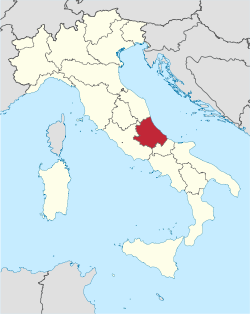
Abruzzo borders the region of Marche to the north, Lazio to the west and northwest, Molise to the south, and the Adriatic Sea to the east. Geographically, Abruzzo is divided into a mountainous area in the west, which includes the highest massifs of the Apennines, such as the Gran Sasso d'Italia and the Maiella, and a coastal area in the east, with beaches on the Adriatic Sea.
Abruzzo is considered a region of Southern Italy in terms of its culture, language, economy, and history, though in terms of physical geography, it is often considered part of Central Italy. The Italian statistical authority ISTAT deems it to be part of Southern Italy, partly because of Abruzzo's historic association with the Kingdom of the Two Sicilies.
Almost half of the region's territory is protected through national parks and nature reserves, more than any administrative region on the continent, leading it to be dubbed "the greenest region in Europe." There are three national parks, one regional park, and 38 protected nature reserves. These ensure the survival of rare species, such as the golden eagle, the Abruzzo (or Abruzzese) chamois, the Apennine wolf, and the Marsican brown bear. Abruzzo's parks and reserves host 75% of Europe's animal species. The region is also home to Calderone, one of Europe's southernmost glaciers.
Nineteenth-century Italian diplomat and journalist Primo Levi (1853–1917) chose the adjectives forte e gentile ("strong and kind") to capture what he saw as the character of the region and its people. Forte e gentile has since become the motto of the region.
The name Abruzzo, according to the most accredited hypothesis first proposed by Renaissance historian Flavio Biondo in Italia Illustrata, derives from Aprutium as a popular evolution of (ad) Praetutium, meaning "land of the Praetutii", an ancient Italic people that lived in the area of present-day Teramo. According to other hypotheses, the name could also derive from abruptus (Latin for "steep" or "precipitous").
In the 1273 Treaty of Alife, King Charles I of Anjou divided the Justiciarate of Abruzzo (Giustizierato d'Abruzzo) into two territories along the Pescara river: Abruzzo Citeriore (nearer Abruzzo) and Abruzzo Ulteriore (further Abruzzo); from then on, the region was also known by the plural name Abruzzi.
Although an earlier presence cannot be ruled out, findings in the region related to archaic humans date from up to around 700,000 years ago (Acheulean Culture). Thousands of flint tools and weapons have been collected on fluvial terraces (e.g. Madonna del Freddo at Chieti) and near former lakes (e.g. Valle Giumentina at Caramanico Terme and Valle Peligna at Popoli). These testify to the presence of different Homo species over time, ranging from Homo erectus and Neanderthals to modern humans. A site located at Popoli (Svolte di Popoli) also contained animal bones, which in that case belonged to a hippopotamus. The most important evidence of Neanderthals' presence in the region was found in caves in Calascio and dates back to the Middle Paleolithic.
Abruzzo
Abruzzo (US: /ɑːˈbruːtsoʊ, əˈ-/, UK: /æˈbrʊtsoʊ/; Italian: [aˈbruttso]; Abruzzese Neapolitan: Abbrùzze [abˈbruttsə], Abbrìzze [abˈbrittsə], or Abbrèzze [abˈbrɛttsə]; Aquilano: Abbrùzzu), historically also known as Abruzzi, is a region of Southern Italy. It has an area of 10,831.84 square kilometres (4,182.20 sq mi) and a population of nearly 1.3 million. It is divided into four provinces: L'Aquila, Teramo, Pescara, and Chieti. Its western border lies 80 km (50 mi) east of Rome. L'Aquila is both the capital city of the Abruzzo region and of the Province of L'Aquila, as well as the second largest city.The other provincial capitals are Pescara, which is Abruzzo's largest city and major port; Teramo; and Chieti. Other large cities and towns in Abruzzo include the industrial and high tech center Avezzano, as well as three important industrial and touristic centers: Vasto (pop. 40,636), Lanciano, and Sulmona.
Abruzzo borders the region of Marche to the north, Lazio to the west and northwest, Molise to the south, and the Adriatic Sea to the east. Geographically, Abruzzo is divided into a mountainous area in the west, which includes the highest massifs of the Apennines, such as the Gran Sasso d'Italia and the Maiella, and a coastal area in the east, with beaches on the Adriatic Sea.
Abruzzo is considered a region of Southern Italy in terms of its culture, language, economy, and history, though in terms of physical geography, it is often considered part of Central Italy. The Italian statistical authority ISTAT deems it to be part of Southern Italy, partly because of Abruzzo's historic association with the Kingdom of the Two Sicilies.
Almost half of the region's territory is protected through national parks and nature reserves, more than any administrative region on the continent, leading it to be dubbed "the greenest region in Europe." There are three national parks, one regional park, and 38 protected nature reserves. These ensure the survival of rare species, such as the golden eagle, the Abruzzo (or Abruzzese) chamois, the Apennine wolf, and the Marsican brown bear. Abruzzo's parks and reserves host 75% of Europe's animal species. The region is also home to Calderone, one of Europe's southernmost glaciers.
Nineteenth-century Italian diplomat and journalist Primo Levi (1853–1917) chose the adjectives forte e gentile ("strong and kind") to capture what he saw as the character of the region and its people. Forte e gentile has since become the motto of the region.
The name Abruzzo, according to the most accredited hypothesis first proposed by Renaissance historian Flavio Biondo in Italia Illustrata, derives from Aprutium as a popular evolution of (ad) Praetutium, meaning "land of the Praetutii", an ancient Italic people that lived in the area of present-day Teramo. According to other hypotheses, the name could also derive from abruptus (Latin for "steep" or "precipitous").
In the 1273 Treaty of Alife, King Charles I of Anjou divided the Justiciarate of Abruzzo (Giustizierato d'Abruzzo) into two territories along the Pescara river: Abruzzo Citeriore (nearer Abruzzo) and Abruzzo Ulteriore (further Abruzzo); from then on, the region was also known by the plural name Abruzzi.
Although an earlier presence cannot be ruled out, findings in the region related to archaic humans date from up to around 700,000 years ago (Acheulean Culture). Thousands of flint tools and weapons have been collected on fluvial terraces (e.g. Madonna del Freddo at Chieti) and near former lakes (e.g. Valle Giumentina at Caramanico Terme and Valle Peligna at Popoli). These testify to the presence of different Homo species over time, ranging from Homo erectus and Neanderthals to modern humans. A site located at Popoli (Svolte di Popoli) also contained animal bones, which in that case belonged to a hippopotamus. The most important evidence of Neanderthals' presence in the region was found in caves in Calascio and dates back to the Middle Paleolithic.
Recent media
Recent media