
Recent from talks
Martin Block
Knowledge base stats:
Talk channels stats:
Members stats:
Martin Block
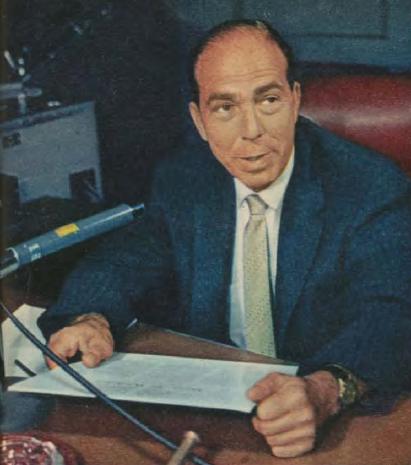
Martin Block (February 3, 1903 – September 18, 1967) was an American disc jockey. It is said that Walter Winchell invented the term "disc jockey" as a means of describing Block's radio work.
A native of Los Angeles, Block began working in radio in Tijuana, Mexico, and then as junior assistant to Al Jarvis at KFWB when he began playing records on the air introducing them with information he'd gleaned from Billboard and Variety, creating the show The World's Largest Make Believe Ballroom. Before that, Block sold small household items and appliances. At the age of only 13, he became an office boy at General Electric. When his career had stalled in Los Angeles, Block moved his family to New York; he was only there for a week before he got an announcing job. Block came up with two famous advertising slogans for his sponsors: "ABC-Always Buy Chesterfield" for Liggett & Myers and "LSMFT"-Lucky Strike Means Fine Tobacco" for Lucky Strike. He was also an avid amateur radio operator with a large station at his home in Englewood, New Jersey.
In 1934, Block went to work for WNEW at a salary of $20 per week. In 1935, while listeners to New York's WNEW in New York (now information outlet WBBR) were awaiting developments in the Lindbergh kidnapping, Block built his audience by playing records between the Lindbergh news bulletins. This led to his Make Believe Ballroom, which began on February 3, 1935 with Block borrowing both the concept and the title from West Coast disc jockey Al Jarvis, creating the illusion that he was broadcasting from a ballroom with the nation’s top dance bands performing live. He bought some records from a local music shop for the program as the radio station had none. Block purchased five Clyde McCoy records, selecting his "Sugar Blues" for the radio show's initial theme song.
Because Block was told by the station's sales staff that nobody would sponsor a radio show playing music, he had to find himself a sponsor. Block lined up a producer of reducing pills called "Retardo". Within a week of sponsoring the program, the company had over 3,000 responses to the ads on Block's radio show.
Block's style of announcing was considerably different than the usual manner of delivery at the time. Instead of speaking in a voice loud enough to be heard in a theater, Block spoke in a normal voice, as if he was having a one-on-one conversation with a listener. When one of Block's sponsors offered a sale on refrigerators during a New York snowstorm, 109 people braved the elements for the bargain Block advertised; by 1941 potential sponsors for his show had to be put on a waiting list for availabilities.
In 1936, Block and his "Ballroom" inadvertently came to the aid of a young man accused of being a pickpocket. His alibi was that he was home at the time, listening to the show, describing how Guy Lombardo, who was to appear on Make Believe Ballroom, was unable to keep the engagement and sent a telegram, which was read on the air. His story was verified and all charges were dropped. Two years later, current events unwittingly entered the "Make Believe" world with Louis Armstrong singer Midge Williams' renditions of two American popular songs in Japanese. NBC received many telephone calls and telegrams protesting her performance from listeners who were irate over the recent Japanese invasion of China.
Make Believe Ballroom was nationally syndicated in 1940. That same year, Block hosted what was billed as a "$20,000 Jam Session" on the show, featuring artists including both Dorsey brothers, Count Basie, Harry James, and Gene Krupa. The musicians improvised live for a half-hour. One segment of Ballroom was entitled "Saturday Night in Harlem". During this, Cab Calloway, Louis Armstrong, Duke Ellington and other jazz musicians' music was featured. Block and Make Believe Ballroom made the cover of Billboard magazine in April, 1942. During the 1942–44 musicians' strike (also known as the American Federation of Musicians (AFM) recording ban), he was able to obtain new records with full orchestral backing for his program by having friends in England send him UK recordings, as the ban applied to the United States only.
When Spike Jones and his City Slickers returned from entertaining the troops in 1944, the New York hotel room shortage meant the musicians had nowhere to sleep. Jones telephoned Martin Block, who went on the air with the news. WNEW was flooded with listener calls offering to accommodate Jones and his band.
Hub AI
Martin Block AI simulator
(@Martin Block_simulator)
Martin Block
Martin Block (February 3, 1903 – September 18, 1967) was an American disc jockey. It is said that Walter Winchell invented the term "disc jockey" as a means of describing Block's radio work.
A native of Los Angeles, Block began working in radio in Tijuana, Mexico, and then as junior assistant to Al Jarvis at KFWB when he began playing records on the air introducing them with information he'd gleaned from Billboard and Variety, creating the show The World's Largest Make Believe Ballroom. Before that, Block sold small household items and appliances. At the age of only 13, he became an office boy at General Electric. When his career had stalled in Los Angeles, Block moved his family to New York; he was only there for a week before he got an announcing job. Block came up with two famous advertising slogans for his sponsors: "ABC-Always Buy Chesterfield" for Liggett & Myers and "LSMFT"-Lucky Strike Means Fine Tobacco" for Lucky Strike. He was also an avid amateur radio operator with a large station at his home in Englewood, New Jersey.
In 1934, Block went to work for WNEW at a salary of $20 per week. In 1935, while listeners to New York's WNEW in New York (now information outlet WBBR) were awaiting developments in the Lindbergh kidnapping, Block built his audience by playing records between the Lindbergh news bulletins. This led to his Make Believe Ballroom, which began on February 3, 1935 with Block borrowing both the concept and the title from West Coast disc jockey Al Jarvis, creating the illusion that he was broadcasting from a ballroom with the nation’s top dance bands performing live. He bought some records from a local music shop for the program as the radio station had none. Block purchased five Clyde McCoy records, selecting his "Sugar Blues" for the radio show's initial theme song.
Because Block was told by the station's sales staff that nobody would sponsor a radio show playing music, he had to find himself a sponsor. Block lined up a producer of reducing pills called "Retardo". Within a week of sponsoring the program, the company had over 3,000 responses to the ads on Block's radio show.
Block's style of announcing was considerably different than the usual manner of delivery at the time. Instead of speaking in a voice loud enough to be heard in a theater, Block spoke in a normal voice, as if he was having a one-on-one conversation with a listener. When one of Block's sponsors offered a sale on refrigerators during a New York snowstorm, 109 people braved the elements for the bargain Block advertised; by 1941 potential sponsors for his show had to be put on a waiting list for availabilities.
In 1936, Block and his "Ballroom" inadvertently came to the aid of a young man accused of being a pickpocket. His alibi was that he was home at the time, listening to the show, describing how Guy Lombardo, who was to appear on Make Believe Ballroom, was unable to keep the engagement and sent a telegram, which was read on the air. His story was verified and all charges were dropped. Two years later, current events unwittingly entered the "Make Believe" world with Louis Armstrong singer Midge Williams' renditions of two American popular songs in Japanese. NBC received many telephone calls and telegrams protesting her performance from listeners who were irate over the recent Japanese invasion of China.
Make Believe Ballroom was nationally syndicated in 1940. That same year, Block hosted what was billed as a "$20,000 Jam Session" on the show, featuring artists including both Dorsey brothers, Count Basie, Harry James, and Gene Krupa. The musicians improvised live for a half-hour. One segment of Ballroom was entitled "Saturday Night in Harlem". During this, Cab Calloway, Louis Armstrong, Duke Ellington and other jazz musicians' music was featured. Block and Make Believe Ballroom made the cover of Billboard magazine in April, 1942. During the 1942–44 musicians' strike (also known as the American Federation of Musicians (AFM) recording ban), he was able to obtain new records with full orchestral backing for his program by having friends in England send him UK recordings, as the ban applied to the United States only.
When Spike Jones and his City Slickers returned from entertaining the troops in 1944, the New York hotel room shortage meant the musicians had nowhere to sleep. Jones telephoned Martin Block, who went on the air with the news. WNEW was flooded with listener calls offering to accommodate Jones and his band.
Recent media