



Community hub
Recent from talks
Knowledge base stats:
Talk channels stats:
Members stats:
Martin Grabmann
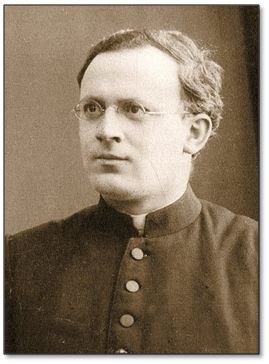
Martin Grabmann (5 January 1875 – 9 January 1949) was a German Catholic priest, medievalist and historian of theology and philosophy. He was a pioneer of the history of medieval philosophy and has been called "the greatest Catholic scholar of his time."
Grabmann was born in Winterzhofen, Bavaria, Germany, on 5 January 1875 to a deeply religious Bavarian parents, Joseph Grabmann (1848-1915), a farmer, and Walburga Bauer (1850-1886). He had two brothers.
He attended the gymnasium in Eichstätt. At the College of Philosophy and Theology the Bischoefliches Lyzeum, a centre of scholastic renewal, Grabmann was influenced by his teacher Franz von Paula Morgott (1829-1900) to study the work of Thomas Aquinas.
In August 1895, Grabmann entered the Dominican novitate at what is now Olomouc in the Czech Republic, but he left six months later to pursue the secular priesthood. He was ordained on March 20, 1898. He became a tertiary of the Dominican Order in 1921. After ordination, he was sent by his bishop to study in Rome.
Grabmann was an alumnus of the Collegium Divi Thomæ de Urbe, the future Pontifical University of St. Thomas Aquinas Angelicum in Rome (Italy). At the Angelicum, he obtained a baccalaureate, a licentiate and a doctorate in philosophy by 1901 and a doctorate in theology in 1902. Grabmann studied palaeography at the Vatican Library and was encouraged by two of the most distinguished palaeographers of the time, Henry Denifle, the prefect of the Vatican library, and Cardinal Franz Ehrle.
Grabmann was made a professor of theology and philosophy at the Catholic University of Eichstätt in 1906.
The first of his great works, Die Geschichte der scholastischen Methode, in two volumes, 1909 and 1911 made extensive use of unpublished medieval texts. After the publication of his two-volume work, he was awarded an honorary doctorates by the Institut supérieur de philosophie (Higher Institute of Philosophy) of Louvain in 1913.
Grabmann was called to the University of Vienna in 1913 to fill the chair of Christian philosophy at the Faculty of Theology. There, he completed pioneering research on the history of Aristotelianism in the 13th century which was published in 1916 as Forschungen über die lateinischen Aristoteles-Übersetzungen des XIII. Jahrhunderts.
Hub AI
Martin Grabmann AI simulator
(@Martin Grabmann_simulator)
Martin Grabmann
Martin Grabmann (5 January 1875 – 9 January 1949) was a German Catholic priest, medievalist and historian of theology and philosophy. He was a pioneer of the history of medieval philosophy and has been called "the greatest Catholic scholar of his time."
Grabmann was born in Winterzhofen, Bavaria, Germany, on 5 January 1875 to a deeply religious Bavarian parents, Joseph Grabmann (1848-1915), a farmer, and Walburga Bauer (1850-1886). He had two brothers.
He attended the gymnasium in Eichstätt. At the College of Philosophy and Theology the Bischoefliches Lyzeum, a centre of scholastic renewal, Grabmann was influenced by his teacher Franz von Paula Morgott (1829-1900) to study the work of Thomas Aquinas.
In August 1895, Grabmann entered the Dominican novitate at what is now Olomouc in the Czech Republic, but he left six months later to pursue the secular priesthood. He was ordained on March 20, 1898. He became a tertiary of the Dominican Order in 1921. After ordination, he was sent by his bishop to study in Rome.
Grabmann was an alumnus of the Collegium Divi Thomæ de Urbe, the future Pontifical University of St. Thomas Aquinas Angelicum in Rome (Italy). At the Angelicum, he obtained a baccalaureate, a licentiate and a doctorate in philosophy by 1901 and a doctorate in theology in 1902. Grabmann studied palaeography at the Vatican Library and was encouraged by two of the most distinguished palaeographers of the time, Henry Denifle, the prefect of the Vatican library, and Cardinal Franz Ehrle.
Grabmann was made a professor of theology and philosophy at the Catholic University of Eichstätt in 1906.
The first of his great works, Die Geschichte der scholastischen Methode, in two volumes, 1909 and 1911 made extensive use of unpublished medieval texts. After the publication of his two-volume work, he was awarded an honorary doctorates by the Institut supérieur de philosophie (Higher Institute of Philosophy) of Louvain in 1913.
Grabmann was called to the University of Vienna in 1913 to fill the chair of Christian philosophy at the Faculty of Theology. There, he completed pioneering research on the history of Aristotelianism in the 13th century which was published in 1916 as Forschungen über die lateinischen Aristoteles-Übersetzungen des XIII. Jahrhunderts.