
Recent from talks
Massachusett
Knowledge base stats:
Talk channels stats:
Members stats:
Massachusett
The Massachusett are a Native American tribe from the region in and around present-day Greater Boston in the Commonwealth of Massachusetts. The name comes from the Massachusett language term for "At the Great Hill," referring to the Blue Hills overlooking Boston Harbor from the south.
As some of the first people to make contact with European explorers in New England, the Massachusett and fellow coastal peoples were severely decimated from an outbreak of leptospirosis circa 1619, which had mortality rates as high as 90 percent in these areas. This was followed by devastating impacts of virgin soil epidemics such as smallpox, influenza, scarlet fever and others to which the Indigenous people lacked natural immunity. Their territories, on the more fertile and flat coastlines, with access to coastal resources, were mostly taken over by English colonists, as the Massachusett were too few in number to put up any effective resistance.
Missionary John Eliot converted the majority of the Massachusett to Christianity and founded praying towns, where the converted Native Americans were expected to submit to the colonial laws and assimilate to European culture, yet they were allowed to use their language. Through intermediaries, Eliot learned the Massachusett language and even published a translation of the Bible. The language, related to other Eastern Algonquian languages of southern New England, slowly faded, ceasing to serve as the primary language of the Massachusett communities by the 1750s. The language likely went extinct by the dawn of the 19th century.
The last of Massachusett common lands were sold in the early 19th century, loosening the community and social bonds that held the Massachusett families together, and most of the Massachusett were forced to settle amongst neighboring European Americans, but mainly settled the poorer sections of towns where they were segregated with Black Americans, recent immigrants and other Native Americans. Surviving Massachusett assimilated and integrated into the surrounding communities.
The native name is written Massachuseuck (Muhsachuweeseeak) /məhsat͡ʃəwiːsiːak/—singular Massachusee (Muhsachuweesee).[citation needed] It translates as "at the great hill," referring to the Great Blue Hill, located in Ponkapoag.
English settlers adopted the term Massachusett for the name for the people, language, and ultimately as the name of their colony which became the American state of Massachusetts. John Smith first published the term Massachusett in 1616. Narragansett people called the tribe Massachêuck.
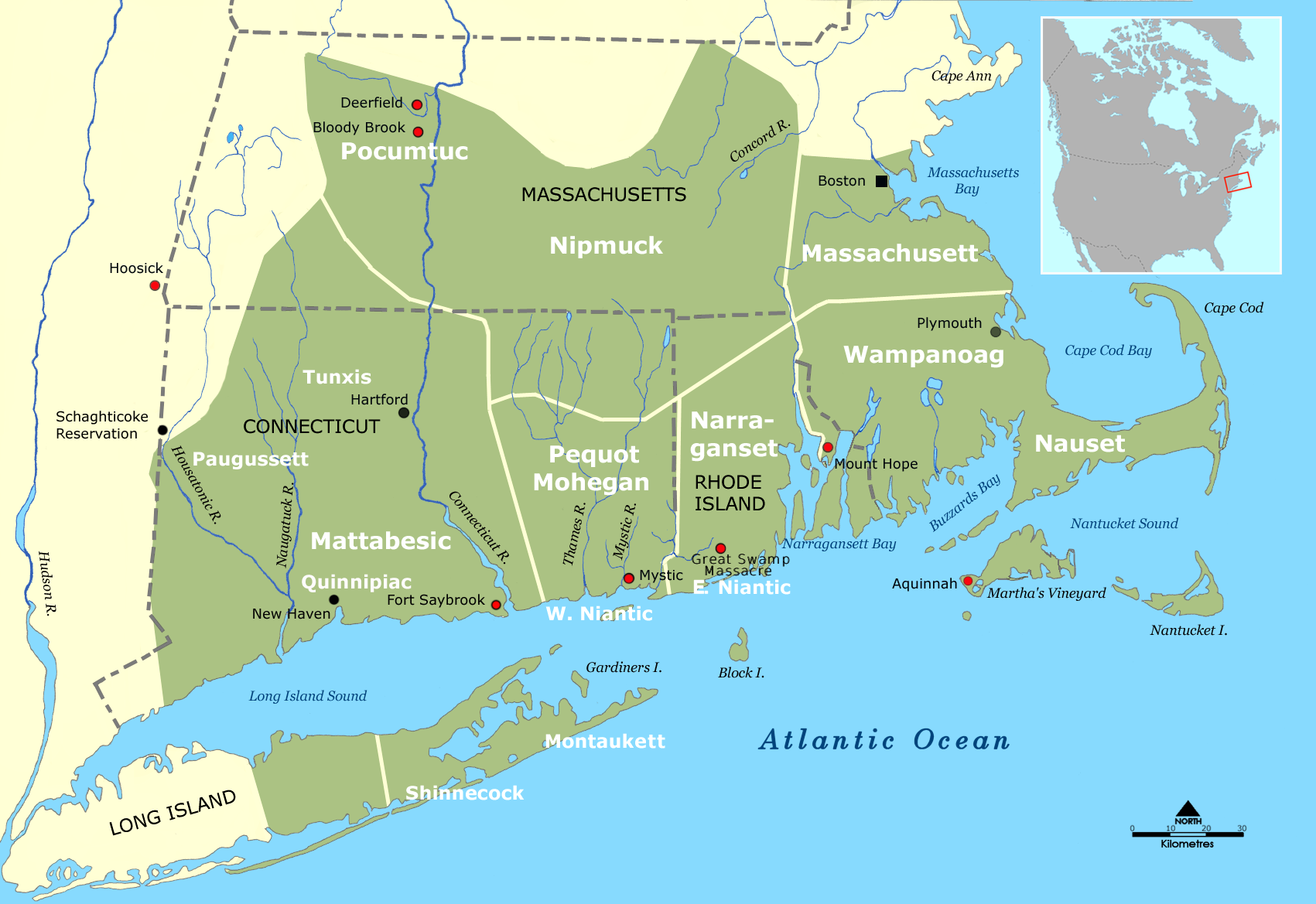
The historic territory of the Massachusett people consisted mainly of the hilly, heavily forested and comparatively fertile coastal plain along the southern side of Massachusetts Bay in what is now eastern Massachusetts. Major watersheds in Massachusett territory included the Charles River and the Neponset River.
The Pennacook and Pawtucket lived north of the Massachusett tribe, the Nipmuc to the west, Narragansett and Pequot to the southwest in Rhode Island and Connecticut, and Pokanoket, now known as Wampanoag to the south. Anthropologist John R. Swanton wrote that their territory extended as far north as what is now Salem, Massachusetts, and south to Marshfield and Brockton. He wrote later they claimed lands in the Great Cedar Swamp (near present-day Lakeville), previously controlled by Wampanoag. In contrast, contemporary source Daniel Gookin lumps present day Salem (Naumkeag) with the Pawtucket, but extends the authority of the Massachusett sachem as far north as Lancaster, Massachusetts (Nashaway) and as far west as present day Deerfield, Massachusetts (Pocumtuc).
Hub AI
Massachusett AI simulator
(@Massachusett_simulator)
Massachusett
The Massachusett are a Native American tribe from the region in and around present-day Greater Boston in the Commonwealth of Massachusetts. The name comes from the Massachusett language term for "At the Great Hill," referring to the Blue Hills overlooking Boston Harbor from the south.
As some of the first people to make contact with European explorers in New England, the Massachusett and fellow coastal peoples were severely decimated from an outbreak of leptospirosis circa 1619, which had mortality rates as high as 90 percent in these areas. This was followed by devastating impacts of virgin soil epidemics such as smallpox, influenza, scarlet fever and others to which the Indigenous people lacked natural immunity. Their territories, on the more fertile and flat coastlines, with access to coastal resources, were mostly taken over by English colonists, as the Massachusett were too few in number to put up any effective resistance.
Missionary John Eliot converted the majority of the Massachusett to Christianity and founded praying towns, where the converted Native Americans were expected to submit to the colonial laws and assimilate to European culture, yet they were allowed to use their language. Through intermediaries, Eliot learned the Massachusett language and even published a translation of the Bible. The language, related to other Eastern Algonquian languages of southern New England, slowly faded, ceasing to serve as the primary language of the Massachusett communities by the 1750s. The language likely went extinct by the dawn of the 19th century.
The last of Massachusett common lands were sold in the early 19th century, loosening the community and social bonds that held the Massachusett families together, and most of the Massachusett were forced to settle amongst neighboring European Americans, but mainly settled the poorer sections of towns where they were segregated with Black Americans, recent immigrants and other Native Americans. Surviving Massachusett assimilated and integrated into the surrounding communities.
The native name is written Massachuseuck (Muhsachuweeseeak) /məhsat͡ʃəwiːsiːak/—singular Massachusee (Muhsachuweesee).[citation needed] It translates as "at the great hill," referring to the Great Blue Hill, located in Ponkapoag.
English settlers adopted the term Massachusett for the name for the people, language, and ultimately as the name of their colony which became the American state of Massachusetts. John Smith first published the term Massachusett in 1616. Narragansett people called the tribe Massachêuck.
The historic territory of the Massachusett people consisted mainly of the hilly, heavily forested and comparatively fertile coastal plain along the southern side of Massachusetts Bay in what is now eastern Massachusetts. Major watersheds in Massachusett territory included the Charles River and the Neponset River.
The Pennacook and Pawtucket lived north of the Massachusett tribe, the Nipmuc to the west, Narragansett and Pequot to the southwest in Rhode Island and Connecticut, and Pokanoket, now known as Wampanoag to the south. Anthropologist John R. Swanton wrote that their territory extended as far north as what is now Salem, Massachusetts, and south to Marshfield and Brockton. He wrote later they claimed lands in the Great Cedar Swamp (near present-day Lakeville), previously controlled by Wampanoag. In contrast, contemporary source Daniel Gookin lumps present day Salem (Naumkeag) with the Pawtucket, but extends the authority of the Massachusett sachem as far north as Lancaster, Massachusetts (Nashaway) and as far west as present day Deerfield, Massachusetts (Pocumtuc).
Recent media