Hubbry Logo
Mat HoffmanMat HoffmanMain
Open search
Mat Hoffman
Community hub
Mat Hoffman
logo
8 pages, 0 posts
0 subscribers
Be the first to start a discussion here.
Mat Hoffman
Mat Hoffman
from Wikipedia

Medal record
Summer X Games
Representing  United States
Gold medal – first place 1995 Newport BMX Vert
Gold medal – first place 1996 Newport BMX Vert
Silver medal – second place 2002 Philadelphia BMX Vert
Bronze medal – third place 1997 San Diego BMX Vert
Bronze medal – third place 2000 San Francisco BMX Vert
Bronze medal – third place 2001 Philadelphia BMX Vert

Key Information

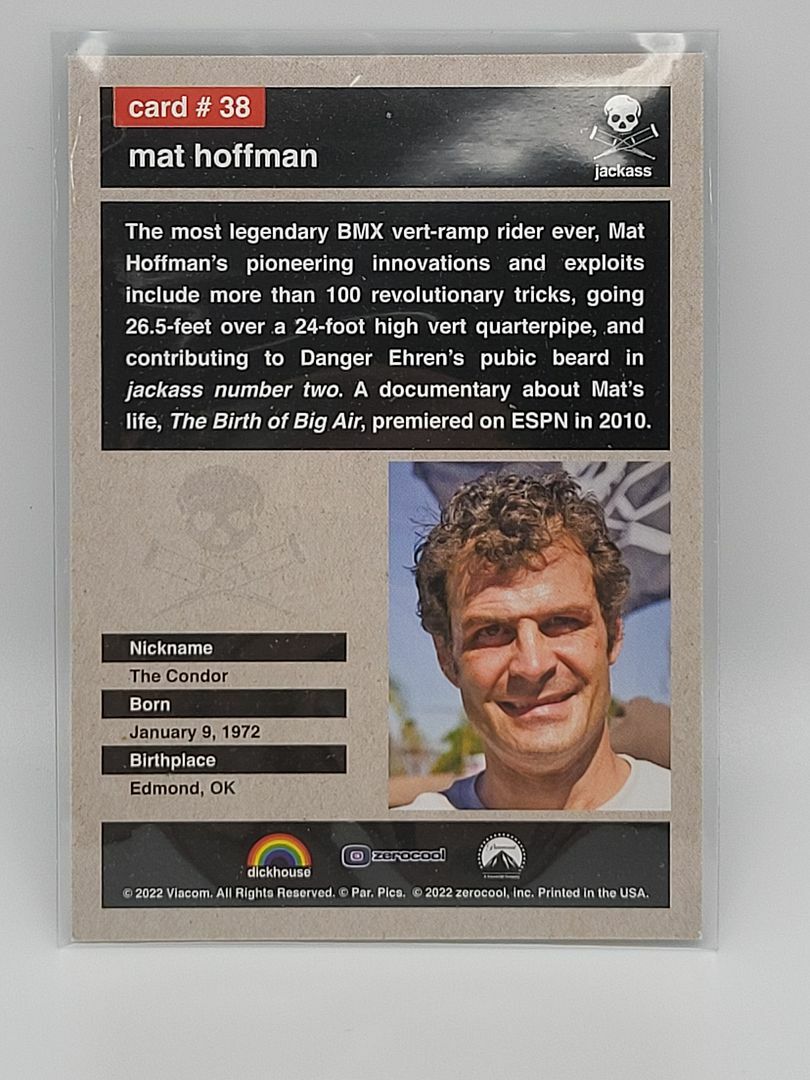
Mathew Hoffman (born January 9, 1972)[1] is an American professional BMX rider who was considered one of the best vert ramp riders in the history of the sport.[2] He was nicknamed "The Condor" and ran the BMX Freestyle brand Hoffman BMX Bikes based in Oklahoma City, Oklahoma. He was a sponsored rider for Skyway and then Haro Bikes before starting his own brand.

Early life

[edit]

Mathew Hoffman[3] was born on January 9, 1972, in Edmond, Oklahoma, to Joni (Geovanna Teresa Papa) and Matthew Hoffman. He has two sisters, Lina and Gina, and two brothers, Todd and Travis.

Hoffman started out racing motocross with his motorcycle being a Kawasaki KDX 80.1, and eventually moving through various other motorcycles such as Yamaha YZ 80 and a Honda CB 80.

In 1982 at the age of ten, Hoffman and his brothers built their first quarterpipe from plans in an issue of BMX Action Magazine. Hoffman began entering BMX freestyle competitions in 1985 around the state of Oklahoma as an amateur. Growing up Mat was a dedicated basketball, football player and wrestler, but around this time he gave up on those and committed completely to BMX.

When he was 11 he got his first real BMX bike, a red Mongoose. A few years later with a group of friends they started the Edmond Bike Shop Trick Team. Around this time his father and uncle built a new nine foot quarterpipe for the trick team that they would haul around to events and put on shows.

Career

[edit]

Independent beginnings

[edit]

In the summer of 1985, a Mountain Dew commercial began airing that featured pro California riders Eddie Fiola, Ron Wilkerson and R.L. Osborn. Hoffman said, "Its flight lasted all summer, and Travis, Steve, and I would surf around channels trying to avoid the shows but find the advertisement. My mom saw how psyched we'd get and called the local Pepsi bottling and distribution center to talk about creating a local form of promotion in sync with the commercial. A few days later we set up our ramp in the Pepsi distributorship parking lot and did a show in full uniform for a couple of executives from the plant. They were stoked, and we were in. We painted a big Mountain Dew logo on our ramp, got jerseys and stickers, and they set us up with a sponsorship through Edmond Bike Shop to keep us flush with parts and inner tubes. In exchange for the Mountain Dew support, we'd do shows at random supermarkets that sold the soda."[4]

In 1986 the Haro Freestyle Team came through Oklahoma on their tour with Dennis McCoy and Tony Murray. Hoffman said, "They let us ride their ramp with them before the demo, and I unleashed everything I had to impress the famous factory superstars. They paid me the ultimate honor, asking me to ride with them during their demo. This was the equivalent of an aspiring local guitarist being asked by Metallica to come on stage and jam. Afterward, Dennis took Steve Swope and me to dinner and announced that he wanted to bring me on the road for the rest of their tour. I was so blown away I could barely stammer out "sure," and during dinner I was already mentally packing my gear bag for the tour. Dennis made a phone call to tell the guys at Haro the good news. He came back with a weird look on his face that said the call hadn't gone well. Today, I understand how silly it must have sounded when he phoned in his request: "Hey, I found some random fourteen-year-old kid in Oklahoma who rules. Can we pick him up and take him on tour around the rest of the United States?"[5]

Mat Hoffman first came to the attention of people outside of Edmond, Oklahoma, when a letter and photo appeared in the Street Talk section of Freestylin' Magazine's August 1986 issue. In the letter he mentions being sponsored by Mountain Dew and the image shows him pulling off a one footer over a nine foot quarter pipe.

In 1986 Hoffman entered two national freestyle competitions as an unsponsored rider. The first was the AFA Master Series Round 2 in his home state of Oklahoma in August. Mat was prepared to enter as an amateur but his father convinced him to enter as an expert for the competition. Mat was one of the only riders to wear a full face helmet and JT motocross body armor. Once he began riding the spectators and other riders understood why he had on the protection. He finished first in 14-15 expert ramp and stole the show. He had learned to ride BMX with a few friends and with no professionals for reference other than from magazine pictures. He remembers: "When I got to that contest I went 'woah, I guess I am going higher than everyone else'."[6]

Hoffman entered his second national competition on June 29, 1986, at the General Bicycles/AFA Freestyle Championships at Madison Square Garden in New York City. He finished first in 14-15 expert ramp category riding a blue Haro Sport and was the rider everyone was talking about. In the November 1986 issue of Freestylin' Magazine coverage of the event, Hoffman received a two page photo spread because of his performance. After the competition he was solicited by over 15 sponsors/bike manufactures to ride for them. Hoffman said, "Before I'd caught my breath after my run, the team managers from Skyway and Haro had approached with sponsorship offers. Haro wanted to try me out on their B Team, and let me work my way up. Skyway didn't operate like that, I would be part of their factory squad and get to go on tour, get flown to contests, and draw a salary."[4]

Skyway years

[edit]

In July 1986, Hoffman signed a one-year sponsorship deal with Skyway Recreation. "I signed on the line with Skyway and was soon flown to their headquarters in Redland, California. The team manager had been hyping my skills, and the owners wanted to witness their new kid in action. During the show I slammed so hard I snapped my other collarbone and wound up in the hospital. Luckily, they decided to keep me on the team."[4]

After healing his collarbone, Hoffman made his Skyway debut in August at the IBMXF World Freestyle Championships in Vancouver. This competition was held in conjunction with Expo 86 the World's Fair. The freestyle contest was sanctioned by the International BMX Federation and run by the Canadian Freestyle Association using AFA rules. The majority of the 72 participants were from the U.S. and Canada, with one rider from Switzerland and one from France. Skyway, Mongoose and Kuwahara sent full squads of combatants, and while most of the other major factory teams had a couple of riders in attendance, there were some serious absentees. Hoffman finishing second behind Kuwahara's Tim Rogers.

On December 13, 1986, Hoffman rode in his first 2-Hip King of Vert contest at Ron Wilkerson's The Enchanted Ramp in Encinitas, California. There were six pros (Wilkerson, Todd Anderson, Mike Dominguez, Eddie Fiola, Brian Blyther and Josh White and the expert division had riders such as Tim Rogers, Steve Broderson, Marc McGlynn and Hoffman. It was thought that the contest would be a battle between Rodgers and Broderson, "but they weren't on the same level as Matt Hoffman. Matt wasn't 15 yet, but he was by far the raddest guy in the class. He was popping off eight to nine-foot aerials, no-footed cancans, regular cancans, no handers and all sorts of other tricks. He was unbelievable. He was actually radder during practice than he was in his run (like he was at the Velodrome), but still rad enough in his run that there was no doubt who had won. If he stays in freestyle long enough, it's virtually a sure thing he'll be the raddest guy alive in a couple of years. He's kind of shy and quiet when you meet him, not at all what you'd expect from someone so radical."[7]

While only 15 years old, Hoffman began construction on an indoor half pipe in his father's medical supply distribution warehouse. He dubbed it The Secret Ninja Ramp and it was made for year round training as opposed to shoveling the snow off his previous ramp. His father donated the space and Hoffman's Skyway salary paid for the materials.

Haro years

[edit]

In 1988, at the age of 16, Hoffman signs a one-year deal to ride for Haro Bikes after the departure of Dennis McCoy and Joe Johnson from the Haro roster freeing up the budget. Hoffman said, "For years, I'd wanted to ride for Haro – the first company to create a freestyle bike – run by the guy who invented the sport. It was a pure respect thing. Adding to the appeal, Haro's roster of sponsored riders was the coolest in the world: Ron Wilkerson, Brian Blyther, Dave Nourie, Joe Johnson, Dennis McCoy... it was the dream team.

Around this time, a shady lady had entered the bike scene with high hopes of turning bike riders into Michael-Jordan-level megabrands. Despite having little clue as to what bike riding was even about, she began handling the careers of a few riders-including Joe Johnson and Dennis McCoy. Whispers of big-buck sponsorships convinced McCoy and Johnson to quit the Haro team, which left gaps in Haro's am and pro ranks and loosened up quite a bit of cash in their team rider budget. It took months for the drama to unfold, but their manager almost "managed" to torpedo their careers. It was unsettling to see two of the best riders in the sport paying their own way to contests, wearing Adidas track suits and doing demos at Chrysler dealerships, just to make a little extra money until that bazillion dollar Pepsi/Huffy deal kicked in (which, of course, never did). But Dennis and Joe's lapse in judgment was my gain-I made a phone call to Rhino and secured a spot on the Haro team. I would remain classified as an am for at least the rest of the year, but I got a pay increase and was making about $50,000 in annual salary -approximately ten times what I earned with Skyway."[4]

At the 1989 2-Hip King of Vert finals in Irvine, California, Hoffman competes in first contest as a professional while still competing as an amateur. The amateurs rode first and Hoffman placed first then turned pro after his run and took first in the pro class. He also won the highest air of the contest and also finished the year as 1988 #1 amateur. An article in Ride Magazine commented: "What's left to say about a guy who ignored all established limits and redefined vert riding – at age 15[?]". In 1989 he won the first contest he entered as a professional and took home a $2,200 check,[6] after winning the amateur contest of the day, taking the year title in the amateur class.

First 900

[edit]

On March 25, 1989, in Kitchener, Ontario, Hoffman lands the first 900 ten years before Tony Hawk landed one at X Games V. It was only Hoffman's second pro contest and first after quitting Haro. Hoffman had only attempted the 900 once before.

In early 1990, nearly a year after quitting Haro and riding independently on a SE P.K. Ripper, Hoffman re-signs with Haro. Hoffman said, "I was sponsorless for about a year. It was a learning experience -I learned how to fix my parts really well.""[4] But in 1991, a year later, Hoffman would leave Haro a second and last time before starting his own company Hoffman Bikes. "When Bob Haro left in 87, I was there 88 and 89, now it's Jim Fordes company and Jim has to make money and these people don't know where they're going with Haro, they don't know how to reinvent. Haro weren't about reinventing, they were just about growth, and I was about reinventing. I was the reason why Haro had a bash guard and had pegs coming out of the forks, they were my designs. I was trying to do new things for Haro, but I would design something and by the time it got to the table and back to me, it was not what I was saying. I was getting knocked out daily, often because of bad parts. Whenever it was about designing parts, I can't tell someone how to do it, I have to do it myself. I could have stayed at Haro and it would have been easier but I would never have got what I believed in, I'd always have to compromise. I never got into BMX to compromise. I got into BMX to dream and keep it pure whatever I dreamed about."[4]

Hoffman Bikes

[edit]

In late 1991 after leaving Haro, Mat Hoffman began the seeds of Hoffman Bikes. Linn Kasten the founder and engineer of Redline Bicycles helped Hoffman develop a frame and fork and made him five prototype Condor sets in his shop in California. Hoffman remembers, "I went to Linn's house where my crude drawings became intense technical discussions. We tuned the geometry in the drawing and discussed the dilemma of weight versus strength. I wanted a bulletproof bike, but it had to fly. There were incidents in the past where I'd broken three brand-new bikes in one day -and was sick of that crap. I wanted top quality, which meant using American made 4130 aircraft grade chrome-moly tubing, the best money can buy. I was also stoked that it was going to be built in America, which was a rarity for freestyle bikes. A couple of weeks later Linn's machine shop had built me five prototype Condor frames, one for Steve Swope, Rick Thorne, Dave Mirra, Davin Hallford, and me. Our mission was to try and break them. The Condor was good. It was quick, it was stiff, it had clean angles, but more than anything, it was built to last. (rode my prototype frame and fork set for seven months, trying everything in my power to bring it to its knees. The bike held up to flatbottom landings, rooftop drops, handrails, gaps, dirt, street, ditches, extreme weather conditions, name-calling, and giant ramps. I caused my body way more harm than my bike, and the rest of the prototypes held up, too. Midway through the testing phase, I made a couple of minor improvements and declared the design phase done. Time to see if the public would buy them."[4]

In the summer of 1992, the first Hoffman Bikes production frames became available to the public. Although the prototypes were made by Kasten, Hoffman switched to SE Racing for manufacturing. Hoffman said, "Precision materials and craftsmanship came with a steep price tag, and I found out I couldn't afford to have Linn Kastan's shop do production. Mike Devitt of SE Racing saved the day. Mike was another old school BMX guy, and he'd been through the ups and downs of the industry with another legendary company, SE. Their machine shop could make a limited run of custom frame and fork sets. The condition was, I had to pay for half the batch up front, the other half on delivery "Make me two hundred of these," I told Devitt and sent off the schematic for the Condor with a down payment check for $18,000."[4]

He developed the Bicycle Stunt (BS) series to give riders a place to compete and to showcase their talents. ESPN joined with Hoffman Promotions in 1995 to produce and televise the series each year.

The growth of Hoffman Promotions gave birth to the Hoffman Sports Association (H.S.A.), the organizing body for BMX Freestyle events worldwide, such as ESPN's X Games and all international X Games bicycle-stunt events.

Hoffman has produced, directed and hosted several TV series for ESPN including Kids in the Way, HBtv, and Mat's World. In February 2008, Hoffman produced and co-hosted Mat Hoffman's Evel Knievel Tribute with Johnny Knoxville, which aired on MTV and featured record-breaking stunts by Travis Pastrana, Trigger Gunn, Allan Cooke and Davin Halford.

On April 2, 2023, Hoffman hosted a BMX stunt show during the inaugural Thunder Ride and Bike Fest held by the Oklahoma City Thunder.[8] Kenny Belaey, Terry Adams and Ryan Williams joined Hoffman.[8]

Achievements

[edit]

Hoffman is responsible for building the sport for decades, providing support to the biggest names in the industry, including Dave Mirra, Jay Miron, Kevin Robinson, Chad Kagy, Seth Kimbrough, Taj Mihelich, Brad Simms, Anthony Napolitan, Mike Escamilla, Rick Thorne, Kevin Jones, Chase Gouin, Pete Augustin, Day Smith, and Art Thomason, among others.

Hoffman and his team were selected to take part in the closing ceremonies of the 1996 Summer Olympic Games in Atlanta in a production called "Sport as Art". In 1999, H.S.A. developed Mat Hoffman's Crazy Freakin' Bikers Series (CFB), which provides amateur and professional Freestyle bikers a venue in which they can compete. Not only does the H.S.A. promote, organize and host the series, but it also produces all the television programming for the CFB Series, which is aired on ESPN2.

The H.S.A. organizes BMX Freestyle portions of annual U.S. and international events, including the X Games and all international X Games qualifiers. The year 2005 marked the 14th consecutive year of competition production for Hoffman Promotions.

In 2001, Hoffman competed at the X Games, earning the bronze medal. He stunned the industry and fans, alike, when he set another record by successfully completing the first-ever No-handed 900 at the 2002 X Games, resulting in the silver medal.

Hoffman was the first person to ride an oversized ("Big") ramp in 1993 with his first High Air attempt off of a 24-foot quarter pipe. On one of his runs, he tore his spleen, and had he not gotten to a hospital within five minutes, he would have died. When Hoffman achieved 26.6 feet above the ramp in March 1999 to 2001, he had a team of four professional photographers, an elaborate scaffolding system to record the attempt at different angles and had an ABC Wide World of Sports camera crew on-site.

Hoffman is also credited with being the first person to perform a double peg grind down a handrail, as documented in the video Head First, released in 1991. The trick has gone on to be a foundation of modern-day street riding.

In 2005, Hoffman was elected president of the International BMX Freestyle Federation, the international governing body of BMX Freestyle. Also in 2005, the Mat Hoffman Action Sports Park opened in Oklahoma City, Oklahoma. It has since been recognized as one of the 10 best such parks in the nation.[9]

In February 2018, Hoffman was inducted into the Oklahoma Sports Hall of Fame.[10]

Filmography

[edit]

Television

[edit]

An ESPN 30 for 30 documentary entitled The Birth of Big Air, directed and produced by Jeff Tremaine, Johnny Knoxville, Spike Jonze and Hoffman himself, was released in July 2010.

Past projects include three shows produced by Hoffman – Mat Hoffman's Crazy Freakin' Stunt Show and Mat Hoffman's Aggro Circus at Universal Studios in Orlando, Florida, and Mat Hoffman's Danger Defying Daredevils at Six Flags Magic Mountain near Los Angeles, California.

The book The Ride of My Life[13] documents Hoffman's story through 2001.

Video games

[edit]

Hoffman worked with Activision to produce the video games Mat Hoffman's Pro BMX (2001) and Mat Hoffman's Pro BMX 2 (2002), the latter released in conjunction with the Mat Hoffman's Pro BMX 2 Tour TV show, which aired on ESPN2 and is available on DVD and VHS.

Hoffman also appeared as an unlockable playable character in Tony Hawk's Pro Skater 4 (2002) and Tony Hawk's American Wasteland (2005), also produced by Activision.

Music videos

[edit]

X Games competition history

[edit]
GOLD (2) SILVER (1) BRONZE (3)
YEAR X GAMES EVENTS RANK MEDAL
1995 Extreme Games BMX Vert 1st
1996 Summer X Games II BMX Vert 1st
1997 Summer X Games III BMX Vert 3rd
1999 Summer X Games V BMX Vert 7th
2000 Summer X Games VI BMX Vert 3rd
2001 Summer X Games VII BMX Vert 3rd
2002 Summer X Games VIII BMX Vert 2nd
2007 Summer X Games XIII BMX Big Air 6th

References

[edit]
[edit]
Revisions and contributorsEdit on WikipediaRead on Wikipedia
from Grokipedia
Mat Hoffman (born January 9, 1972) is an American professional rider, entrepreneur, and innovator widely regarded as one of the greatest riders in the history of the sport. Known by the nickname "" for his soaring aerial maneuvers, Hoffman was born in , , and began riding at a young age, building his first ramp in his parents' backyard in nearby Edmond by age 13. Hoffman's career is defined by his invention of over 100 tricks, including the —a 900-degree aerial spin he first landed in —and the flair, a backward 540 with a 180-degree twist. He achieved groundbreaking heights, such as clearing 26.5 feet above a 24-foot vert quarterpipe (over 50 feet from the ground) and becoming the first to land a no-handed in competition at the 2002 . As a competitor, he secured multiple world championships and medals, pushing the boundaries of freestyle through daring feats on massive ramps he helped design and build. Beyond riding, Hoffman founded Hoffman Bikes in 1991 and Hoffman Promotions, which launched the Bicycle Stunt (BS) Series—a professional contest circuit that partnered with in 1995 and laid the groundwork for the ' extreme sports format. He has also influenced culture through video game production, including Mat Hoffman's Pro BMX (2000), and media appearances in films like the Jackass series and 's The Birth of documentary (2010). Today, Hoffman serves as a sport organizer for the and continues to advocate for the sport's growth via the Hoffman Sports Association, which hosts global events.

Biography

Early life

Mat Hoffman was born on January 9, 1972, in . He grew up in a family of six children, including two older brothers, Travis and Todd, and two older sisters, Gina and Linda; his father supported his developing interest in by helping construct ramps, including an indoor at his office known as the "Secret Ninja Ramp" in 1988. At around age eight, Hoffman received his first and began riding independently in , far from the sport's West Coast epicenter, where he emulated professional riders through self-directed practice. His initial "true" BMX bike was a red , on which he progressed to freestyle elements by watching instructional videos and frequenting local skateparks. By age 10 in 1982, Hoffman had built his first ramp—a six-foot quarterpipe in the backyard—using plans from BMX Action magazine, marking the start of his self-taught experimentation with jumps and basic maneuvers. His father's encouragement extended to pushing him to enter local competitions at age 11, fostering Hoffman's confidence despite limited peers in the isolated scene.

Personal life

Mat Hoffman married Jaci Hoffman in 1993, and the couple has two children, Giavanna and Jet. They reside in , where Hoffman has maintained a family home since purchasing an 8,000-square-foot property in 2010. Hoffman is actively involved in family-oriented , particularly through initiatives that introduce children to riding. Throughout his life, Hoffman has endured significant health challenges from his pursuits, including an estimated 100 concussions, which he describes as a common risk in action sports. A pivotal incident occurred in 2001, when Hoffman suffered a severe injury after falling approximately 17 meters (55 feet) during a practice session in ; he fell into a seven-day , lost his sense of taste, and suffered six months of , requiring his wife Jaci to help him relearn personal memories and daily routines during recovery. By 2010, these injuries had necessitated 23 surgeries for issues like broken bones and rotator cuff repairs, and as of 2025, he has undergone more than 23 surgeries, including additional procedures following a 2021 car accident that caused a and . Beyond , pursues hobbies such as curation, exemplified by his creation of a personal featuring favorite tracks that reflect his influences. He also enjoys paramotoring as a recreational outlet. Drawing from his injury history, advocates for greater safety awareness in extreme sports, emphasizing the long-term impacts of concussions and the need for better protective measures and recovery protocols among athletes.

Professional career

Independent beginnings

Hoffman entered his first national BMX freestyle competition as an amateur in 1986, competing locally around before gaining wider attention. In August 1986, at age 14, he secured his first major amateur victory in the 14-15 expert ramp class at the American Freestyle Association (AFA) Masters Series Round 2, held in . This win, where he outperformed established riders, marked him as a prodigy in the freestyle scene and earned him recognition from peers. Beginning that same year, Hoffman, supported by his , began self-funded road trips across the in a to pursue competitive opportunities. He competed in dozens of amateur events throughout 1986, traveling primarily through the South and Midwest to local and regional contests in states like and . These travels allowed him to hone his skills against diverse competition while funding his efforts through modest prize winnings accumulated from consistent placements. To practice and promote his riding without formal support, Hoffman constructed homemade ramps in his backyard and local Oklahoma areas, experimenting with vert and air tricks in isolation from major BMX hubs. He also produced early homemade videos documenting his sessions, distributing them informally within the growing freestyle community. These efforts built his underground reputation among riders, showcasing innovative aerial maneuvers before he attracted sponsorship attention. During these independent years, Hoffman independently developed signature tricks like the Hoffman 360—a 360-degree spin combined with a no-footer—and variations on the no-footer, where both feet are removed from the pedals mid-air for added style and difficulty. He frequently performed these in informal gatherings and smaller contests, pushing the boundaries of through self-taught progression.

Sponsorship periods

Hoffman's professional sponsorship career began in 1987 when, at the age of 15, he signed with Skyway Recreation as part of their freestyle team. This marked his entry into the factory-sponsored circuit, where he toured extensively across the alongside teammates such as Eddie Roman, competing in prominent events including the AFA Masters and the 2-Hip Meet the Street series. His performances during these tours helped elevate Skyway's visibility in the scene, showcasing high-air vert riding that pushed the sport's boundaries. In 1988, Hoffman transitioned to Haro Bikes, his longtime dream sponsor, signing a one-year deal at age 16 following the departure of key riders like Dennis McCoy and Joe Johnson from the roster. With Haro, he collaborated on product developments, including the design of a bash guard and fork-mounted pegs that enhanced freestyle capabilities. He competed in international events such as the 1988 Bercy 5 in Paris, contributing to the team's success in promoting vert ramp riding on a global scale. Team dynamics at Haro involved both collaborations and underlying rivalries among top riders, including brief overlaps and subsequent paths with figures like Joe Johnson, who had been a prominent vert specialist before leaving for other sponsors. Hoffman and his teammates, such as Ron Wilkerson and Brian Blyther, fostered a competitive environment that drove in vert techniques, helping popularize the worldwide through tours and high-profile contests. During this era, Hoffman debuted several groundbreaking tricks on vert ramps, further solidifying his influence. By the early 1990s, Hoffman ended his major sponsorships with Haro in 1991 after a brief return in 1990, driven by a desire for greater creative control and independence from team constraints. This shift led to freelance riding opportunities, allowing him to pursue personal projects outside structured team affiliations.

Key innovations

Mat Hoffman is recognized as one of the most prolific innovators in BMX freestyle, credited with inventing or popularizing over 100 tricks, particularly in vert ramp riding, which expanded the technical and aerial possibilities of the sport. His contributions emphasized fluid transitions between grabs, spins, and flips, often developed through iterative experimentation to achieve greater height, rotation, and style. Among his early inventions, the candy bar—a no-handed air where the rider crosses the arms over the handlebars while grabbing the seat—set a foundation for limbless aerial variations that prioritized balance and visual appeal. Hoffman introduced the superman, a no-hander seat grab with legs extended backward behind the rider, which added a dynamic, stretched pose to vert airs and influenced subsequent no-footed maneuvers. By 1987, he advanced tailwhip variations, incorporating the frame-whipping rotation into airs on ramps, building on earlier flatland concepts to create combo potential in vert contexts. A pinnacle of Hoffman's trick innovation came with the 900, a 900-degree (two-and-a-half ) air, which he first landed on March 25, 1989, during the 2-Hip King of Vert contest in , . This breakthrough followed months of dedicated practice on a custom-built ramp in his backyard, where he refined the rotation's speed and stability to complete the full spin without losing control upon re-entry. The 900 not only required precise timing and core strength but also pushed the boundaries of rotational physics in , establishing a benchmark for advanced aerial spins that later became staples in competitions. Beyond tricks, Hoffman contributed to BMX equipment design, particularly through Hoffman Bikes, where he developed specialized frame geometry optimized for vert performance. The Hoffman 180 frame featured adjusted angles and chainstay lengths to enhance stability during high-speed launches and landings on steep ramps, allowing riders to maintain control through 180-degree turns and airs. He was also an of gyro systems—detangler mechanisms that uncouple brake cables from handlebar rotations—enabling extended barspins without cable twisting, which was crucial for incorporating multiple handlebar rotations into vert routines. These innovations stemmed from Hoffman's hands-on approach, involving backyard testing on homemade ramps to prototype and stress-test components under real riding conditions. To disseminate his developments, he employed video documentation, capturing sessions to analyze techniques and share them with the community, fostering rapid adoption and evolution of the sport.

Business ventures

In 1991, Mat Hoffman founded Hoffman Bikes, beginning operations with the production of frames designed for freestyle riding. The venture quickly gained traction within the community, leveraging Hoffman's reputation as a pioneering rider to emphasize durable, rider-focused components. Initial frames, such as early prototypes inspired by designs, were manufactured in collaboration with established producers like to ensure quality and scalability. By 1993, Hoffman Bikes had expanded to offer complete bicycles, starting with the iconic 24-inch cruiser model, which became a staple for vert and street riders due to its robust geometry and compatibility with freestyle tricks. Signature parts, including specialized forks, hubs, and tires, were introduced alongside the bikes, incorporating Hoffman's innovations like reinforced bashguards for enhanced durability during high-impact maneuvers. Distribution began through established channels like , providing nationwide reach, before transitioning to independent sales to maintain control over branding and quality. Over the following years, the lineup grew to include more than 100 complete bike models, ranging from entry-level options to pro-signature editions used by sponsored athletes. The company further diversified by venturing into apparel, offering branded t-shirts, hats, and accessories that appealed to BMX enthusiasts, and by organizing community events to build loyalty. In 1995, Hoffman launched the Hoffman Army fan club, a membership-based group providing exclusive merchandise, updates, and access to rider meetups, alongside the inaugural Hoffman Challenge contests—annual competitions that showcased emerging talent and promoted the brand's ethos of innovation and progression. These initiatives helped foster a dedicated following, turning Hoffman Bikes into a cultural touchstone in . Like many companies in the cycling industry, Hoffman Bikes faced challenges during the 2008 global recession, including reduced sales. The brand adapted by shifting emphasis to direct-to-consumer online sales via its website and forming key partnerships with retailers and component manufacturers to streamline operations and cut costs. By the mid-2010s, these strategies had stabilized the company, enabling a resurgence with anniversary editions and expanded product lines; as of 2025, Hoffman Bikes continues to thrive, celebrating over 30 years with limited-edition releases and ongoing event support. As of 2025, Hoffman remains involved in BMX through organizing events via the Hoffman Sports Association and supporting the X Games.

Achievements

Competition history

Hoffman's competitive career began in the amateur division, where he dominated early national events. In 1985, he claimed several regional amateur victories, building momentum for national exposure. By 1986, at age 14, he secured first place in the 14-15 expert ramp class at the AFA Masters Round 4 in and additional amateur wins in the 2-Hip King of Vert series. Transitioning to professional competition in 1987, Hoffman quickly established himself as a vert ramp standout. He won the 14+ Ramps division at the BMX Beat! World Championships in Carlisle, , and followed with another victory in the same event in 1988, earning dual world titles in the amateur-to-pro crossover phase. In 1989, he captured gold at the 2-Hip King of Vert finals in —his first professional title—while competing in both amateur and pro classes on the same day and also winning the highest air award. The launch of the in 1995 marked a pivotal era in Hoffman's career, where he excelled in Vert. He won gold in the inaugural event, followed by another gold in 1996 with a standout run featuring high airs and technical variations. Hoffman added a bronze in 1997, a bronze in 2000, and bronze in 2001, bringing his X Games medal count to five (two golds, three bronzes) by that point. In 2002, he returned from a brief hiatus to claim silver, highlighted by the first no-handed 900 in competition history during his final run. Throughout the 2000s, Hoffman competed in select niche events amid mounting injuries, including multiple wrist fractures and a 2001 from a training crash that limited his participation. He won vert titles at the B3 Tuned events in 1999 and 2000, showcasing consistent dominance in the series he helped develop. After the 2002 X Games, accumulating injuries prompted his retirement from full-time competition in 2003. He made a one-off appearance in 2013 at Barcelona but did not medal.

Records and awards

Mat Hoffman set a World Record for the highest vertical air achieved on a bicycle, reaching 8.07 meters (26 feet 6 inches) from a 7.31-meter (24-foot) quarterpipe ramp on March 20, 2001. He also holds the distinction of landing the first —a 2.5-rotation aerial—in history, achieved at age 17 during the 2-Hip King of Vert contest in , on March 25, 1989. Hoffman earned six X Games medals in BMX Vert, establishing himself as one of the event's most decorated competitors through the early 2000s. These include gold medals in 1995 and 1996, bronzes in 1997, 2000, and 2001, and a silver in 2002 for his pioneering no-handed 900. His vert ramp performances from 1987 to 2001 exemplified dominance, highlighted by his first Vert World Championship win in 1987 and subsequent titles that solidified his status as a 10-time world vert champion overall. In recognition of his contributions, Hoffman was inducted into the National BMX Hall of Fame in 2012. He received further honors with induction into the Sports Hall of Fame in 2018, celebrating his Oklahoma roots and lifelong impact on the sport. Additionally, he was named the 2002 Laureus World Action Sportsperson of the Year for innovations like the highest air record and over 100 trick inventions.

Media appearances

Films and videos

Hoffman made his early mark in BMX videos through underground productions that captured his pioneering tricks, including footage of his first 900-degree air at the 1989 2-Hip King of Vert contest in Kitchener, Ontario. This moment, filmed during his second professional contest at age 17, documented a breakthrough that elevated vert riding and was featured in low-budget releases like Aggro Riding and Kung Fu Fighting (1986), a no-budget effort blending comedy, martial arts skits, and raw BMX action at local Oklahoma ramps. Similarly, Aggroman (1989), directed by Eddie Roman, starred Hoffman as a BMX superhero and introduced street riding to video audiences, distributing around 1,000 VHS copies while showcasing his innovative airs and grinds. In the 1990s, Hoffman starred in and influenced a series of videos produced under his Hoffman Bikes banner, emphasizing team riding and high-impact vert sequences. Head First (1991), also by Eddie Roman, centered on Hoffman's vert dominance with clips of multiple 900s and grinds, selling approximately 5,000 copies and praised for its groundbreaking filming and editing that set new standards for . Ride On (1992), another Roman project, included Hoffman as a key rider in 45 minutes of contest footage, street, and dirt sections, reaching about 10,000 viewers and highlighting his role in organizing the Stunts video series. Hoffman took a more hands-on role in Madd Matt (1995), the first full-length Hoffman Bikes team video produced by , featuring 40 minutes of his own airs alongside team demos at his facility and European tours. Later entries like Until Monkeys Fly (1997), which Hoffman wrote and produced, incorporated a sci-fi narrative around 40 minutes of riding, while (2002) showcased his world-record 26.6-foot air and team sections with editing by Bryan Baxter. Hoffman's contributions extended to documentary features that chronicled his career and the sport's evolution. He starred in Ultimate X: The Movie (2002), an IMAX production highlighting X Games athletes, including his vert performances that helped define extreme sports cinema. The ESPN 30 for 30 film The Birth of Big Air (2010), directed by Jeff Tremaine, focused on Hoffman's journey from a 13-year-old amateur to a 10-time world champion, detailing over 100 invented tricks and his role in popularizing big-air vert riding through archival footage and interviews. Throughout his career, Hoffman earned production credits on numerous BMX videos via Hoffman Bikes, influencing the genre with innovative techniques like slow-motion captures of tricks to emphasize height and rotation—exemplified in Head First and Madd Matt, which prioritized dynamic editing over static contest recaps. These efforts, spanning from self-produced underground tapes to team showcases, helped professionalize BMX video production and distributed tens of thousands of copies, shaping the visual style of the sport.

Television and other media

In the 1990s, Mat Hoffman partnered with to produce and televise the Bicycle Stunt Series, marking a significant expansion of coverage on national television. He also produced, directed, and hosted several series during this period, including Kids in the Way, HBtv, and Mat's World, which showcased tricks and competitions. During the 2000s, Hoffman continued his involvement with through the production of Mat Hoffman's Pro BMX2 Tour, a TV show that aired on in 2002 and highlighted professional events and rider profiles. His contributions extended to broadcasts, where he helped shape event production alongside his competitive roles. Hoffman made guest appearances on popular shows, notably in a 2001 episode of MTV's Jackass titled "The Loop," where he performed daring stunts inside a cylindrical loop ramp alongside . Hoffman secured commercial endorsements with major brands in the 1990s, including sponsorship deals with Recreation in 1986 that evolved into ongoing promotions and by 1990, often featuring his signature tricks in promotional materials. In print media, Hoffman was prominently featured in skate and BMX magazines throughout the late 1980s to 2010s. Thrasher Magazine included a major interview with him in its June 1994 issue, exploring his vert riding innovations alongside coverage of the Indianapolis skate scene. Transworld BMX highlighted him on covers and in stories, such as the June 2001 issue and December 2001 cover, emphasizing his influence on freestyle progression.

Video games

Mat Hoffman has been prominently featured in several video games, leveraging his expertise as a professional rider to contribute to titles that simulate extreme sports. He partnered with to develop and star in the series, beginning with the inaugural game released in 2001 for platforms including , , , and others. In this title, Hoffman served as the lead playable character, with the game utilizing a modified engine from the series to emphasize -specific mechanics like riding and trick combinations. The sequel, , launched in 2002 and expanded on these elements, incorporating real-world locations and promoting Hoffman's associated TV tour through integrated video content. Hoffman also appeared in the broader Tony Hawk's Pro Skater franchise, showcasing his crossover appeal in extreme sports gaming. In Tony Hawk's Pro Skater 4 (2002), he featured as a non-playable character (NPC) who assigns challenges to players in levels like Kona and , drawing from BMX vert dynamics to enhance gameplay variety. His involvement extended to Tony Hawk's American Wasteland (2005), where he became an unlockable playable skater, allowing users to perform his signature tricks in an open-world environment that included modes. These appearances highlighted Hoffman's advisory input on realistic bike handling and vert-specific physics, ensuring authenticity in stunt simulations.

Legacy

Influence on BMX

Mat Hoffman played a pivotal role in shifting freestyle from predominantly street-based riding to vertical () ramp dominance during the 1980s, a transition that elevated the sport's technical and aerial dimensions. Starting as a self-taught rider in , he began constructing homemade quarterpipes and vert ramps as early as 1985, pushing the boundaries of what was possible on two wheels by focusing on high-air maneuvers and complex rotations. His innovations on vert ramps, including the first 900-degree spin in 1989, not only redefined competition formats but also inspired the evolution toward larger structures, culminating in the mega-ramp designs that became synonymous with big-air events in the and beyond. Through his promotional efforts and media productions, Hoffman mentored a generation of riders, including , by sharing advanced techniques via instructional videos and organized events. In the early 1990s, he produced films like The Maddest Matt Hoffman Video (1995), which demonstrated vert-specific tricks and encouraged aspiring riders to experiment safely on ramps, influencing Mirra's early career as the younger rider followed Hoffman's aerial style to become a vert pioneer himself. Hoffman's Hoffman Sports Association (H.S.A.) also hosted clinics and contests that provided hands-on guidance, fostering talents who adopted and expanded upon his vert-focused approaches, such as Mirra's no-footed airs. While cross-sport inspiration extended to figures like , Hoffman's direct impact stayed rooted in through these resources. Hoffman's partnership with ESPN in 1995 marked a cultural turning point, popularizing as a mainstream by co-developing the Bicycle Stunt (BS) Series into the inaugural , which debuted that year and showcased vert and big-air disciplines to a global audience. As a key organizer through H.S.A., he helped integrate into the framework, transforming it from a niche pursuit into a televised spectacle that drew millions and legitimized freestyle riding within action sports. This involvement not only boosted participation rates but also shifted public perception, positioning alongside as a high-adrenaline discipline worthy of professional recognition. In the post-1990s era, Hoffman drove industry advancements by advocating for enhanced safety standards and establishing structured pathways. His extensive injury history, including multiple concussions and a ruptured , led him to promote advanced protective equipment, such as signature Bell helmets and Simpson designed for high-impact vert riding, influencing manufacturers to prioritize rider protection in extreme conditions. Simultaneously, through the BS Series and H.S.A., he pioneered leagues that standardized vert competitions, offering prize money and global tours that professionalized BMX careers and ensured the sport's sustainable growth.

Recent activities

Hoffman continues to lead Hoffman Bikes, which marked its 30th anniversary in 2021 with the release of commemorative frames such as the 30 YR Anniversary —his signature model—and the 30 YR Anniversary Big Daddy, emphasizing durable chromoly construction for freestyle riding. These updates maintain the brand's focus on high-quality equipment, with ongoing availability through online sales and international shipping options for global riders. In 2024, Hoffman appeared at Ventura, performing smooth airs on the course that provided a contrasting calm amid the event's high-energy atmosphere, showcasing his enduring connection to competitive action sports. Hoffman sustains an active social media presence on under the handle @condorbmx, where he shares archival footage of iconic tricks like his 1989 no-handed 900 and 2002 performances, alongside personal updates; the account has grown to over 185,000 followers by 2025. Following multiple surgeries after a 2021 car accident that resulted in a and , Hoffman has shared insights into his recovery process publicly, highlighting resilience in action sports.

References

Add your contribution
Related Hubs
User Avatar
No comments yet.