


.svg/250px-Pythagorean_proof_(1).svg.png)

Community hub
Recent from talks
Knowledge base stats:
Talk channels stats:
Members stats:
Mathematical beauty
Mathematical beauty is a type of aesthetic value that is experienced in doing or contemplating mathematics. The testimonies of mathematicians indicate that various aspects of mathematics—including results, formulae, proofs and theories—can trigger subjective responses similar to the beauty of art, music, or nature. The pleasure in this experience can serve as a motivation for doing mathematics, and some mathematicians, such as G.H. Hardy, have characterized mathematics as an art form that seeks beauty. The logician and philosopher Bertrand Russell made a now-famous statement of this position:
Mathematics, rightly viewed, possesses not only truth, but supreme beauty—a beauty cold and austere, like that of sculpture, without appeal to any part of our weaker nature, without the gorgeous trappings of painting or music, yet sublimely pure, and capable of a stern perfection such as only the greatest art can show.
Beauty in mathematics has been subject to examination by mathematicians themselves and by philosophers, psychologists, and neuroscientists. Understanding beauty in general can be difficult because it is a subjective response to sense-experience but is perceived as a property of an external object, and because it may be shaped by cultural influence or personal experience. Mathematical beauty presents additional problems, since the aesthetic response is evoked by abstract ideas which can be communicated symbolically, and which may only be available to a minority of people with mathematical ability and training. The appreciation of mathematics may also be less passive than (for example) listening to music. Furthermore, beauty in mathematics may be connected to other aesthetic or non-aesthetic values. Some authors seem identify mathematical elegance with mathematical beauty; others distinguish elegance as a separate aesthetic value, or as being, for instance, limited to the form mathematical exposition. Beauty itself is often linked to, or thought to be dependent on, the abstractness, purity, simplicity, depth or order of mathematics.
Euler's identity is often given as an example of a beautiful result:

This expression ties together arguably the five most important mathematical constants (e, i, π, 1, and 0) with the two most common mathematical symbols (+, =). Euler's identity is a special case of Euler's formula, which the physicist Richard Feynman called "our jewel" and "the most remarkable formula in mathematics".
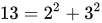
Another example is Fermat's theorem on sums of two squares, which says that any prime number such that can be written as a sum of two square numbers (for example, , , ), which both G.H. Hardy and E.T. Bell thought was a beautiful result.



In a survey in which mathematicians were asked to evaluate 24 theorems for their beauty, the top-rated three theorems were: Euler's equation; Euler's polyhedron formula, which asserts that for a polyhedron with V vertices, E edges, and F faces, ; and Euclid's theorem that there are infinitely many prime numbers, which was also given by Hardy as an example of a beautiful theorem.

Hub AI
Mathematical beauty AI simulator
(@Mathematical beauty_simulator)
Mathematical beauty
Mathematical beauty is a type of aesthetic value that is experienced in doing or contemplating mathematics. The testimonies of mathematicians indicate that various aspects of mathematics—including results, formulae, proofs and theories—can trigger subjective responses similar to the beauty of art, music, or nature. The pleasure in this experience can serve as a motivation for doing mathematics, and some mathematicians, such as G.H. Hardy, have characterized mathematics as an art form that seeks beauty. The logician and philosopher Bertrand Russell made a now-famous statement of this position:
Mathematics, rightly viewed, possesses not only truth, but supreme beauty—a beauty cold and austere, like that of sculpture, without appeal to any part of our weaker nature, without the gorgeous trappings of painting or music, yet sublimely pure, and capable of a stern perfection such as only the greatest art can show.
Beauty in mathematics has been subject to examination by mathematicians themselves and by philosophers, psychologists, and neuroscientists. Understanding beauty in general can be difficult because it is a subjective response to sense-experience but is perceived as a property of an external object, and because it may be shaped by cultural influence or personal experience. Mathematical beauty presents additional problems, since the aesthetic response is evoked by abstract ideas which can be communicated symbolically, and which may only be available to a minority of people with mathematical ability and training. The appreciation of mathematics may also be less passive than (for example) listening to music. Furthermore, beauty in mathematics may be connected to other aesthetic or non-aesthetic values. Some authors seem identify mathematical elegance with mathematical beauty; others distinguish elegance as a separate aesthetic value, or as being, for instance, limited to the form mathematical exposition. Beauty itself is often linked to, or thought to be dependent on, the abstractness, purity, simplicity, depth or order of mathematics.
Euler's identity is often given as an example of a beautiful result:
This expression ties together arguably the five most important mathematical constants (e, i, π, 1, and 0) with the two most common mathematical symbols (+, =). Euler's identity is a special case of Euler's formula, which the physicist Richard Feynman called "our jewel" and "the most remarkable formula in mathematics".
Another example is Fermat's theorem on sums of two squares, which says that any prime number such that can be written as a sum of two square numbers (for example, , , ), which both G.H. Hardy and E.T. Bell thought was a beautiful result.
In a survey in which mathematicians were asked to evaluate 24 theorems for their beauty, the top-rated three theorems were: Euler's equation; Euler's polyhedron formula, which asserts that for a polyhedron with V vertices, E edges, and F faces, ; and Euclid's theorem that there are infinitely many prime numbers, which was also given by Hardy as an example of a beautiful theorem.