Recent from talks
Early Life and Education
Feynman's Philosophy and Approach to Science
Quantum Electrodynamics (QED) and the Nobel Prize
Main milestones
Legacy and Influence
The Manhattan Project
Travels and Adventures
Public Persona and Popularization of Science
Challenger Disaster Investigation
Awards and Honors
Later Life and Illness
Personal Life and Relationships
Academic Career at Cornell and Caltech
Nothing was collected or created yet.
Richard Feynman
View on Wikipedia
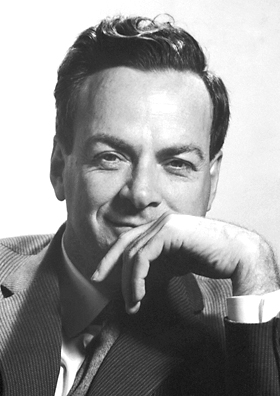
Richard Phillips Feynman (/ˈfaɪnmən/; May 11, 1918 – February 15, 1988) was an American theoretical physicist. He is best known for his work in the path integral formulation of quantum mechanics, the theory of quantum electrodynamics, the physics of the superfluidity of supercooled liquid helium, and in particle physics, for which he proposed the parton model. For his contributions to the development of quantum electrodynamics, Feynman received the Nobel Prize in Physics in 1965 jointly with Julian Schwinger and Shin'ichirō Tomonaga.
Key Information
Feynman developed a pictorial representation scheme for the mathematical expressions describing the behavior of subatomic particles, which later became known as Feynman diagrams and is widely used. During his lifetime, Feynman became one of the best-known scientists in the world. In a 1999 poll of 130 leading physicists worldwide by the British journal Physics World, he was ranked the seventh-greatest physicist of all time.[1]
He assisted in the development of the atomic bomb during World War II and became known to the wider public in the 1980s as a member of the Rogers Commission, the panel that investigated the Space Shuttle Challenger disaster. Along with his work in theoretical physics, Feynman has been credited with having pioneered the field of quantum computing and introducing the concept of nanotechnology. He held the Richard C. Tolman professorship in theoretical physics at the California Institute of Technology.
Feynman was a keen popularizer of physics through both books and lectures, including a talk on top-down nanotechnology, "There's Plenty of Room at the Bottom" (1959) and the three-volumes of his undergraduate lectures, The Feynman Lectures on Physics (1961–1964). He delivered lectures for lay audiences, recorded in The Character of Physical Law (1965) and QED: The Strange Theory of Light and Matter (1985). Feynman also became known through his autobiographical books Surely You're Joking, Mr. Feynman! (1985) and What Do You Care What Other People Think? (1988), and books written about him such as Tuva or Bust! by Ralph Leighton and the biography Genius: The Life and Science of Richard Feynman by James Gleick.
Early life
[edit]Feynman was born on May 11, 1918, in New York City,[2] to Lucille (née Phillips), a homemaker, and Melville Arthur Feynman, a sales manager.[3] Feynman's father was born into a Jewish family in Minsk, Russian Empire,[4] and immigrated with his parents to the United States at the age of five. Feynman's mother was born in the United States into a Jewish family. Lucille's father had emigrated from Poland, and her mother also came from a family of Polish immigrants. She trained as a primary school teacher but married Melville in 1917, before taking up a profession.[2][3] Richard was a late talker and did not speak until after his third birthday. As an adult, he spoke with a New York accent[5][6] strong enough to be perceived as an affectation or exaggeration,[7][8] so much so that his friends Wolfgang Pauli and Hans Bethe once commented that Feynman spoke like a "bum".[7]
The young Feynman was heavily influenced by his father, who encouraged him to ask questions to challenge orthodox thinking, and who was always ready to teach Feynman something new. From his mother, he gained the sense of humor that he had throughout his life. As a child, he had a talent for engineering,[9] maintained an experimental laboratory in his home, and delighted in repairing radios. This radio repairing was probably the first job Feynman had, and during this time he showed early signs of an aptitude for his later career in theoretical physics, when he would analyze the issues theoretically and arrive at the solutions.[10] When he was in grade school, he created a home burglar alarm system while his parents were out for the day running errands.[11]
When Richard was five, his mother gave birth to a younger brother, Henry Phillips, who died at age four weeks.[12] Four years later, Richard's sister Joan was born and the family moved to Far Rockaway, Queens.[3] Though separated by nine years, Joan and Richard were close, and they both shared a curiosity about the world.[13] Though their mother thought women lacked the capacity to understand such things, Richard encouraged Joan's interest in astronomy, taking her to see the aurora borealis in Far Rockaway.[14] As an astrophysicist, Joan would help to explain what caused the northern lights.[15][13]
Religion
[edit]Feynman's parents were both from Jewish families,[3] and his family went to the synagogue every Friday.[16] However, by his youth, Feynman described himself as an "avowed atheist".[17][18] Many years later, in a letter to Tina Levitan, declining a request for information for her book on Jewish Nobel Prize winners, he stated, "To select, for approbation the peculiar elements that come from some supposedly Jewish heredity is to open the door to all kinds of nonsense on racial theory", adding, "at thirteen I was not only converted to other religious views, but I also stopped believing that the Jewish people are in any way 'the chosen people'".[19]
Later in life, during a visit to the Jewish Theological Seminary, Feynman encountered the Talmud for the first time. He saw that it contained the original text in a little square on each page, and surrounding it were commentaries written over time by different people. In this way, the Talmud had evolved, and everything that was discussed was carefully recorded. Despite being impressed, Feynman was disappointed with the lack of interest in nature and the outside world expressed by the rabbis, who cared about only those questions which arise from the Talmud.[20]
Education
[edit]Feynman attended Far Rockaway High School, which was also attended by fellow Nobel laureates Burton Richter and Baruch Samuel Blumberg.[21] Upon starting high school, Feynman was quickly promoted to a higher math class. An IQ test administered in high school estimated his IQ at 125—high but "merely respectable", according to biographer James Gleick.[22][23] His sister Joan, who scored one point higher, later jokingly claimed to an interviewer that she was smarter. Years later he declined to join Mensa International, saying that his IQ was too low.[24]
When Feynman was 15, he taught himself trigonometry, advanced algebra, infinite series, analytic geometry, and both differential and integral calculus.[25] Before entering college, he was experimenting with mathematical topics such as the half-derivative using his own notation.[26] He created special symbols for logarithm, sine, cosine and tangent functions so they did not look like three variables multiplied together, and for the derivative, to remove the temptation of canceling out the 's in .[27][28] A member of the Arista Honor Society, in his last year in high school he won the New York University Math Championship.[29] His habit of direct characterization sometimes rattled more conventional thinkers; for example, one of his questions, when learning feline anatomy, was "Do you have a map of the cat?" (referring to an anatomical chart).[30]
Feynman applied to Columbia University but was not accepted because of its quota for the number of Jews admitted.[3] Instead, he attended the Massachusetts Institute of Technology, where he joined the Pi Lambda Phi fraternity.[31] Although he originally majored in mathematics, he later switched to electrical engineering, as he considered mathematics to be too abstract. Noticing that he "had gone too far", he then switched to physics, which he claimed was "somewhere in between".[32] As an undergraduate, he published two papers in the Physical Review.[29] One of these, which was co-written with Manuel Vallarta, was titled "The Scattering of Cosmic Rays by the Stars of a Galaxy".[33]
Vallarta let his student in on a secret of mentor-protégé publishing: the senior scientist's name comes first. Feynman had his revenge a few years later, when Heisenberg concluded an entire book on cosmic rays with the phrase: "such an effect is not to be expected according to Vallarta and Feynman". When they next met, Feynman asked gleefully whether Vallarta had seen Heisenberg's book. Vallarta knew why Feynman was grinning. "Yes," he replied. "You're the last word in cosmic rays."[34]
The other was his senior thesis, on "Forces in Molecules",[35] based on a topic assigned by John C. Slater, who was sufficiently impressed by the paper to have it published. Its main result is known as the Hellmann–Feynman theorem.[36]
In 1939, Feynman received a bachelor's degree[37] and was named a Putnam Fellow.[38] He attained a perfect score on the graduate school entrance exams to Princeton University in physics—an unprecedented feat—and an outstanding score in mathematics, but did poorly on the history and English portions. The head of the physics department there, Henry D. Smyth, had another concern, writing to Philip M. Morse to ask: "Is Feynman Jewish? We have no definite rule against Jews but have to keep their proportion in our department reasonably small because of the difficulty of placing them."[39] Morse conceded that Feynman was indeed Jewish, but reassured Smyth that Feynman's "physiognomy and manner, however, show no trace of this characteristic".[39]
Attendees at Feynman's first seminar, which was on the classical version of the Wheeler–Feynman absorber theory, included Albert Einstein, Wolfgang Pauli, and John von Neumann. Pauli made the prescient comment that the theory would be extremely difficult to quantize, and Einstein said that one might try to apply this method to gravity in general relativity,[40] which Sir Fred Hoyle and Jayant Narlikar did much later as the Hoyle–Narlikar theory of gravity.[41][42] Feynman received a PhD from Princeton in 1942; his thesis advisor was John Archibald Wheeler.[43] In his doctoral thesis titled "The Principle of Least Action in Quantum Mechanics",[44] Feynman applied the principle of stationary action to problems of quantum mechanics, inspired by a desire to quantize the Wheeler–Feynman absorber theory of electrodynamics, and laid the groundwork for the path integral formulation and Feynman diagrams.[45] A key insight was that positrons behaved like electrons moving backwards in time.[45] James Gleick wrote:
This was Richard Feynman nearing the crest of his powers. At twenty-three ... there may now have been no physicist on earth who could match his exuberant command over the native materials of theoretical science. It was not just a facility at mathematics (though it had become clear ... that the mathematical machinery emerging in the Wheeler–Feynman collaboration was beyond Wheeler's own ability). Feynman seemed to possess a frightening ease with the substance behind the equations, like Einstein at the same age, like the Soviet physicist Lev Landau—but few others.[43]
One of the conditions of Feynman's scholarship to Princeton was that he could not be married; nevertheless, he continued to see his high school sweetheart, Arline Greenbaum, and was determined to marry her once he had been awarded his PhD despite the knowledge that she was seriously ill with tuberculosis. This was an incurable disease at the time, and she was not expected to live more than two years. On June 29, 1942, they took the ferry to Staten Island, where they were married in the city office. The ceremony was attended by neither family nor friends and was witnessed by a pair of strangers. Feynman could kiss Arline only on the cheek. After the ceremony he took her to Deborah Hospital, where he visited her on weekends.[46][47]
Manhattan Project
[edit]
In 1941, with World War II occurring in Europe but the United States not yet at war, Feynman spent the summer working on ballistics problems at the Frankford Arsenal in Pennsylvania.[48][49] After the attack on Pearl Harbor brought the United States into the war, Feynman was recruited by Robert R. Wilson, who was working on means to produce enriched uranium for use in an atomic bomb, as part of what would become the Manhattan Project.[50][51] At the time, Feynman had not earned a graduate degree.[52] Wilson's team at Princeton was working on a device called an isotron, intended to electromagnetically separate uranium-235 from uranium-238. This was done in a quite different manner from that used by the calutron that was under development by a team under Wilson's former mentor, Ernest O. Lawrence, at the Radiation Laboratory of the University of California.[citation needed] On paper, the isotron was many times more efficient than the calutron, but Feynman and Paul Olum struggled to determine whether it was practical. Ultimately, on Lawrence's recommendation, the isotron project was abandoned.[53]
At this juncture, in early 1943, Robert Oppenheimer was establishing the Los Alamos Laboratory, a secret laboratory on a mesa in New Mexico where atomic bombs would be designed and built. An offer was made to the Princeton team to be redeployed there. "Like a bunch of professional soldiers," Wilson later recalled, "we signed up, en masse, to go to Los Alamos."[54] Oppenheimer recruited many young physicists, including Feynman, who he telephoned long distance from Chicago to inform that he had found a Presbyterian sanatorium in Albuquerque, New Mexico for Arline. They were among the first to depart for New Mexico, leaving on a train on March 28, 1943. The railroad supplied Arline with a wheelchair, and Feynman paid extra for a private room for her. There they spent their wedding anniversary.[55]
At Los Alamos, Feynman was assigned to Hans Bethe's Theoretical (T) Division,[56] and impressed Bethe enough to be made a group leader.[57] He and Bethe developed the Bethe–Feynman formula for calculating the yield of a fission bomb, which built upon previous work by Robert Serber.[58] As a junior physicist, he was not central to the project. He administered the computation group of human computers in the theoretical division. With Stanley Frankel and Nicholas Metropolis, he assisted in establishing a system for using IBM punched cards for computation.[59] He invented a new method of computing logarithms that he later used on the Connection Machine.[60][61] An avid drummer, Feynman figured out how to get the machine to click in musical rhythms.[62] Other work at Los Alamos included calculating neutron equations for the Los Alamos "Water Boiler", a small nuclear reactor, to measure how close an assembly of fissile material was to criticality.[63] On completing this work, Feynman was sent to the Clinton Engineer Works in Oak Ridge, Tennessee, where the Manhattan Project had its uranium enrichment facilities. He aided the engineers there in devising safety procedures for material storage so that criticality accidents could be avoided, especially when enriched uranium came into contact with water, which acted as a neutron moderator. He insisted on giving the rank and file a lecture on nuclear physics so that they would realize the dangers.[64] He explained that while any amount of unenriched uranium could be safely stored, the enriched uranium had to be carefully handled. He developed a series of safety recommendations for the various grades of enrichments.[65] He was told that if the people at Oak Ridge gave him any difficulty with his proposals, he was to inform them that Los Alamos "could not be responsible for their safety otherwise".[66]

Returning to Los Alamos, Feynman was put in charge of the group responsible for the theoretical work and calculations on the proposed uranium hydride bomb, which ultimately proved to be infeasible.[57][67] He was sought out by physicist Niels Bohr for one-on-one discussions. He later discovered the reason: most of the other physicists were too much in awe of Bohr to argue with him. Feynman had no such inhibitions, vigorously pointing out anything he considered to be flawed in Bohr's thinking. He said he felt as much respect for Bohr as anyone else, but once anyone got him talking about physics, he would become so focused he forgot about social niceties. Perhaps because of this, Bohr never warmed to Feynman.[68][69] Feynman impressed Oppenheimer, who wrote in a letter to the University of California's physics department chairman, Raymond T. Birge, in November 1943 that Feynman was "by all odds the most brilliant young physicist here, and everyone knows this."[70][71]
At Los Alamos, which was isolated for security, Feynman amused himself by investigating the combination locks on the cabinets and desks of physicists. He often found that they left the lock combinations on the factory settings, wrote the combinations down, or used easily guessable combinations like dates.[72] He found one cabinet's combination by trying numbers he thought a physicist might use (it proved to be 27–18–28 after the base of natural logarithms, e = 2.71828 ...), and found that the three filing cabinets where a colleague kept research notes all had the same combination. He left notes in the cabinets as a prank, spooking his colleague, Frederic de Hoffmann, into thinking a spy had gained access to them.[73][74]
Feynman's $380 (equivalent to $7,000 in 2024) monthly salary was about half the amount needed for his modest living expenses and Arline's medical bills, and they were forced to dip into her $3,300 (equivalent to $60,000 in 2024) in savings.[75] On weekends he borrowed a car from his friend Klaus Fuchs to drive to Albuquerque to see Arline.[71][76] Asked who at Los Alamos was most likely to be a spy, Fuchs mentioned Feynman's safe-cracking and frequent trips to Albuquerque;[71] Fuchs himself later confessed to spying for the Soviet Union.[77] The FBI would compile a bulky file on Feynman,[78] particularly in view of Feynman's Q clearance.[79]

Informed that Arline was dying, Feynman drove to Albuquerque and sat with her for hours until she died on June 16, 1945.[80] He then immersed himself in work on the project and was present at the Trinity nuclear test. Feynman claimed to be the only person to see the explosion without the very dark glasses or welder's lenses provided, reasoning that it was safe to look through a truck windshield, as it would screen out the harmful ultraviolet radiation. The immense brightness of the explosion made him duck to the truck's floor, where he saw a temporary "purple splotch" afterimage.[81]
Cornell (1945–1949)
[edit]Feynman nominally held an appointment at the University of Wisconsin–Madison as an assistant professor of physics, but was on unpaid leave during his involvement in the Manhattan Project.[82] In 1945, he received a letter from Dean Mark Ingraham of the College of Letters and Science requesting his return to the university to teach in the coming academic year. His appointment was not extended when he did not commit to returning. In a talk given there several years later, Feynman quipped, "It's great to be back at the only university that ever had the good sense to fire me."[83]
As early as October 30, 1943, Bethe had written to the chairman of the physics department of his university, Cornell, to recommend that Feynman be hired. On February 28, 1944, this was endorsed by Robert Bacher,[84] also from Cornell,[85] and one of the most senior scientists at Los Alamos.[86] This led to an offer being made in August 1944, which Feynman accepted. Oppenheimer had hoped to recruit Feynman to the University of California, but Birge was reluctant. He made Feynman an offer in May 1945, but Feynman turned it down. Cornell matched its salary offer of $3,900 (equivalent to $68,000 in 2024) per annum.[84] Feynman became one of the first of the Los Alamos Laboratory's group leaders to depart, leaving for Ithaca, New York, in October 1945.[87]
Because Feynman was no longer working at the Los Alamos Laboratory, he was no longer exempt from the draft. At his induction physical, Army psychiatrists diagnosed Feynman as suffering from a mental illness and the Army gave him a 4-F exemption on mental grounds.[88][89] His father died suddenly on October 8, 1946, and Feynman suffered from depression.[90] On October 17, 1946, he wrote a letter to Arline, expressing his deep love and heartbreak. The letter was sealed and only opened after his death. "Please excuse my not mailing this," the letter concluded, "but I don't know your new address."[91] Unable to focus on research problems, Feynman began tackling physics problems, not for utility, but for self-satisfaction.[90] One of these involved analyzing the physics of a twirling, nutating disk as it is moving through the air, inspired by an incident in the cafeteria at Cornell when someone tossed a dinner plate in the air.[92] He read the work of Sir William Rowan Hamilton on quaternions, and tried unsuccessfully to use them to formulate a relativistic theory of electrons. His work during this period, which used equations of rotation to express various spinning speeds, ultimately proved important to his Nobel Prize–winning work, yet because he felt burned out and had turned his attention to less immediately practical problems, he was surprised by the offers of professorships from other renowned universities, including the Institute for Advanced Study, the University of California, Los Angeles, and the University of California, Berkeley.[90]

Feynman was not the only frustrated theoretical physicist in the early post-war years. Quantum electrodynamics suffered from infinite integrals in perturbation theory. These were clear mathematical flaws in the theory, which Feynman and Wheeler had tried, unsuccessfully, to work around.[93] "Theoreticians", noted Murray Gell-Mann, "were in disgrace".[94] In June 1947, leading American physicists met at the Shelter Island Conference. For Feynman, it was his "first big conference with big men ... I had never gone to one like this one in peacetime."[95] The problems plaguing quantum electrodynamics were discussed, but the theoreticians were completely overshadowed by the achievements of the experimentalists, who reported the discovery of the Lamb shift, the measurement of the magnetic moment of the electron, and Robert Marshak's two-meson hypothesis.[96]
Bethe took the lead from the work of Hans Kramers, and derived a renormalized non-relativistic quantum equation for the Lamb shift. The next step was to create a relativistic version. Feynman thought that he could do this, but when he went back to Bethe with his solution, it did not converge.[97] Feynman carefully worked through the problem again, applying the path integral formulation that he had used in his thesis. Like Bethe, he made the integral finite by applying a cut-off term. The result corresponded to Bethe's version.[98][99] Feynman presented his work to his peers at the Pocono Conference in 1948. It did not go well. Julian Schwinger gave a long presentation of his work in quantum electrodynamics, and Feynman then offered his version, entitled "Alternative Formulation of Quantum Electrodynamics". The unfamiliar Feynman diagrams, used for the first time, puzzled the audience. Feynman failed to get his point across, and Paul Dirac, Edward Teller and Niels Bohr all raised objections.[100][101]
To Freeman Dyson, one thing at least was clear: Shin'ichirō Tomonaga, Schwinger and Feynman understood what they were talking about even if no one else did, but had not published anything. He was convinced that Feynman's formulation was easier to understand, and ultimately managed to convince Oppenheimer that this was the case.[102] Dyson published a paper in 1949, which added new rules to Feynman's that told how to implement renormalization.[103] Feynman was prompted to publish his ideas in the Physical Review in a series of papers over three years.[104] His 1948 papers on "A Relativistic Cut-Off for Classical Electrodynamics" attempted to explain what he had been unable to get across at Pocono.[105] His 1949 paper on "The Theory of Positrons" addressed the Schrödinger equation and Dirac equation, and introduced what is now called the Feynman propagator.[106] Finally, in papers on the "Mathematical Formulation of the Quantum Theory of Electromagnetic Interaction" in 1950 and "An Operator Calculus Having Applications in Quantum Electrodynamics" in 1951, he developed the mathematical basis of his ideas, derived familiar formulae and advanced new ones.[107]
While papers by others initially cited Schwinger, papers citing Feynman and employing Feynman diagrams appeared in 1950, and soon became prevalent.[108] Students learned and used the powerful new tool that Feynman had created. Computer programs were later written to evaluate Feynman diagrams, enabling physicists to use quantum field theory to make high-precision predictions.[109] Marc Kac adapted Feynman's technique of summing over possible histories of a particle to the study of parabolic partial differential equations, yielding what is now known as the Feynman–Kac formula, the use of which extends beyond physics to many applications of stochastic processes.[110] To Schwinger, however, the Feynman diagram was "pedagogy, not physics".[111]
Looking back on this period, Feynman would reflect fondly on his time at the Telluride House, where he resided for a large period of his Cornell career. In an interview, he described the House as "a group of boys that have been specially selected because of their scholarship, because of their cleverness or whatever it is, to be given free board and lodging and so on, because of their brains". He enjoyed the house's convenience and said that "it's there that I did the fundamental work" for which he won the Nobel Prize.[112][113]
However, Feynman was also reported to have been quite restless during his time at Cornell. By 1949, as the period was coming to a close, he had never settled into a particular house or apartment, moving instead between guest houses or student residences. While he did spend some time living with various married friends, these situations were reported to frequently end because the "arrangements became sexually volatile".[114] The renowned 31 year old was known to frequently pursue his married female friends, undergraduate girls and women, and to hire sex workers, which would sour many of his friendships.[115] Additionally, Feynman was not fond of Ithaca's cold winter weather or feeling as though he lived in the shadow of Hans Bethe while at Cornell.[116]
Brazil (1949–1952)
[edit]Feynman spent several weeks in Rio de Janeiro in July 1949.[117] That year, the Soviet Union detonated its first atomic bomb, generating concerns about espionage.[118] Fuchs was arrested as a Soviet spy in 1950 and the FBI questioned Bethe about Feynman's loyalty.[119] Physicist David Bohm was arrested on December 4, 1950,[120] and emigrated to Brazil in October 1951.[121] Because of the fears of a nuclear war, a girlfriend told Feynman that he should also consider moving to South America.[118] He had a sabbatical coming for 1951–1952,[122] and elected to spend it in Brazil, where he gave courses at the Centro Brasileiro de Pesquisas Físicas.

In Brazil, Feynman was impressed with samba music, and learned to play the frigideira,[123] a metal percussion instrument based on a frying pan.[124] He was an enthusiastic amateur player of bongo and conga drums and often played them in the pit orchestra in musicals.[125][126] He spent time in Rio with his friend Bohm, but Bohm could not convince Feynman to investigate Bohm's ideas on physics.[127]
Caltech and later years (1952–1978)
[edit]
Personal and political life
[edit]Feynman did not return to Cornell. Bacher, who had been instrumental in bringing Feynman to Cornell, had lured him to the California Institute of Technology (Caltech). Part of the deal was that he could spend his first year on sabbatical in Brazil.[128][114] He had become smitten by Mary Louise Bell from Neodesha, Kansas. They had met in a cafeteria in Cornell, where she had studied the history of Mexican art and textiles. She later followed him to Caltech, where he gave a lecture. While he was in Brazil, she taught classes on the history of furniture and interiors at Michigan State University. He proposed to her by mail from Rio de Janeiro, and they married in Boise, Idaho, on June 28, 1952, shortly after he returned. They frequently quarreled and she was frightened by what she described as "a violent temper".[129] Their politics were different; although he registered and voted as a Republican, she was more conservative, and her opinion on the 1954 Oppenheimer security hearing ("Where there's smoke there's fire") offended him. They separated on May 20, 1956. An interlocutory decree of divorce was entered on June 19, 1956, on the grounds of "extreme cruelty". The divorce became final on May 5, 1958.[130][131]
... the appointee's wife was granted a divorce from him because of appointee's constantly working calculus problems in his head as soon as awake, while driving car, sitting in living room, and so forth, and that his one hobby was playing his African drums. His ex-wife reportedly testified that on several occasions when she unwittingly disturbed either his calculus or his drums he flew into a violent rage, during which time he choked her, threw pieces of bric-a-brac about and smashed the furniture ...
— Special Agent in Charge in Los Angeles, in mail to FBI director, July 24, 1958[132]
In the wake of the 1957 Sputnik crisis, the U.S. government's interest in science rose for a time. Feynman was considered for a seat on the President's Science Advisory Committee, but was not appointed. At this time, the FBI interviewed a woman close to Feynman, possibly his ex-wife Bell, who sent a written statement to J. Edgar Hoover on August 8, 1958:
I do not know—but I believe that Richard Feynman is either a Communist or very strongly pro-Communist—and as such is a very definite security risk. This man is, in my opinion, an extremely complex and dangerous person, a very dangerous person to have in a position of public trust ... In matters of intrigue Richard Feynman is, I believe immensely clever—indeed a genius—and he is, I further believe, completely ruthless, unhampered by morals, ethics, or religion—and will stop at absolutely nothing to achieve his ends.[131]
The U.S. government nevertheless sent Feynman to Geneva for the September 1958 Atoms for Peace Conference. On the beach at Lake Geneva, he met Gweneth Howarth, who was from Ripponden, West Yorkshire, and working in Switzerland as an au pair. Feynman's love life had been turbulent since his divorce; his previous girlfriend had walked off with his Albert Einstein Award medal and, on the advice of an earlier girlfriend, had feigned pregnancy and extorted him into paying for an abortion, then used the money to buy furniture. When Feynman found that Howarth was being paid only $25 a month, he offered her $20 (equivalent to $202 in 2022) a week to be his live-in maid. Feynman knew that this sort of behavior was illegal under the Mann Act, so he had a friend, Matthew Sands, act as her sponsor. Howarth pointed out that she already had two boyfriends, but decided to take Feynman up on his offer, and arrived in Altadena, California, in June 1959. She made a point of dating other men, but Feynman proposed in early 1960. They were married on September 24, 1960, at the Huntington Hotel in Pasadena. They had a son, Carl, in 1962, and adopted a daughter, Michelle, in 1968.[133][134] Besides their home in Altadena, they had a beach house in Baja California, purchased with the money from Feynman's Nobel Prize.[135]
Allegations of sexism
[edit]There were protests over his alleged sexism at Caltech in 1968, and again in 1972. Protesters "objected to his use of sexist stories about 'lady drivers' and clueless women in his lectures."[136][137] Feynman recalled protesters entering a hall and picketing a lecture he was about to make in San Francisco, calling him a "sexist pig". He later reflected on the incident claiming that it prompted him to address the protesters, saying that "women do indeed suffer prejudice and discrimination in physics, and your presence here today serves to remind us of these difficulties and the need to remedy them".[138]
In his 1985 memoir, Surely You're Joking, Mr. Feynman!, he recalled holding meetings in strip clubs, drawing naked portraits of his female students while lecturing at Caltech, and pretending to be an undergraduate to deceive younger women into sleeping with him.[139]
Feynman diagram van
[edit]In 1975, in Long Beach, California, Feynman bought a Dodge Tradesman Maxivan with a bronze-khaki exterior and yellow-green interior, with custom Feynman diagram exterior murals.[140] After Feynman's death, Gweneth sold the van for $1 to one of Feynman's friends, film producer Ralph Leighton, who later put it into storage, where it began to rust. In 2012, video game designer Seamus Blackley, a father of the Xbox, bought the van.[141][142] Qantum was the license plate ID.[143][when?]
Physics
[edit]At Caltech, Feynman investigated the physics of the superfluidity of supercooled liquid helium, where helium seems to display a complete lack of viscosity when flowing. Feynman provided a quantum-mechanical explanation for the Soviet physicist Lev Landau's theory of superfluidity.[144] Applying the Schrödinger equation to the question showed that the superfluid was displaying quantum mechanical behavior observable on a macroscopic scale. This helped with the problem of superconductivity, but the solution eluded Feynman.[145] It was solved with the BCS theory of superconductivity, proposed by John Bardeen, Leon Neil Cooper, and John Robert Schrieffer in 1957.[144]

Feynman, inspired by a desire to quantize the Wheeler–Feynman absorber theory of electrodynamics, laid the groundwork for the path integral formulation and Feynman diagrams.[45]
With Murray Gell-Mann, Feynman developed a model of weak decay, which showed that the current coupling in the process is a combination of vector and axial currents (an example of weak decay is the decay of a neutron into an electron, a proton, and an antineutrino). Although E. C. George Sudarshan and Robert Marshak developed the theory nearly simultaneously, Feynman's collaboration with Gell-Mann was seen as seminal because the weak interaction was neatly described by the vector and axial currents. It thus combined the 1933 beta decay theory of Enrico Fermi with an explanation of parity violation.[146]
Feynman attempted an explanation, called the parton model, of the strong interactions governing nucleon scattering. The parton model emerged as a complement to the quark model developed by Gell-Mann. The relationship between the two models was murky; Gell-Mann referred to Feynman's partons derisively as "put-ons". In the mid-1960s, physicists believed that quarks were just a bookkeeping device for symmetry numbers, not real particles; the statistics of the omega-minus particle, if it were interpreted as three identical strange quarks bound together, seemed impossible if quarks were real.[147][148]
The SLAC National Accelerator Laboratory deep inelastic scattering experiments of the late 1960s showed that nucleons (protons and neutrons) contained point-like particles that scattered electrons. It was natural to identify these with quarks, but Feynman's parton model attempted to interpret the experimental data in a way that did not introduce additional hypotheses. For example, the data showed that some 45% of the energy momentum was carried by electrically neutral particles in the nucleon. These electrically neutral particles are now seen to be the gluons that carry the forces between the quarks, and their three-valued color quantum number solves the omega-minus problem. Feynman did not dispute the quark model; for example, when the fifth quark was discovered in 1977, Feynman immediately pointed out to his students that the discovery implied the existence of a sixth quark, which was discovered in the decade after his death.[147][149]
After the success of quantum electrodynamics, Feynman turned to quantum gravity. By analogy with the photon, which has spin 1, he investigated the consequences of a free massless spin 2 field and derived the Einstein field equation of general relativity, but little more. The computational device that Feynman discovered then for gravity, "ghosts", which are "particles" in the interior of his diagrams that have the "wrong" connection between spin and statistics, have proved invaluable in explaining the quantum particle behavior of the Yang–Mills theories, for example, quantum chromodynamics and the electro-weak theory.[150] He did work on all four of the fundamental interactions of nature: electromagnetic, the weak force, the strong force and gravity. John and Mary Gribbin state in their book on Feynman that "Nobody else has made such influential contributions to the investigation of all four of the interactions".[151]
Partly as a way to bring publicity to progress in physics, Feynman offered $1,000 prizes for two of his challenges in nanotechnology; one was claimed by William McLellan and the other by Tom Newman.[152]
Feynman was also interested in the relationship between physics and computation. He was also one of the first scientists to conceive the possibility of quantum computers.[153][154][155] In the 1980s he began to spend his summers working at Thinking Machines Corporation, helping to build some of the first parallel supercomputers and considering the construction of quantum computers.[156][157]
Between 1984 and 1986, he developed a variational method for the approximate calculation of path integrals, which has led to a powerful method of converting divergent perturbation expansions into convergent strong-coupling expansions (variational perturbation theory) and, as a consequence, to the most accurate determination[158] of critical exponents measured in satellite experiments.[159] At Caltech, he once chalked "What I cannot create I do not understand" on his blackboard.[160]
Machine technology
[edit]
Feynman had studied the ideas of John von Neumann while researching quantum field theory. His most famous lecture on the subject was delivered in 1959 at the California Institute of Technology, published under the title "There's Plenty of Room at the Bottom" a year later. In this lecture he theorized on future opportunities for designing miniaturized machines, which could build smaller reproductions of themselves. This lecture is frequently cited in technical literature on microtechnology, and nanotechnology.[161]
Feynman also suggested that it should be possible, in principle, to make nanoscale machines that "arrange the atoms the way we want" and do chemical synthesis by mechanical manipulation.[162]
He also presented the possibility of "swallowing the doctor", an idea that he credited in the essay to his friend and graduate student Albert Hibbs. This concept involved building a tiny, swallowable surgical robot.[162]
Pedagogy
[edit]
In the early 1960s, Feynman acceded to a request to "spruce up" the teaching of undergraduates at the California Institute of Technology, also called Caltech. After three years devoted to the task, he produced a series of lectures that later became The Feynman Lectures on Physics. Accounts vary about how successful the original lectures were. Feynman's own preface, written just after an exam on which the students did poorly, was somewhat pessimistic. His colleagues David L. Goodstein and Gerry Neugebauer said later that the intended audience of first-year students found the material intimidating while older students and faculty found it inspirational, so the lecture hall remained full even as the first-year students dropped away. In contrast, physicist Matthew Sands recalled the student attendance as being typical for a large lecture course.[163]
Converting the lectures into books occupied Matthew Sands and Robert B. Leighton as part-time co-authors for several years. Feynman suggested that the book cover should have a picture of a drum with mathematical diagrams about vibrations drawn upon it, in order to illustrate the application of mathematics to understanding the world. Instead, the publishers gave the books plain red covers, though they included a picture of Feynman playing drums in the foreword.[164] Even though the books were not adopted by universities as textbooks, they continue to sell well because they provide a deep understanding of physics.[165]
Many of Feynman's lectures and miscellaneous talks were turned into other books, including The Character of Physical Law, QED: The Strange Theory of Light and Matter, Statistical Mechanics, Lectures on Gravitation, and the Feynman Lectures on Computation.[166]
Feynman wrote about his experiences teaching physics undergraduates in Brazil. The students' studying habits and the Portuguese language textbooks were so devoid of any context or applications for their information that, in Feynman's opinion, the students were not learning physics at all. At the end of the year, Feynman was invited to give a lecture on his teaching experiences, and he agreed to do so, provided he could speak frankly, which he did.[167][168]
Feynman opposed rote learning, or unthinking memorization, as well as other teaching methods that emphasized form over function. In his mind, clear thinking and clear presentation were fundamental prerequisites for his attention. It could be perilous even to approach him unprepared, and he did not forget fools and pretenders.[169]
In 1964, he served on the California State Curriculum Commission, which was responsible for approving textbooks to be used by schools in California. He was not impressed with what he found.[170] Many of the mathematics texts covered subjects of use only to pure mathematicians as part of the "New Math". Elementary students were taught about sets, but:
It will perhaps surprise most people who have studied these textbooks to discover that the symbol ∪ or ∩ representing union and intersection of sets and the special use of the brackets { } and so forth, all the elaborate notation for sets that is given in these books, almost never appear in any writings in theoretical physics, in engineering, in business arithmetic, computer design, or other places where mathematics is being used. I see no need or reason for this all to be explained or to be taught in school. It is not a useful way to express one's self. It is not a cogent and simple way. It is claimed to be precise, but precise for what purpose?[171]
In April 1966, Feynman delivered an address to the National Science Teachers Association, in which he suggested how students could be made to think like scientists, be open-minded, curious, and especially, to doubt. In the course of the lecture, he gave a definition of science, which he said came about by several stages. The evolution of intelligent life on planet Earth—creatures such as cats that play and learn from experience. The evolution of humans, who came to use language to pass knowledge from one individual to the next, so that the knowledge was not lost when an individual died. Unfortunately, incorrect knowledge could be passed down as well as correct knowledge, so another step was needed. Galileo and others started doubting the truth of what was passed down and to investigate ab initio, from experience, what the true situation was—this was science.[172]
In 1974, Feynman delivered the Caltech commencement address on the topic of cargo cult science, which has the semblance of science, but is only pseudoscience due to a lack of "a kind of scientific integrity, a principle of scientific thought that corresponds to a kind of utter honesty" on the part of the scientist. He instructed the graduating class that "The first principle is that you must not fool yourself—and you are the easiest person to fool. So you have to be very careful about that. After you've not fooled yourself, it's easy not to fool other scientists. You just have to be honest in a conventional way after that."[173]
Feynman served as doctoral advisor to 30 students.[174]
Case before the Equal Employment Opportunity Commission
[edit]In 1977, Feynman supported his English literature colleague Jenijoy La Belle, who had been hired as Caltech's first female professor in 1969, and filed suit with the Equal Employment Opportunity Commission after she was refused tenure in 1974. The EEOC ruled against Caltech in 1977, adding that La Belle had been paid less than male colleagues. La Belle finally received tenure in 1979. Many of Feynman's colleagues were surprised that he took her side, but he had gotten to know La Belle and liked and admired her.[136][175]
Surely You're Joking, Mr. Feynman!
[edit]In the 1960s, Feynman began thinking of writing an autobiography, and he began granting interviews to historians. In the 1980s, working with Ralph Leighton (Robert Leighton's son), he recorded chapters on audio tape that Ralph transcribed. The book was published in 1985 as Surely You're Joking, Mr. Feynman! and became a best-seller.[176]
Gell-Mann was upset by Feynman's account in the book of the weak interaction work, and threatened to sue, resulting in a correction being inserted in later editions.[177] This incident was just the latest provocation in decades of bad feeling between the two scientists. Gell-Mann often expressed frustration at the attention Feynman received;[178] he remarked: "[Feynman] was a great scientist, but he spent a great deal of his effort generating anecdotes about himself."[179]
Feynman has been criticized for a chapter in the book entitled "You Just Ask Them?", where he describes how he learned to seduce women at a bar he went to in the summer of 1946. A mentor taught him to ask a woman if she would sleep with him before buying her anything. He describes seeing women at the bar as "bitches" in his thoughts, and tells a story of how he told a woman named Ann that she was "worse than a whore" after Ann persuaded him to buy her sandwiches by telling him he could eat them at her place, but then, after he bought them, saying they actually could not eat together because another man was coming over. Later on that same evening, Ann returned to the bar to take Feynman to her place.[180][181][182] Feynman states at the end of the chapter that this behavior was not typical of him: "So it worked even with an ordinary girl! But no matter how effective the lesson was, I never really used it after that. I didn't enjoy doing it that way. But it was interesting to know that things worked much differently from how I was brought up."[113]
Challenger disaster
[edit]
Feynman played an important role on the Presidential Rogers Commission, which investigated the 1986 Space Shuttle Challenger disaster. He had been reluctant to participate, but was persuaded by advice from his wife.[183] Feynman clashed several times with commission chairman William P. Rogers. During a break in one hearing, Rogers told commission member Neil Armstrong, "Feynman is becoming a pain in the ass."[184]
During a televised hearing, Feynman demonstrated that the material used in the shuttle's O-rings became less resilient in cold weather by compressing a sample of the material in a clamp and immersing it in ice-cold water.[185] The commission ultimately determined that the disaster was caused by the primary O-ring not properly sealing in unusually cold weather at Cape Canaveral.[186]
Feynman devoted the latter half of his 1988 book What Do You Care What Other People Think? to his experience on the Rogers Commission, straying from his usual convention of brief, light-hearted anecdotes to deliver an extended and sober narrative. Feynman's account reveals a disconnect between NASA's engineers and executives that was far more striking than he expected. His interviews of NASA's high-ranking managers revealed startling misunderstandings of elementary concepts. For instance, NASA managers claimed that there was a 1 in 100,000 probability of a catastrophic failure aboard the Shuttle, but Feynman discovered that NASA's own engineers estimated the probability of a catastrophe at closer to 1 in 200. He concluded that NASA management's estimate of the reliability of the Space Shuttle was unrealistic, and he was particularly angered that NASA used it to recruit Christa McAuliffe into the Teacher-in-Space program. He warned in his appendix to the commission's report (which was included only after he threatened not to sign the report), "For a successful technology, reality must take precedence over public relations, for nature cannot be fooled."[187]
Recognition and awards
[edit]The first public recognition of Feynman's work came in 1954, when Lewis Strauss, the chairman of the Atomic Energy Commission (AEC) notified him that he had won the Albert Einstein Award, which was worth $15,000 and came with a gold medal. Because of Strauss's actions in stripping Oppenheimer of his security clearance, Feynman was reluctant to accept the award, but Isidor Isaac Rabi cautioned him: "You should never turn a man's generosity as a sword against him. Any virtue that a man has, even if he has many vices, should not be used as a tool against him."[188] It was followed by the AEC's Ernest Orlando Lawrence Award in 1962.[189] Schwinger, Tomonaga and Feynman shared the 1965 Nobel Prize in Physics "for their fundamental work in quantum electrodynamics, with deep-ploughing consequences for the physics of elementary particles".[190] He was elected a Foreign Member of the Royal Society in 1965,[2][191] received the Oersted Medal in 1972,[192] and the National Medal of Science in 1979.[193] He was elected a Member of the National Academy of Sciences, but ultimately resigned[194][195] and is no longer listed by them.[196] Schwinger called him "an honest man, the outstanding intuitionist of our age, and a prime example of what may lie in store for anyone who dares follow the beat of a different drum."[197]
Death
[edit]
In 1978, Feynman sought medical treatment for abdominal pains and was diagnosed with liposarcoma, a rare form of cancer. Surgeons removed a "very large" tumor that had crushed one kidney and his spleen. In 1986, doctors discovered another cancer, Waldenström macroglobulinemia.[198] Further operations were performed in October 1986 and October 1987.[199] He was again hospitalized at the UCLA Medical Center on February 3, 1988. A ruptured duodenal ulcer caused kidney failure, and he declined to undergo the dialysis that might have prolonged his life for a few months. Feynman's wife Gweneth, sister Joan, and cousin Frances Lewine watched over him during the final days of his life until he died on February 15, 1988.[200]
When Feynman was nearing death, he asked his friend and colleague Danny Hillis why Hillis appeared so sad. Hillis replied that he thought Feynman was going to die soon. Hillis quotes Feynman as replying:
"Yeah," he sighed, "that bugs me sometimes too. But not so much as you think. [...] When you get as old as I am, you start to realize that you've told most of the good stuff you know to other people anyway."[201]
Near the end of his life, Feynman attempted to visit the Tuvan Autonomous Soviet Socialist Republic (ASSR) in the Soviet Union, a dream thwarted by Cold War bureaucratic issues. The letter from the Soviet government authorizing the trip was not received until the day after he died. His daughter Michelle later made the journey.[202] Ralph Leighton chronicled the attempt in Tuva or Bust!, published in 1991.
His burial was at Mountain View Cemetery and Mausoleum in Altadena, California.[203] His last words were "This dying is boring" in reference to the extended coma that preceded his death.[202]
Popular legacy
[edit]
Aspects of Feynman's life have been portrayed in various media. Feynman was portrayed by Matthew Broderick in the 1996 biopic Infinity.[204] Actor Alan Alda commissioned playwright Peter Parnell to write a two-character play about a fictional day in the life of Feynman set two years before Feynman's death. The play, QED, premiered at the Mark Taper Forum in Los Angeles in 2001[205] and was later presented at the Vivian Beaumont Theater on Broadway, with both productions starring Alda as Richard Feynman.[206][207] Real Time Opera premiered its opera Feynman at the Norfolk (Connecticut) Chamber Music Festival in June 2005.[208] In 2011, Feynman was the subject of a biographical graphic novel entitled simply Feynman, written by Jim Ottaviani and illustrated by Leland Myrick.[209] In 2013, Feynman's role on the Rogers Commission was dramatized by the BBC in The Challenger (US title: The Challenger Disaster), with William Hurt playing Feynman.[210][211][212] In 2016, Oscar Isaac performed a public reading of Feynman's 1946 love letter to the late Arline.[213] In the 2023 American film Oppenheimer, directed by Christopher Nolan and based on American Prometheus, Feynman is portrayed by actor Jack Quaid.[214]
On May 4, 2005, the United States Postal Service issued the "American Scientists" commemorative set of four 37-cent stamps in several configurations. The scientists depicted were Richard Feynman, John von Neumann, Barbara McClintock, and Josiah Willard Gibbs. Feynman's stamp features a photograph of Feynman in his thirties and eight small Feynman diagrams.[215] The stamps were designed by Victor Stabin under the artistic direction of Carl T. Herrman.[216][217][218][219][220] The main building for the Computing Division at Fermilab is named the "Feynman Computing Center" in his honor,[221] as is the Richard P. Feynman Center for Innovation at the Los Alamos National Laboratory.[222] Two photographs of Feynman were used in Apple Computer's "Think Different" advertising campaign, which launched in 1997.[223][224] Sheldon Cooper, a fictional theoretical physicist from the television series The Big Bang Theory, was depicted as a Feynman fan, even emulating him by playing the bongo drums.[225] On January 27, 2016, co-founder of Microsoft Bill Gates wrote an article describing Feynman's talents as a teacher ("The Best Teacher I Never Had"), which inspired Gates to create Project Tuva to place the videos of Feynman's Messenger Lectures, The Character of Physical Law, on a website for public viewing.[226] In 2015, Gates made a video in response to Caltech's request for thoughts on Feynman for the 50th anniversary of Feynman's 1965 Nobel Prize, on why he thought Feynman was special.[226]
Works
[edit]Selected scientific works
[edit]- Feynman, Richard P. (1942). Laurie M. Brown (ed.). The Principle of Least Action in Quantum Mechanics. PhD Dissertation, Princeton University. World Scientific (with title "Feynman's Thesis: a New Approach to Quantum Theory") (published 2005). ISBN 978-981-256-380-4
- Wheeler, John A.; Feynman, Richard P. (1945). "Interaction with the Absorber as the Mechanism of Radiation". Reviews of Modern Physics. 17 (2–3): 157–181. Bibcode:1945RvMP...17..157W. doi:10.1103/RevModPhys.17.157. Archived from the original on April 17, 2020. Retrieved May 20, 2019.
- Feynman, Richard P. (1946). A Theorem and its Application to Finite Tampers. Los Alamos Scientific Laboratory, Atomic Energy Commission. doi:10.2172/4341197. OSTI 4341197.
- Feynman, Richard P.; Welton, T. A. (1946). Neutron Diffusion in a Space Lattice of Fissionable and Absorbing Materials. Los Alamos Scientific Laboratory, Atomic Energy Commission. doi:10.2172/4381097. OSTI 4381097.
- Feynman, Richard P.; Metropolis, N.; Teller, E. (1947). Equations of State of Elements Based on the Generalized Fermi-Thomas Theory (PDF). Los Alamos Scientific Laboratory, Atomic Energy Commission. doi:10.2172/4417654. OSTI 4417654.
- Feynman, Richard P. (1948). "Space-time approach to non-relativistic quantum mechanics". Reviews of Modern Physics. 20 (2): 367–387. Bibcode:1948RvMP...20..367F. doi:10.1103/RevModPhys.20.367. Archived from the original on September 17, 2020. Retrieved May 20, 2019.
- Feynman, Richard P. (1948). "A Relativistic Cut-Off for Classical Electrodynamics". Physical Review. 74 (8): 939–946. Bibcode:1948PhRv...74..939F. doi:10.1103/PhysRev.74.939. Archived from the original on September 19, 2020. Retrieved May 20, 2019.
- Feynman, Richard P. (1948). "Relativistic Cut-Off for Quantum Electrodynamics". Physical Review. 74 (10): 1430–1438. Bibcode:1948PhRv...74.1430F. doi:10.1103/PhysRev.74.1430. Archived from the original on September 19, 2020. Retrieved May 20, 2019.
- Wheeler, John A.; Feynman, Richard P. (1949). "Classical Electrodynamics in Terms of Direct Interparticle Action" (PDF). Reviews of Modern Physics. 21 (3): 425–433. Bibcode:1949RvMP...21..425W. doi:10.1103/RevModPhys.21.425.
- Feynman, Richard P. (1949). "The theory of positrons". Physical Review. 76 (6): 749–759. Bibcode:1949PhRv...76..749F. doi:10.1103/PhysRev.76.749. S2CID 120117564. Archived from the original on August 9, 2022. Retrieved May 20, 2019.
- Feynman, Richard P. (1949). "Space-Time Approach to Quantum Electrodynamic". Physical Review. 76 (6): 769–789. Bibcode:1949PhRv...76..769F. doi:10.1103/PhysRev.76.769.
- Feynman, Richard P. (1950). "Mathematical formulation of the quantum theory of electromagnetic interaction". Physical Review. 80 (3): 440–457. Bibcode:1950PhRv...80..440F. doi:10.1103/PhysRev.80.440. Archived from the original on September 14, 2020. Retrieved May 20, 2019.
- Feynman, Richard P. (1951). "An Operator Calculus Having Applications in Quantum Electrodynamics". Physical Review. 84 (1): 108–128. Bibcode:1951PhRv...84..108F. doi:10.1103/PhysRev.84.108. Archived from the original on September 15, 2020. Retrieved May 20, 2019.
- Feynman, Richard P. (1953). "The λ-Transition in Liquid Helium". Physical Review. 90 (6): 1116–1117. Bibcode:1953PhRv...90.1116F. doi:10.1103/PhysRev.90.1116.2. Archived from the original on September 17, 2020. Retrieved May 20, 2019.
- Feynman, Richard P.; de Hoffmann, F.; Serber, R. (1955). Dispersion of the Neutron Emission in U235 Fission. Los Alamos Scientific Laboratory, Atomic Energy Commission. doi:10.2172/4354998. OSTI 4354998.
- Feynman, Richard P. (1956). "Science and the Open Channel". Science. 123 (3191) (published February 24, 1956): 307. Bibcode:1956Sci...123..307F. doi:10.1126/science.123.3191.307. PMID 17774518.
- Cohen, M.; Feynman, Richard P. (1957). "Theory of Inelastic Scattering of Cold Neutrons from Liquid Helium". Physical Review. 107 (1): 13–24. Bibcode:1957PhRv..107...13C. doi:10.1103/PhysRev.107.13. Archived from the original on September 14, 2020. Retrieved May 20, 2019.
- Feynman, Richard P.; Vernon, F. L.; Hellwarth, R. W. (1957). "Geometric representation of the Schrödinger equation for solving maser equations" (PDF). Journal of Applied Physics. 28 (1): 49. Bibcode:1957JAP....28...49F. doi:10.1063/1.1722572.
- Feynman, Richard P. (1960). "There's Plenty of Room at the Bottom". Engineering and Science. 23 (5): 22–36.
- Edgar, R. S.; Feynman, Richard P.; Klein, S.; Lielausis, I.; Steinberg, C. M. (1962). "Mapping experiments with r mutants of bacteriophage T4D". Genetics. 47 (2) (published February 1962): 179–86. doi:10.1093/genetics/47.2.179. PMC 1210321. PMID 13889186.
- Feynman, Richard P. (1968) [1966]. "What is Science?" (PDF). The Physics Teacher. 7 (6): 313–320. Bibcode:1969PhTea...7..313F. doi:10.1119/1.2351388. Retrieved June 10, 2023. Lecture presented at the fifteenth annual meeting of the National Science Teachers Association, 1966 in New York City.
- Feynman, Richard P. (1966). "The Development of the Space-Time View of Quantum Electrodynamics". Science. 153 (3737) (published August 12, 1966): 699–708. Bibcode:1966Sci...153..699F. doi:10.1126/science.153.3737.699. PMID 17791121.
- Feynman, Richard P. (1974a). "Structure of the proton". Science. 183 (4125). American Association for the Advancement of Science (published February 15, 1974): 601–610. Bibcode:1974Sci...183..601F. doi:10.1126/science.183.4125.601. JSTOR 1737688. PMID 17778830. S2CID 9938227.
- Feynman, Richard P. (1974). "Cargo Cult Science" (PDF). Engineering and Science. 37 (7).
- Feynman, Richard P.; Kleinert, Hagen (1986). "Effective classical partition functions" (PDF). Physical Review A. 34 (6) (published December 1986): 5080–5084. Bibcode:1986PhRvA..34.5080F. doi:10.1103/PhysRevA.34.5080. PMID 9897894.
- Feynman, Richard P. (1986). Rogers Commission Report, Volume 2 Appendix F – Personal Observations on Reliability of Shuttle. NASA.
- Feynman, Richard P. (1988), "Difficulties in Applying the Variational Principle to Quantum Field Theories", in Polley, L.; Pottinger, D. E. L. (eds.), Variational Calculations in Quantum Field Theory, World Scientific (published August 1, 1988), pp. 28–40, doi:10.1142/9789814390187_0003, ISBN 9971-50-500-2 Proceedings of the International Workshop at Wangerooge Island, Germany; Sept 1–4, 1987.
- Feynman, Richard P. (2000). Laurie M. Brown (ed.). Selected Papers of Richard Feynman: With Commentary. 20th Century Physics. World Scientific. ISBN 978-981-02-4131-5.
Textbooks and lecture notes
[edit]
The Feynman Lectures on Physics is perhaps his most accessible work for anyone with an interest in physics, compiled from lectures to Caltech undergraduates in 1961–1964. As news of the lectures' lucidity grew, professional physicists and graduate students began to drop in to listen. Co-authors Robert B. Leighton and Matthew Sands, colleagues of Feynman, edited and illustrated them into book form. The work has endured and is useful to this day. They were edited and supplemented in 2005 with Feynman's Tips on Physics: A Problem-Solving Supplement to the Feynman Lectures on Physics by Michael Gottlieb and Ralph Leighton (Robert Leighton's son), with support from Kip Thorne and other physicists.
- Feynman, Richard P.; Leighton, Robert B.; Sands, Matthew (2005) [1970]. The Feynman Lectures on Physics: The Definitive and Extended Edition (2nd ed.). Addison Wesley. ISBN 0-8053-9045-6. Includes Feynman's Tips on Physics (with Michael Gottlieb and Ralph Leighton), which includes four previously unreleased lectures on problem solving, exercises by Robert Leighton and Rochus Vogt, and a historical essay by Matthew Sands. Three volumes; originally published as separate volumes in 1964 and 1966.
- Feynman, Richard P. (1961). Theory of Fundamental Processes. Addison Wesley.
- Feynman, Richard P. (1962). Quantum Electrodynamics. Addison Wesley.
- Feynman, Richard P.; Hibbs, Albert (1965). Quantum Mechanics and Path Integrals. McGraw Hill. ISBN 0-07-020650-3.
- Feynman, Richard P. (1967). The Character of Physical Law: The 1964 Messenger Lectures. MIT Press. ISBN 0-262-56003-8.
- Feynman, Richard P. (1972). Statistical Mechanics: A Set of Lectures. Reading, Mass: W. A. Benjamin. ISBN 0-8053-2509-3.
- Feynman, Richard P. (1972). Photon-Hadron interactions. Reading, Mass: W. A. Benjamin. ISBN 0-201-36074-8.
- Feynman, Richard P. (1985b). QED: The Strange Theory of Light and Matter. Princeton University Press. ISBN 0-691-02417-0.
- Feynman, Richard P. (1987). Elementary Particles and the Laws of Physics: The 1986 Dirac Memorial Lectures. Cambridge University Press. ISBN 0-521-34000-4.
- Feynman, Richard P. (1995). Brian Hatfield (ed.). Lectures on Gravitation. Addison Wesley Longman. ISBN 0-201-62734-5.
- Feynman, Richard P. (1997). Feynman's Lost Lecture: The Motion of Planets Around the Sun (Vintage Press ed.). London, England: Vintage. ISBN 0-09-973621-7.
- Feynman, Richard P. (2000). Hey, Tony; Allen, Robin W. (eds.). Feynman Lectures on Computation. Perseus Books Group. ISBN 0-7382-0296-7.
Computer science also differs from physics in that it is not actually a science. It does not study natural objects. Neither is it, as you might think, mathematics; although it does use mathematical reasoning pretty extensively. Rather, computer science is like engineering – it is all about getting something to do something, rather than just dealing with abstractions
.
Popular works
[edit]- Feynman, Richard P. (1985). Leighton, Ralph (ed.). Surely You're Joking, Mr. Feynman!: Adventures of a Curious Character. W. W. Norton & Company. ISBN 0-393-01921-7. OCLC 10925248.
- Feynman, Richard P. (1988a). Leighton, Ralph (ed.). What Do You Care What Other People Think?: Further Adventures of a Curious Character. W. W. Norton & Company. ISBN 0-393-02659-0.
- No Ordinary Genius: The Illustrated Richard Feynman, ed. Christopher Sykes, W. W. Norton & Company, 1996, ISBN 0-393-31393-X.
- Six Easy Pieces: Essentials of Physics Explained by Its Most Brilliant Teacher, Perseus Books, 1994, ISBN 0-201-40955-0. Listed by the board of directors of the Modern Library as one of the 100 best nonfiction books.[227]
- Six Not So Easy Pieces: Einstein's Relativity, Symmetry and Space-Time, Addison Wesley, 1997, ISBN 0-201-15026-3.
- Feynman, Richard P. (1998). The Meaning of It All: Thoughts of a Citizen-Scientist. Reading, Massachusetts: Perseus Publishing. ISBN 0-7382-0166-9.
- Feynman, Richard P. (1999). Robbins, Jeffrey (ed.). The Pleasure of Finding Things Out: The Best Short Works of Richard P. Feynman. Cambridge, Massachusetts: Perseus Books. ISBN 0-7382-0108-1.
- Classic Feynman: All the Adventures of a Curious Character, edited by Ralph Leighton, W. W. Norton & Company, 2005, ISBN 0-393-06132-9. Chronologically reordered omnibus volume of Surely You're Joking, Mr. Feynman! and What Do You Care What Other People Think?, with a bundled CD containing one of Feynman's signature lectures.
Audio and video recordings
[edit]- Safecracker Suite (a collection of drum pieces interspersed with Feynman telling anecdotes)
- Los Alamos From Below (audio, talk given by Feynman at Santa Barbara on February 6, 1975)
- The Feynman Lectures on Physics: The Complete Audio Collection, selections from which were also released as Six Easy Pieces and Six Not So Easy Pieces
- The Messenger Lectures (link), given at Cornell in 1964, in which he explains basic topics in physics;[228] they were also adapted into the book The Character of Physical Law
- The Douglas Robb Memorial Lectures, four public lectures of which the four chapters of the book QED: The Strange Theory of Light and Matter are transcripts. (1979)
- The Pleasure of Finding Things Out, BBC Horizon episode (1981) (not to be confused with the later published book of the same title)
- Richard Feynman: Fun to Imagine Collection, BBC Archive of six short films of Feynman talking in a style that is accessible to all about the physics behind common to all experiences. (1983)
- Elementary Particles and the Laws of Physics, from the 1986 Dirac Memorial Lectures (video, 1986)
- Tiny Machines: The Feynman Talk on Nanotechnology (video, 1984)
- Computers From the Inside Out (video)
- Quantum Mechanical View of Reality: Workshop at Esalen (video, 1983)
- Idiosyncratic Thinking Workshop (video, 1985)
- Bits and Pieces—From Richard's Life and Times (video, 1988)
- Strangeness Minus Three (video, BBC Horizon 1964)
- No Ordinary Genius (video, Cristopher Sykes Documentary)
- Four NOVA episodes are made about or with him. (TV program, 1975, 1983, 1989, 1993)
- The Motion of Planets Around the Sun (audio, sometimes titled "Feynman's Lost Lecture")
- Nature of Matter (audio)
References
[edit]- ^ Tindol, Robert (December 2, 1999). "Physics World poll names Richard Feynman one of 10 greatest physicists of all time" (Press release). California Institute of Technology. Retrieved June 10, 2023.
- ^ a b c "Richard P. Feynman – Biographical". The Nobel Foundation. Archived from the original on July 1, 2006. Retrieved April 23, 2013.
- ^ a b c d e O'Connor, J. J.; Robertson, E. F. (August 2002). "Richard Feynman (1918–1988) – Biography – MacTutor History of Mathematics". University of St. Andrews. Retrieved June 10, 2023.
- ^ Oakes 2007, p. 231.
- ^ Chown 1985, p. 34.
- ^ Close 2011, p. 58.
- ^ a b Sykes 1994, p. 54.
- ^ Friedman 2004, p. 231.
- ^ Feynman 1985, p. 18.
- ^ Feynman 1985, p. 20.
- ^ Henderson 2011, p. 8.
- ^ Gleick 1992, pp. 25–26.
- ^ a b Seelye, Katharine Q. (September 10, 2020). "Joan Feynman, Who Shined Light on the Aurora Borealis, Dies at 93". The New York Times. Retrieved September 13, 2020.
- ^ Gleick (1992), p. 27.
- ^ Hirshberg, Charles (April 18, 2002). "My Mother, the Scientist". Popular Science. Retrieved June 10, 2023.
- ^ Haynie, D. T. (2007). "And the award goes to..." International Journal of Nanomedicine. 2 (2): 125–127. ISSN 1176-9114. PMC 2673976. PMID 17722541.
- ^ Feynman 1988a, p. 25.
- ^ Brian 2001, p. 49: "Interviewer: Do you call yourself an agnostic or an atheist? Feynman: An atheist. Agnostic for me would be trying to weasel out and sound a little nicer than I am about this."
- ^ Harrison, John. "Physics, bongos and the art of the nude". The Daily Telegraph. Archived from the original on January 10, 2022. Retrieved April 23, 2013.
- ^ Feynman 1985, pp. 284–287.
- ^ Schwach, Howard (April 15, 2005). "Museum Tracks Down FRHS Nobel Laureates". The Wave. Archived from the original on May 5, 2019. Retrieved April 23, 2013.
- ^ Gleick 1992, p. 30.
- ^ Carroll 1996, p. 9: "The general experience of psychologists in applying tests would lead them to expect that Feynman would have made a much higher IQ if he had been properly tested."
- ^ Gribbin & Gribbin 1997, pp. 19–20: Gleick says his IQ was 125; No Ordinary Genius says 123
- ^ Schweber 1994, p. 374.
- ^ "Richard Feynman | Biographies". Atomic Archive. Retrieved June 10, 2023.
- ^ Feynman 1985, p. 24.
- ^ Gleick 1992, p. 15.
- ^ a b Mehra 1994, p. 41.
- ^ Feynman 1985, p. 72.
- ^ Gribbin & Gribbin 1997, pp. 45–46.
- ^ Feynman, Richard (March 5, 1966). "Richard Feynman – Session II" (Interview). Interviewed by Charles Weiner. American Institute of Physics. Archived from the original on May 5, 2019. Retrieved May 25, 2017.
- ^ Vallarta, M. S.; Feynman, Richard P. (March 1939). "The Scattering of Cosmic Rays by the Stars of a Galaxy" (PDF). Physical Review. 55 (5). American Physical Society: 506–507. Bibcode:1939PhRv...55..506V. doi:10.1103/PhysRev.55.506.2. ISSN 0031-899X. Archived (PDF) from the original on November 25, 2020. Retrieved December 13, 2019.
- ^ Gleick 1992, p. 82.
- ^ Feynman, R. P. (August 1939). "Forces in Molecules". Physical Review. 56 (4). American Physical Society: 340–343. Bibcode:1939PhRv...56..340F. doi:10.1103/PhysRev.56.340. S2CID 121972425. Archived from the original on September 19, 2020. Retrieved May 20, 2019.
- ^ Mehra 1994, pp. 71–78.
- ^ Gribbin & Gribbin 1997, p. 56.
- ^ "List of Previous Putnam Winners" (PDF). Mathematical Association of America. Retrieved June 10, 2023.
- ^ a b Gleick 1992, p. 84.
- ^ Feynman 1985, pp. 77–80.
- ^ "Cosmology: Math Plus Mach Equals Far-Out Gravity". Time. June 26, 1964. Archived from the original on December 13, 2011. Retrieved August 7, 2010.
- ^ Hoyle, F.; Narlikar, J. V. (1964). "A New Theory of Gravitation". Proceedings of the Royal Society A. 282 (1389): 191–207. Bibcode:1964RSPSA.282..191H. doi:10.1098/rspa.1964.0227. S2CID 59402270.
- ^ a b Gleick 1992, pp. 129–130.
- ^ Feynman, Richard P. (1942). The Principle of Least Action in Quantum Mechanics (PDF) (PhD). Princeton University. Archived (PDF) from the original on December 20, 2019. Retrieved July 12, 2016.
- ^ a b c Mehra 1994, pp. 92–101.
- ^ Gribbin & Gribbin 1997, pp. 66–67.
- ^ Gleick 1992, pp. 150–151.
- ^ Gribbin & Gribbin 1997, pp. 63–64.
- ^ Feynman 1985, pp. 99–103.
- ^ Gribbin & Gribbin 1997, pp. 64–65.
- ^ Feynman 1985, pp. 107–108.
- ^ Richard Feynman Lecture – "Los Alamos From Below" Archived May 5, 2020, at the Wayback Machine, talk given at UCSB in 1975 (posted to YouTube on July 12, 2016)
Quote:
"I did not even have my degree when I started to work on stuff associated with the Manhattan Project."
Later in this same talk, at 5m34s Archived March 4, 2022, at the Wayback Machine, he explains that he took a six week vacation to finish his thesis so received his PhD prior to his arrival at Los Alamos. - ^ Gleick 1992, pp. 141–145.
- ^ Hoddeson et al. 1993, p. 59.
- ^ Gleick 1992, pp. 158–160.
- ^ Gleick 1992, pp. 165–169.
- ^ a b Hoddeson et al. 1993, pp. 157–159.
- ^ Hoddeson et al. 1993, p. 183.
- ^ Bashe et al. 1986, p. 14.
- ^ Hillis 1989, p. 78.
- ^ Feynman 1985, pp. 125–129.
- ^ Gleick 1992, p. 181.
- ^ Galison 1998, pp. 403–407.
- ^ Galison 1998, pp. 407–409.
- ^ Wellerstein, Alex (June 6, 2014). "Feynman and the Bomb". Restricted Data. Retrieved June 10, 2023.
- ^ Feynman 1985, p. 122.
- ^ Galison 1998, pp. 414–422.
- ^ Gleick 1992, p. 257.
- ^ Gribbin & Gribbin 1997, pp. 95–96.
- ^ Smith & Weiner 1980, p. 269.
- ^ a b c Gleick 1992, p. 184.
- ^ Gleick 1992, pp. 188–190.
- ^ Feynman 1985, pp. 147–149.
- ^ Pugh 2017, pp. 1–2.
- ^ Gribbin & Gribbin 1997, p. 99.
- ^ Gribbin & Gribbin 1997, p. 96.
- ^ Gleick 1992, pp. 296–297.
- ^ Morisy, Michael; Hovden, Robert (June 6, 2012). J Pat Brown (ed.). "The Feynman Files: The professor's invitation past the Iron Curtain". MuckRock. Archived from the original on May 5, 2019. Retrieved July 13, 2016.
- ^ SAC (Special Agent in Charge ), Washington Field Office) (January 26, 1955). "FOI Request FBI files on Richard Feynman Requested by Michael Morisy on March 12, 2012 for the Federal Bureau of Investigation of United States of America and fulfilled on March 21, 2012". p. 1(324). Retrieved June 10, 2023.
In a report by SA at Albuquerque, New Mexico, dated 3/14/50 captioned -R," there is set forth the fact that RICHARD PHILLIPS [F]EYNMAN was employed at Los Alamos, New Mexico, on the atomic bomb project in the Theoretical Physics Division from April 1, 1943, to October 27, 1945. This individual, according to this report, was granted Atomic Energy Commission security clearance rating of Q clearance on 5/25/49.
- ^ Gleick 1992, pp. 200–202.
- ^ Feynman 1985, p. 134.
- ^ Gribbin & Gribbin 1997, p. 101.
- ^ March, Robert H. (2003). "Physics at the University of Wisconsin: A History". Physics in Perspective. 5 (2): 130–149. Bibcode:2003PhP.....5..130M. doi:10.1007/s00016-003-0142-6. S2CID 120730710.
- ^ a b Mehra 1994, pp. 161–164, 178–179.
- ^ Hoddeson et al. 1993, pp. 47–52.
- ^ Hoddeson et al. 1993, p. 316.
- ^ Gleick 1992, p. 205.
- ^ Gleick 1992, p. 225.
- ^ Feynman 1985, pp. 162–163.
- ^ a b c Mehra 1994, pp. 171–174.
- ^ "I love my wife. My wife is dead". Letters of Note. February 15, 2012. Retrieved April 23, 2013.
- ^ Gleick 1992, pp. 227–229.
- ^ Mehra 1994, pp. 213–214.
- ^ Gleick 1992, p. 232.
- ^ Mehra 1994, p. 217.
- ^ Mehra 1994, pp. 218–219.
- ^ Mehra 1994, pp. 223–228.
- ^ Mehra 1994, pp. 229–234.
- ^ Feynman, Richard P. (December 11, 1965). "Richard P. Feynman – Nobel Lecture: The Development of the Space–Time View of Quantum Electrodynamics". Nobel Foundation. Retrieved June 10, 2023.
- ^ Mehra 1994, pp. 246–248.
- ^ Gleick 1992, pp. 256–258.
- ^ Gleick 1992, pp. 267–269.
- ^ Dyson, F. J. (1949). "The radiation theories of Tomonaga, Schwinger, and Feynman". Physical Review. 75 (3): 486–502. Bibcode:1949PhRv...75..486D. doi:10.1103/PhysRev.75.486.
- ^ Gleick 1992, pp. 271–272.
- ^ Mehra 1994, pp. 251–252.
- ^ Mehra 1994, pp. 271–272.
- ^ Mehra 1994, pp. 301–302.
- ^ Gleick 1992, pp. 275–276.
- ^ Aoyama, Tatsumi; Kinoshita, Toichiro; Nio, Makiko (February 8, 2018). "Revised and improved value of the QED tenth-order electron anomalous magnetic moment". Physical Review D. 97 (3) 036001. arXiv:1712.06060. Bibcode:2018PhRvD..97c6001A. doi:10.1103/PhysRevD.97.036001. ISSN 2470-0010. S2CID 118922814.
- ^ Kac, Mark (1949). "On Distributions of Certain Wiener Functionals". Transactions of the American Mathematical Society. 65 (1): 1–13. doi:10.2307/1990512. JSTOR 1990512.
- ^ Gleick 1992, p. 276.
- ^ Feynman, Richard (March 5, 1966). "Richard Feynman – Session III" (Interview). Interviewed by Charles Weiner. American Institute of Physics. Archived from the original on August 9, 2016. Retrieved June 19, 2016.
- ^ a b Feynman 1985, p. 191.
- ^ a b Gleick 1992, p. 277.
- ^ Gleick 1992, p. 287.
- ^ Feynman 1985, pp. 232–233.
- ^ Mehra 1994, p. 333.
- ^ a b Gleick 1992, p. 278.
- ^ Gleick 1992, p. 296.
- ^ Peat 1997, p. 98.
- ^ Peat 1997, p. 120.
- ^ Mehra 1994, p. 331.
- ^ Gleick 1992, pp. 283–286.
- ^ Beck, John H. (2013). Encyclopedia of Percussion. Taylor & Francis. p. 155. ISBN 978-1-317-74768-0. Archived from the original on March 4, 2022. Retrieved August 1, 2020.
- ^ Feynman 1985, pp. 322–327.
- ^ "Calisphere: Richard Feynman playing the conga drum". Calisphere. December 1956. Archived from the original on May 13, 2019. Retrieved May 13, 2019.
- ^ Peat 1997, pp. 125–127.
- ^ Feynman 1985, pp. 233–236.
- ^ "Who smeared Richard Feynman?". Restricted Data: A Nuclear History Blog. Retrieved October 17, 2024.
- ^ Gleick 1992, pp. 291–294.
- ^ a b Wellerstein, Alex (July 11, 2014). "Who smeared Richard Feynman?". Restricted Data. Retrieved June 10, 2023.
- ^ "FOIA Responsive documents of FBI Files on Richard Feynman". MuckRock.com. March 12, 2012. p. 64.
- ^ Gleick 1992, pp. 339–347.
- ^ Gribbin & Gribbin 1997, pp. 151–153.
- ^ "A Weekend at Richard Feynman's House". It's Just A Life Story. November 19, 2008. Archived from the original on October 7, 2016. Retrieved July 15, 2016.
- ^ a b Gleick 1992, pp. 409–412.
- ^ Lipman, Julia C. (March 5, 1999). "Finding the Real Feynman". The Tech. Archived from the original on October 10, 2019. Retrieved October 9, 2019.
- ^ Feynman 1988a, p. 74.
- ^ Feynman, Richard P.; Leighton, Ralph; Hutchings, Edward (1985). "Surely you're joking, Mr. Feynman!": adventures of a curious character. New York: W.W. Norton. ISBN 978-0-393-01921-6.
- ^ "The Feynman van – Richard Feynman". Archived from the original on December 18, 2019.
- ^ Jepsen, Kathryn (August 5, 2014). "Saving the Feynman van". Symmetry Magazine. Retrieved June 23, 2022.
- ^ Dubner, Stephen J. (February 7, 2024). "The Brilliant Mr. Feynman". Freakonomics. Retrieved February 9, 2024.
- ^ "Quantum".
- ^ a b Gleick 1992, pp. 299–303.
- ^ Pines, David (1989). "Richard Feynman and Condensed Matter Physics". Physics Today. 42 (2): 61. Bibcode:1989PhT....42b..61P. doi:10.1063/1.881194.
- ^ Gleick 1992, pp. 330–339.
- ^ a b Gleick 1992, pp. 387–396.
- ^ Mehra 1994, pp. 507–514.
- ^ Mehra 1994, pp. 516–519.
- ^ Mehra 1994, pp. 505–507.
- ^ Gribbin & Gribbin 1997, p. 189.
- ^ Gribbin & Gribbin 1997, p. 170.
- ^ Nielsen, Michael A.; Chuang, Isaac L. (2010). Quantum Computation and Quantum Information (10th anniversary ed.). Cambridge: Cambridge University Press. p. 7. ISBN 978-1-107-00217-3. OCLC 844974180.
- ^ Rieffel, Eleanor G.; Polak, Wolfgang H. (March 4, 2011). Quantum Computing: A Gentle Introduction. MIT Press. p. 44. ISBN 978-0-262-01506-6.
- ^ Deutsch 1992, pp. 57–61.
- ^ Hillis 1989, pp. 78–83.
- ^ Feynman, Richard (1982). "Simulating Physics with Computers". International Journal of Theoretical Physics. 21 (6–7): 467–488. Bibcode:1982IJTP...21..467F. CiteSeerX 10.1.1.45.9310. doi:10.1007/BF02650179. S2CID 124545445.
- ^ Kleinert, Hagen (1999). "Specific heat of liquid helium in zero gravity very near the lambda point". Physical Review D. 60 (8) 085001. arXiv:hep-th/9812197. Bibcode:1999PhRvD..60h5001K. doi:10.1103/PhysRevD.60.085001. S2CID 117436273.
- ^ Lipa, J. A.; Nissen, J.; Stricker, D.; Swanson, D.; Chui, T. (2003). "Specific heat of liquid helium in zero gravity very near the lambda point". Physical Review B. 68 (17) 174518. arXiv:cond-mat/0310163. Bibcode:2003PhRvB..68q4518L. doi:10.1103/PhysRevB.68.174518. S2CID 55646571.
- ^ Way, Michael (2017). "What I cannot create, I do not understand". Journal of Cell Science. 130 (18): 2941–2942. doi:10.1242/jcs.209791. ISSN 1477-9137. PMID 28916552. S2CID 36379246.
- ^ Martin Ebers; Susana Navas, eds. (2020). Algorithms and Law. Cambridge University Press. pp. 5–6. ISBN 978-1-108-42482-0.
- ^ a b Feynman, Richard P. (1959) There's Plenty of Room at the Bottom. zyvex.com
- ^ Sands, Matthew (April 1, 2005). "Capturing the Wisdom of Feynman". Physics Today. 58 (4): 49–55. Bibcode:2005PhT....58d..49S. doi:10.1063/1.1955479. ISSN 0031-9228.
- ^ Feynman 1985, pp. 318.
- ^ Gleick 1992, pp. 357–364.
- ^ Gleick 1992, pp. 12–13.
- ^ Feynman 1985, pp. 241–246.
- ^ Mehra 1994, pp. 336–341.
- ^ Bethe 1991, p. 241.
- ^ Feynman 1985, pp. 288–302.
- ^ Feynman, Richard P. (March 1965). "New Textbooks for the "New" Mathematics" (PDF). Engineering and Science. 28 (6). California Institute of Technology: 9–15. ISSN 0013-7812. Retrieved June 10, 2023.
- ^ Feynman 1999, pp. 184–185.
- ^ Feynman, Richard P. (June 1974). "Cargo Cult Science" (PDF). Engineering and Science. 37 (7). California Institute of Technology: 10–13. ISSN 0013-7812. Retrieved June 10, 2023.
- ^ Van Kortryk, T. (May 2017). "The doctoral students of Richard Feynman". Physics Today (5) 12179. arXiv:1801.04574. Bibcode:2017PhT..2017e2179.. doi:10.1063/PT.5.9100. S2CID 119088526.
- ^ "Interview with Jenijoy La Belle" (PDF). Caltech. Retrieved June 10, 2023.
- ^ Gleick 1992, pp. 409–411.
- ^ Gleick 1992, p. 411.
- ^ Johnson, George (July 2000). "The Jaguar and the Fox". The Atlantic. Retrieved June 10, 2023.
- ^ Murray Gell-Mann talks about Richard Feynman in January 12, 2012 on YouTube
- ^ Feynman 1985, pp. 184–191.
- ^ Gleick 1992, pp. 287–291, 341–345.
- ^ Multiple sources:
- Hu, Jane C. (September 19, 2018). "Replacing names in science after #MeToo". Quartzy. Retrieved June 10, 2023.
- Urry, Meg (August 9, 2014). "Sexual harassment in science needs to stop (Opinion)". CNN. Retrieved June 10, 2023.
- Koren, Marina (October 24, 2018). "Lawrence Krauss and the Legacy of Harassment in Science: The theoretical physicist isn't the first celebrity scientist to be accused of sexual misconduct, but he is the first to face consequences". The Atlantic. Archived from the original on May 30, 2021. Retrieved September 26, 2019.
- ^ Feynman, Richard P (1988b). "An Outsider's Inside View of the Challenger Inquiry" (PDF). Physics Today. 41 (1): 26–37. Bibcode:1988PhT....41b..26F. doi:10.1063/1.881143. Archived (PDF) from the original on August 17, 2021. Retrieved April 26, 2021.
Gweneth... explained how she thought I would make a unique contribution—in a way that I am modest enough not to describe. Nevertheless, I believed what she said. So I said, 'OK. I'll accept.'
- ^ Gleick 1992, p. 423.
- ^ Feynman 1988a, p. 151.
- ^ Gleick, James (February 17, 1988). "Richard Feynman Dead at 69; Leading Theoretical Physicist". The New York Times. Retrieved June 10, 2023.
- ^ Feynman, Richard P. "Appendix F – Personal observations on the reliability of the Shuttle". Kennedy Space Center. Archived from the original on May 5, 2019. Retrieved September 11, 2017.
- ^ Gleick 1992, pp. 295–296.
- ^ "LAWRENCE Richard P. Feynman, 196..." United States Department of Energy. December 28, 2010. Retrieved June 10, 2023.
- ^ "The Nobel Prize in Physics 1965". The Nobel Foundation. Archived from the original on April 7, 2018. Retrieved July 15, 2016.
- ^ Mehra, J. (2002). "Richard Phillips Feynman 11 May 1918 – 15 February 1988". Biographical Memoirs of Fellows of the Royal Society. 48: 97–128. doi:10.1098/rsbm.2002.0007. S2CID 62221940.
- ^ "The Oersted Medal". American Association of Physics Teachers. Retrieved June 10, 2023.
- ^ "The President's National Medal of Science: Recipient Details". National Science Foundation. Archived from the original on May 5, 2019. Retrieved July 15, 2016.
- ^ Toumey, Chris (2005). "SPT v8n3 – Reviews – Feynman Unprocessed". Techné: Research in Philosophy and Technology. 8 (3). Virginia Tech. doi:10.5840/techne20058314. Archived from the original on March 19, 2019.
- ^ Feynman, Richard; Feynman, Michelle (2005). Perfectly reasonable deviations from the beaten track: the letters of Richard P. Feynman. New York: Basic Books. ISBN 0-7382-0636-9. OCLC 57393623.
- ^ Feynman 1999, p. 13.
- ^ Gleick (1992), p. 16.
- ^ John Simmons, Lynda Simmons, The Scientific 100, p. 250.
- ^ Mehra 1994, pp. 600–605.
- ^ Gleick 1992, p. 437.
- ^ Hillis, W. Daniel (1989). "Richard Feynman and The Connection Machine". Physics Today. 42 (2). American Institute of Physics: 78–83. Bibcode:1989PhT....42b..78H. doi:10.1063/1.881196. ISSN 0031-9228 – via The Long Now. Hillis on his conversation with Feynman about his dying.
- ^ a b Gribbin & Gribbin 1997, pp. 257–258.
- ^ Rasmussen, Cecilia (June 5, 2005). "History Exhumed Via Computer Chip". Los Angeles Times. Retrieved June 10, 2023.
- ^ Holden, Stephen (October 4, 1996). "A Man, a Woman and an Atomic Bomb". The New York Times. Retrieved June 10, 2023.
- ^ Goodstein, David (May 1, 2001). "Feynman returns to center stage". Physics World.
- ^ Overbye, Dennis (November 13, 2001). "On Stage, a Day in the Life of an Idiosyncratic Physicist". The New York Times.
- ^ "QED (play)". Vivian Beaumont Theatre: Internet Broadway Database. November 18, 2001.
- ^ "Real Time Opera productions". Real Time Opera. Archived from the original on September 28, 2018. Retrieved January 30, 2017.
- ^ Ottaviani & Myrick 2011.
- ^ "The Challenger". BBC. Archived from the original on January 17, 2019. Retrieved March 18, 2013.
- ^ "The Challenger". BBC Two. Archived from the original on April 18, 2019. Retrieved March 19, 2013.
- ^ Goldberg, Lesley (September 26, 2012). "William Hurt to Star in Science Channel/BBC Challenger Docu-Drama (Exclusive)". The Hollywood Reporter. Retrieved June 10, 2023.
- ^ Feynman, Richard. "Richard Feynman's Poignant Letter to His Departed Wife Arline: Watch Actor Oscar Isaac Read It Live Onstage". OpenCulture. Retrieved June 10, 2023.
- ^ "The Cast of 'Oppenheimer' and the Real People They Play". Vanity Fair. July 20, 2023.
- ^ "Who is Richard Feynman?". feynmangroup.com. Archived from the original on November 5, 2011. Retrieved December 1, 2012.
- ^ "American Scientists Series Slideshow". beyondtheperf.com. Archived from the original on May 23, 2013. Retrieved December 1, 2012.
- ^ Lauer-Williams, Kathy (October 5, 2021). "Carbon artist designs stamps". Morning Call. Retrieved June 10, 2023.
- ^ "Philately". March 31, 2005. Retrieved June 10, 2023.
- ^ "USPS – The 2005 Commemorative Stamp Program". December 2, 2004. Archived from the original on December 30, 2006.
- ^ "The Feynman Stamp – Richard Feynman". May 11, 2005. Retrieved June 10, 2023.
- ^ "Fermilab Open House: Computing Division". fnal.gov. Retrieved June 10, 2023.
- ^ "Richard P. Feynman Center for Innovation". LANL. Retrieved July 16, 2025.
- ^ "Think Different". Retrieved June 10, 2023.
- ^ Schwab, Katharine (November 16, 2017). "The Female Supercomputer Designer Who Inspired Steve Jobs". Fast Company. Retrieved July 23, 2022.
- ^ Miller, Anthony (March 13, 2013). "Big Bang Theory: Sheldon's Top 5 Moments". Los Angeles Magazine. Retrieved June 10, 2023.
- ^ a b Gates, Bill. "The Best Teacher I Never Had". The Gates Notes. Retrieved August 5, 2025.
- ^ "100 Best Nonfiction". Modern Library. Archived from the original on August 25, 2012. Retrieved November 12, 2016.
- ^ "Feynman's Messenger Lectures". feynmanlectures.caltech.edu. 2021. Retrieved July 23, 2022.
Sources
[edit]- Bashe, Charles J.; Johnson, Lyle R.; Palmer, John H.; Pugh, Emerson W. (1986). IBM's Early Computers. Cambridge, Massachusetts: MIT. ISBN 0-262-02225-7. OCLC 12021988.
- Bethe, Hans A. (1991). The Road from Los Alamos. Masters of Modern Physics. Vol. 2. New York: Simon and Schuster. ISBN 0-671-74012-1. OCLC 24734608.
- Brian, Denis (2001). The Voice of Genius: Conversations with Nobel Scientists and Other Luminaries. Cambridge, Massachusetts: Perseus. ISBN 978-0-7382-0447-5. OCLC 751292707.
- Carroll, John Bissell (1996). Sternberg, Robert J.; Ben-Zeev, Talia (eds.). The Nature of Mathematical Thinking. Mahwah, New Jersey: L. Erlbaum Associates. ISBN 978-0-8058-1799-7. OCLC 34513302.
- Chown, Marcus (May 2, 1985). "Strangeness and Charm". New Scientist: 34. ISSN 0262-4079.
- Close, Frank (2011). The Infinity Puzzle: The Personalities, Politics, and Extraordinary Science Behind the Higgs Boson. Oxford University Press. ISBN 978-0-19-959350-7. OCLC 840427493.
- Deutsch, David (June 1, 1992). "Quantum computation". Physics World. 5 (6): 57–61. doi:10.1088/2058-7058/5/6/38. ISSN 0953-8585.
- Friedman, Jerome (2004). "A Student's View of Fermi". In Cronin, James W. (ed.). Fermi Remembered. Chicago, Illinois: University of Chicago Press. ISBN 978-0-226-12111-6. OCLC 835230762.
- Galison, Peter (1998). "Feynman's War: Modelling Weapons, Modelling Nature". Studies in History and Philosophy of Science Part B: Studies in History and Philosophy of Modern Physics. 29 (3): 391–434. Bibcode:1998SHPMP..29..391G. doi:10.1016/S1355-2198(98)00013-6.
- Gleick, James (1992). Genius: The Life and Science of Richard Feynman. Pantheon Books. ISBN 0-679-40836-3. OCLC 243743850.
- Gribbin, John; Gribbin, Mary (1997). Richard Feynman: A Life in Science. Dutton. ISBN 0-525-94124-X. OCLC 636838499.
- Henderson, Harry (2011). Richard Feynman: Quarks, Bombs, and Bongos. Chelsea House Publishers. ISBN 978-0-8160-6176-1. OCLC 751114185.
- Hoddeson, Lillian; Henriksen, Paul W.; Meade, Roger A.; Westfall, Catherine L. (1993). Critical Assembly: A Technical History of Los Alamos During the Oppenheimer Years, 1943–1945. New York: Cambridge University Press. ISBN 0-521-44132-3. OCLC 26764320.
- Mehra, Jagdish (1994). The Beat of a Different Drum: The Life and Science of Richard Feynman. New York: Oxford University Press. ISBN 0-19-853948-7. OCLC 28507544.
- Oakes, Elizabeth H. (2007). Encyclopedia of World Scientists, Revised edition. New York: Facts on File. ISBN 978-1-4381-1882-6. OCLC 466364697.
- Peat, David (1997). Infinite Potential: the Life and Times of David Bohm. Reading, Massachusetts: Addison Wesley. ISBN 0-201-40635-7. OCLC 1014736570.
- Pugh, Kevin J. (2017). Computers, Cockroaches, and Ecosystems: Understanding Learning Through Metaphor. Charlotte, North Carolina: Information Age Publishing. ISBN 978-1-68123-776-3. OCLC 971941339.
- Schweber, Silvan S. (1994). QED and the Men Who Made It: Dyson, Feynman, Schwinger, and Tomonaga. Princeton University Press. ISBN 0-691-03327-7. OCLC 918243948.
- Sykes, Christopher (1994). No Ordinary Genius: the Illustrated Richard Feynman. New York: W. W. Norton. ISBN 0-393-03621-9. OCLC 924553844.
- Smith, Alice Kimball; Weiner, Charles (1980). Robert Oppenheimer: Letters and Recollections. Cambridge, Massachusetts: Harvard University Press. ISBN 978-0-8047-2620-7.
Further reading
[edit]Articles
[edit]- Physics Today, American Institute of Physics magazine, February 1989 Issue. (Vol. 42, No. 2.) Special Feynman memorial issue containing non-technical articles on Feynman's life and work in physics.
- Feynman, Richard P. (1987). Leighton, Ralph (ed.). "Mr. Feynman Goes to Washington". Engineering and Science. 51 (1). Caltech: 6–22. ISSN 0013-7812.
Books
[edit]- Brown, Laurie M. and Rigden, John S. (editors) (1993) Most of the Good Stuff: Memories of Richard Feynman Simon & Schuster, New York, ISBN 0-88318-870-8. Commentary by Joan Feynman, John Wheeler, Hans Bethe, Julian Schwinger, Murray Gell-Mann, Daniel Hillis, David Goodstein, Freeman Dyson, and Laurie Brown
- Dyson, Freeman (1979) Disturbing the Universe. Harper and Row. ISBN 0-06-011108-9. Dyson's autobiography. The chapters "A Scientific Apprenticeship" and "A Ride to Albuquerque" describe his impressions of Feynman in the period 1947–1948 when Dyson was a graduate student at Cornell
- Krauss, Lawrence M. (2011). Quantum Man: Richard Feynman's Life in Science. W. W. Norton & Company. ISBN 978-0-393-06471-1. OCLC 601108916.
- Leighton, Ralph (2000). Tuva or Bust!: Richard Feynman's last journey. W. W. Norton & Company. ISBN 0-393-32069-3.
- LeVine, Harry (2009). The Great Explainer: The Story of Richard Feynman. Greensboro, North Carolina: Morgan Reynolds. ISBN 978-1-59935-113-1. for high school readers
- Milburn, Gerald J. (1998). The Feynman Processor: Quantum Entanglement and the Computing Revolution. Reading, Massachusetts: Perseus Books. ISBN 0-7382-0173-1.
- Mlodinow, Leonard (2003). Feynman's Rainbow: A Search For Beauty In Physics And In Life. New York: Warner Books. ISBN 0-446-69251-4. Published in the United Kingdom as Some Time With Feynman
- Ottaviani, Jim; Myrick, Leland (2011). Feynman: The Graphic Novel. New York: First Second. ISBN 978-1-59643-259-8. OCLC 664838951.
Films and plays
[edit]- Infinity (1996), a movie both directed by and starring Matthew Broderick as Feynman, depicting his love affair with his first wife and ending with the Trinity test.
- Parnell, Peter (2002), QED, Applause Books, ISBN 978-1-55783-592-5 (play)
- Whittell, Crispin (2006), Clever Dick, Oberon Books, (play)
- "The Quest for Tannu Tuva", with Richard Feynman and Ralph Leighton. 1987, BBC Horizon and PBS Nova (entitled "Last Journey of a Genius").
- No Ordinary Genius, a two-part documentary about Feynman's life and work, with contributions from colleagues, friends and family. 1993, BBC Horizon and PBS Nova (a one-hour version, under the title The Best Mind Since Einstein) (2 × 50-minute films)
- The Challenger (2013), a BBC Two factual drama starring William Hurt, tells the story of American Nobel prize-winning physicist Richard Feynman's determination to reveal the truth behind the 1986 Space Shuttle Challenger disaster.
- The Fantastic Mr Feynman. One hour documentary. 2013, BBC TV
- How We Built The Bomb, a docudrama about The Manhattan Project at Los Alamos. Feynman is played by actor/playwright Michael Raver. 2015
- Oppenheimer (2023), a biopic based on the 2005 biography American Prometheus. Feynman is played by actor Jack Quaid.
External links
[edit]| External videos | |
|---|---|
- Official website
- Appearances on C-SPAN
- Richard Feynman at IMDb
- Richard Feynman discography at Discogs
- Online edition of The Feynman Lectures on Physics by California Institute of Technology, Michael A. Gottlieb, and Rudolf Pfeiffer
- Oral history interview transcript with Richard Feynman on 4 March 1966 – Session I from Oral History Interviews, Niels Bohr Library & Archives, American Institute of Physics
- Oral history interview transcript with Richard Feynman on 5 March 1966 – Session II from Oral History Interviews, Niels Bohr Library & Archives, American Institute of Physics
- Oral history interview transcript with Richard Feynman on 27 June 1966 – Session III from Oral History Interviews, Niels Bohr Library & Archives, American Institute of Physics
- Oral history interview transcript with Richard Feynman on 28 June 1966 – Session IV from Oral History Interviews, Niels Bohr Library & Archives, American Institute of Physics
- Oral history interview transcript with Richard Feynman on 4 February 1973 – Session V from Oral History Interviews, Niels Bohr Library & Archives, American Institute of Physics
- Richard Feynman – Scientist. Teacher. Raconteur. Musician — A site dedicated to Richard Feynman
- Los Alamos National laboratory page on Feynman
Richard Feynman
View on GrokipediaRichard Phillips Feynman (May 11, 1918 – February 15, 1988) was an American theoretical physicist renowned for his pioneering work in quantum electrodynamics, earning him a share of the 1965 Nobel Prize in Physics alongside Julian Schwinger and Sin-Itiro Tomonaga for developing a relativistic quantum theory of electrons interacting with electromagnetic fields.[1][2] Born in New York City, he earned his bachelor's degree from the Massachusetts Institute of Technology in 1939 and a doctorate from Princeton University in 1942 before joining the Manhattan Project at Los Alamos National Laboratory, where he conducted theoretical calculations on neutron diffusion, uranium hydride reactivity, and aspects of atomic bomb design critical to the project's success.[3][4] Feynman's innovations included the path integral formulation of quantum mechanics and Feynman diagrams, visual tools that simplified computations of particle interactions and became indispensable in quantum field theory, enabling precise predictions matching experimental data to high accuracy.[3][5] After the war, he joined the California Institute of Technology as a professor in 1950, where he taught for decades and delivered the influential Feynman Lectures on Physics, emphasizing intuitive understanding over rote memorization.[3] In 1986, Feynman served on the Rogers Commission investigating the Space Shuttle Challenger disaster, famously demonstrating in a televised hearing how cold temperatures compromised the resilience of O-ring seals in the solid rocket boosters, pinpointing a key causal failure amid organizational pressures that overrode engineering warnings.[6][7] His career exemplified a commitment to empirical verification and skepticism toward unsubstantiated claims, as seen in his critiques of pseudoscience and advocacy for scientific method as a tool for uncovering reliable knowledge.[6]
Early Life
Childhood and Family
Richard Phillips Feynman was born on May 11, 1918, in New York City to Melville Arthur Feynman, a sales manager specializing in uniforms, and Lucille Phillips, a homemaker.[8][9] Melville, born in 1890 in Minsk, Belarus, to a Jewish family, emigrated to the United States as a child with his parents, settling in New York, where he later worked in sales amid economic fluctuations including the Great Depression.[8][10] Lucille, born in 1895, came from Jewish immigrant parents whose origins traced to Poland or Germany, and she managed the household while providing emotional support and a sense of humor to the family.[11][12] The family, of Ashkenazi Jewish descent but non-observant in religious practice, maintained a middle-class existence, neither affluent nor impoverished, initially in Manhattan before relocating to Far Rockaway in Queens when Richard was five years old.[13][12] Feynman's younger sister, Joan, was born in 1927, nine years after him, leaving him without close-in-age playmates during early childhood and fostering independent pursuits.[14] The household emphasized intellectual curiosity over strict dogma; Melville, despite lacking formal scientific training, instilled in his son a skepticism toward unquestioned authority and a drive to comprehend underlying principles, such as explaining natural phenomena through experimentation rather than rote acceptance.[15][9] Lucille contributed by nurturing a playful environment, though Melville's influence proved dominant in shaping Richard's analytical mindset from toddlerhood, including early lessons in probability and mechanics using household objects.[16][17]Intellectual and Scientific Awakening
Richard Feynman's intellectual and scientific interests emerged early in childhood, nurtured primarily by his father, Melville Feynman, a salesman who emphasized understanding natural phenomena through causal mechanisms rather than mere nomenclature. Melville would demonstrate principles such as inertia by observing toys' movements or explain biological behaviors by questioning dependencies, like asking what a bird would eat without worms, thereby instilling a habit of probing "why" questions and distinguishing superficial knowledge from deeper comprehension.[18] This approach, applied during family outings and discussions, cultivated Feynman's skepticism toward authority and preference for empirical reasoning over dogmatic labels.[8] By his pre-teen years, Feynman had established a home laboratory in Far Rockaway, Queens, where he conducted chemistry experiments, including reactions that occasionally resulted in explosions damaging windows, reflecting his hands-on drive to test hypotheses independently.[8] He developed proficiency in electronics around age 13, repairing and assembling radios without formal instruction, which honed his problem-solving skills through trial and disassembly.[19] Mathematically self-taught, by age 15 he progressed through texts such as Algebra for the Practical Man and Calculus for the Practical Man by J.E. Thompson, mastering differential and integral calculus ahead of peers.[19][20] At Far Rockaway High School from 1931 to 1935, these foundations propelled Feynman to academic prominence; he was promoted to advanced mathematics classes, scored an estimated IQ of 125 on a school test, and dominated competitions, winning the New York University Mathematics Championship in his senior year with a margin far exceeding competitors.[21][22] His high school experiences solidified a trajectory toward professional science, blending intuitive experimentation with rigorous analysis, unburdened by institutional biases that might stifle unconventional inquiry.Education
Undergraduate Years at MIT
Feynman enrolled at the Massachusetts Institute of Technology in September 1935 at the age of 17, initially majoring in mathematics. He quickly found the courses unchallenging and lacking in rigor, leading him to switch to electrical engineering to gain access to laboratory work and physics instruction, as the physics department was integrated into engineering at MIT during that era.[8] He soon shifted his focus primarily to physics, completing the requirements for a Bachelor of Science degree in the field by June 1939.[8] Throughout his undergraduate tenure, Feynman enrolled in every available physics course, demonstrating exceptional aptitude by mastering the material with relative ease while critiquing the curriculum's emphasis on rote techniques over foundational principles.[23] He supplemented formal studies with self-directed problem-solving, honing an intuitive approach to physical phenomena that prioritized underlying mechanisms.[8] Interactions with faculty, including quantum mechanics instruction under department head John C. Slater, exposed him to advanced topics, though he often independently derived solutions to challenge problems posed in class.[24] Upon nearing graduation, Feynman expressed reluctance to depart MIT, valuing its rigorous environment and resources, but institutional policy required physics undergraduates to pursue graduate work at other universities to foster broader exposure and prevent insularity.[25] This rule compelled his application to Princeton, where he continued studies in theoretical physics later that year.[25] His MIT experience solidified a preference for empirical validation and causal insight in scientific inquiry, influencing his subsequent theoretical innovations.[8]Graduate Work at Princeton
Feynman commenced his graduate studies in theoretical physics at Princeton University in the fall of 1939, shortly after earning his bachelor's degree from the Massachusetts Institute of Technology.[4] Assigned as a teaching assistant, he began working under the supervision of John Archibald Wheeler, a professor seven years his senior who recognized Feynman's exceptional talent despite initial reservations about his unconventional background.[26] Early in his tenure, Feynman delivered his first seminar at Princeton to an audience including luminaries such as Wolfgang Pauli, who critiqued his Dirac equation calculations but later acknowledged their rigor upon verification.[4] Feynman's research focused on reconciling quantum mechanics with classical electrodynamics, particularly the action-at-a-distance formulation developed by Wheeler.[27] Motivated by the infinities plaguing traditional quantum electrodynamics, he pursued a reformulation using the principle of least action as the foundational concept, generalizing quantum mechanics to treat the action integral—analogous to its role in classical mechanics—as central to probability amplitudes for particle paths.[28] This approach involved summing contributions over all possible paths, prefiguring his later path integral method, and aimed to quantize Wheeler's absorber theory of radiation without divergences.[29] In his doctoral dissertation, titled "The Principle of Least Action in Quantum Mechanics," defended in May 1942 under Wheeler's supervision, Feynman demonstrated how this variational principle could yield quantum transition probabilities directly from the classical action, bypassing Hamiltonian formulations and enabling computations for systems like the Dirac equation and positrons interpreted as backward-moving electrons.[30] [21] He received his PhD from Princeton in June 1942, with the thesis providing a consistent framework for quantum electrodynamics that resolved key inconsistencies in relativistic treatments.[14] This work, initially unpublished in full until 2005, formed the conceptual core of his subsequent breakthroughs in quantum field theory.[31]Manhattan Project
Recruitment to Los Alamos
In 1941, while pursuing his Ph.D. at Princeton University under John Wheeler, Richard Feynman was recruited by Robert Wilson to contribute to classified uranium research focused on isotope separation, driven by fears of Nazi Germany developing an atomic bomb.[32] This work involved theoretical calculations on chain reactions and neutron diffusion, halting progress on his thesis temporarily, though he completed his doctorate in 1942.[4] When the Princeton project's approach was abandoned in early 1943, Edwin McMillan, assisting J. Robert Oppenheimer in organizing the Los Alamos Laboratory, recruited the 24-year-old Feynman for the theoretical effort.[4] Oppenheimer himself extended the invitation, recognizing Feynman's emerging expertise in theoretical physics as essential for bomb design calculations.[32] Feynman accepted, traveling first to Chicago to review relevant data before joining the site as one of the initial staff members to establish operations.[32] Upon arrival in March 1943, Feynman was assigned to Hans Bethe's Theoretical (T) Division, where his youth belied his rapid promotion to group leader due to his computational and analytical skills.[33] This recruitment underscored the Manhattan Project's urgency to assemble top theoretical talent, with Feynman contributing to critical mass and implosion hydrodynamics despite limited prior experience in nuclear weapons.[4]Technical Contributions to the Bomb
Feynman joined the Theoretical Division (T Division) at Los Alamos in March 1943, shortly after completing his doctorate at Princeton, where he contributed to theoretical calculations essential for atomic bomb design.[34] He worked alongside and interacted with leading physicists, including Enrico Fermi, for whom he developed a deep admiration, regarding him as one of the greatest physicists and enjoying their discussions.[35] Under Hans Bethe, he initially focused on computations for the uranium hydride bomb, a proposed design using uranium hydride as the fissile material to achieve supercriticality with reduced critical mass, though this approach was ultimately abandoned due to inefficiencies in neutron economy.[4] His work expanded to broader bomb physics, including neutron diffusion equations to model chain reactions, critical mass determinations, and efficiency predictions for fission explosions.[4] Feynman developed an integral theorem relating neutron distributions in different configurations of fissile material, allowing transformations between critical assemblies for bombs or reactors, which streamlined theoretical modeling of neutron flux under varying geometries.[36] These advancements supported assessments of assembly compression and neutron multiplication rates. For the plutonium implosion bomb—addressing plutonium's high spontaneous fission rate that precluded a simple gun-type design—Feynman's group performed extensive calculations on implosion hydrodynamics and neutronics.[37] He co-authored the Bethe-Feynman formula, an approximation for implosion yield that estimates explosive power from the compression factor of the fissile core, incorporating neutron diffusion and fission efficiencies to predict performance without full hydrodynamic simulations.[37] This formula proved vital for gauging the Fat Man bomb's expected output, around 20 kilotons of TNT equivalent, by relating density increases to neutron generation. Feynman's team pioneered computational shortcuts, such as assuming velocity conservation for scattered neutrons in multi-group transport models, which accelerated solutions to the neutron diffusion equation using Los Alamos's IBM punched-card machines and human "computers" (calculators).[38] These methods enabled iterative verification of implosion symmetry and tamper effects, reducing uncertainties in critical assembly timing and yield from initial estimates of 1-10 kilotons to more precise values validated post-Trinity test on July 16, 1945.[4] His emphasis on rigorous checking—through independent recomputations—minimized errors in the complex, hand-calculated simulations that underpinned the plutonium device's success.[36] During his time at Los Alamos, Feynman formed a friendship with Fermi, who contributed to the project while dividing time between Chicago and the site. This friendship continued after the war through correspondence, including a personal letter Feynman sent to Fermi from Rio de Janeiro on December 19, 1951. Their direct interactions ended with Fermi's death on November 28, 1954.[35][39]Post-War Academic Positions
Cornell Faculty Role
Following the conclusion of the Manhattan Project in 1945, Feynman accepted an appointment as Professor of Theoretical Physics at Cornell University, where he joined his former Los Alamos supervisor Hans Bethe, who had returned to head the physics department.[3][8] His tenure there lasted until 1950. Shortly after arriving, Feynman endured the death of his first wife, Arline Greenbaum, from tuberculosis on June 16, 1945, which led to a period of profound depression and initially shifted his focus toward teaching responsibilities rather than research.[8] Resuming his theoretical work on quantum electrodynamics (QED), Feynman developed a reformulation of quantum mechanics using the path-integral approach and the principle of least action, first outlined in 1948 and published in 1949; this framework incorporated antiparticles and provided a basis for handling relativistic quantum field interactions.[3] He introduced Feynman diagrams as a visual shorthand for perturbative calculations in QED, simplifying the evaluation of complex particle interactions that had previously required cumbersome algebraic manipulations.[15] These advancements, pursued amid a relatively small and isolating academic environment at Cornell compared to larger centers like Caltech, represented foundational steps toward resolving infinities plaguing earlier QED theories, though full renormalization and acceptance came later.[8] By 1950, Feynman departed for Caltech, seeking a more vibrant research setting.[3]Lectures in Brazil
In 1949, Richard Feynman made his first visit to Brazil, lasting approximately six weeks, during which he delivered lectures at institutions including the University of Rio de Janeiro and the Brazilian Academy of Sciences.[40][41] He presented a talk on quantum electrodynamics in Portuguese, marking a notable departure from the academy's traditional use of French and contributing to efforts to advance physics education in the country.[41] Feynman's extended engagement occurred during his 1951–1952 sabbatical from Cornell University, which he spent as a visiting scientist at the Centro Brasileiro de Pesquisas Físicas (CBPF) in Rio de Janeiro, totaling about ten months.[42] There, he taught advanced courses on electricity and magnetism, focusing on Maxwell's equations, aimed at future physics teachers, as well as mathematical methods in physics at an engineering school, emphasizing problem-solving through trial and error.[43][41] Students organized committees to mimeograph his lectures in advance, reflecting enthusiasm but also highlighting systemic issues in preparation and comprehension.[43] Throughout these lectures, Feynman observed that Brazilian students excelled at memorizing textbooks and formulas—such as derivations for polarized light or Brewster's angle—but lacked fundamental understanding or ability to apply concepts, as demonstrated when none could distinguish between a rotating body's properties and its angular momentum in simple tests.[43] Textbooks often presented fabricated experimental data without genuine inquiry, and classroom instruction resembled rote dictation rather than interactive exploration, with students hesitant to ask questions due to cultural emphasis on avoiding loss of face.[43] At the conclusion of his stay, Feynman delivered a public lecture asserting that "no science is being taught in Brazil," arguing that true scientific education requires not just accumulation of facts but predictive comprehension of natural laws, a deficiency he likened to a pervasive institutional flaw requiring fundamental reform.[44][43] These experiences, drawn from Feynman's direct interactions, underscored a broader pattern where early exposure to physics books among youth did not translate to producing research physicists, as rote methods stifled critical thinking and experimental validation.[44] He noted rare exceptions, such as two students who succeeded after studying abroad and a self-taught professor from wartime isolation, suggesting potential for change through exposure to genuine scientific practice.[43] Feynman's critiques, while provocative, aligned with his visits' goal of fostering physics development via seminars and courses, influencing local discourse despite resistance from entrenched educational norms.[41] He returned to Brazil several times through 1966, continuing such contributions.[45]Caltech Years
Establishment at Caltech
Feynman departed Cornell University in 1950 after five years as a professor of theoretical physics, accepting an appointment at the California Institute of Technology (Caltech) as a professor of theoretical physics.[21] [46] The transition followed Caltech's recruitment efforts, which sparked a competitive bidding process with Cornell to secure his services, ultimately drawing him to Pasadena.[47] Upon arrival, Feynman integrated into Caltech's physics division, which emphasized interplay between theory and experiment, contrasting the more isolated theoretical environment he experienced at Cornell.[23] He began teaching and research immediately, leveraging the institution's proximity to advanced experimental facilities to advance his work on quantum electrodynamics.[48] By 1952, he had settled into a permanent role, later holding the Richard Chace Tolman Professorship of Theoretical Physics for the duration of his career there until 1988.[46] [49] This establishment marked a pivotal shift, enabling Feynman to collaborate with emerging talents like Murray Gell-Mann and fostering an environment where his innovative approaches could flourish amid Caltech's rigorous academic culture.[23]Quantum Electrodynamics Breakthroughs
During the late 1940s, Richard Feynman formulated a practical approach to quantum electrodynamics (QED) that resolved longstanding issues with divergent integrals in perturbation theory calculations. Building on his earlier path integral ideas from his 1942 Princeton thesis, Feynman extended the method to relativistic quantum fields, enabling computations of electromagnetic interactions between electrons and photons without immediate infinities.[50] This space-time formulation treated amplitudes as sums over all possible particle paths, weighted by phases from the classical action.[51] In 1948, Feynman introduced Feynman diagrams as graphical tools to represent and compute higher-order corrections in QED processes, such as electron-photon scattering.[52] These diagrams depicted particle worldlines and vertices for interactions, allowing physicists to visually track permutations and interferences that algebraic methods obscured. First sketched privately and presented at the Pocono Manor conference in April 1948, they were formally published in 1949 in Physical Review.[53] The technique streamlined renormalization, where infinities were absorbed into redefined physical parameters like charge and mass, yielding finite, accurate predictions matching experiments, such as the Lamb shift and electron's anomalous magnetic moment.[54] Freeman Dyson's 1949 work proved the equivalence of Feynman's diagrammatic rules to Julian Schwinger's operator formalism and Sin-Itiro Tomonaga's relativistic extension, unifying the field.[2] Feynman's intuitive, calculational efficiency contrasted Schwinger's abstract rigor, accelerating QED applications and influencing subsequent quantum field theories. For these contributions to QED's foundational reformulation, Feynman shared the 1965 Nobel Prize in Physics with Schwinger and Tomonaga.[1]Feynman Diagrams and Path Integrals
Feynman's path integral formulation of quantum mechanics, introduced in his 1948 paper "Space-Time Approach to Non-Relativistic Quantum Mechanics," expresses the quantum propagator as a sum over all possible paths between initial and final states, weighted by the phase factor , where is the classical action.[55] This approach, building on ideas from his 1942 Princeton PhD thesis supervised by John Wheeler, provided an alternative to the Schrödinger equation by integrating over path histories rather than solving differential equations.[56] The formulation unified quantum mechanics with classical limits and laid groundwork for quantum field theory applications.[57] Extending path integrals to relativistic quantum electrodynamics (QED), Feynman developed a perturbative expansion where interaction amplitudes are computed as series of terms corresponding to virtual particle exchanges.[1] In late 1948, he sketched initial diagrams to visualize these space-time processes, with the first published examples appearing in his 1949 Physical Review paper on QED.[58] [54] These line drawings represent particles as lines (electrons as solid, photons as wavy), vertices as interactions, and loops as self-energy corrections, serving as a shorthand for the mathematical rules of the Lagrangian in the path integral formalism.[53] Feynman diagrams facilitated practical calculations in QED by organizing infinite perturbation series, enabling identification of divergent terms resolvable via renormalization—a technique Feynman refined alongside Julian Schwinger and Sin-Itiro Tomonaga, earning them the 1965 Nobel Prize in Physics.[1] [59] Prior methods, like Schwinger's operator approach, were computationally cumbersome; diagrams streamlined evaluations of processes such as electron-photon scattering, predicting agreement with experiments to high precision, as verified in g-2 anomaly measurements.[54] Their adoption spread rapidly, becoming standard in particle physics by the early 1950s for enumerating Feynman rules without explicit path integral derivations.[59]Later Theoretical Advances
In the early 1950s, Feynman developed a quantum-mechanical theory explaining superfluidity in liquid helium, building on phenomenological models by László Tisza and Lev Landau.[51] His approach treated the superfluid as a macroscopic quantum state, accounting for phenomena like frictionless flow and quantized vortices through Bose-Einstein condensation of helium-4 atoms. This work, published in 1953, provided a microscopic justification for Landau's two-fluid model, resolving inconsistencies in earlier descriptions by incorporating quantum coherence across the entire liquid volume. Collaborating with Murray Gell-Mann in the late 1950s, Feynman advanced the understanding of weak interactions, particularly the decays of strange particles such as kaons. Their 1958 analysis incorporated parity violation and proposed mechanisms for non-leptonic decays, influencing the eventual V-A theory of weak processes.[51] This contributed to resolving puzzles in particle lifetimes and selection rules, though Feynman later critiqued overly rigid symmetry-based approaches in favor of dynamical computations. In the late 1960s, Feynman introduced the parton model to describe high-energy scattering in protons, positing that nucleons consist of point-like, weakly interacting constituents he termed "partons." Presented in his 1969 lectures, this intuitive framework explained deep inelastic electron-proton collisions observed at SLAC, where scaling behavior suggested quasi-free scattering off internal components. The model anticipated quark-parton duality, with partons later identified as quarks and gluons in quantum chromodynamics, though Feynman emphasized its probabilistic, non-committal nature over fixed identities.Teaching and Popularization
Undergraduate Lectures
In the fall of 1961, the California Institute of Technology replaced its standard two-year introductory physics course for undergraduates with a new lecture series delivered by Richard Feynman, aimed at freshmen and sophomores.[60] The initiative sought to provide a fresh, unified perspective on physics, drawing from post-World War II advances, without relying on existing textbooks; students received only handouts prepared by Feynman and collaborators Matthew Sands and Robert Leighton.[61] Approximately 180 students attended the lectures, which spanned mechanics, radiation, heat, electromagnetism, matter, and quantum mechanics across roughly 120 sessions delivered from 1961 to 1963.[62] Feynman's approach emphasized intuitive understanding and first-principles reasoning over rote memorization or heavy mathematics, using vivid analogies and thought experiments to convey complex concepts.[63] For instance, he introduced quantum mechanics through path integrals in the later lectures, prioritizing physical insight into probabilistic amplitudes rather than traditional wave function formalism.[60] The sessions were tape-recorded, yielding 122 audio recordings, and supplemented by 611 pages of Feynman's preparatory notes and 744 pages of student handouts.[62] These materials were transcribed, edited by Leighton and Sands, and published as The Feynman Lectures on Physics in three volumes: Volume I (Mainly Mechanics, Radiation, and Heat) in 1963, Volume II (Mainly Electromagnetism and Matter) in 1964, and Volume III (Quantum Mechanics) in 1965.[64] [65] The lectures' unconventional depth challenged many undergraduates, who found them more demanding than typical surveys, yet they fostered a generation of physicists appreciative of Feynman's clarity and enthusiasm.[66] The enduring impact includes free online access to the full text, recordings, and photos since 2011, hosted by Caltech, enabling global dissemination of Feynman's pedagogical innovations.[62] Scholars credit the series with influencing physics education by modeling how to teach advanced ideas accessibly, though its undergraduate suitability remains debated due to the sophisticated content.[67]Communication of Complex Ideas
Richard Feynman distinguished himself by translating abstruse quantum mechanical principles into intuitive narratives accessible to lay audiences, prioritizing conceptual grasp over mathematical rigor. He advocated visualizing phenomena through probabilistic interpretations, such as representing quantum amplitudes as arrows whose lengths denote probability magnitudes and directions indicate phases, enabling audiences to conceptualize interference without delving into integrals. This method underscored the counterintuitive yet empirically validated behaviors of particles and light, like electrons exploring multiple paths simultaneously.[68] In his 1964 Messenger Lectures at Cornell University, compiled as The Character of Physical Law, Feynman dissected the essence of physical laws for a general audience, elucidating how symmetries underpin conservation principles—such as rotational invariance implying angular momentum conservation—via relatable examples from classical mechanics to relativity. He emphasized the provisional nature of scientific laws, noting their evolution through empirical testing rather than absolute derivation, and highlighted challenges in unifying gravity with quantum theory. These lectures, broadcast and later published, exemplified his knack for weaving technical depth with philosophical insight, fostering appreciation for physics' elegance amid its uncertainties.[69] Feynman's 1985 book QED: The Strange Theory of Light and Matter, drawn from public lectures at the University of Auckland, demystified quantum electrodynamics by framing light-matter interactions as sums over myriad photon paths, each contributing an amplitude that interferes based on distance-dependent phases. He illustrated phenomena like reflection and refraction not as deterministic bounces but as probabilistic outcomes where most paths cancel, leaving dominant classical trajectories as approximations. This exposition, eschewing equations for directional arrows on blackboards, revealed QED's predictive precision—accurate to parts per billion—while conveying its probabilistic core, where outcomes emerge from vast cancellations akin to crowd noise yielding coherent sound.[68][70] In 1973, during a family visit to his wife Gweneth Howarth's hometown of Ripponden in West Yorkshire, Feynman participated in the Yorkshire Television documentary Take the World from Another Point of View, which featured an interview with him and a discussion with astrophysicist Fred Hoyle on physics topics including cosmology. The film was broadcast in the United States as part of the PBS Nova series, showcasing Feynman's ability to communicate complex scientific concepts in a conversational format.[71] Through such vehicles, Feynman not only popularized quantum field theory but also modeled scientific communication as an iterative simplification: stripping jargon, deploying analogies (e.g., comparing quantum paths to gamblers' aggregated bets), and admitting knowledge limits to build trust. His 1979 BBC interview series The Pleasure of Finding Things Out further showcased this, recounting discoveries like superfluidity in helium through narrative rather than formula, reinforcing that true comprehension demands explainability in plain terms.[69] This emphasis on simplification inspired the Feynman technique, a learning strategy involving selecting a concept, explaining it in simple terms as if to a child, identifying gaps in understanding, and refining through analogies or further study. Though not formally named or codified by Feynman himself, it reflects his pedagogical philosophy and has been popularized in educational methods for fostering deep comprehension.[72]Personal Life
Marriages and Relationships
Feynman's first marriage was to Arline Greenbaum, his high school sweetheart, on June 29, 1942, despite her advanced tuberculosis, which both families opposed as a factor in her deteriorating health.[73] Arline died from the disease on June 16, 1945, at age 25, while Feynman was at Los Alamos; he drove urgently to her bedside upon learning of her critical condition but could not prevent her passing.[74] Their relationship, marked by deep affection and mutual intellectual stimulation, profoundly influenced Feynman, as evidenced by a private letter he wrote to her 16 months after her death, expressing enduring love and grief.[48] Following Arline's death, Feynman avoided long-term commitments for several years while engaging in numerous casual relationships, often initiated through social dancing and bars, reflecting his extroverted pursuit of companionship amid professional demands. He married Mary Louise Bell, a biochemist from Kansas, in June 1952; the union lasted about four years and ended in divorce in 1956, attributed to fundamental incompatibilities rather than infidelity or abuse.[75][48] Feynman's third marriage, to Gweneth Howarth, from Ripponden, West Yorkshire, an English au pair he met in Geneva in 1959, occurred on September 24, 1960; she was 16 years his junior and shared his adventurous spirit, including travels and home experiments. The family made annual visits to her hometown or nearby Mill Bank, providing context for media appearances like the 1973 documentary Take the World from Another Point of View filmed in the area.[71] They had a son, Carl Richard, born April 22, 1961, and adopted a daughter, Michelle Catherine, born August 13, 1968; the marriage endured until Feynman's death in 1988, providing family stability during his later career.[3] Throughout his life, Feynman maintained candid accounts of his relational patterns, emphasizing physical attraction and lighthearted interactions over emotional dependency after his early loss.[23]Hobbies and Quirks
Feynman engaged in drumming as a prominent hobby, particularly playing bongos and congas, which he took up after a sabbatical in Brazil in 1949 where he immersed himself in local rhythms. He performed frequently with collaborator Ralph Leighton, producing recordings such as improvisations titled "Orange Juice" that showcased his energetic style blending physics-inspired precision with rhythmic flair.[76][77] These sessions highlighted his ability to apply analytical skills to artistic expression, often entertaining audiences at informal gatherings.[78] In 1962, at age 44, Feynman began studying art through formal lessons, focusing on figure drawing from nude models and producing hundreds of sketches and paintings over the next 25 years. He adopted the pseudonym "Ofey" to separate his scientific persona from his artwork, which emphasized anatomical accuracy and fluid lines in portraits, nudes, and occasional landscapes.[79][80] A posthumous collection curated by his daughter Michelle revealed his persistent practice, with works demonstrating technical proficiency gained through disciplined observation rather than innate talent.[79][81] A distinctive quirk emerged during his tenure at Los Alamos from 1943 to 1945, when Feynman, driven by intellectual curiosity about mechanisms, taught himself lock-picking and safe-cracking techniques. He cracked over 30 combination locks on filing cabinets storing Manhattan Project secrets, exposing systemic security flaws by leaving notes inside opened safes and publishing cracked combinations in the local newspaper on June 14, 1945.[82][83] This activity, initially a diversion from wartime isolation, underscored his compulsion to dissect and understand systems, prompting laboratory officials to enhance protocols after his demonstrations.[84][85]Views on Women and Pickup Techniques
In his 1985 memoir Surely You're Joking, Mr. Feynman!, Richard Feynman detailed his approach to casual encounters with women, framing social interactions as testable hypotheses similar to physics experiments. During the mid-1940s, while stationed in New Mexico for the Manhattan Project, he frequented bars in Albuquerque and Santa Fe, where limited social options prompted him to refine pickup techniques through observation and iteration. A key method, learned from an acquaintance, involved positioning oneself near a target without direct approach, signaling the bartender to buy her a drink anonymously, and initiating conversation on neutral topics like local events to avoid signaling romantic intent prematurely; success rates improved by treating initial rejections as data points rather than personal failures.[86][87] Feynman emphasized psychological detachment to sustain motivation, advising himself to mentally categorize bar women as "bitches" or "worthless whores" during pursuits—this crude reframing, he claimed, neutralized emotional investment and enabled persistence across multiple attempts, yielding higher overall encounters. He recounted applying this in practice: after adopting the hunter-like attitude of not caring about individual outcomes, his bar successes increased within days. These self-reported tactics prioritized efficiency in transient settings over mutual respect or long-term bonds, reflecting Feynman's broader curiosity-driven ethos but applied to interpersonal dynamics.[88][86] Later, at Caltech in the 1950s and 1960s, Feynman experimented with deceptions such as posing as an undergraduate to attract coeds or approaching graduate students' spouses, viewing these as extensions of his playful social engineering. While these anecdotes portray women in casual contexts as interchangeable subjects for amusement and validation, Feynman maintained no evidence of professional bias against female scientists, corresponding cordially with women peers and collaborators. His writings, drawn from taped interviews edited posthumously, present these episodes as lighthearted confessions rather than prescriptive advice, though modern interpreters often highlight their objectifying undertones.[89][90]Civic Roles and Critiques
Challenger Disaster Inquiry
Richard Feynman was appointed as a member of the Presidential Commission on the Space Shuttle Challenger Accident, known as the Rogers Commission, by President Ronald Reagan in February 1986, shortly after the shuttle's destruction on January 28, 1986, which killed all seven crew members.[6] Initially reluctant to join due to his ongoing cancer treatments and lack of aerospace expertise, Feynman accepted to ensure a thorough, science-driven inquiry, focusing on technical causes rather than political expediency.[91] He collaborated with engineers at NASA's Kennedy Space Center and Morton Thiokol, reviewing telemetry data, joint designs, and prior flight anomalies, while clashing with commission members over the need for transparency and empirical testing.[92] Feynman's breakthrough came from examining the solid rocket booster field joints, where rubber O-rings sealed against hot gases; prior missions had shown erosion and blow-by, but NASA had normalized these as acceptable.[7] On launch day, temperatures at Cape Canaveral dropped to 28°F (-2°C), far below qualified limits, causing the primary O-ring to fail in resealing after initial deformation from rocket pressure, allowing a flame to breach the joint and ignite external fuel.[6] Thiokol engineers had urged aborting the launch due to cold-induced stiffness in the O-rings, but NASA managers overruled them, prioritizing schedule pressures over data; Feynman highlighted this disconnect, attributing it to compartmentalized communication where engineering risks were downplayed to meet optimistic reliability claims of 1 in 100,000 failure probability, which he estimated closer to 1 in 100 based on historical data.[91][93] During a televised Rogers Commission hearing on February 10, 1986, Feynman demonstrated the O-ring vulnerability by clamping a sample to simulate compression, immersing it in ice water to mimic launch conditions, and showing its delayed rebound—proving rubber elasticity vanishes below 40°F, directly linking cold weather to seal failure.[6] This simple experiment, prepared with hardware store tools, bypassed NASA's abstract models and forced acknowledgment of physical realities ignored in risk assessments.[91] In his appendix to the June 1986 Rogers Commission report, Feynman critiqued NASA's systemic flaws: overreliance on probabilistic safety margins that masked deterministic failures, suppression of dissenting engineer input, and a culture where "reality must take precedence over public relations," as he famously concluded.[7] [93] He argued management "fooled themselves" by extrapolating successes without rigorous testing of failure modes, recommending independent safety oversight and redesigned boosters—reforms partially implemented, grounding the fleet for 32 months.[92] Feynman's insistence on first-hand verification and public disclosure elevated the inquiry's credibility, exposing bureaucratic incentives that prioritized launches over evidence, though he later noted persistent cultural issues at NASA.[6]Exposes of Bureaucratic Failures
During his time at Los Alamos National Laboratory from 1943 to 1945 as part of the Manhattan Project, Feynman exposed vulnerabilities in the site's bureaucratic security protocols by systematically cracking combination safes used to store classified documents.[94] He began by exploiting physical feedback from the locks, such as vibrations and clicks, to deduce combinations through trial and error, often succeeding where authorized personnel could not due to forgotten codes or procedural oversights.[82] This demonstrated that the bureaucratic reliance on unchanged factory-default settings and unverified safeguards rendered the system insecure against determined insiders, prompting officials to upgrade locks—only for Feynman to adapt his techniques and crack the new models as well.[94] His actions highlighted a core failure: bureaucratic processes prioritized administrative convenience over rigorous verification, fostering a false sense of security that could compromise national secrets.[95] In the mid-1960s, Feynman served on the California State Curriculum Commission's textbook selection committee, tasked with evaluating mathematics and science materials for public schools, where he uncovered systemic flaws in the bureaucratic evaluation process.[96] He meticulously reviewed submissions and identified widespread deficiencies, such as textbooks that avoided genuine mathematical reasoning in favor of rote procedures and superficial exercises, yet found that many committee members failed to read the content thoroughly, rating substandard books highly to accommodate publisher influences or personal biases.[97] A striking example involved a publisher submitting a blank "book" as a placeholder alongside two real ones; several evaluators assigned it passing scores without noticing, revealing how procedural checklists supplanted substantive judgment.[96] Further frustrated by rigid rules—like denial of a $2.35 parking reimbursement for lacking a receipt despite his verified honesty in other judgments—Feynman resigned, arguing that the system incentivized mediocrity and political maneuvering over educational merit.[98] Feynman's encounters reinforced his broader skepticism toward bureaucratic authority, as expressed in his writings and lectures, where he advocated testing claims against evidence rather than deferring to institutional procedures or official assurances.[99] He contended that such systems often "fool themselves" by emphasizing form—rules, hierarchies, and appearances—over empirical reality, leading to inefficiencies and errors that competent individuals could circumvent through direct inquiry.[95] These exposes, drawn from his direct participation, underscored a recurring theme in his career: bureaucracies, when insulated from accountability, erode the rigorous standards essential for scientific and technical endeavors.[98]Philosophical Outlook
Advocacy for Rigorous Science
Feynman championed rigorous science as a process demanding unrelenting skepticism toward one's own conclusions and strict adherence to empirical validation over superficial imitation. In his 1974 commencement address at the California Institute of Technology, titled "Cargo Cult Science," he likened certain scientific practices to the rituals of South Pacific cargo cults, where islanders during World War II built mock airstrips and control towers in hopes of attracting airplanes laden with goods, mimicking the form of aviation without grasping its underlying principles.[100] This analogy underscored how researchers could perform experiments and publish findings that superficially resembled science but lacked genuine controls, reproducibility, or honest reporting of discrepancies.[100] Central to Feynman's advocacy was the imperative of self-vigilance against bias, encapsulated in his assertion: "The first principle is that you must not fool yourself—and you are the easiest person to fool." (Portuguese: "O primeiro princípio é que você não deve enganar a si mesmo — e você é a pessoa mais fácil de enganar.")[100] He argued that scientists must actively seek to disprove their hypotheses, reporting all data—including negative results—rather than selectively highlighting supportive evidence to sustain a theory or career.[100] Feynman illustrated this with examples from psychology, such as experiments purporting to demonstrate telepathy in rats through maze navigation, where researchers subtly influenced outcomes via unconscious cues like floor vibrations from their footsteps, yet failed to implement blind protocols or replicate under controlled conditions.[100] He further critiqued advertising claims for products like Alka-Seltzer, where efficacy was touted based on partial data while ignoring unfavorable tests, emphasizing that true scientific integrity requires balanced presentation of a theory's strengths and weaknesses.[100] Feynman's stance extended to a broader call for intellectual honesty in education and research, warning that without rigorous methodology, fields devolve into pseudoscience that erodes public trust.[100] He insisted that scientific progress hinges on doubt and continual checking, not authority or consensus, as untested assumptions propagate errors.[100] This philosophy influenced his approach to teaching, where he prioritized deriving physical laws from fundamental observations over rote memorization, fostering an understanding that withstands scrutiny.[100] Through such advocacy, Feynman positioned science not as a collection of facts but as a disciplined method for discerning truth amid human fallibility.[100]Skepticism Toward Pseudoscience and Authority
Feynman advocated a rigorous skepticism as essential to genuine scientific inquiry, insisting that claims must withstand empirical testing and resist dogmatic adherence to unverified assertions. In his view, true science demands complete honesty, including the reporting of null or contradictory results, without which practices devolve into pseudoscience that apes scientific form but lacks substance.[100] This stance crystallized in his 1974 Caltech commencement address, "Cargo Cult Science," where he drew an analogy to South Pacific islanders who, after World War II, built mock airstrips and rituals to summon cargo-laden planes, mimicking observed behaviors without grasping underlying mechanisms. Feynman applied this to fields like parapsychology, citing J.B. Rhine's extrasensory perception (ESP) experiments at Duke University in the 1930s, which involved subjects guessing card symbols under controlled conditions but failed to account for sensory leakage, poor randomization, or experimenter bias despite repeated critiques. He argued that such work persisted by ignoring negative evidence and overemphasizing positive anomalies, eroding scientific integrity.[100][100] Feynman extended this critique to astrology, dismissing it as incompatible with a scientific worldview; he once remarked that belief in astrology posed a danger to civilization by undermining rational inquiry into physical laws. He proposed a practical test for distinguishing science from pseudoscience: the ability to explain concepts in plain, ordinary language—if proponents resort to jargon or evade clarity, it signals potential fraud or misunderstanding.[101][102] Regarding authority, Feynman urged distrust of experts as a foundational scientific principle, famously stating, "Science is the belief in the ignorance of experts," emphasizing that no credential exempts ideas from scrutiny. He advised, "Have no respect whatsoever for authority; forget who said it and instead look what he starts with, where he ends up, and ask yourself, 'Is it reasonable?'" This reflected his broader philosophy that authority should yield to evidence and reason, as deference without verification stifles discovery.[103][103]Recognition and Awards
Nobel Prize in Physics
Richard Feynman shared the 1965 Nobel Prize in Physics with Sin-Itiro Tomonaga and Julian Schwinger for their foundational contributions to quantum electrodynamics (QED), a theory describing the interactions of light and matter at the quantum level with profound implications for elementary particle physics.[2] The Nobel Committee announced the award on October 21, 1965, recognizing independent yet complementary reformulations of QED that resolved longstanding infinities in perturbation calculations, enabling precise predictions matching experimental data to high accuracy.[5] [50] Feynman's specific innovations included the path integral formulation of quantum mechanics, which sums over all possible particle trajectories to compute probabilities, and the introduction of Feynman diagrams—graphical representations of particle interactions that simplified complex integral evaluations.[50] These tools provided an intuitive, computationally efficient alternative to traditional operator methods, facilitating practical applications in QED and beyond.[50] Unlike the more formal approaches of Schwinger and Tomonaga, Feynman's methods emphasized visual and probabilistic interpretations, yielding equivalent results while proving more accessible for subsequent developments in particle physics.[50] The Nobel ceremonies occurred in Stockholm on December 10-11, 1965. In his banquet speech on December 10, Feynman expressed gratitude and reflected on the collaborative nature of scientific progress, stating, "It is my pleasure to tell you what I think about physics today and its relation to other sciences."[104] His Nobel lecture the following day, titled "The Development of the Space-Time View of Quantum Electrodynamics," detailed the evolution of his spacetime-based approach to QED, underscoring its roots in resolving relativistic quantum inconsistencies.[105] These advancements, verified through agreement with phenomena like the Lamb shift and anomalous magnetic moment of the electron, cemented QED's status as the most precise theory in physics.[50]Other Honors and Legacy Assessments
Feynman received the Oersted Medal from the American Association of Physics Teachers in 1972 for his exceptional contributions to the teaching of physics, an award of which he was particularly proud among his numerous distinctions.[51] In 1979, he was awarded the National Medal of Science by President Jimmy Carter, recognizing his fundamental contributions to the development of quantum electrodynamics and particle physics.[106] Earlier, in 1962, he earned the E.O. Lawrence Award from the Atomic Energy Commission for advancing theoretical physics, particularly in quantum field theory.[107] These honors, alongside his 1965 Nobel Prize, underscored his dual impact in research and pedagogy, though Feynman personally expressed disdain for such accolades, viewing them as distractions from scientific inquiry.[108] Assessments of Feynman's legacy emphasize his path-integral formulation of quantum mechanics and Feynman diagrams as transformative tools that simplified complex calculations in quantum electrodynamics, influencing generations of physicists. His Feynman Lectures on Physics, delivered at Caltech from 1961 to 1963, remain a cornerstone of undergraduate education, praised for distilling advanced concepts into intuitive explanations grounded in empirical reasoning.[51] Posthumously, institutions like Caltech established the Richard P. Feynman Prize for Excellence in Teaching in 1993 to honor innovative educators in his spirit.[109] The Foresight Institute's Feynman Prizes in Nanotechnology, initiated in the 1990s, reflect his visionary 1959 lecture "There's Plenty of Room at the Bottom," which anticipated molecular-scale engineering.[110] While Feynman's scientific achievements are undisputed, some contemporary critiques question the emphasis on his charismatic persona over rigorous contributions, arguing that popular narratives amplify anecdotes at the expense of collaborative context in quantum electrodynamics development.[111] Feynman himself advocated skepticism toward authority and pseudoscience, prioritizing verifiable understanding, which continues to shape scientific culture despite occasional overhype in public portrayals. His irreverence toward honors and focus on curiosity-driven discovery endure as models for causal, evidence-based reasoning in physics and beyond.[112]Illness, Death, and Enduring Impact
Battle with Cancer
In October 1978, Feynman sought treatment for persistent abdominal pains and was diagnosed with liposarcoma, a rare form of soft tissue sarcoma originating in abdominal fat cells. Surgeons at UCLA Medical Center removed a massive 14-pound tumor that had compressed his kidney and spleen, marking the first of multiple operations over the ensuing decade.[113][13] Despite the procedure's initial success, which his physicians initially believed curative, the cancer proved recurrent, demanding further interventions including a stomach cancer surgery in early 1979 and additional resections in the 1980s.[8] By 1986, Feynman faced a second malignancy, Waldenström's macroglobulinemia, a slow-progressing non-Hodgkin lymphoma affecting white blood cells and leading to elevated immunoglobulin levels that complicated his condition. This prompted operations in October 1986 and 1987 to manage symptoms, alongside the persistent liposarcoma recurrences.[114][115] In October 1987, another abdominal surgery addressed tumor regrowth, but postoperative kidney failure from a duodenal ulcer rupture accelerated his decline.[114][116] Throughout this eight-year ordeal, Feynman maintained rigorous productivity, delivering lectures, contributing to the 1986 Challenger investigation, and authoring works like QED: The Strange Theory of Light and Matter (1985), often minimizing the impact of his illness on colleagues.[117] Facing terminal progression in early 1988, he rejected further aggressive therapies, including experimental options, prioritizing quality of life. He continued teaching until mid-February, succumbing to complications of recurrent abdominal cancer on February 15, 1988, at age 69 in UCLA Medical Center.[118][119][116]Posthumous Influence on Physics and Culture
Feynman's path-integral formulation of quantum mechanics, developed during his lifetime, remains a cornerstone for advancing theoretical physics, enabling computations in quantum field theory and influencing subsequent work in quantum gravity and statistical mechanics.[120] His Feynman diagrams, introduced in the 1940s, continue to serve as the primary visual and calculational tool for particle interactions, underpinning modern collider experiments and perturbative calculations in quantum electrodynamics (QED).[119] Posthumously, these contributions have facilitated breakthroughs in areas such as string theory and condensed matter physics, where diagrammatic methods simplify complex amplitude evaluations. The Feynman Lectures on Physics, originally delivered at Caltech from 1961 to 1964 and published in book form shortly thereafter, have endured as a primary resource for physics education worldwide, with digitized versions freely available online since 2011 and ongoing use in undergraduate curricula.[62] Despite Feynman's own view of the lectures as an experimental failure in engaging freshmen, they have inspired generations of physicists through their intuitive explanations of core principles, from classical mechanics to quantum behavior.[121] In particle physics, his QED framework, for which he shared the 1965 Nobel Prize, persists as the most precise theory verified experimentally, with predictions matching observations to over 10 decimal places.[120] Culturally, Feynman's autobiographical works, such as Surely You're Joking, Mr. Feynman! (1985) and posthumously compiled collections like Six Easy Pieces (1994), have popularized scientific inquiry among non-experts, emphasizing curiosity, skepticism, and the joy of discovery over rote memorization.[122] These texts, along with his public demonstrations—like the O-ring experiment during the 1986 Challenger inquiry—have shaped public perceptions of science as an empirical, doubt-driven enterprise, influencing educators and communicators to prioritize clarity and falsifiability.[49] The "Feynman technique" of explaining concepts in simple terms to test understanding, though not formally codified by him, gained widespread adoption in learning strategies post-1988, appearing in self-improvement literature and STEM pedagogy.[123] His legacy extends to fostering a cultural archetype of the irreverent genius, evident in ongoing references in media, documentaries, and motivational contexts, where his motto—"What I cannot create, I do not understand"—drives emphasis on hands-on verification over abstract authority.[124] By 2018, over 30 years after his death on February 15, 1988, Feynman was commemorated for bridging elite physics with accessible storytelling, with institutions like Caltech maintaining archives that sustain his influence on scientific outreach.[49] This dual impact underscores his role in elevating physics' visibility while reinforcing methodological rigor against pseudoscientific claims.[125]Major Works
Scientific Papers and Monographs
Feynman's original research appeared primarily in journal articles, where he developed foundational ideas in quantum mechanics, electrodynamics, and particle physics. These papers, often concise yet profound, addressed challenges like infinities in quantum field theory through innovative reformulations, culminating in his share of the 1965 Nobel Prize for quantum electrodynamics. His approach emphasized diagrammatic representations—now known as Feynman diagrams—for perturbative calculations, and the path integral method as an alternative to traditional Hamiltonian or Lagrangian formulations.[126][127] Early contributions during and post-Manhattan Project included wartime reports on neutron diffusion and tampers, transitioning to fundamental theory. In 1945, with John Wheeler, he proposed an absorber theory of radiation resolving classical electrodynamics paradoxes via direct interparticle action.[126] By 1948, his seminal paper introduced path integrals for non-relativistic quantum mechanics, summing amplitudes over all possible particle paths weighted by action exponentials.[126] Subsequent 1949 works extended this to relativistic QED and positrons, interpreting the latter as electrons traversing backward in time, enabling precise scattering predictions.[126]| Year | Title | Publication | Key Contribution |
|---|---|---|---|
| 1942 | The Principle of Least Action in Quantum Mechanics | PhD Thesis, Princeton University (published 2005 as Feynman's Thesis: A New Approach to Quantum Theory) | Path integral precursor via least action principle.[126] |
| 1948 | Space-Time Approach to Non-Relativistic Quantum Mechanics | Reviews of Modern Physics 20(2): 367–387 | Formalizes path integrals for quantum amplitudes.[126] |
| 1949 | The Theory of Positrons | Physical Review 76(6): 749–759 | Positron as backward-time electron in path formulation.[126] |
| 1949 | Space-Time Approach to Quantum Electrodynamics | Physical Review 76(6): 769–789 | Applies path integrals to QED, introducing diagrams.[126] |
