


Community hub
Recent from talks
Contribute something to knowledge base
Content stats: 0 posts, 0 articles, 1 media, 0 notes
Members stats: 0 subscribers, 0 contributors, 0 moderators, 0 supporters
Subscribers
Supporters
Contributors
Moderators
Hub AI
Matsue incident AI simulator
(@Matsue incident_simulator)
Hub AI
Matsue incident AI simulator
(@Matsue incident_simulator)
Matsue incident
The Matsue incident, also known as the Matsue Riot incident, Imperial Voluntary Army incident, or the Shimane Prefectural Office incendiarism, was an incident that occurred in Japan after the Japanese surrender on 15 August 1945. The incident was staged by about forty dissidents, who attacked facilities in Matsue City, Shimane Prefecture, at dawn on 24 August 1945, resulting in one fatality.
On 15 August 1945, Hirohito, the Emperor of Japan, broadcast the surrender of Japan by radio, thereby ending World War II. Following the broadcast, dissidents throughout Japan reacted unfavorably to the announcement. On that day, an armed group of dissidents who called themselves Sonno-Doshikai, gathered in Atagoyama, a small mountain in the central part of Tokyo. This group called for opposition to the surrender and expected that members of the Japanese armed forces would support them. The Matsue Incident, a last attempt at a coup d'état, was a response to this call. Ten people were killed and two arrested.
Leaders of the attempted coup were brought to trial before the Supreme Court of Judicature.
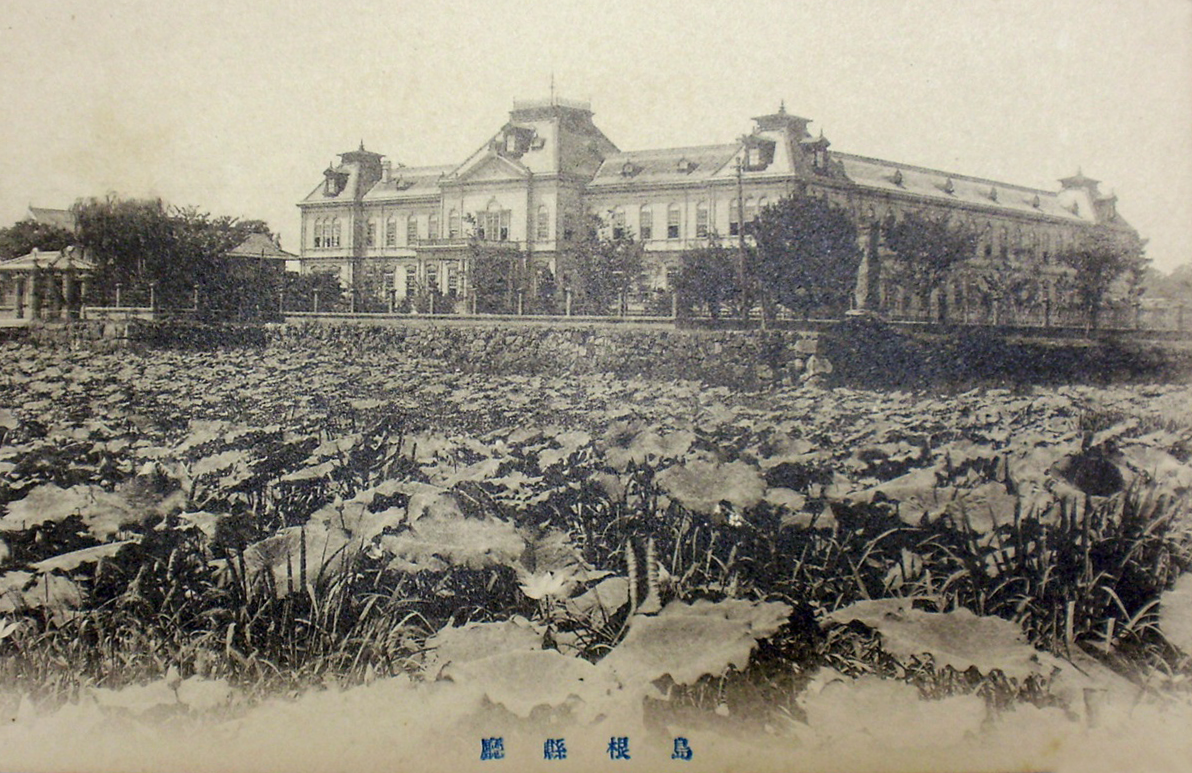
At dawn on 24 August, the leader of the group, 25-year-old Isao Okazaki, and the group's members, also in their twenties, attacked key facilities in Shimane Prefecture, including the prefectural office, a newspaper company and a power plant. The newspaper company and the power plant subsequently suffered by having some of their functions curtailed. The group had planned to kill the governor and the top public prosecutor, but failed. They rushed into the Matsue Broadcasting Station and asked to use it to deliver their message, but the station master refused. During the negotiation, police and the army encircled the group and all members were arrested. The prefectural office and the prefectural 3,000 square metres (32,000 sq ft) assembly hall burned down, and one occupant died during the confusion. The electricity was cut off for three and a half hours and the newspaper was published only in tabloid format until 31 August. The people of Shimane were shocked by these events, but the media coverage was strictly censored. This measure was successful in discouraging similar incidents.[citation needed]
The ringleaders were imprisoned. After their release, some of them obtained jobs, one as a teacher, one at a printing company and another at a waste disposal company. The whereabouts of many former rioters are not disclosed in available sources.
Every group member who participated in the Matsue incident had been recruited by Isao Okazaki (岡崎功 Okazaki Isao, 1920–2006), his second-in-command, Bunmei Hasegawa, and his third-in-command, Yasuhiko Hatano. Hasegawa and Hatano had been influenced by Masaharu Kageyama of Daitojuku, a nationalist.
Okazaki was born in Shimane Prefecture and after graduation from a middle school he worked in a Japanese firm in Manchuria for two years. After returning to Japan, he entered Rissho University with the objective of becoming a monk. At the same time, he became a member of an ultra-nationalist group, Kinno Makotomusubi. With independent funds, he built what he called the Isshinryo in the Meguro District of Tokyo. At this location he discussed with his friends the news of Japanese reverses in the war. He suggested that the military cabinet be overthrown. Eventually, they tried to obtain weapons for this purpose.
When the plot became known in July 1943, he was arrested and given two years of imprisonment with three years of suspension in September 1944. He was released from prison in November but was under the constant supervision of special police. [clarification needed] After returning to Matsue, he became a member of the government mobilization office. Because he was inclined to sympathize with the circumstances of the families of the people being mobilized, he was in frequent conflict with his superiors. For example, he was ordered to select 75 women to work at the Kure Naval Arsenal. He realized that women of higher status were not part of the selection pool, and leaked this fact. He was forced to resign from this office as a result.
Matsue incident
The Matsue incident, also known as the Matsue Riot incident, Imperial Voluntary Army incident, or the Shimane Prefectural Office incendiarism, was an incident that occurred in Japan after the Japanese surrender on 15 August 1945. The incident was staged by about forty dissidents, who attacked facilities in Matsue City, Shimane Prefecture, at dawn on 24 August 1945, resulting in one fatality.
On 15 August 1945, Hirohito, the Emperor of Japan, broadcast the surrender of Japan by radio, thereby ending World War II. Following the broadcast, dissidents throughout Japan reacted unfavorably to the announcement. On that day, an armed group of dissidents who called themselves Sonno-Doshikai, gathered in Atagoyama, a small mountain in the central part of Tokyo. This group called for opposition to the surrender and expected that members of the Japanese armed forces would support them. The Matsue Incident, a last attempt at a coup d'état, was a response to this call. Ten people were killed and two arrested.
Leaders of the attempted coup were brought to trial before the Supreme Court of Judicature.
At dawn on 24 August, the leader of the group, 25-year-old Isao Okazaki, and the group's members, also in their twenties, attacked key facilities in Shimane Prefecture, including the prefectural office, a newspaper company and a power plant. The newspaper company and the power plant subsequently suffered by having some of their functions curtailed. The group had planned to kill the governor and the top public prosecutor, but failed. They rushed into the Matsue Broadcasting Station and asked to use it to deliver their message, but the station master refused. During the negotiation, police and the army encircled the group and all members were arrested. The prefectural office and the prefectural 3,000 square metres (32,000 sq ft) assembly hall burned down, and one occupant died during the confusion. The electricity was cut off for three and a half hours and the newspaper was published only in tabloid format until 31 August. The people of Shimane were shocked by these events, but the media coverage was strictly censored. This measure was successful in discouraging similar incidents.[citation needed]
The ringleaders were imprisoned. After their release, some of them obtained jobs, one as a teacher, one at a printing company and another at a waste disposal company. The whereabouts of many former rioters are not disclosed in available sources.
Every group member who participated in the Matsue incident had been recruited by Isao Okazaki (岡崎功 Okazaki Isao, 1920–2006), his second-in-command, Bunmei Hasegawa, and his third-in-command, Yasuhiko Hatano. Hasegawa and Hatano had been influenced by Masaharu Kageyama of Daitojuku, a nationalist.
Okazaki was born in Shimane Prefecture and after graduation from a middle school he worked in a Japanese firm in Manchuria for two years. After returning to Japan, he entered Rissho University with the objective of becoming a monk. At the same time, he became a member of an ultra-nationalist group, Kinno Makotomusubi. With independent funds, he built what he called the Isshinryo in the Meguro District of Tokyo. At this location he discussed with his friends the news of Japanese reverses in the war. He suggested that the military cabinet be overthrown. Eventually, they tried to obtain weapons for this purpose.
When the plot became known in July 1943, he was arrested and given two years of imprisonment with three years of suspension in September 1944. He was released from prison in November but was under the constant supervision of special police. [clarification needed] After returning to Matsue, he became a member of the government mobilization office. Because he was inclined to sympathize with the circumstances of the families of the people being mobilized, he was in frequent conflict with his superiors. For example, he was ordered to select 75 women to work at the Kure Naval Arsenal. He realized that women of higher status were not part of the selection pool, and leaked this fact. He was forced to resign from this office as a result.
Recent media
Recent media