
Recent from talks
Matsutake
Knowledge base stats:
Talk channels stats:
Members stats:
Matsutake
Matsutake (Japanese: 松茸/マツタケ), Tricholoma matsutake, is a species of choice edible mycorrhizal mushroom that grows in Eurasia and North America. It is prized in Japanese cuisine for its distinct aroma.
The common name and specific epithet, matsutake, in use since the late 19th century, derives from Japanese matsu (pine tree) and take (mushroom).
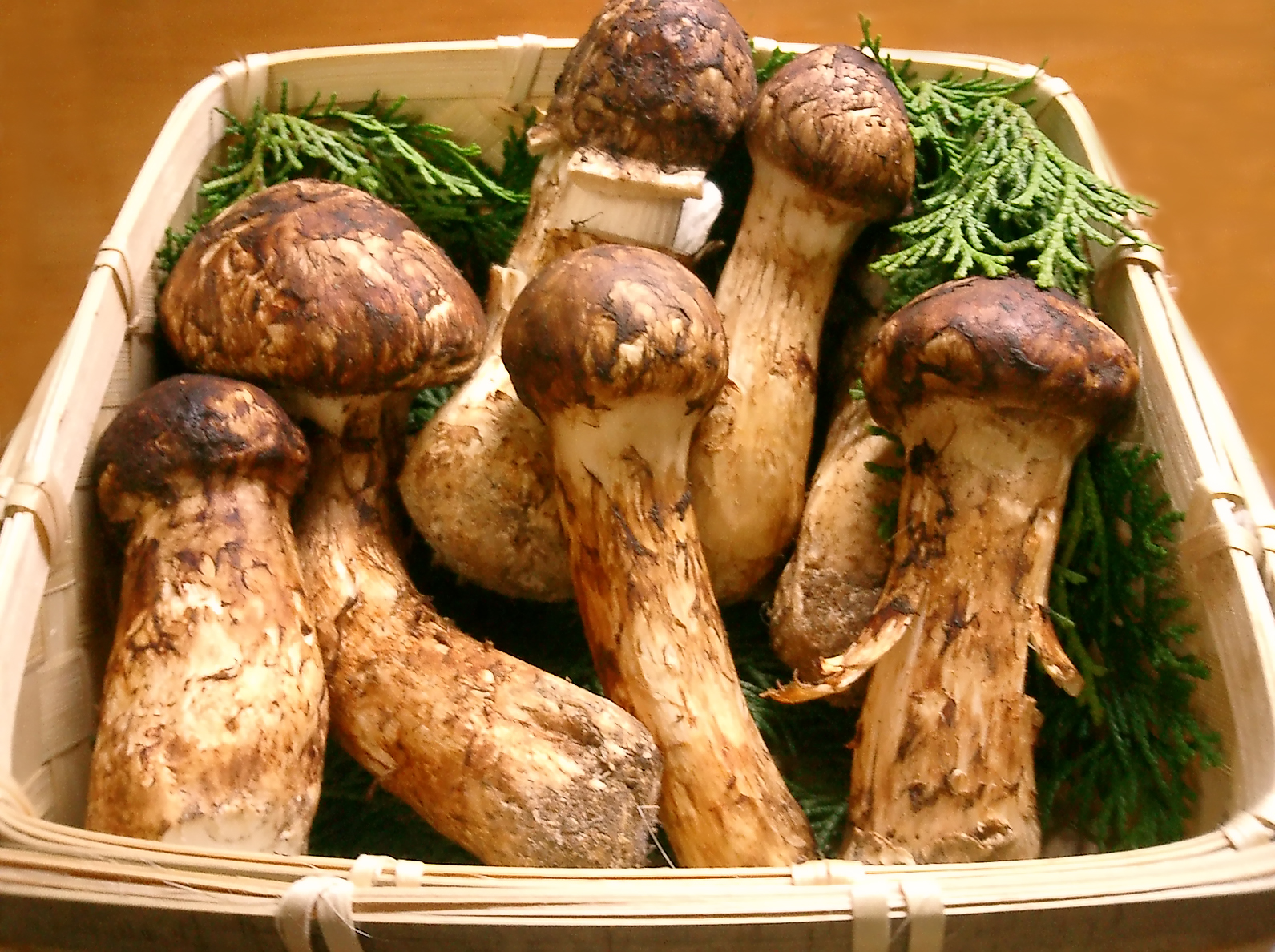
The cap, stem, and gills are initially white then discolor brownish. Similarly dark fibrils appear on the cap and stalk. The cap can reach up to 35 centimetres (14 in) across while the stem is up to 15 cm (6 in) long and 5 cm thick. A ring is usually present. The flesh is white and firm, with a cinnamon-like aroma. The spore print is white.
In Japan, several closely related species have been found, including Tricholoma bakamatsutake (baka-matsutake – 'fool's matsutake' in Japanese), T. fulvocastaneum (nise-matsutake – 'fake matsutake'), and T. robustum (matsutake-modoki – 'imitation of matsutake'). Of those species, only baka-matsutake has a taste similar to that of matsutake. Both baka-matsutake and nise-matsutake grow in Fagaceae forests, while matsutake-modoki grows in the same pine forests as the genuine matsutake.
In the North American Pacific Northwest, T. murrillianum is found in coniferous forests of one or more of the following tree species: western hemlock, Douglas-fir, Noble fir, Shasta red fir, Sugar pine, Ponderosa pine, or Lodgepole pine. In California and parts of Oregon, it is also associated with hardwoods, including Tanoak, Madrone, Rhododendron, Salal, and Manzanita. In northeastern North America, the closely related mushroom Tricholoma magnivelare is generally found in Jack pine forests. A 2000 report categorized T. nauseosum as a synonym of T. matsutake. Inocybe pyriodora is a small poisonous lookalike with brown spores.
Matsutake mushrooms grow in East Asia, South Asia (Bhutan), and Southeast Asia (Laos), parts of Europe such as Estonia, Finland, Norway, Poland, Sweden,[citation needed] and in northern North America, especially the Pacific Northwest around November.
Matsutake mushrooms grow under trees and are usually concealed under litter on the forest floor, forming a symbiotic relationship with roots of various tree species. In Korea and Japan, matsutake mushrooms are most commonly associated with Pinus densiflora. In China, matsutake (Chinese: 松茸; pinyin: sōngróng) is mainly distributed in the northeast and southwest regions. In the northeast, the growth of matsutake depends on the P. densiflora, its distribution is the same as that of P. densiflora. Longjing City, Jilin Province, China is known as the "Hometown of Matsutake". "天佛指山/Tianfozhi Mountain" in Longjing has been approved as a national nature reserve by the State Council of China. This is the first nature reserve for an edible mushroom and its ecosystem in China.
The candy cane plant or sugarstick, Allotropa virgata, parasitizes these mushrooms by deriving nourishment from the fungal mycelia via its root system. These plants can be used to signal hunters of the mushrooms, both human and animal, to the location of the fungus' underground mycelia. Additionally, insects are also known to target these mushrooms as food and a place to lay their eggs, limiting the amount of the mushrooms that can be harvested by human gatherers.
Hub AI
Matsutake AI simulator
(@Matsutake_simulator)
Matsutake
Matsutake (Japanese: 松茸/マツタケ), Tricholoma matsutake, is a species of choice edible mycorrhizal mushroom that grows in Eurasia and North America. It is prized in Japanese cuisine for its distinct aroma.
The common name and specific epithet, matsutake, in use since the late 19th century, derives from Japanese matsu (pine tree) and take (mushroom).
The cap, stem, and gills are initially white then discolor brownish. Similarly dark fibrils appear on the cap and stalk. The cap can reach up to 35 centimetres (14 in) across while the stem is up to 15 cm (6 in) long and 5 cm thick. A ring is usually present. The flesh is white and firm, with a cinnamon-like aroma. The spore print is white.
In Japan, several closely related species have been found, including Tricholoma bakamatsutake (baka-matsutake – 'fool's matsutake' in Japanese), T. fulvocastaneum (nise-matsutake – 'fake matsutake'), and T. robustum (matsutake-modoki – 'imitation of matsutake'). Of those species, only baka-matsutake has a taste similar to that of matsutake. Both baka-matsutake and nise-matsutake grow in Fagaceae forests, while matsutake-modoki grows in the same pine forests as the genuine matsutake.
In the North American Pacific Northwest, T. murrillianum is found in coniferous forests of one or more of the following tree species: western hemlock, Douglas-fir, Noble fir, Shasta red fir, Sugar pine, Ponderosa pine, or Lodgepole pine. In California and parts of Oregon, it is also associated with hardwoods, including Tanoak, Madrone, Rhododendron, Salal, and Manzanita. In northeastern North America, the closely related mushroom Tricholoma magnivelare is generally found in Jack pine forests. A 2000 report categorized T. nauseosum as a synonym of T. matsutake. Inocybe pyriodora is a small poisonous lookalike with brown spores.
Matsutake mushrooms grow in East Asia, South Asia (Bhutan), and Southeast Asia (Laos), parts of Europe such as Estonia, Finland, Norway, Poland, Sweden,[citation needed] and in northern North America, especially the Pacific Northwest around November.
Matsutake mushrooms grow under trees and are usually concealed under litter on the forest floor, forming a symbiotic relationship with roots of various tree species. In Korea and Japan, matsutake mushrooms are most commonly associated with Pinus densiflora. In China, matsutake (Chinese: 松茸; pinyin: sōngróng) is mainly distributed in the northeast and southwest regions. In the northeast, the growth of matsutake depends on the P. densiflora, its distribution is the same as that of P. densiflora. Longjing City, Jilin Province, China is known as the "Hometown of Matsutake". "天佛指山/Tianfozhi Mountain" in Longjing has been approved as a national nature reserve by the State Council of China. This is the first nature reserve for an edible mushroom and its ecosystem in China.
The candy cane plant or sugarstick, Allotropa virgata, parasitizes these mushrooms by deriving nourishment from the fungal mycelia via its root system. These plants can be used to signal hunters of the mushrooms, both human and animal, to the location of the fungus' underground mycelia. Additionally, insects are also known to target these mushrooms as food and a place to lay their eggs, limiting the amount of the mushrooms that can be harvested by human gatherers.
Recent media