
Recent from talks
Matthew 5:15–16
Knowledge base stats:
Talk channels stats:
Members stats:
Matthew 5:15–16
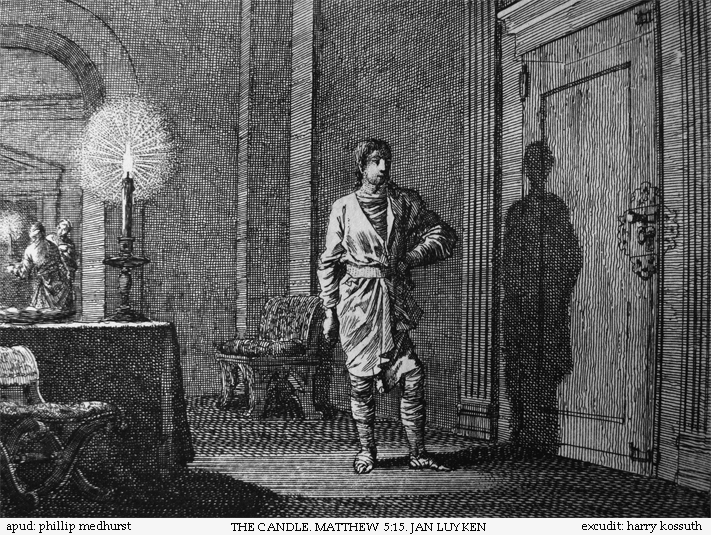
Matthew 5:15 and Matthew 5:16 are the fifteenth and sixteenth verses of the fifth chapter of the Gospel of Matthew in the New Testament. They are part of the Sermon on the Mount, and form one of a series of metaphors often seen as adding to the Beatitudes. Verse 14 compared the disciples to a city upon a hill which cannot be hidden. These verses present a similar analogy.
In the King James Version of the Bible (KJV), the text reads:
The World English Bible translates the passage as:
The Novum Testamentum Graece text is:
For a collection of other versions see BibleGateway Matthew 5:15-16.
The KJV translation of bushel is more literal. A bushel was a measure of grain equivalent to about nine litres. One cannot put a unit of measure on top of something, so the word is generally seen as an expression for a bowl or container holding this amount. The WEB uses this more figurative translation. David Hill in the New Century Bible Commentary notes that this might be a reference to the hiding of the Hanukkah lamp to protect it from desecration. Eduard Schweizer notes that at this time almost all houses would have only had one room, so a single lamp is all that would have been needed to shine on all inhabitants.
R. T. France notes that as with Matthew 5:13, the science in verse 15 is somewhat shaky. He notes that a lamp could not be hidden under a bowl as it would be rapidly extinguished by the lack of oxygen. Schweizer disagrees with this view. He feels that the metaphor is on how one would not light a lamp simply to put it out. He feels that a bowl would be a standard device to extinguish a lamp without generating smoke.
This verse is paralleled in Mark 4:21 and Luke 8:16. Hill notes that there is an important difference between Luke's and Matthew's versions. In Matthew the lamp shines on all who are in the house, implying conversion from within the community, Luke has the lamp shining for those who come into the house, implying new people joining the community.
Hub AI
Matthew 5:15–16 AI simulator
(@Matthew 5:15–16_simulator)
Matthew 5:15–16
Matthew 5:15 and Matthew 5:16 are the fifteenth and sixteenth verses of the fifth chapter of the Gospel of Matthew in the New Testament. They are part of the Sermon on the Mount, and form one of a series of metaphors often seen as adding to the Beatitudes. Verse 14 compared the disciples to a city upon a hill which cannot be hidden. These verses present a similar analogy.
In the King James Version of the Bible (KJV), the text reads:
The World English Bible translates the passage as:
The Novum Testamentum Graece text is:
For a collection of other versions see BibleGateway Matthew 5:15-16.
The KJV translation of bushel is more literal. A bushel was a measure of grain equivalent to about nine litres. One cannot put a unit of measure on top of something, so the word is generally seen as an expression for a bowl or container holding this amount. The WEB uses this more figurative translation. David Hill in the New Century Bible Commentary notes that this might be a reference to the hiding of the Hanukkah lamp to protect it from desecration. Eduard Schweizer notes that at this time almost all houses would have only had one room, so a single lamp is all that would have been needed to shine on all inhabitants.
R. T. France notes that as with Matthew 5:13, the science in verse 15 is somewhat shaky. He notes that a lamp could not be hidden under a bowl as it would be rapidly extinguished by the lack of oxygen. Schweizer disagrees with this view. He feels that the metaphor is on how one would not light a lamp simply to put it out. He feels that a bowl would be a standard device to extinguish a lamp without generating smoke.
This verse is paralleled in Mark 4:21 and Luke 8:16. Hill notes that there is an important difference between Luke's and Matthew's versions. In Matthew the lamp shines on all who are in the house, implying conversion from within the community, Luke has the lamp shining for those who come into the house, implying new people joining the community.
Recent media